
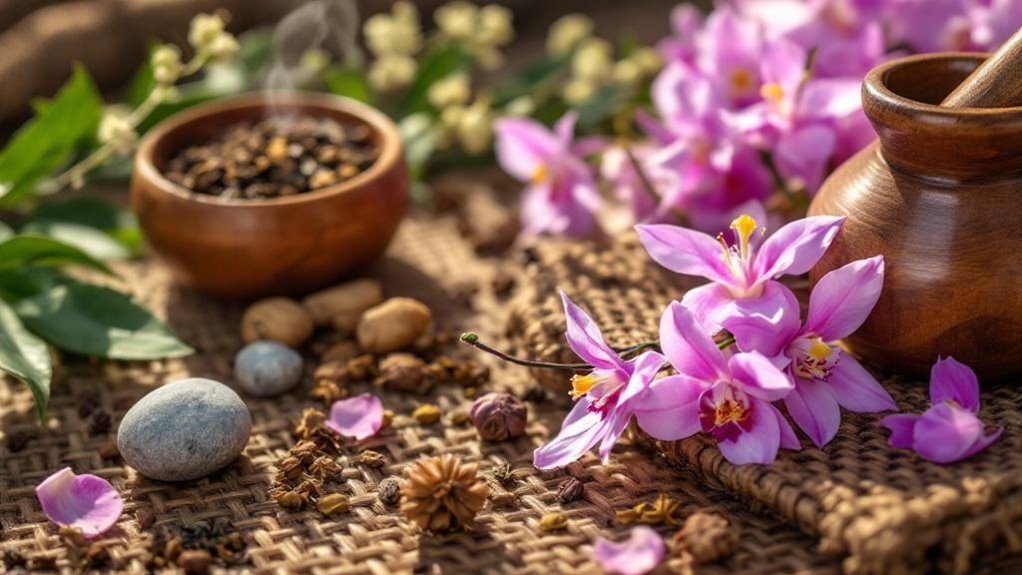
Yes, you can trace orchids through long healing traditions, where observational practice linked plant qualities to human needs, and cultivated genera such as Dendrobium and Orchis became part of teas, tonics, and restorative remedies. In Chinese medicine, Dendrobium, especially Dendrobium nobile, has been used to support immunity and ease depletion; elsewhere, Orchis mascula addressed digestion and gum disease. Modern research now examines antibacterial effects, extract use, and broader wellness applications further.
- Key Takeaways
- Are Orchids Used in Healing Traditions?
- How Did Orchids Enter Traditional Medicine?
- Which Orchids Are Used Medicinally?
- How Are Orchids Used in Chinese Medicine?
- Why Is Dendrobium Important in Herbal Medicine?
- How Are Orchids Used in Turkish Salep?
- How Are Orchids Used in Middle Eastern Remedies?
- Which Health Claims Are Linked to Orchids?
- What Research Says About Medicinal Orchids
- How Are Orchid Extracts Used in Skin Care?
- Can Growing Orchids Improve Well-Being?
- How Can You Use Orchids Safely Today?
- Frequently Asked Questions
- Conclusion
Key Takeaways
- Yes, orchids have long been used in healing traditions across Asia and the Middle East.
- Traditional healers matched orchid traits to medicinal uses through observation and inherited knowledge.
- Dendrobium species, especially Dendrobium nobile, are used in Chinese medicine for immune support and illness-related weakness.
- Orchis mascula appears in Middle Eastern remedies for digestive problems and gum disease.
- Orchid preparations include teas, tonics, powders, and pills, with some traditions noting antibacterial effects.
Are Orchids Used in Healing Traditions?
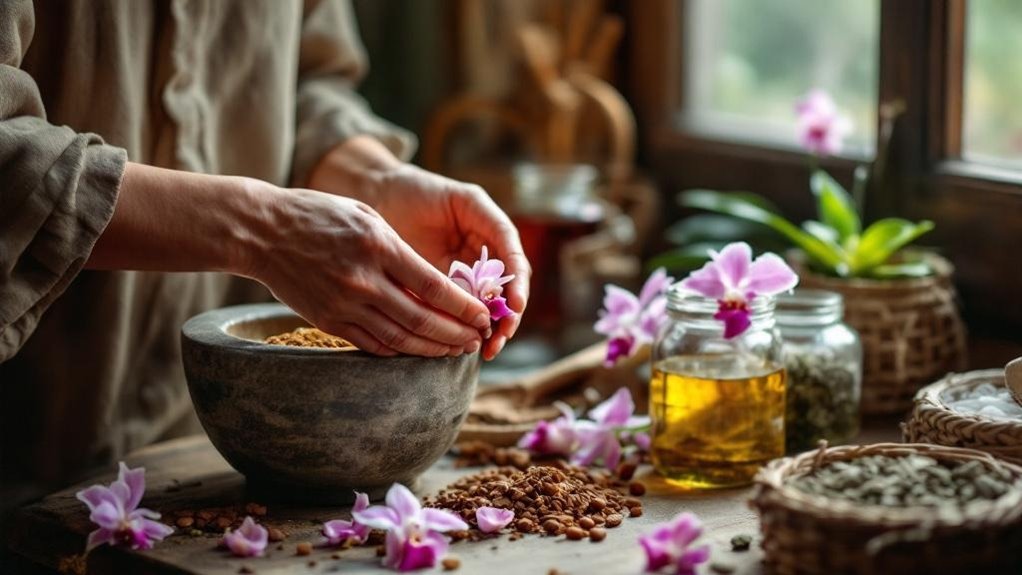
Although orchids are often cultivated for their beauty, they’ve also held a clear place in healing traditions, especially in observational systems of medicine that linked plant qualities to bodily needs and recorded those uses over centuries.
Beyond ornament, orchids have long figured in healing traditions that matched plant traits to human needs.
You can see this across cultures: dendrobium and orchis appear in traditional Chinese practice for their medicinal properties; in Turkey, orchid tubers become Salep, a drink associated with digestive support and curing sore throats.
You also find Calanthe liukiuensis used in flour and pills, where it’s valued for addressing hair loss and improving blood circulation, especially when stagnant patterns are emphasized.
Modern study adds support, noting antibacterial substances and phytochemicals in some species, which helps explain why orchid-based remedies still attract attention for possible health benefits in contemporary herbal wellness practices today.
How Did Orchids Enter Traditional Medicine?
One clear path explains how orchids entered traditional medicine: healers repeatedly observed their effects, recorded those observations in early medical systems, and then carried those uses forward through cultivated practice, trade, and ritual preparation.
You can trace orchids in medicine to ancient documentation, including Shen Nung’s medical writings, where observational knowledge became stable enough to guide treatment rather than remain local or stagnant.
As communities tested orchid preparations, they linked certain plants with medicinal properties, then preserved those associations through teas, tonics, and beverages such as Salep, which people used for digestive problems and sore throat.
You also see integration deepen when healers noticed antibacterial actions and useful phytochemicals, then folded those findings into established herbal traditions.
Modern herbal practice continues that pattern, showing continuity rather than reinvention across cultures and generations today.
Which Orchids Are Used Medicinally?
You can trace medicinal orchid use through a few cultivated examples, beginning with Dendrobium species in Chinese medicine, where practitioners prepare teas from dried stems and value them for supporting immune function and easing certain cancer-related side effects.
You also find Orchis mascula in traditional Middle Eastern remedies, where its long observational record links it to treatment for digestive disorders and gum disease, while Calanthe liukiuensis appears in medicinal flour or pills used for hair loss and increased skin blood flow.
As you consider these orchids together, you can see that their roles haven’t remained stagnant; they continue to inform research on related species, including Eulophia campestris and Vanda, for antibacterial effects and other useful phytochemicals.
Dendrobium Healing Uses
Among medicinal orchids, Dendrobium—especially *Dendrobium nobile*—holds a cultivated place in Chinese healing traditions, where practitioners have long used its dried stems in teas and other preparations to support immune function, sharpen eyesight, and restore strength during periods of depletion.
If you examine its medicinal record, you’ll find reasons for that regard:
- brewed as tea, its stems are used to support the immune system and ease depletion;
- observational research suggests compounds may offer antibacterial action against stagnant infections;
- modern wellness practice values it for stress relief, recovery support, and possible protection during radiation therapy.
You also see Dendrobium in Hawaiian leis, which reflects cultural continuity rather than mere ornament.
In contemporary herbal practice, you encounter it as a steady, relevant remedy, positioned between traditional knowledge and ongoing clinical interest today.
Orchis In Traditional Remedies
If you look beyond those species, you find that roots and tubers from orchids such as *Orchis latifolia* were also valued for medicinal purposes, because communities observed that they possess medicinal properties useful against diarrhea and certain gum disorders; that observational record, though not modern proof, explains their persistent role in household care.
You also encounter a claimed calming effect in these preparations, which likely helped maintain their standing when stagnant digestion or throat irritation unsettled daily function for many.
Calanthe And Salep Practices
- Calanthe Liukiuensis appears in powdered preparations, cultivated for cooking or supplementation, and people have used it for hair loss and low-protein ailments.
- Salep, prepared from tubers of Orchis militaris and *Orchis mascula*, has long soothed sore throats and digestive discomfort, especially during stagnant winter months.
- Related traditions also include Dendrobium valued for immune support and easing cancer-related symptoms, while research examines antibacterial phytochemicals in lesser-known orchids.
Across Turkey and the Middle East, you see Salep carrying both medicinal and cultural weight still today.
How Are Orchids Used in Chinese Medicine?
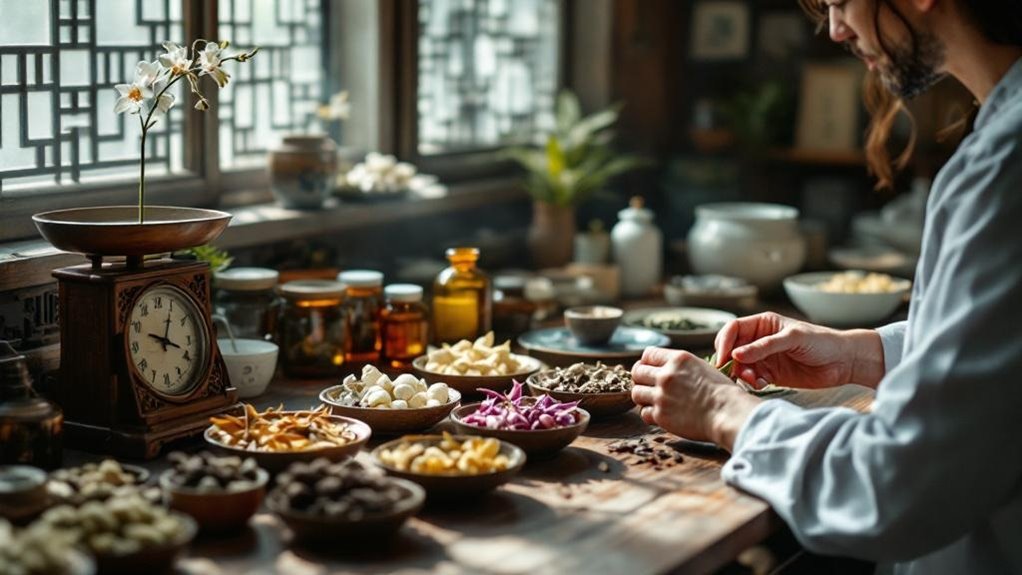
In Chinese medicine, you can trace orchids, especially Dendrobium, from ancient observational records linked to Emperor Shen Nung to modern herbal practice, where cultivated stems still appear in remedies meant to support immune function, restore energy, and address serious illness.
You see these orchids prepared most often as medicinal teas and related herbal formulations, and you can connect their long use to beliefs about clearing heat, easing dryness, and strengthening the body without leaving it stagnant.
You can also note that current research gives these traditions added support, since certain orchid phytochemicals show antibacterial potential, which helps explain why their role in Chinese healing has remained steady for centuries.
Dendrobium In Herbal Remedies
Steeped into teas, soups, and tonics, Dendrobium has held a cultivated place in Chinese medicine for centuries, valued most for clearing heat, restoring fluids, and supporting the body when dryness, irritation, or stagnant recovery begin to wear down overall health.
In healing traditions, you encounter Dendrobium as one of the orchid family’s more practical exotic flowers, prepared from dried stems and taken when heat-related imbalance, throat discomfort, or depleted moisture suggests a need for steadier nourishment.
- You brew it as tea to support immune function and ease fatigue.
- You find it in soups and tonics that replenish fluids and soothe dryness.
- You see observational interest in phytochemicals linked to eyesight support and recovery from radiation damage.
Its continued use reflects both holistic practice and measured modern herbal inquiry today.
Ancient Chinese Orchid Uses
Tradition anchors the Chinese medical use of orchids, and early accounts commonly trace that lineage to Emperor Shen Nung, the “Father of Medicine,” whose writings are said to have recorded the medicinal value of orchid species, especially dendrobium.
From that cultivated foundation, physicians prepared dried stems as teas and restorative formulas used when dryness, throat irritation, weakened recovery, or stagnant depletion suggested the need for fluid support, clearer vision, and steadier resilience.
When you examine later Chinese writings, you find bletilla striata appearing across more than 2,800 years of observational medicine, valued for sore throats and related complaints, while dendrobium remained important in care surrounding radiation strain and recovery.
Unlike an orchid show or the Ottoman Empire’s ornamental interests, Shen Nung’s legacy frames orchids as cultivated agents of holistic balance, serving physical endurance and spiritual composure alike.
Traditional Preparations And Benefits
Because Chinese medicine treats orchids as cultivated remedies rather than mere ornament, practitioners have long prepared dendrobium by drying its stems and brewing them into medicinal teas or concentrating them into tinctures, methods intended to draw out the plant’s restorative qualities while making its use consistent within observational care.
You see this tradition reaching back to Shen Nung’s records, where orchids entered medicine as more than stagnant symbols.
- You find dendrobium prescribed to support immunity, preserve eyesight, and in some traditions accompany cancer care.
- You encounter bletilla striata in respiratory remedies, where it’s valued for easing irritation and restoring health.
- You also notice orchids framed holistically, as research continues to examine their pharmacological promise within Chinese herbal wellness practices today.
Why Is Dendrobium Important in Herbal Medicine?
Among the many orchids cultivated for beauty and ritual use, Dendrobium holds a distinct place in herbal medicine, especially in traditional Chinese medicine, where practitioners value its dried stems for teas believed to strengthen the immune system, support eye health, and restore balance during periods of physical depletion. You encounter it where observational practice meets modern inquiry; researchers examine antibacterial compounds and phytochemicals, and clinicians note its potential to ease radiation-related discomfort.
| Image | Meaning |
|---|---|
| Pale stems steeping | restorative tea |
| Clear gaze at dawn | eyesight support |
| Quiet ward bedside | reduced treatment strain |
| Lei draped on shoulders | cultural continuity |
Because it’s affordable, cultivated widely, and never treated as stagnant tradition, you see why Dendrobium remains important in herbal medicine and daily healing contexts today.
How Are Orchids Used in Turkish Salep?
When you consider Turkish salep, you begin with specific orchids, especially *Orchis militaris* and *Orchis mascula*, whose cultivated tubers provide the starchy base that gives the drink its distinctive body and keeps its long medicinal reputation from becoming stagnant folklore.
You prepare it by drying those tubers, grinding them into a fine, flour-like powder, and blending that powder with hot milk and sweeteners; through this method, you can observe how a simple observational process turns orchid material into both nourishment and remedy.
You also see why salep remained valued from the Ottoman Empire into modern Turkey and neighboring regions, since people have long used it to soothe sore throats, ease digestive discomfort and diarrhea, support gum health, and thicken desserts and ice cream with the same botanical substance.
Salep Orchid Species
- You find these orchids central to salep’s identity, because their tubers give the drink body, nutritional value, and an observational link to Turkish therapeutic custom.
- You also see salep beyond Turkey, in Saudi Arabia, Syria, and Iran, where people drink it during cold months rather than let tradition grow stagnant.
- You encounter longstanding medicinal claims around sore throats, digestion, and diarrhea, which show how these orchid species entered cuisine and healing together.
Tuber Preparation Methods
When you prepare salep, you use that flour sparingly, because a small amount thickens milk without turning the mixture stagnant; you stir in sugar and, often, spices, then heat it until the texture turns smooth and cohesive.
This method, refined over centuries and widely known since the Ottoman Empire, preserves the tuber’s functional character while shaping a drink that remains common across Turkey and nearby regions during colder months, when warmth and texture matter most.
Traditional Healing Uses
- You encounter salep as a throat-soothing, stomach-settling tonic.
- You see Ottoman practice continue in Turkey, Syria, Iran, and Saudi Arabia.
- You recognize orchid tubers as culinary and healing resources.
How Are Orchids Used in Middle Eastern Remedies?
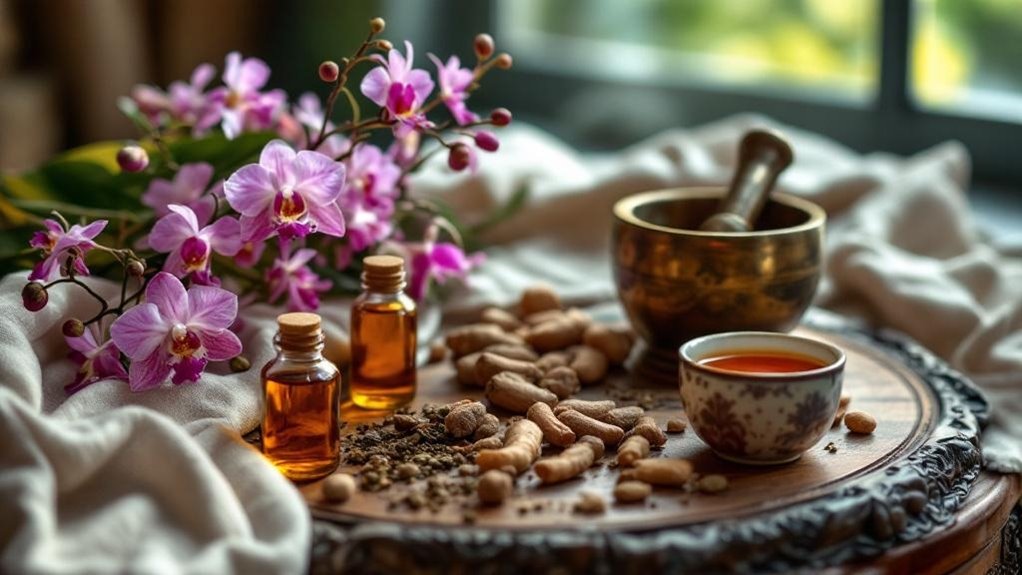
When you look beyond salep, you find orchids entering herbal preparations across Turkey, Saudi Arabia, Syria, and Iran, where healers use them in remedies for diarrhea, gum disease, and related irritations, partly because their antimicrobial qualities align with long-tested regional practice.
You also see why salep never became a stagnant custom alone; it offers fiber and nutrients, so you consume it as both supportive nourishment and measured medicine.
Which Health Claims Are Linked to Orchids?
Across these healing traditions, orchids carry a wider set of health claims than salep alone suggests, and you see that range most clearly in Chinese and regional herbal practice, where cultivated species such as dendrobium and bletilla striata have long been linked to restorative effects that go beyond simple nourishment.
You find dendrobium associated with immune support, clearer eyesight, and relief from treatment-related weakness, often through dried stem teas.
You see salep tied to digestive comfort and oral care; orchid tubers were used against stagnant digestion and gum irritation.
You encounter a longer observational record, reaching back to Shen Nung, while contemporary Chinese herbal practice still treats orchids as relevant therapeutic plants.
You also hear claims around lesser-known orchids, including antibacterial effects, which regional healers fold into broader ideas of protection and recovery.
What Research Says About Medicinal Orchids
Although modern research remains uneven from one species to the next, it generally supports the view that medicinal orchids deserve serious attention, because laboratory and phytochemical studies have identified anti-inflammatory, antibacterial, and immune-modulating compounds in species long used in traditional practice, including Dendrobium and Orchis mascula.
The overlap between observational use and measurable plant chemistry gives several older claims a more credible footing.
You can also see support in clinical-adjacent use: dried Dendrobium stems are still prepared as teas in China, where practitioners employ them to ease radiation side effects and support recovery.
Ongoing studies of cultivated and wild species, including Vanda tessellata and Eulophia campestris, suggest the field isn’t stagnant, even if validation still proceeds cautiously and species by species today.
How Are Orchid Extracts Used in Skin Care?
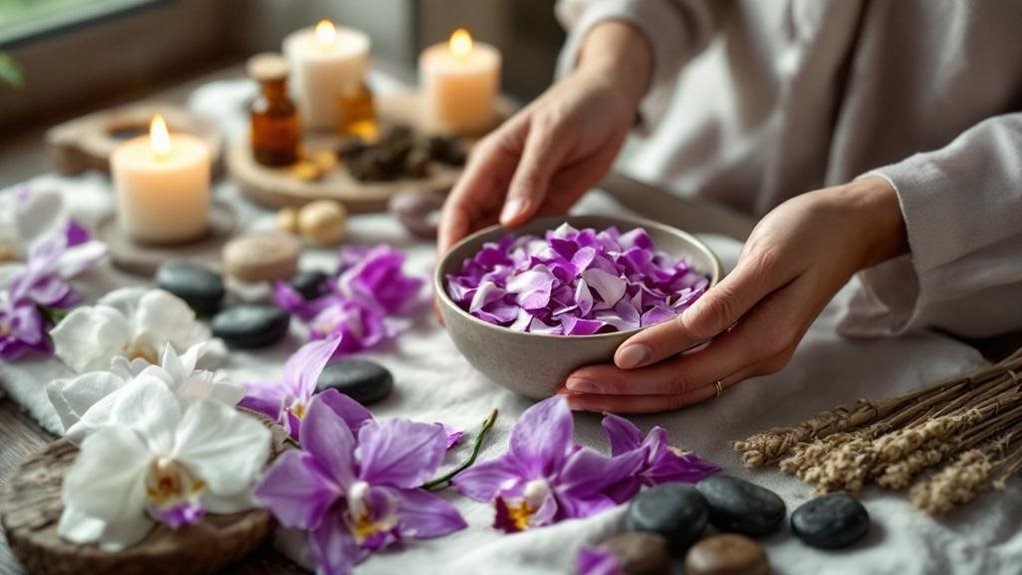
Because orchid extracts carry a notable mix of humectant compounds, antioxidants, and soothing plant constituents, they’ve become increasingly common in skin-care formulas that aim to improve hydration, refine texture, and support a more even tone. In practice, manufacturers use extracts from several orchid species in serums, creams, masks, and revitalizing treatments because these materials can help the skin hold moisture, soften roughness, and limit some of the dulling effects associated with oxidative stress.
- You’ll often see them in moisturizers, where cultivated orchid compounds support hydration and smoother texture.
- Antioxidants, including Vitamin C and anthocyanins, help you address uneven tone and observational signs of skin aging.
- Vanda extracts are used for soothing care, especially when stagnant irritation, acne, or eczema affect comfort.
Traditional uses also link orchid preparations with reduced fatigue.
Can Growing Orchids Improve Well-Being?
Cultivation, when it centers on orchids, can support well-being in several practical ways, since the steady routines of watering, monitoring light and humidity, and observing subtle changes in roots, leaves, and blooms tend to quiet mental noise, reduce stress, and create a more tranquil domestic environment.
As you repot, prune, and adjust placements, you engage in gentle movement that can ease stiffness, support joint flexibility, and help interrupt stagnant pain patterns linked to arthritis.
The observational attention orchids require also exercises memory and reasoning, because you track growth cycles, notice deviations, and respond with cultivated precision. Over time, successful care gives you a stable sense of purpose and achievement, which may be especially valuable during recovery from trauma.
Orchids also improve indoor air quality, supporting healthier sleep and steadier comfort.
How Can You Use Orchids Safely Today?
When you use orchids in a healing context today, you should begin with careful research into species that have a documented place in traditional practice, such as certain Dendrobium varieties that are sometimes prepared as teas or elixirs.
You should also confirm identification with precision, since not every orchid offers medicinal value and some may carry toxic risks.
- Consult a qualified herbalist or healthcare professional, especially if you take medications or manage chronic conditions.
- Use cultivated orchids cautiously in preparations; evidence remains observational, and stagnant assumptions about safety can mislead.
- Follow local laws on harvesting and consumption, because many wild orchids are protected, endangered, or both.
You should treat orchid remedies as adjuncts, not replacements, and proceed with measured restraint, because tradition deserves respect, yet safety requires verification and informed oversight.
Frequently Asked Questions
Do Orchids Symbolize Healing?
Yes, you can see orchids symbolize healing in many cultures, where people link them to wellness, renewal, and vigor. You’ll also find their medicinal use in traditions reinforces that healing symbolism across herbal and holistic practices.
What Does the Bible Say About Orchids?
You won’t find orchids mentioned explicitly in the Bible, but you can connect them to biblical flower imagery that celebrates beauty, God’s care, purity, and life’s fleeting nature, especially in Song of Solomon and Matthew 6:28-30.
Which Is the Most Medicinal Flower in the World?
Calendula is your strongest medicinal flower, a golden healer in nature’s аптечка. You’ll value its anti-inflammatory, antiseptic, and wound-healing powers. You can also turn to chamomile, hibiscus, echinacea, and lavender for remarkable therapeutic support.
How Are Orchids Used Medicinally?
You use orchids medicinally in teas, powders, foods, and salves to soothe sore throats, aid digestion, fight bacteria, support immunity, improve eyesight, boost circulation, and address issues like gum disease, hair loss, and inflammation.
Conclusion
As you consider orchids in healing traditions, you see a cultivated history shaped by observation, ritual, and cautious use; some species, especially in Chinese medicine, carry documented value, while others remain uncertain under modern review. You can appreciate their role without drifting into stagnant folklore, because evidence, preparation, and species identification still govern safe use. Yet one question remains just beyond the visible surface: which orchids, once closely studied, may quietly alter what medicine recognizes.