
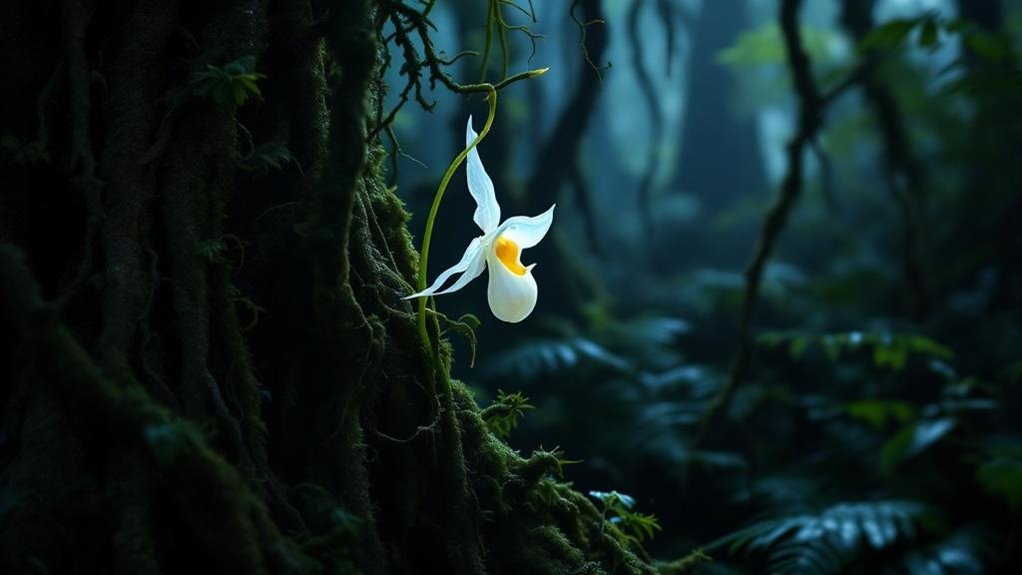
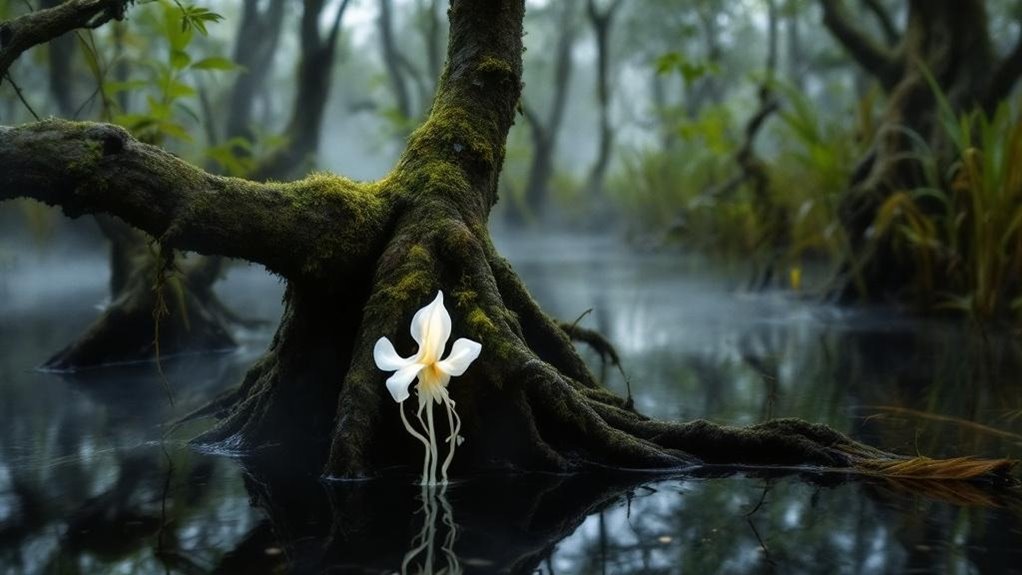
You’ll find that ghost orchid legend grows from appearance: its white bloom seems to float without leaves, so people cast it as spirit or memory; in fact, it’s a leafless epiphyte, rooted to cypress bark in the humid, stagnant swamps of Florida and Cuba, taking moisture from air and detritus. Its rarity is biological, not mystical, because few plants bloom from June to August, pollination is complex, and habitat loss, poaching, and altered water levels constrain survival further.
- Key Takeaways
- What Is the Ghost Orchid?
- Why Does the Ghost Orchid Look So Strange?
- Where Does the Ghost Orchid Grow?
- Why Is the Ghost Orchid Called Ghostly?
- Why Are Ghost Orchid Blooms So Hard to See?
- How Rare Is the Ghost Orchid Today?
- Which Ghost Orchid Legends Are Most Common?
- Which Ghost Orchid Myths Are False?
- What Pollinates the Ghost Orchid?
- Why Did Ghost Orchid Pollination Theory Change?
- How Does Poaching Threaten the Ghost Orchid?
- Why Do Everglades Water Levels Matter?
- What Determines the Ghost Orchid’s Future?
- Frequently Asked Questions
- Conclusion
Key Takeaways
- The ghost orchid is a real, leafless epiphytic orchid, *Dendrophylax lindenii*, native to Florida swamps and parts of Cuba.
- Legend portrays it as a spirit or lost lover, but its ghostly look comes from white blooms and nearly invisible roots.
- It is not pollinated by only one moth; multiple moth species, including the giant sphinx moth, can pollinate it.
- Blooms are not common or easy to find; only a small fraction flower from June to August in precise swamp microclimates.
- It cannot thrive easily at home; survival depends on humid, stagnant air, stable water levels, and protected swamp habitat.
What Is the Ghost Orchid?
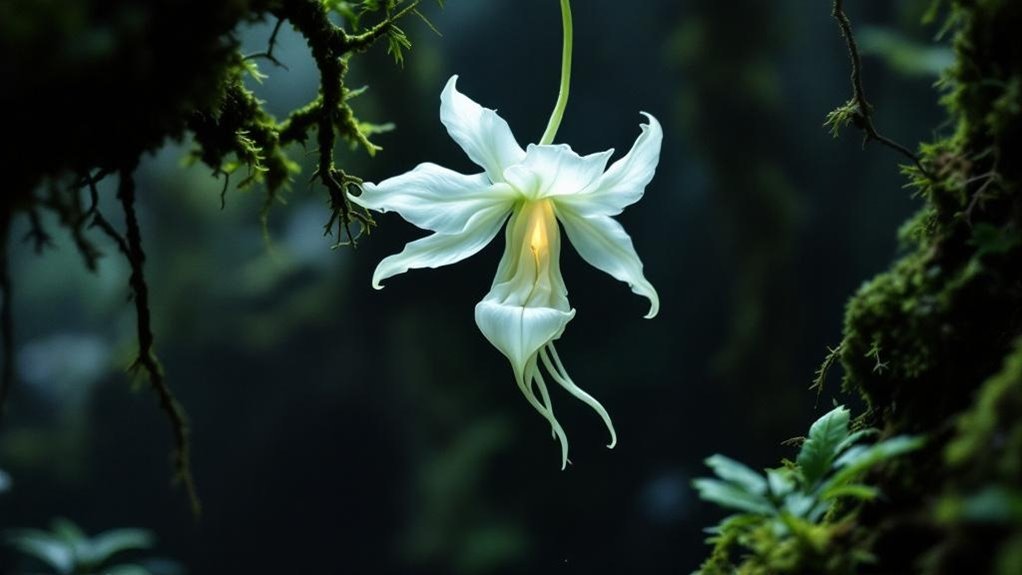
A botanical apparition, the Ghost Orchid, *Dendrophylax lindenii*, is a rare, leafless epiphytic orchid that lives chiefly in the humid, stagnant swamps of the Florida Everglades and parts of Cuba, where it anchors itself to tree bark rather than soil and draws what it needs from the surrounding air and moisture.
If you ask what the ghost orchid is one of, it’s one of the region’s most elusive endangered plants, with only about 2,000 remaining in the Everglades. You observe it chiefly during its cultivated blooming window, June through August, when it may produce two white flowers, and sightings remain uncommon because the display lasts only three to four months.
Its survival depends on highly specific pollination, especially by the giant sphinx moth, though observational evidence suggests additional moth species may assist, too.
Why Does the Ghost Orchid Look So Strange?
Why does the ghost orchid seem almost unreal? When you study the ghost orchid’s form, you notice that its leafless body removes the visual anchors you expect, while two white flowers hover like spirits, suspended rather than rooted, and this cultivated strangeness serves practical ends.
Because it lives as an epiphyte, it draws moisture and nutrients from air and detritus instead of soil, so you’re seeing an organism shaped by atmospheric dependence, not stagnant ground.
Its curling tendrils and bright crown soften its outline, helping it merge with humid forest light, and when summer sun refracts through the canopy, the blossoms appear even less substantial. This observational oddity also reflects function; the flower’s unusual shape evolved to guide specialized pollinators, especially the giant sphinx moth, whose long proboscis reaches hidden nectar.
Where Does the Ghost Orchid Grow?
You’ll find the ghost orchid in native swamp habitats across the Florida Everglades and parts of Cuba, where humid, stagnant air and highly specific water patterns create the narrow conditions it requires.
If you trace its usual locations more closely, you’ll notice it’s often anchored to cypress trees in secluded, observational corners of untouched wetlands, where its root system absorbs moisture and nutrients from the air and from cultivated layers of detritus on the host.
As you consider its range across the Everglades and the Caribbean, you can see why this orchid remains so rarely observed; it depends on remote ecosystems that stay remarkably stable, undisturbed, and difficult to access.
Native Swamp Habitats
Silence defines the ghost orchid’s native range; it grows chiefly in the swamp forests of South Florida’s Everglades and in parts of Cuba, where high humidity, shaded canopies, and finely balanced microclimates create the cultivated stability this species needs.
- You find the ghost orchid, *Dendrophylax lindenii*, in remote, observational wetlands where stagnant air, filtered light, and moisture remain consistent.
- It lives as a leafless epiphyte, taking water and nutrients from humid air and nearby organic material, not soil.
- You see its strongest refuge in protected Everglades tracts, including Fakahatchee Strand Preserve State Park, where disturbance stays limited.
- Its habitat depends on stable hydrology; with hydroperiods declining nearly 30 percent over fifty years, these swamps now offer less reliable conditions for survival and flowering over time.
Cypress Tree Locations
Within those swamp forests, the ghost orchid appears most often on cypress trees, whose bark, height, and position in stagnant, humid air create the cultivated conditions this species can tolerate year after year.
If you were searching for it, you’d look not at soil but upward, because this leafless epiphyte anchors itself to cypress trees and draws moisture, air, and detritus from the trunk rather than from the ground below.
In protected, observational settings such as remote swamp preserves, you may find orchids positioned more than 50 feet high, their pale blooms obscured among branches and knees.
That dependence on undisturbed cypress trees makes the plant exacting and vulnerable; when humidity shifts, water patterns change, or poachers remove specimens, the locations that sustain it can quickly stop functioning altogether for long-term survival.
Everglades And Caribbean Range
Across southern Florida, the ghost orchid’s best-known American range lies in the Everglades and adjoining swamp forests, especially in remote preserves such as Fakahatchee Strand, where stagnant water, dense canopy cover, and reliably humid air create the cultivated conditions this species requires; beyond Florida, it also occurs in Cuba and parts of the Caribbean, which tells you its distribution is narrow but not isolated, tied less to political boundaries than to a very specific tropical wetland pattern.
- You’ll find it in Fakahatchee Strand Preserve State Park.
- It anchors itself to host trees as an epiphyte.
- You can observe blooms from June through August, though irregularly.
- You should note that hydrology governs survival; if water patterns shift, populations decline, and conservation of these observational swamp habitats becomes essential.
Why Is the Ghost Orchid Called Ghostly?
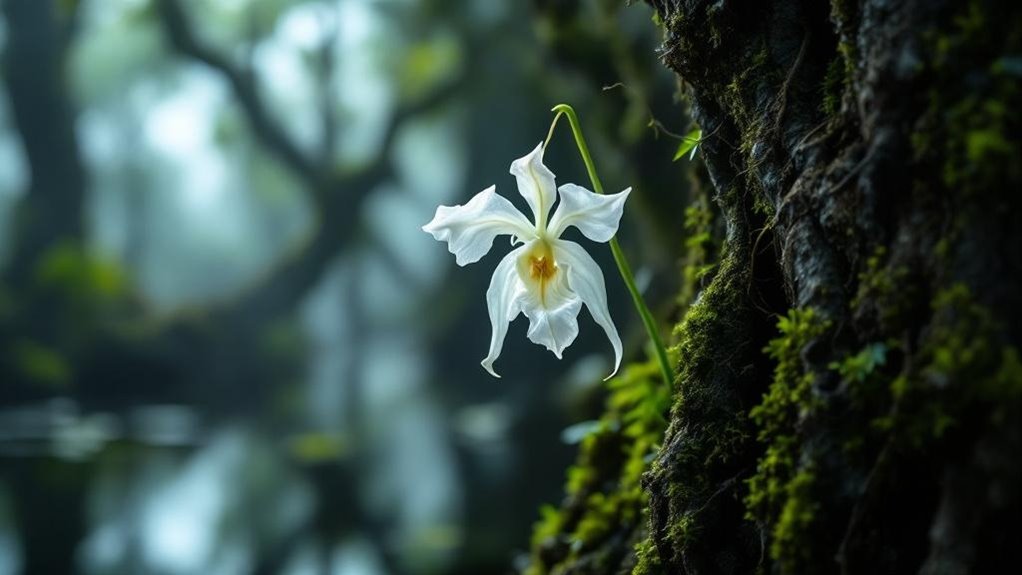
A cultivated aura surrounds the ghost orchid because its pale, white bloom appears to hover in the stagnant air of swamp forests, suspended from cypress branches with so little visible structure that you don’t immediately register the plant as rooted at all.
You perceive its ghostly quality in that visual effect, but also in its biology; without leaves, Dendrophylax lindenii reduces itself to roots and flower, draws what it needs from air and host detritus, and merges with bark and shadow.
When summer brings the white bloom, the plant takes on an otherworldly presence that feels cultivated by the swamp itself.
Legend deepens that impression, because some traditions cast the ghost orchid as the spirit of a lost lover, joining rarity, memory, beauty, and the ghost of absence in one enduring image.
Why Are Ghost Orchid Blooms So Hard to See?
That ghostly effect also explains why the bloom is so often missed, because even when a ghost orchid flowers, you’re looking for a rare white form that appears only in a narrow summer window, usually from June through August, and may persist for up to 85 days, suspended against cypress trunks and stagnant swamp light in a way that doesn’t readily separate it from its surroundings.
Even in bloom, the ghost orchid slips into cypress bark and swamp light, visible only briefly in summer.
- You must arrive during a brief blooming period.
- You need the right Everglades microclimate; otherwise, the ghost orchid won’t flower.
- You’re often scanning cultivated observational routes where blooms still merge with bark and light.
- You may search diligently, yet only a fraction bloom each season, so the ghost orchid remains difficult to detect, even before distance, water, and obstructing foliage further limit visibility there.
How Rare Is the Ghost Orchid Today?
When you look at current population estimates, you find that the ghost orchid is critically endangered, with only about 2,000 individuals remaining in the Everglades, a cultivated figure shaped by habitat loss, poaching, and increasingly stagnant hydrology.
You also need to weigh observational rarity against simple survival, because this leafless epiphyte depends on narrow microclimates and blooms mainly in summer, yet only a small fraction flowers in any given season.
As you consider how rare it’s today, you can see that sightings of blooms remain especially uncommon, and that uncertainty around pollination only reinforces how limited successful reproduction may be.
Current Population Estimates
Only about 2,000 ghost orchids are thought to remain in the Everglades today, a cultivated estimate that still places the species among the rarest orchids in the world; if you consider how few of those plants flower in any given season, the orchid’s true visibility in the wild becomes even more limited.
- You’re looking at a ghost orchid population reduced by poaching and habitat destruction.
- You can trace part of the decline to disrupted hydrology, stagnant water patterns, and broader Everglades disturbance.
- You should note that conservationists now guard location data, using secrecy as an observational defense against collectors.
- You’re seeing more than one rare plant’s struggle; you’re seeing an ecosystem signal, because when ghost orchid numbers fall this low, the surrounding habitat usually reflects persistent ecological stress too.
Blooming Sighting Rarity
Rarity becomes even more apparent once you ask how often a person might actually see a ghost orchid in bloom, because a cultivated estimate of roughly 2,000 plants in the Everglades doesn’t translate into 2,000 visible flowers; most plants won’t bloom in a given year, the flowering window is largely confined to June through August, and many of the orchids that do produce blossoms remain concealed high on cypress trunks in remote, water-bound habitat where observational access is limited.
| Factor | Effect | Result |
|---|---|---|
| Small population | Fewer plants | Lower odds |
| Short season | June–August | Narrow timing |
| Hidden habitat | High cypress trunks | Poor access |
You face blooming sighting rarity even then, because conservation secrecy blocks known sites, and 6,800 camera hours recorded only a handful of blooms, confirming how elusive the ghost orchid remains today.
Which Ghost Orchid Legends Are Most Common?
Why do the most common ghost orchid legends return so consistently to longing, absence, and discovery; they persist because the flower’s pale, floating form seems to detach beauty from any fixed body. This observational impression has encouraged stories in which it becomes the soul of a lost lover, a sign of memory held in silence, or a quiet guide between ordinary ground and sacred domains.
- You’ll often encounter the ghost orchid as a lost lover’s soul, lingering between memory and sacred space.
- You’ll see it symbolize beauty freed from form, which deepens associations with silence and absence.
- You’ll notice folklore placing it where longing turns to light, especially in stagnant swamps.
- You’ll find legends stressing discovery over cultivated possession, reinforcing its rarity and spiritual guidance between worlds for many observers.
Which Ghost Orchid Myths Are False?
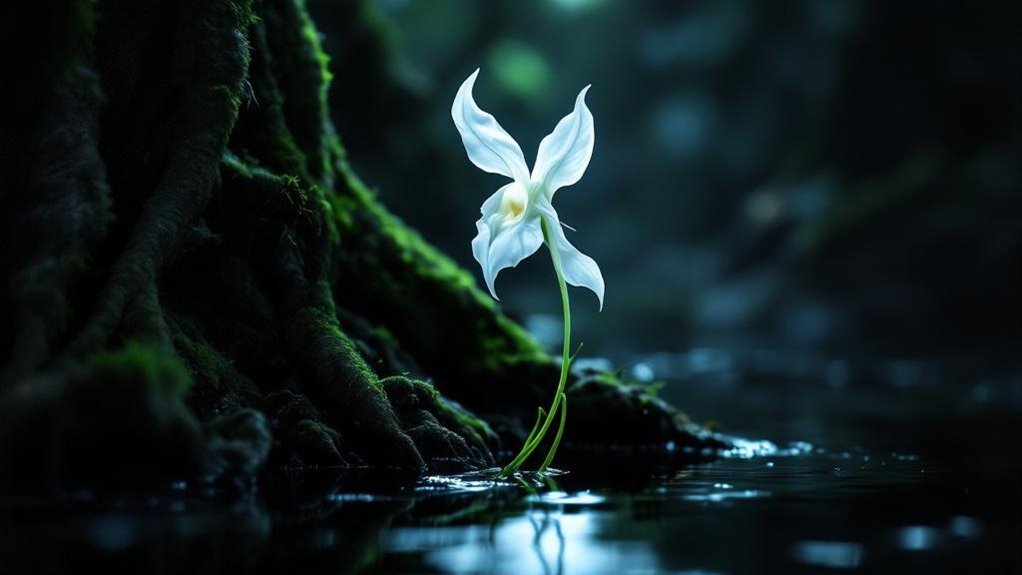
Although ghost orchids attract a dense layer of folklore, several widely repeated claims collapse under observational evidence; they aren’t pollinated by a single giant sphinx moth, they don’t bloom abundantly each season, and they don’t depend on extensive sunlight or some mystical setting beyond ordinary ecology.
When you examine the ghost orchid without legend, you find a plant tied to shaded, humid swamps, not bright clearings or stagnant fantasy landscapes. You also see why sightings remain uncommon: only a limited share of plants flowers in any given season, so abundance is largely imagined.
Another false belief holds that this species can be readily cultivated at home, yet its specialized habitat needs, host relationships, and protected status make successful cultivation uncommon outside native ranges, even under careful horticultural management today.
What Pollinates the Ghost Orchid?
Set aside the older legend of a single destined pollinator, and the ghost orchid comes into clearer view as a plant served mainly by moths whose long feeding structures match the flower’s nectar spur. The giant sphinx moth, *Cocythus antaeus*, has long stood at the center of that account because its proboscis can reach the nectar.
Beyond the single-pollinator legend, the ghost orchid appears shaped by moths whose long tongues meet its hidden nectar.
Yet observational research has shown a more complex pattern, with five additional moth species also recorded carrying pollinia and effecting fertilization.
- You should picture a ghost orchid depending on several specialized moths, not one.
- You should note that nectar access doesn’t always mean pollination occurs.
- You can see why cultivated recovery remains difficult in stagnant habitats.
- You should recognize that habitat loss and pollinator decline together limit fertilization in Everglades populations today.
Why Did Ghost Orchid Pollination Theory Change?
You can see why Darwin’s theory had to be revisited, because extensive observational evidence no longer supports a cultivated belief in one essential moth, and the old view became stagnant once researchers documented a broader pattern.
After more than 6,800 hours of camera footage focused on a ghost orchid growing 50 feet up in a cypress tree, scientists recorded five moth species visiting the flower, and they found that some took nectar without moving pollen.
That changed the theory in a clear way: you now have evidence that multiple moth pollinators shape ghost orchid reproduction, while the giant sphinx moth may matter less than earlier accounts claimed.
Darwin’s Theory Revisited
Because Darwin linked long-spurred orchids to moths with equally long proboscises, the ghost orchid was long treated as a case in which one highly specialized pollinator, usually identified as the giant sphinx moth, determined whether reproduction could occur at all; yet observational work in wild populations has revised that cultivated certainty, showing that several moth species visit the flowers, that nectar extraction doesn’t always place or remove pollen effectively, and that the old model confused access to nectar with successful pollination.
- You now see theory yield to field evidence.
- You recognize nectar access isn’t proof of pollination.
- You understand the giant sphinx moth’s role looks less decisive.
- You see the ghost orchid as less biologically stagnant.
That shift doesn’t erase risk; habitat loss and poaching still threaten survival today.
Multiple Moth Pollinators
Field evidence changed the pollination theory by replacing a cultivated certainty with observational detail; camera monitoring in wild ghost orchid populations recorded five moth species contacting flowers in ways that could move pollen, not just the giant sphinx moth.
That broader record showed that long mouthparts alone don’t determine reproductive success. When you follow the evidence, you see why the old view couldn’t remain stagnant: some moth visitors reached nectar yet failed to carry or deposit pollen, which means nectar theft may occur alongside true pollination.
The giant sphinx moth no longer stands as a solitary answer. Instead, you have a more complex system, shaped by several moth species, variable flower contact, and ecological context.
That revised understanding gives conservation work a firmer, more observational foundation for protecting endangered ghost orchids today.
How Does Poaching Threaten the Ghost Orchid?
Although poaching may seem like an isolated act of collection, it has become one of the clearest pressures on the ghost orchid, steadily reducing already fragile populations in the Everglades, where only about 2,000 plants are thought to remain.
- You remove reproductive plants before most observers ever see them bloom.
- You intensify risk because the ghost orchid is rare, and only a fraction flowers each season.
- You force conservationists into secrecy, keeping known sites quiet rather than cultivated for observational study.
- You deepen conflict, as illegal collecting fuels debate over cultural practice, ownership, and conservation obligations.
When poachers strip orchids from trees, you don’t just lose specimens; you also disturb surrounding habitat, making pollinator relationships more stagnant and less reliable, including those involving the giant sphinx moth.
Why Do Everglades Water Levels Matter?
Poaching removes individual plants, yet water levels shape whether any ghost orchid population can persist at all, since the Everglades depends on long-standing hydrologic patterns that keep tree islands, swamp forests, and humid air conditions within the narrow range many species require.
When you observe the ghost orchid in context, you see that nearly 30 percent water loss over fifty years alters hydroperiods, dries cultivated wet forests, and turns once-reliable moisture patterns unstable; that shift weakens flowering, pollination, and seedling establishment for many native species.
You also depend on this system, because the Everglades supports habitat, moderates stagnant or excessive flooding, and helps protect drinking water supplies for nearly nine million South Floridians.
Sound water management and restoration consequently matter as practical, observational safeguards for ecological function and continuity.
What Determines the Ghost Orchid’s Future?
Because the ghost orchid survives within such a narrow ecological margin, its future is determined by several pressures acting at once: the illegal orchid trade continues to remove plants from an already diminished population of roughly 2,000 individuals in the Everglades.
Managers now keep many known locations deliberately obscure to limit further losses, and long-term environmental change steadily erodes the wet, humid conditions the species depends on.
- You can trace decline to poaching.
- You can observe hydroperiod loss, about 30%.
- You can’t assume pollinators sustain reproduction.
- You can support cultivated, collaborative management.
As you consider the ghost orchid, you see that stagnant water patterns, weakened pollination by the giant sphinx moth, and observational research all matter.
If conservationists maintain secrecy, restore Everglades function, and coordinate long-term protection, the species retains a measurable chance.
Frequently Asked Questions
What Is Unique About the Ghost Orchid?
You’ll find the ghost orchid unique because it grows leafless, feeds through exposed roots, and produces striking white flowers that seem to float midair. It depends on precise swamp conditions, which makes its rare survival especially remarkable.
Why Are Ghost Orchids Illegal?
Because they’re worth a million whispers, you can’t legally take ghost orchids because they’re endangered and protected by Florida law. If you remove them, you fuel poaching, shrink tiny wild populations, and threaten their survival in the Everglades.
Why Put Cinnamon on Orchids?
You put cinnamon on orchids because it fights fungus, slows bacteria, and protects fresh cuts from rot. It helps wounds dry after repotting, supports healthier growth, and gives you a natural, chemical-free treatment option.
What Do Ghost Orchids Symbolize?
Ghost orchids symbolize beauty, fragility, mystery, and longing. Fewer than 2,000 remain in Florida, so you can see why they also represent endangered wonder, interdependence, and your responsibility to protect rare, delicate ecosystems and memories.
Conclusion
When you weigh legend against observational fact, you see the ghost orchid more clearly: not as an apparition, but as a cultivated specialist shaped by water, pollinators, and chance; not as a symbol of mystery alone, but as a living measure of healthy habitat. You understand why stagnant hydrology, poaching, and shifting science matter, and you recognize that its future depends not on myth, but on careful protection, patient study, and intact wetlands.