
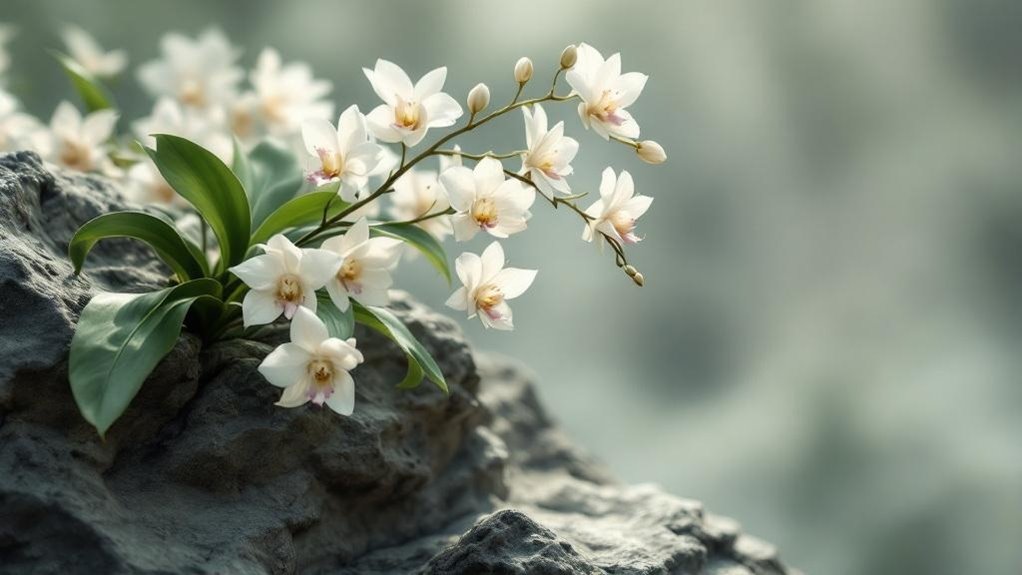
In Chinese poetry and painting, you see orchids as cultivated signs of purity, restraint, and principled solitude; poets from Qu Yuan onward used their observational beauty to express moral resolve, exile, and unrecognized worth within a stagnant world. Painters then translated that ethical language into ink, where slender leaves, spare brushwork, and quiet space suggest humility, resilience, and inward steadiness. If you continue, you’ll see how figures like Zhao Mengjian and Ma Xianglan shaped that tradition.
- Key Takeaways
- Why Orchids Matter in Chinese Culture
- What Orchids Symbolize in Chinese Poetry
- How Qu Yuan Made Orchids Literary Symbols
- How Later Poets Reused Orchid Symbolism
- How Poetry Shaped Orchid Painting
- How Zhao Mengjian Shaped Chinese Orchid Painting
- How Ma Xianglan Used Ink Orchids
- How Ink Painters Express Orchid Virtue
- How to Read Symbolism in Orchid Paintings
- Frequently Asked Questions
- Conclusion
Key Takeaways
- In Chinese culture, orchids symbolize purity, humility, nobility, and the disciplined inner character of the gentleman.
- Qu Yuan made orchids powerful poetic symbols of moral resolve, exile, sorrow, and unrecognized worth.
- In poetry, orchids often represent principled solitude, expressing integrity maintained apart from corruption or social noise.
- In painting, artists use elegant brushwork, sparse composition, and blank space to convey orchid grace, restraint, and inward feeling.
- Orchid imagery became central to literati art, where beauty and moral character are inseparable in both poems and ink paintings.
Why Orchids Matter in Chinese Culture
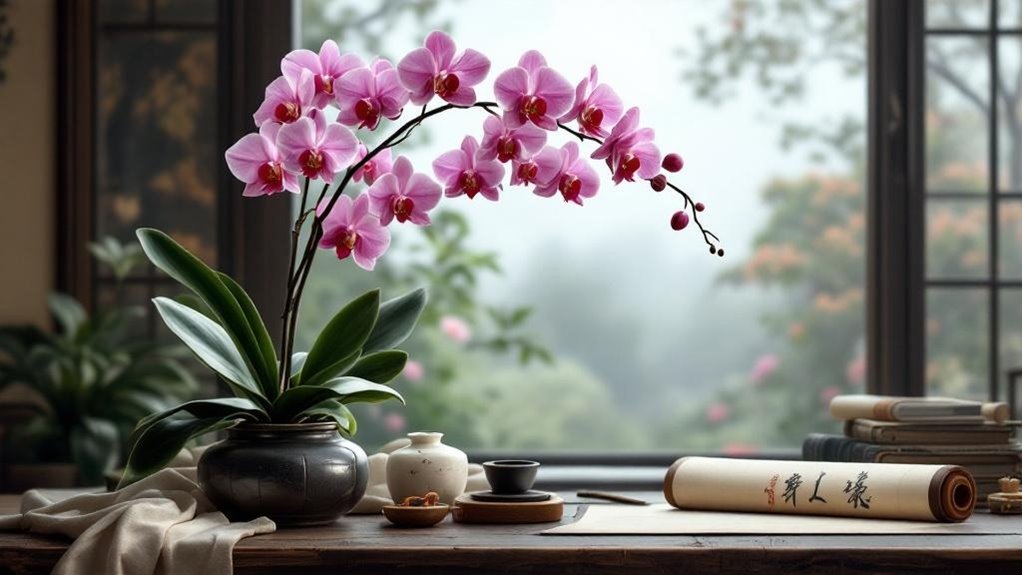
Reverence helps explain why orchids matter so deeply in Chinese culture, because 兰花 (Lánhuā) has been cultivated for more than 2,000 years and has come to represent far more than a decorative flower; it stands for beauty, good taste, and a disciplined inner character that Chinese thinkers and artists refused to let become stagnant or merely ornamental.
When you trace its place in Chinese culture, you find an observational ethic: the philosopher Confucius praised orchids as models of virtue under hardship, and scholars grouped them among the Four Gentlemen to affirm integrity, humility, nobility, and self-restraint.
You also see how art preserved that standard; Zhao Mengjian’s Spring Orchid Scroll, the earliest known orchid painting, shows that cultivated taste required moral steadiness, not display alone, in enduring educated life.
What Orchids Symbolize in Chinese Poetry
As you read Chinese poetry, you see orchids stand for the cultivated virtues of a gentleman—integrity, nobility, and humility—and their place among the Four Gentlemen confirms that moral character, not outward display, gives them lasting meaning.
You also notice that poets place orchids in quiet, desolate settings, where they remain unstained and observational rather than stagnant, so their solitude becomes a sign of inner steadiness and principled independence.
In this way, you can understand why writers from Qu Yuan to Tang poets used orchids to express both honorable character and the difficult fate of those who keep their values apart from the world.
Virtue And Nobility
For many Chinese poets, the orchid came to signify the cultivated virtues of a gentleman—integrity, nobility, and humility—because it offered an observational model of worth that didn’t depend on display; its fragrance deepened in solitude, its beauty remained restrained rather than ostentatious, and its presence suggested authenticity in a world often judged by louder, more stagnant forms of prestige.
In ancient Chinese thought, Orchid flowers joined plum blossoms, bamboo, and chrysanthemums as the Four Gentlemen, so you read them as emblems of moral character and refined taste.
When Qu Yuan praised orchids, you see scholarly integrity made visible through cultivation and art.
In Emperor Wu of Han’s “Autumn Wind Song,” the orchid’s symbolism steadies shifting feeling, reminding you that nobility endures even as joy fades, age advances, and nostalgia gathers quietly.
Solitude And Integrity
That moral nobility acquires sharper meaning when you see where the orchid grows and how it endures; in Chinese poetry, it often stands in remote valleys and quiet ravines, blooming beyond public notice.
That setting lets poets present integrity not as a performed virtue but as an inward steadiness that remains intact amid neglect, distance, and stagnant worldly ambition.
Confucius makes that reading cultivated and observational: you recognize the orchid as the gentleman who remains authentic when no one praises him.
Among the Four Gentlemen, it carries refinement without display, purity without withdrawal from principle.
In Tang Yanqian’s vision, and even in painted orchids, you see independent beauty joined to perseverance; loss, time, and desolation test character, yet they don’t exhaust it or diminish its nobility.
How Qu Yuan Made Orchids Literary Symbols
When Qu Yuan wrote of orchids, he didn’t treat them as mere flowers; he cultivated them, observed their elegance and fragrance, and turned them into a disciplined literary symbol through which beauty, purity, and moral resolve could be joined.
If you follow his observational method, you see how the orchid becomes more than ornament: it carries his noble ideals, his cultivated sense of virtue, and his refusal to accept a stagnant moral world.
He aligns the flower with worthy scholars, whose beauty lies not in display but in resilience, and whose fragrance suggests integrity preserved under pressure.
Because exile sharpened his perception, the orchid also expresses isolation and a restrained longing for recognition; through it, you can trace how personal sorrow becomes ethical statement, and how refined natural imagery gains lasting literary authority in Chinese tradition.
How Later Poets Reused Orchid Symbolism
You can see later poets recast the orchid’s inherited meanings, using its cultivated beauty, refinement, and moral character to sustain an observational link with classical verse across dynasties.
As you follow these poems, you find the flower’s quiet growth in remote valleys standing against stagnant society, a steady metaphor for nobility and integrity that recalls Confucius and Han Yu while preserving its force in new historical settings.
You also notice how writers such as Tang Yanqian, and the enduring ideal of the Four Gentlemen, turned the orchid’s image and fragrance toward noble purity, independent beauty, and the measured expression of love, loss, and solitude.
Recasting Orchid Virtue
Across later Chinese poetry, the orchid retained its cultivated authority as a sign of integrity, yet poets didn’t merely repeat an inherited emblem; they recast it to meet new moral and emotional pressures, drawing on earlier literary tradition while giving the flower an observational force suited to changing times.
You can see this recasting when later writers place the orchid among the Four Gentlemen, where its refinement stands beside plum blossom and bamboo, then sharpen its meaning through solitude, endurance, and self-command.
In Tang Yanqian especially, the flower prospers apart from stagnant society, and you read that distance not as withdrawal alone but as disciplined purity, a Confucian resilience tested by adversity.
Because of that flexibility, the orchid keeps carrying beauty and moral character together, without losing emotional depth ever.
Echoes Across Dynasties
Because orchid symbolism had already fused beauty with moral judgment in early writing, later poets didn’t invent a new language for the flower so much as reactivate an inherited one, returning to established images of fragrance, seclusion, and cultivated form in order to address their own periods of uncertainty, decline, or stagnant public life.
| Poet/Tradition | Reused image | Meaning |
|---|---|---|
| Emperor Wu echoes | autumn transience | fragile life |
| Tang Yanqian | emerald circles | noble purity |
| Four Gentlemen | modest orchid | inner strength |
You see this observational continuity across dynasties: poets reuse the orchid to affirm Confucian virtue, cultivated restraint, and resilience under pressure; they also preserve its place among the Four Gentlemen, where beauty never stands alone, and where love, modesty, and integrity endure despite changing courts, expectations, and stagnant public life.
How Poetry Shaped Orchid Painting
Although orchid painting developed as a visual art, its cultivated language came directly from poetry, where the flower had long stood for the virtues of the gentleman, and scholar-artists adopted that moral symbolism as both subject and standard.
When you read classical verse, you see how orchids entered painting already charged with ethical meaning; among the Four Gentlemen, they offered a framework for beauty disciplined by character, never stagnant display.
Tang Yanqian’s “Ode to the Orchid,” with its observational metaphors of nobility and elegance, gave painters a verbal model for line, restraint, and atmosphere.
As a scholar-artist, you wouldn’t paint fragrance directly, yet you could suggest it through spacing, controlled brushwork, and an unforced composition.
In that meditative process, poetry guided feeling into form, aligning private emotion with Confucian ideals of humility, authenticity, and self-command.
How Zhao Mengjian Shaped Chinese Orchid Painting
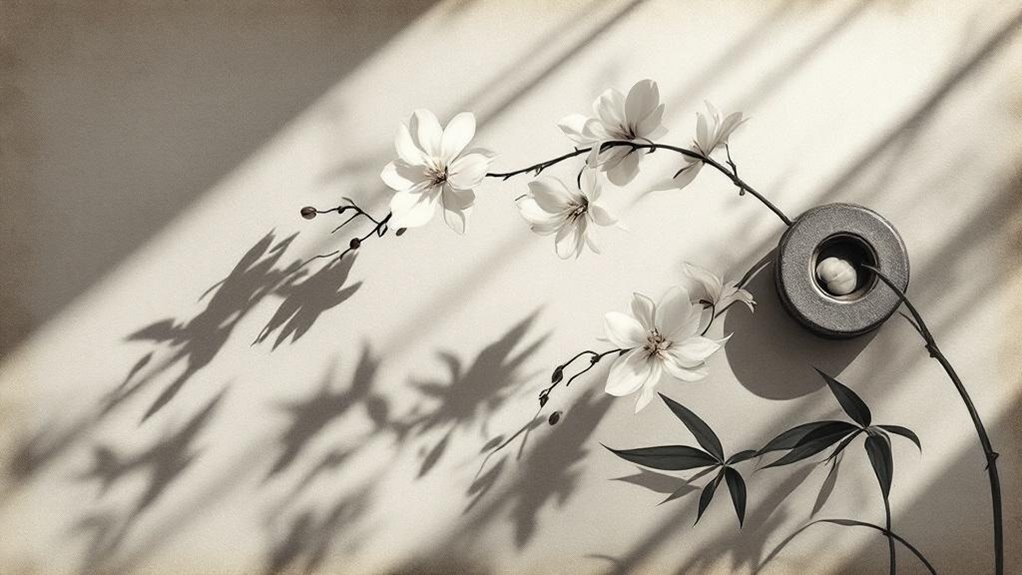
When you turn to Zhao Mengjian, you meet the figure who gave Chinese orchid painting its earliest secure model. His *Spring Orchid Scroll*, widely regarded as the first extant work of its kind, established a cultivated standard in which observational precision, elegant brushwork, and moral intention moved together rather than apart.
As you study the scroll, you see how each bloom holds a distinct presence within a harmonious setting; nothing feels stagnant because Zhao balances intricate line, measured space, and refined rhythm.
You also see why later painters returned to him: he joined aesthetic grace to literati ideals, so the orchid became more than a beautiful plant, becoming a sign of solitude, virtue, and disciplined inward life.
Through that union, you can trace his influence across Chinese orchid painting, including contemporary practice today.
How Ma Xianglan Used Ink Orchids
Restraint defines Ma Xianglan’s use of ink orchids, for from her studio, the Pavilion of Hidden Orchids, she joined the cultivation of living plants to a cultivated artistic practice in which a single stem or bloom, placed against a blank ground, could carry the full weight of solitude, memory, and inward feeling without ever seeming stagnant.
As you look at her paintings, you see how that observational economy works: ink variations do the emotional labor, each tonal shift registering hesitation, distance, or desire, and the orchid becomes a vehicle for unfulfilled love and longing rather than mere botanical likeness.
She doesn’t crowd the surface; instead, she leaves space for silence, asking you to read what isn’t declared, to attend to brushwork, reserve, and the quiet narrative that lingers after the image has finished speaking.
How Ink Painters Express Orchid Virtue
Because ink painters treat the orchid as more than a botanical subject, they use its slender leaves, measured growth, and implied fragrance to express the virtues of a cultivated gentleman, rendering elegance not as display but as inward character made visible through delicate brushwork and subtle tonal variation.
As you look closely, you see how implied fragrance becomes an observational metaphor for humility and restraint, qualities Confucian thought values because they endure without demanding notice. Scholar-artists favored orchids when they wished to register solitude and unrecognized integrity, and you can feel that preference in compositions that avoid stagnant fullness.
The Mustard Seed Garden Manual stresses breath and rhythm in each stroke, so authenticity arises through disciplined movement. In sparse settings, as with Ma Xianglan, you encounter virtue intensified through restraint.
How to Read Symbolism in Orchid Paintings
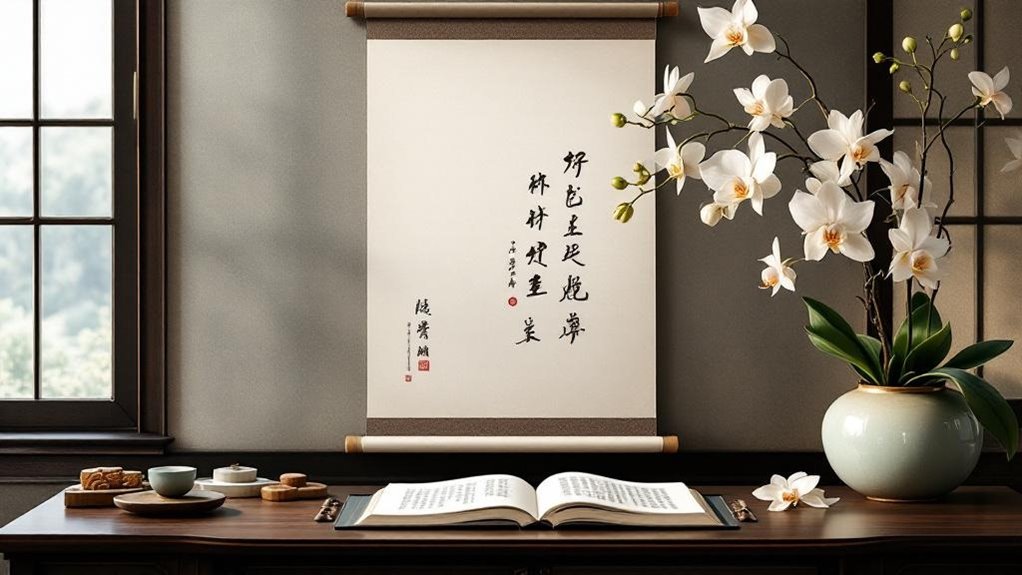
A scroll offers its meanings gradually, so you should begin by observing how the orchid is formed on the page, since its delicate beauty often serves less as description than as a moral sign, reflecting purity, nobility, and grace within a cultivated Chinese visual language.
Then study the brushwork, because each stroke records breath, pressure, and emotional depth; tonal shifts and textured ink reveal whether the artist pursued restraint, sorrow, or quiet strength.
Study the brushwork closely, for each stroke preserves breath and pressure, while ink tones disclose restraint, sorrow, or quiet strength.
You should also note placement: a solitary orchid can suggest principled seclusion, while one set among rocks or grasses may indicate resilience, neglect, or beauty unrecognized, an observational echo of Confucian reflection.
Finally, attend to surrounding space, never stagnant, because emptiness shapes the painting’s narrative, and if you look slowly, with disciplined attention, refined taste and thoughtfulness emerge.
Frequently Asked Questions
What Does an Orchid Symbolize in Chinese Culture?
In Chinese culture, you’d see an orchid symbolize beauty, refinement, virtue, and noble character. You can also read it as fertility, many children, and romantic interest, especially when someone gives or displays orchids.
What Did Confucius Say About Orchids?
Like a quiet lantern, Confucius said orchids embody a gentleman’s virtue: integrity, humility, and authenticity. You see them thriving unseen in desolate places, showing that true character doesn’t need recognition to endure or spread fragrance.
What Is the Feng Shui for Orchids?
In feng shui, you use orchids to attract positive energy, love, beauty, and refinement. Place them in your southeast area for wealth, or your bedroom for romance. Keep them healthy, because thriving blooms boost harmony.
Why Do Asians Love Orchids?
You love orchids because they embody a universe of elegance, virtue, and restraint. In many Asian cultures, you see their beauty, fragrance, and symbolism as expressions of love, refinement, good fortune, and deeply admired character.
Conclusion
When you look at orchids in Chinese poetry and painting, you enter a cultivated world where fragrance drifts through quiet rooms, ink leaves bend against empty silk, and character matters more than display; you see why poets chose orchids to resist stagnant values, why painters followed those lines into observational brushwork, and why the flower still endures as a measured sign of integrity, restraint, and inward grace, rooted in nature yet refined by art and memory.