
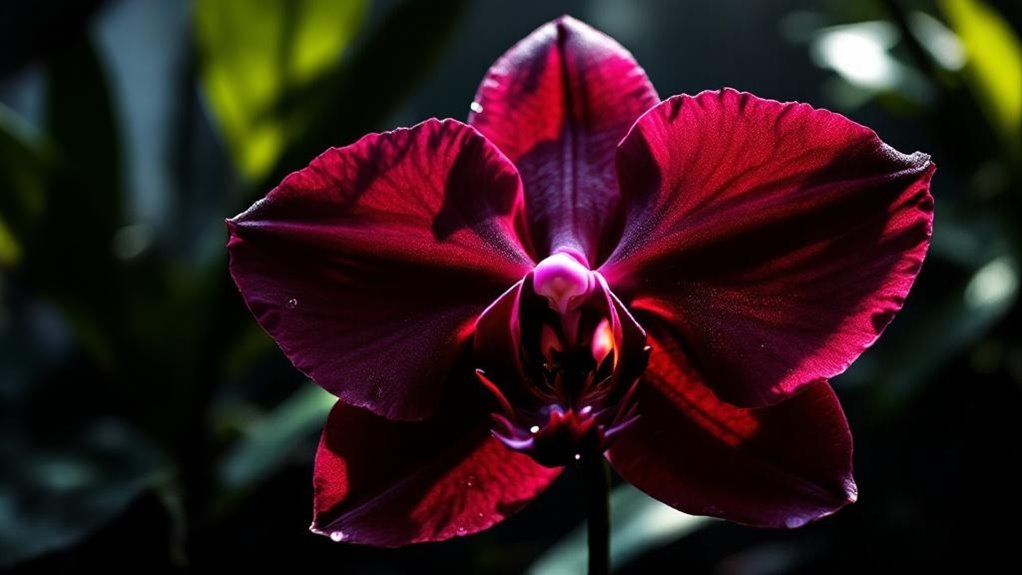
Black orchids are real in cultivation, but you’re usually seeing an observational label, not a truly black flower; most blooms rely on densely layered purple, maroon, or red pigments that absorb light and appear nearly black under certain conditions. True black coloration is exceptionally rare because orchid genetics and pigment biology don’t support it well, so breeders select for darker saturation instead. If you continue, you’ll see which varieties look darkest, and how to grow them well.
- Key Takeaways
- Are Black Orchids Real?
- Why Are True Black Orchids So Rare?
- Why Can’t Orchids Bloom True Black?
- Which Orchids Count as Black Orchids?
- Which Black Orchid Varieties Look Darkest?
- Is Coelogyne Pandurata Really a Black Orchid?
- What Are Fredclarkeara After Dark Hybrids?
- Why Is Monnierara Millenium Magic Witchcraft So Dark?
- Which Dracula Orchids Look Almost Black?
- How Growers Breed Darker Black Orchid Hybrids
- What Black Orchids Look Like in Real Life
- Black Orchids vs. Blue Orchids
- Are Blue Orchids Real or Dyed?
- Why Purple Orchids Look More Natural
- How to Buy Black Orchids
- How to Care for Black Orchids
- Should You Grow a Black Orchid?
- Frequently Asked Questions
- Conclusion
Key Takeaways
- Black orchids are real as cultivated flowers, but they are usually very dark purple, maroon, or red rather than truly black.
- Their black appearance comes from dense pigments and bloom texture that absorb light and create a near-black optical effect.
- True black pigment is extremely rare in orchids because their genetics and chemistry do not normally produce fully black coloration.
- Famous “black” orchids include Fredclarkeara After Dark and Monnierara Millenium Magic Witchcraft, both bred for exceptionally dark blooms.
- Much of the myth comes from marketing and misunderstanding, while the reality is that near-black orchids do exist and can be grown successfully.
Are Black Orchids Real?
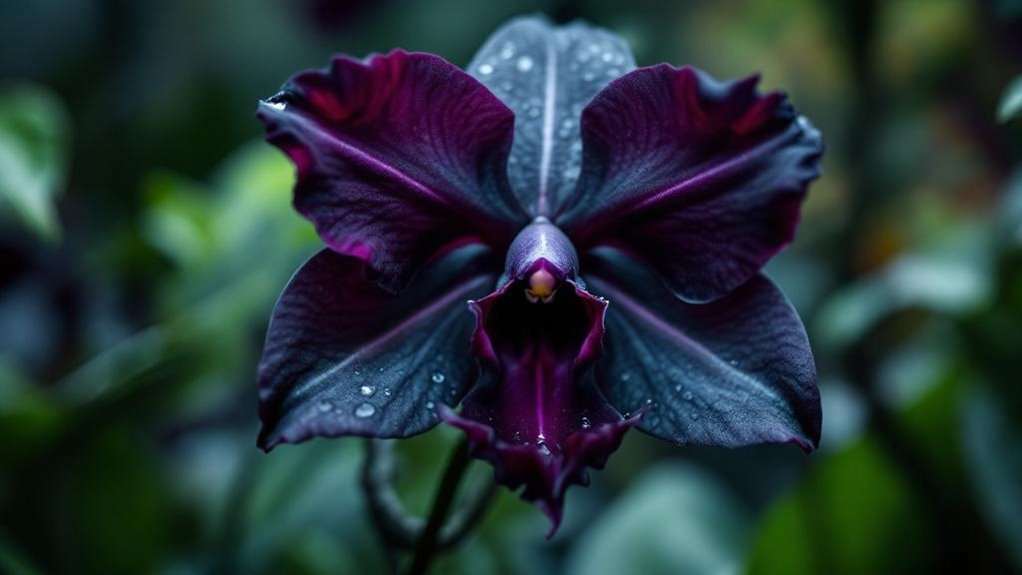
Are black orchids real, strictly speaking; not in the way the name suggests, because the flowers most people identify as black are usually cultivated in such deep shades of purple, maroon, or red that they read as black under certain light, while researched literature hasn’t verified a definitive orchid species with truly black pigmentation.
When you encounter black orchids in catalogs or regional descriptions, you’re usually seeing an observational label rather than a botanical conclusion; even notable examples, including Prosthechea cochleata and Coelogyne pandurata, present dark, dramatic features without reaching true black.
For you as a grower or observer, that distinction matters, because a rare orchid may look almost stagnant in shadow yet still derive its color from concentrated red or violet pigments, and hybrids like Fredclarkeara After Dark confirm how close cultivation can come.
Why Are True Black Orchids So Rare?
The rarity of true black orchids comes down largely to pigment biology and genetic constraint, because orchid tissues don’t readily produce the kind of light-absorbing coloration that would register as pure black.
What you usually observe instead is an extreme concentration of purple, red, or maroon pigments that appears black only under certain angles or subdued light.
You see this in many orchids in the world, where observational study shows dark lips, spots, or cultivated shading rather than pure black flowers.
Even celebrated hybrids, including Fredclarkeara After Dark and Catasetum tenebrosum, remain rare examples of deep color, not absolute black.
- You notice near-black petals shift in stronger light.
- You find genetics keep outcomes stagnant.
- You recognize rarity fuels careful admiration.
- You understand why growers pursue darker tones.
Why Can’t Orchids Bloom True Black?
What keeps orchids from blooming true black is not a failure of cultivation but a limit built into their genetic makeup; they don’t produce a black pigment in the flower tissues, so even the darkest blooms rely on dense concentrations of purple, red, or maroon compounds that only read as black under selective conditions.
| Cause | Effect | Observation |
|---|---|---|
| No black pigment | Color stays almost black | Genetics remain decisive |
| Dense dark compounds | Illusion strengthens | Lighting shifts perception |
When you examine the mystery of black orchids, you find an observational problem as much as a cultivated one; deep shades of purple, red, and maroon can appear stagnant and blackened, yet the flower still lacks true black pigmentation, and regional naming often reinforces that impression rather than changing the biology.
Which Orchids Count as Black Orchids?
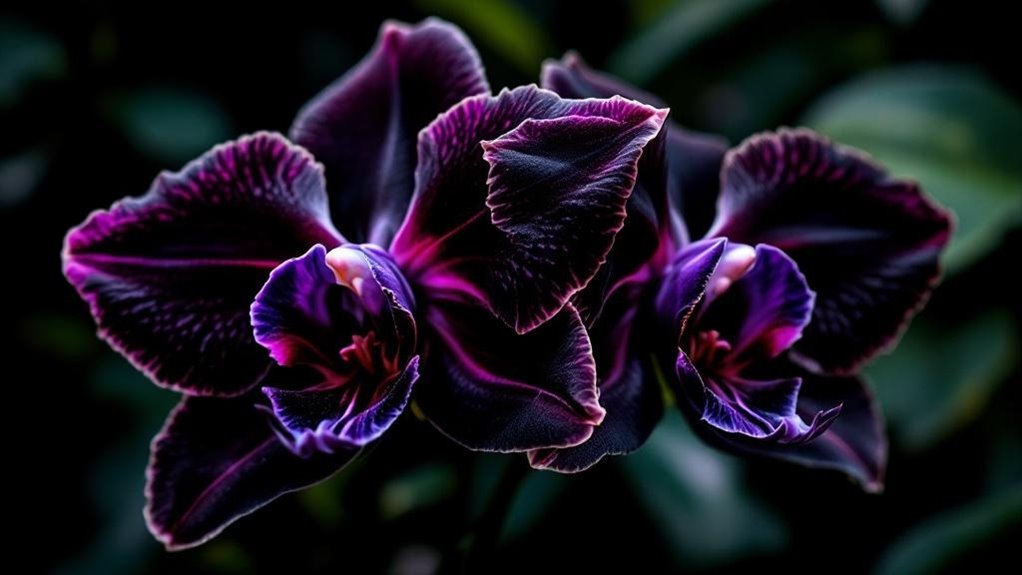
Which orchids count as black orchids depends less on any true black pigment than on which cultivated varieties and species consistently present an observational impression of black under ordinary viewing conditions; in practice, growers and collectors usually include Coelogyne pandurata, long treated as the original black orchid because of its dark lip, along with deeply shaded forms such as *Cymbidium canaliculatum var. Sparkesii*.
You’ll also see *Maxillaria variabilis Black*, *Trichoglottis brachiata*, *Fredclarkeara After Dark* selections, and some *Dracula* orchids grouped with dark-hued orchids, because their blooms read as nearly black, not stagnant purple, in common light.
- You recognize heritage in Coelogyne pandurata.
- You notice cultivated depth in Fredclarkeara lines.
- You accept Dracula Raven as part of the spectrum.
- You understand most black orchids remain maroon or purple.
Which Black Orchid Varieties Look Darkest?
Among orchids described as black, the darkest-looking varieties are usually those that combine saturated maroon or purple pigmentation with a velvety surface, a narrow bloom shape, or a shadowed throat.
This is because those traits suppress reflected light and make the flower read as black under ordinary observational conditions. For that reason, growers often place Fredclarkeara After Dark cultivars such as Black Pearl and Black Diamond near the top of the list, while Dracula Raven also ranks highly for its dense, rich pigmentation and sculptural form.
You’ll also see Cattleya Black Jack and Cymbidium Little Black Sambo Black Magic cited among black orchids, since their cultivated blooms hold unusually stagnant, dark tones.
Coelogyne pandurata, Maxillaria variabilis Black, Trichoglottis brachiata, and other Dracula orchids complete the darkest tier.
Is Coelogyne Pandurata Really a Black Orchid?
At first glance, Coelogyne pandurata can seem to justify the label “black orchid,” yet that name overstates its coloration, because the flower doesn’t present as uniformly black and instead relies on the strong visual contrast between its lighter green petals and sepals and its markedly dark lip; in observational terms, the effect is striking rather than absolute.
You can understand its appeal through four quiet impressions:
Its appeal unfolds through four quiet impressions, each clarifying why this flower feels so dark without ever becoming truly black.
- You see contrast, not stagnant blackness.
- You notice tones closer to deep purple orchids or brown.
- You recognize Borneo’s endemic Coelogyne pandurata as distinctive, not mythical.
- You understand why black orchids remain elusive in nature.
When you examine cultivated plants carefully, you find a persuasive example of why black orchids fascinate observers, yet also why truly black flowers remain exceptionally rare worldwide.
What Are Fredclarkeara After Dark Hybrids?
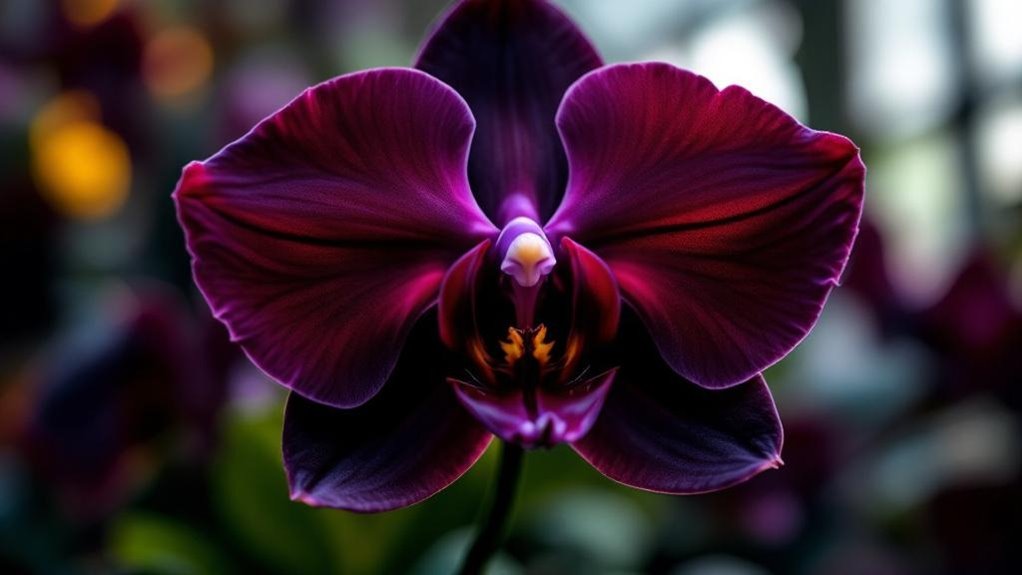
If Coelogyne pandurata shows how contrast can suggest blackness without fully achieving it, Fredclarkeara After Dark hybrids show how cultivated breeding can push that impression much further, producing flowers with such deep, saturated coloration that they often read as nearly black in observational terms, even though they still rest within very dark shades of purple, red, or maroon rather than stagnant black itself.
| Feature | Note |
|---|---|
| Lineage | Catasetum, Mormodes, Clowesia |
| Examples | ‘Black Pearl,’ ‘Black Diamond’ |
| Color | Nearly Black |
| Growing | Controlled greenhouses |
| Access | More commercially available |
When you evaluate Fredclarkeara After Dark hybrids, you see why Black Orchids: Rare fascinate collectors; breeding creates unusual forms, variable care needs, and dependable blooming under managed greenhouse conditions, making these plants increasingly obtainable for serious enthusiasts.
Why Is Monnierara Millenium Magic Witchcraft So Dark?
When you look at Monnierara Millenium Magic Witchcraft, you can trace its near-black effect to dense pigment and petal structure working together; dark maroon layers absorb light, and the flower’s surface reduces reflection, so the blooms appear deeper and less stagnant under shifting conditions.
You can also see the mark of cultivated breeding, because growers combined dark-flowered orchid lines with observational precision, selecting again and again for stronger saturation and a more uniform, almost black presentation.
If you maintain bright, indirect light and balanced feeding, you help preserve that carefully bred coloration, which is why this hybrid remains so valued among collectors who want rare, visually commanding orchids.
Pigment And Petal Structure
Velvet is the closest visual comparison, because Monnierara Millenium Magic Witchcraft looks so dark not through any true black pigment, but through a cultivated concentration of anthocyanins that absorb much of the light striking the petals, while the flower’s complex surface structure limits bright reflection and deepens the observational impression of blackness; genetics set the range of possible pigmentation, environmental conditions can push those tones darker than in more typical orchids, and the result is a bloom whose hue appears almost stagnant in its depth, demonstrating both how rare this effect is and why even the darkest orchids still rely on densely layered shades rather than pure black color.
- You notice stillness.
- You register depth.
- You see rarity.
- You understand one species can seem nearly unreal.
Breeding For Darker Blooms
That observational impression of blackness doesn’t arise from pigment alone, because Monnierara Millenium Magic Witchcraft was also bred, with unusual discipline, for darker and more stagnant-looking blooms through the careful hybridization of orchids with strong color potential, including lines from Brassia and Miltonia; by selecting parent plants that already carried deep pigmentation traits and pairing them across generations, hybridizer Fred Clarke concentrated the likelihood of offspring producing denser, richer tones, and the result shows how cultivated breeding can push an orchid beyond what most wild flowers present, creating a bloom so dark it seems to test the natural limits of floral color without ever becoming truly black.
| Factor | Effect |
|---|---|
| Brassia lineage | Deepens tone |
| Miltonia lineage | Enriches color |
| Parent selection | Stabilizes darkness |
| Fred Clarke’s work | Refines black orchids |
| breeding for darker blooms | Defines Monnierara Millenium Magic Witchcraft |
Which Dracula Orchids Look Almost Black?
When you look for Dracula orchids that seem almost black, you’ll notice that varieties such as Dracula raven and Dracula vampira stand out first, because their cultivated blooms carry such dense maroon and purple pigmentation that, under subdued light, the color reads as nearly black rather than merely dark.
You can also identify this effect through observational details in the flowers themselves, since the heavy anthocyanin content deepens the petals while pale markings or fine patterning create contrast, prevent the surface from appearing flat or stagnant, and sharpen the orchids’ mysterious outline.
If you choose to grow these near-black Dracula varieties, you’ll find that their dramatic appearance depends not only on genetics but also on cool temperatures, steady moisture, and careful light management, all of which influence how dark the blooms appear.
Near-Black Dracula Varieties
Among the Dracula orchids, a few cultivated varieties stand apart for their near-black effect, most notably Dracula Raven and Dracula vampira, whose dense maroon and purple pigmentation can read as black in subdued or stagnant light; this impression owes less to true black coloration than to the way their saturated tones absorb shadow, deepen across the flower’s unusual surface, and emphasize the genus’s already dramatic, face-like forms.
You notice their mystique through observational details:
- Their near-black presence feels solemn, not harsh.
- Their unique shapes hold your attention quietly.
- Their cool, moist growing needs invite careful respect.
- Their cultivated rarity gives collectors a measured sense of privilege.
When you encounter these Dracula orchids, you’re seeing flowers valued for atmosphere, structure, and restraint, rather than any literal black pigment or certainty.
Color And Marking Traits
What makes certain Dracula orchids look almost black isn’t a single pigment but a combination of saturated maroon, purple, and brown-black tones, dense petal and sepal surfaces, and markings that control how you read shadow across the flower; in cultivated forms such as Dracula raven and Dracula vampira, this effect often intensifies under subdued or stagnant light, where the blooms absorb more than they reflect and their darker lips or sepals seem to consolidate into a near-black field.
| Trait | Effect | Example |
|---|---|---|
| Dark pigments | Deepens coloration | raven |
| Lighter markings | Heightens contrast | vampira |
| Velvety texture | Holds shadow | sepals |
| Cloud-forest light | Strengthens darkness | habitat |
You’ll notice Dracula orchids read darkest when contrast, texture, and observational lighting work together, not when petals are truly black.
How Growers Breed Darker Black Orchid Hybrids
Although truly black orchids don’t occur as a stable natural color class, growers can cultivate the illusion of black by crossbreeding already dark-hued orchids, then selecting offspring that carry denser purple, maroon, or near-ebony pigmentation; this is the basis of modern dark-hybrid breeding, and it depends on careful observational work rather than chance.
With each Orchid Plant, you rely on dark-hued orchid varieties and precise breeding techniques, including selective pollination, because parent plants with concentrated pigments tend to pass stronger coloration onward. Firms such as Sunset Valley Orchids refined this method through crosses behind Fredclarkeara After Dark.
You also control cultivation conditions so pigment production doesn’t become stagnant:
- steadier light,
- balanced nutrients,
- patient selection,
- repeated evaluation.
As these cultivated hybrids improve, you can access darker orchids more reliably than earlier generations.
What Black Orchids Look Like in Real Life
Seen in real life, so-called black orchids reflect the results of that cultivated breeding work, yet they don’t read as flat, absolute black; instead, you typically notice saturated purple, wine-red, or maroon tones so dense that the flower appears nearly ebony under certain light.
When you examine black orchids closely, the effect often comes from contrast rather than stagnant uniformity; Coelogyne pandurata, for example, shows a dark lip against greener petals, while Dracula raven carries such deep purple pigmentation that your observational impression approaches black without reaching it.
You’ll also see spotting, velvety surfaces, and shadowed throats that deepen the cultivated illusion. In darker hybrids, including some Fredclarkeara After Dark forms, those layered pigments absorb light so effectively that the flowers seem black at first glance, then resolve into color.
Black Orchids vs. Blue Orchids
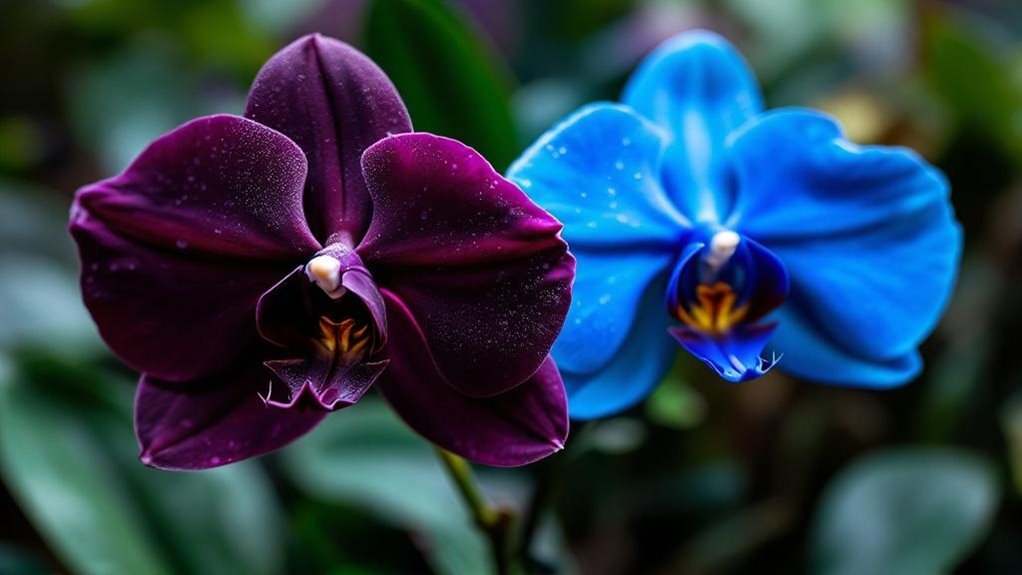
Why do black orchids and blue orchids invite similar myths, yet diverge so clearly in practice; in both cases, you’re usually looking at cultivated color effects constrained by orchid genetics, not at flowers that produce a pure black or true blue pigment on their own.
- You see black orchids as saturated purples, maroons, or reds, not absolute black.
- You encounter blue orchids most often as altered white Phalaenopsis orchids, not stable natural blue.
- You find natural blue orchids only in limited, observational exceptions, never as a stagnant standard.
- You notice both colors reflect genetic limits; cultivation pushes appearance further than nature permits.
This distinction matters: black orchids such as Dracula Raven or Monnierara Millenium Magic Witchcraft stay near-black by breeding, while blue orchids seldom hold that cultivated look when they bloom again.
Are Blue Orchids Real or Dyed?
How often do the vivid blue orchids in garden centers represent nature rather than intervention; in most cases, they don’t, because the intense cobalt or electric-blue flowers you see are dyed white Phalaenopsis orchids, cultivated for temporary visual impact rather than for a stable genetic trait.
If you buy blue orchids, you should expect the next bloom cycle to return to white, since the dye doesn’t alter genetics, only appearance; that observational fact helps you avoid stagnant assumptions. Truly natural blue orchids exist, but they’re rare and usually softer in tone.
| Store specimens | Usually dyed white orchids |
|---|---|
| Re-bloom color | Returns to white |
Closest natural examples include *Cyanicula gemmata*, *Disa graminifolia*, and *Dendrobium dedicatulum*; meanwhile, breeders continue pursuing naturally blue hybrids, so informed purchasing remains the clearest standard.
Why Purple Orchids Look More Natural
When you compare purple orchids with more unusual colors, you notice that their appearance feels more natural because anthocyanin pigments produce those hues in the plant itself, creating an observational sense of authenticity rather than a cultivated effect that can seem stagnant or imposed.
You also find purple readily among common Phalaenopsis varieties, which makes these blooms more familiar in nature and cultivation, and that frequency reinforces their credible, unaltered presence.
Because their color arises naturally and spans shades from pale lavender to deep royal purple, you can regard purple orchids as a more authentic expression of orchid beauty, especially when contrasted with artificially dyed alternatives.
Natural Anthocyanin Pigments
The deep purple seen in many orchids comes from anthocyanins, natural pigments that the plant produces for its own protection and display; these compounds help shield delicate tissues from intense sunlight, and they create the violet-to-plum range that observers often read as more natural, more stable, and more visually convincing than any dyed bloom.
In your orchid, anthocyanins respond to light and temperature, so cultivated conditions can deepen or soften color without pushing it into true black or blue, which these natural pigments can’t produce.
- You see steadiness, not a stagnant artificial stain.
- You trust color rooted in genetics.
- You notice observational depth across petals.
- You value a bloom that returns unchanged.
Unlike dyed flowers, purple orchids re-bloom in their inherent shades, which is why collectors and decorators continue choosing them.
Common Phalaenopsis Varieties
Across common Phalaenopsis varieties, you encounter lavender, mauve, plum, and saturated violet tones that read as naturally convincing because they arise from cultivated genetics and anthocyanin expression, not from a stagnant surface treatment; this is why purple orchids often appear more observationally deep and visually coherent than blooms pushed toward artificial black.
When you choose these Orchids, you’re seeing color produced by pigments that also help the plant manage sunlight, while genetics and indoor conditions shape whether the flowers lean soft lilac or richer violet;
let’s uncover the truth behind their familiarity: Phalaenopsis orchids are widely cultivated, easy to maintain indoors, and commonly used in arrangements because their purple range feels stable, natural, and adaptable, while also carrying associations with admiration, respect, and creativity in everyday settings.
Authentic Color Appeal
A purple orchid usually looks more natural because its color develops from anthocyanin within the bloom itself, not from a stagnant surface treatment.
So you register depth, variation, and tonal consistency rather than a flat effect imposed from the outside; genetics shape whether the petals read as lilac, violet, plum, or mauve, and that cultivated range gives the flower an observational credibility that artificial black rarely sustains.
You also respond to what purple signifies and how reliably it performs indoors:
- You see admiration and respect.
- You sense creativity without theatricality.
- You trust its widespread authenticity.
- You appreciate long bloom life and modest care.
When you choose purple orchids for a room or a gift, you select something naturally available, visually persuasive, and quietly enduring.
How to Buy Black Orchids
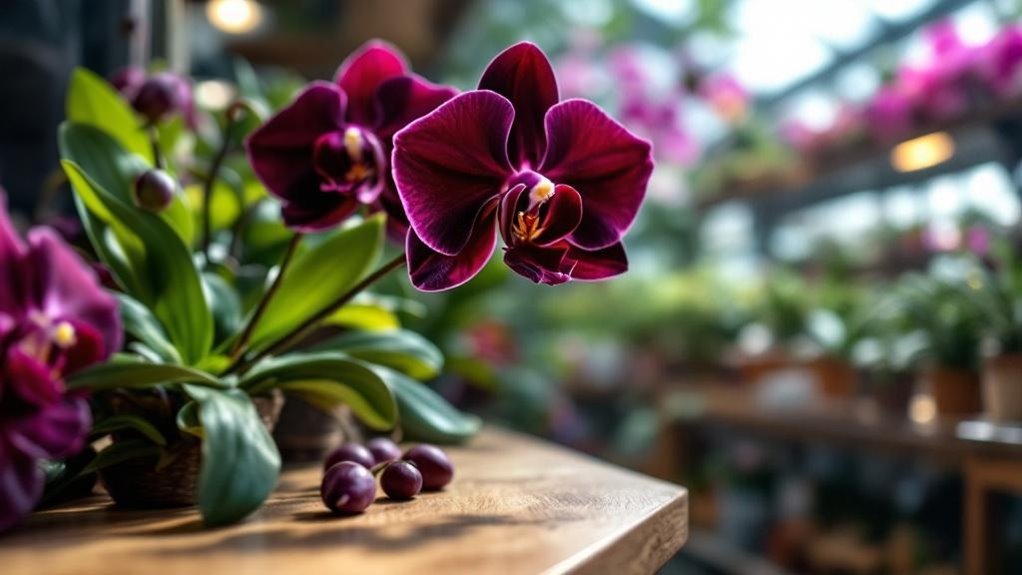
When you set out to buy a black orchid, start with an observational standard that keeps marketing claims in check; true black orchids don’t exist, and most cultivated plants sold under that label are dark purple, maroon, or deep red varieties that read as black only under certain lighting.
| Source | Look For | Why |
|---|---|---|
| Nurseries | Fredclarkeara | Reliable breeding |
| Breeders | Witchcraft | Specific lineage |
| Shows | Descriptions | Better verification |
| Online | Photos | Color context |
You should favor specialty nurseries, established breeders, orchid shows, and careful online sellers, because reputable sources identify lineage, describe coloration precisely, and reduce stagnant uncertainty. Seek Coelogyne pandurata for its dark lip, Fredclarkeara After Dark hybrids like Black Pearl and Black Diamond, and Monnierara Millenium Magic Witchcraft; before paying, verify characteristics and authenticity.
How to Care for Black Orchids
To keep black orchids cultivated and stable, you’ll place them in bright, indirect light and water with restraint, allowing the roots to dry between waterings because direct sun can scar the petals and stagnant moisture can weaken the plant.
You’ll also use a well-draining orchid mix that supports air circulation around the roots, an observational step that helps prevent excess moisture from collecting where rot begins.
During the growing season, you’ll feed them with a balanced orchid fertilizer every two to three weeks and maintain moderate humidity, because consistent feeding and controlled moisture support stronger growth and better blooms.
Light And Water
Two factors govern successful care here: light should stay bright but indirect, because direct sun can scorch the petals and stress the plant, and water should be given with restraint, because black orchids prefer a cultivated balance in which the growing medium drains freely and the roots dry slightly between soakings rather than sitting in stagnant moisture.
- Place yours near filtered light, where color stays rich.
- Check roots through a clear pot; this observational habit prevents guesswork.
- Water about once weekly, then adjust for humidity and temperature.
- Wait until roots dry slightly, because excess moisture damages them.
If you follow these measures, you support steadier growth, preserve the flowers’ dark elegance, and avoid the most common decline, which usually begins not with neglect, but with misplaced generosity and too much water.
Potting And Feeding
Potting and feeding shape how well a black orchid can use the light and measured watering you’ve already provided, because even careful routines fail in a compacted, stagnant medium or in a pot that limits airflow around the roots.
Choose a well-draining orchid mix, because cultivated black orchids decline quickly when roots stay wet, and use a pot that supports air circulation; clear pots are especially useful, since they give you an observational view of root color and moisture levels.
Water only when the medium feels dry to the touch, then let the roots dry between waterings, which reduces rot and keeps growth steady. During the growing season, feed every two to three weeks with a balanced orchid fertilizer, because regular, moderate nutrition supports stronger foliage and deeper blooms.
Keep the plant in bright, indirect sun to protect leaves.
Should You Grow a Black Orchid?
Why grow a black orchid if true black orchids don’t exist; because the appeal lies in the cultivated illusion itself, in those dense maroon, purple, and near-ebony tones that make varieties such as Coelogyne pandurata or Fredclarkeara After Dark visually distinct, and in the observational discipline required to keep them healthy under conditions that can’t become stagnant or careless.
If you value challenge and restraint, you should consider one.
1. You
Frequently Asked Questions
Is There a Real Black Orchid?
No, you won’t find a truly black orchid in nature. What people call black orchids usually show very dark purple, maroon, or red tones. You can, however, see hybrids and cultivars that look nearly black.
What Does the Bible Say About Orchids?
The Bible doesn’t mention orchids directly. You can connect them to lilies and other flowers that symbolize beauty, love, and God’s care for creation, especially in Song of Solomon and Matthew, where nature reflects divine splendor.
Why Put Cinnamon on Orchids?
Like a tiny shield, you put cinnamon on orchids because it fights fungus, discourages pests, protects cuts, and can encourage rooting. You’ll use it as a natural, gentle treatment instead of relying on harsher chemical products.
What Do Black Orchids Symbolize?
Black orchids symbolize mystery, elegance, power, and rare beauty. You’ll often see them represent strength, deep passion, and allure. Because they’re so uncommon-looking, they can also suggest prestige, uniqueness, and something almost unattainable to others.
Conclusion
Black orchids are real enough to satisfy the eye, though nature rarely drives pigment to that abyssal edge; when you choose one, you’re selecting cultivated depth, not myth, and that distinction matters. You’ll usually find the darkest blooms in deep purple or maroon, because true black remains biologically stagnant in orchids; still, with careful buying and steady care, you can grow a flower that looks as if twilight itself settled onto each petal and refused to lift.