
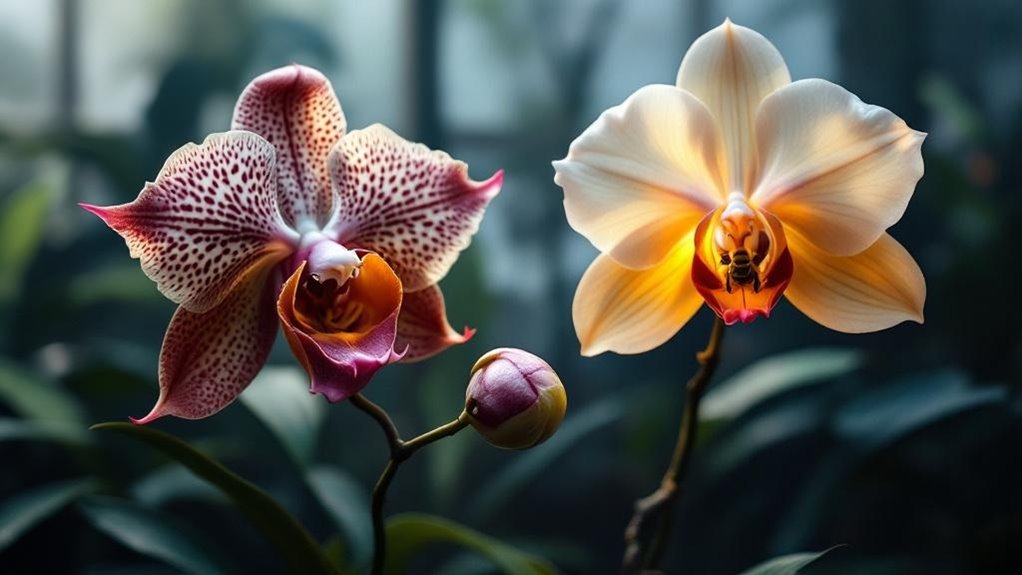
You’ll find the most unusual orchids where observational strangeness, cultivated rarity, and exact ecological dependence meet; the Monkey Face Orchid suggests nature’s playful intelligence, the Ghost Orchid embodies mystery and absence through its elusive, hovering bloom, the Lady’s Slipper conveys grace and nurture, the Flying Duck Orchid signals transformation, and Rothschild’s Slipper reflects prestige through scarcity, beauty, and patient cultivation. Continue and you’ll see how form, habitat, and rarity shape each meaning.
Key Takeaways
- The Monkey Face Orchid symbolizes nature’s playful intelligence, with monkey-like blooms adapted to cool, misty cloud forests in Ecuador and Peru.
- The Ghost Orchid represents mystery, elusive beauty, and love, surviving through highly specific relationships with fungi and host trees.
- The Lady’s Slipper Orchid symbolizes femininity, grace, and nurturing, with its pouch-shaped flower reflecting both elegance and specialized pollination.
- The Flying Duck Orchid signifies transformation, motion, and escape, its duck-like form showing how unusual shapes inspire deeper cultural meanings.
- Rare orchids like Rothschild’s Slipper symbolize exclusivity and prestige, their scarcity, slow blooming, and exacting care increasing their allure.
What Makes an Orchid Unusual?
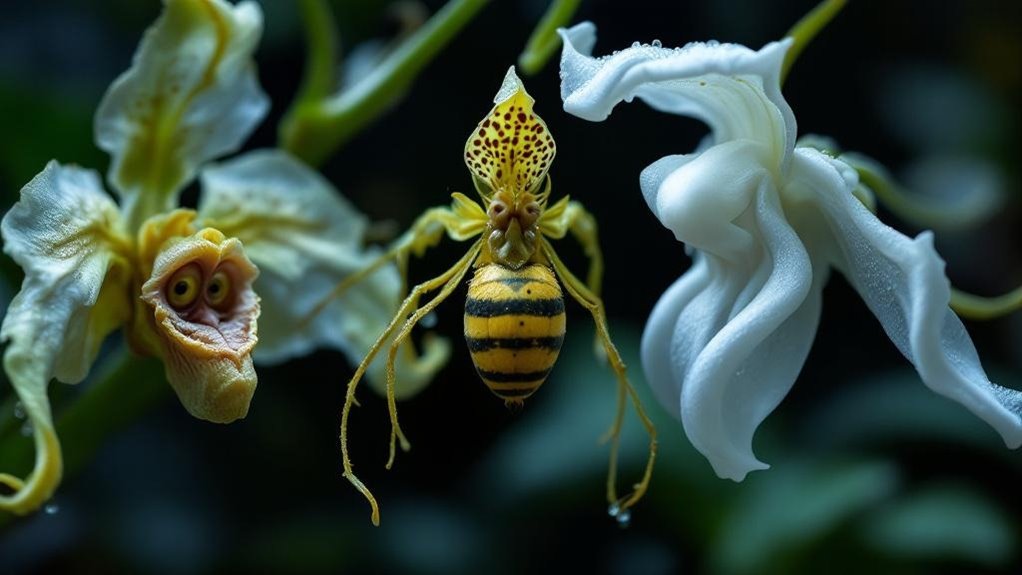
Several traits can make an orchid unusual, and they often appear together: a flower may carry an observational strangeness in its form or color, grow only in a narrow and stagnant habitat, depend on highly specific biological relationships, or bloom so briefly that its presence is easily missed.
When you examine unusual orchids, you notice that unique shapes and colors often define first impressions, yet rarity usually comes from stricter conditions; some rare orchid species survive only in isolated wetlands or forests and must be carefully cultivated because habitat loss quickly narrows their range.
Unique shapes catch the eye, but true orchid rarity grows from fragile habitats and shrinking ranges.
You also find that some species rely on fungi rather than photosynthesis, which makes their survival unusually dependent and fragile. Limited blooming periods deepen that sense of rarity, since a flower may appear for only hours, then vanish.
In many traditions, orchids symbolize refinement, mystery, endurance, and transience.
Which Rare Orchids Stand Out Most?
You notice the Monkey Face Orchid first, because its cultivated, almost human-like bloom gives rarity a distinctly observational quality, and it shows how unusual form can make an orchid feel immediate rather than stagnant.
You then turn to the Ghost Orchid, whose mystery endures through its elusive growth in Cuba and Florida, its creamy-white petals, and its near-spectral outline, which together make it one of the most sought-after orchids in the world.
As you compare the two, you see that one stands out through resemblance and the other through absence, and that contrast begins to clarify why certain rare orchids hold such lasting symbolic weight.
Monkey Face Orchid
Among the rare orchids that command immediate attention, the Monkey Face Orchid, or *Dracula simia*, stands apart because its reddish-brown flowers form an uncanny simian expression, a feature that feels almost observational in its precision and yet remains wholly natural.
You find this Monkey Face Orchid in Ecuador and Peru’s cloud forests, where cool, moist air and elevations of 1,200 to 2,000 meters sustain its unique flower shape; outside that narrow range, it’s rarely cultivated well, especially in stagnant conditions. Its clustered blooms release a faint sweetness that draws specialized pollinators, including certain bees, and that quiet ecological dependence reinforces its symbolism.
When you consider its scarcity, exacting habitat, and exotic beauty, you see why it represents rarity, natural invention, and the fragile balance that unusual orchids quietly reveal.
Ghost Orchid Mystery
Few orchids sustain a deeper sense of observational mystery than the Ghost Orchid, a species native to the UK and also found in Cuba and parts of the United States, where its creamy-white petals form a pale silhouette that appears to hover in shady forests and makes it one of the rarest orchids in the world.
When you consider the ghost orchid, you see why its rare, elusive presence has cultivated lasting fascination; it blooms only under narrow conditions, often in stagnant, shaded woods, and only about a dozen wild individuals have been documented.
You also find that this beauty survives through exact symbiotic ties, drawing support from host trees and fungal partners, which explains its fragility.
As a symbol, it suggests mystery, beauty, and the extraordinary; you read in it the quiet allure of what remains largely unattainable.
Rare Orchids With the Strangest Shapes
As you consider rare orchids with the strangest shapes, you notice how insect-like forms such as the Bee Orchid use cultivated mimicry to secure pollination, turning appearance into strategy and symbolism into something observational rather than ornamental.
You also encounter the Monkey Orchid and the Ghost Orchid, whose faces and pale, suspended blooms resist anything stagnant, and you see why they suggest playful beauty, mystery, and the quiet pull of what remains difficult to find.
Through these odd shapes, you recognize that unusual orchids don’t merely attract attention; they express seduction, rarity, and the cycle of life with a precision that feels natural, not exaggerated.
Insect-Like Orchid Forms
Curiosity sharpens your view when you encounter insect-like orchid forms, because these rare flowers don’t merely look unusual; they use cultivated illusion as a working strategy, shaping petals, color, and posture to attract pollinators with remarkable precision.
| Orchid | Effect |
|---|---|
| Bee Orchid | Resembles a female bee |
| Mantis Orchid | Suggests a pale mantis |
| Masked Duck Orchid | Evokes a ducklike insect lure |
You notice how these orchids turn observational mimicry into survival, avoiding stagnant display; the Bee Orchid deceives male bee pollinators, while the Mantis Orchid uses white, angular structure to hold attention. The Masked Duck Orchid extends that strategy toward bees and wasps, and the Dancing Lady Orchid broadens the visual vocabulary. Even the Monkey Orchid, though not strictly insect-like, reinforces how form directs response in specialized habitats.
Monkey And Ghost Blooms
When you turn from insect mimicry to Monkey and Ghost orchids, the logic of observational form becomes even stranger and more refined; Monkey Orchids, native to the cloud forests of Ecuador and Colombia, present a face-like bloom that resembles a monkey with such cultivated precision that the flower seems almost staged, yet its structure likely serves a practical purpose by guiding specific bee pollinators toward the reproductive parts.
As you study Ghost Orchids in Florida and Cuba, you encounter a unique flower shape of another order, leafless, pale, and often hidden beyond stagnant understory light, where direct sunlight sustains photosynthesis and bloom appears only under narrow conditions.
Because Monkey Orchids and Ghost Orchids are highly sought, you see how rarity sharpens attention; their forms record adaptation with unusual clarity, and collectors often read in them a severe kind of individualism.
Symbolism Of Odd Shapes
From the face-like precision of Monkey Orchids and the austere silhouette of Ghost Orchids, you can see how unusual form invites symbolism as readily as it serves pollination, because people rarely look at these cultivated oddities without assigning meaning to their shapes.
In that observational spirit, the Monkey Face Orchid suggests nature’s playful intelligence; the Flying Duck Orchid implies transformation, motion, and release from stagnant conditions; the Cobra Orchid carries mystery and controlled allure through its serpent-headed form.
When you encounter the Naked Man Orchid, you register life’s theatrical side, rendered in botanical detail rather than sentiment, while the Lady’s Slipper Orchid, with its elegant pouch, directs your attention toward femininity, grace, and rarity.
Together, these shapes show you how orchids turn structure into quiet symbols with enduring cultural weight today.
What Do Unusual Orchids Symbolize?
Symbolism gives unusual orchids their deeper presence, because each rare form suggests a cultivated meaning that extends beyond appearance; the Ghost Orchid, with its pale, almost suspended bloom, symbolizes love and beauty while also carrying an air of mystery, since its rarity and limited visibility in nature keep it just beyond ordinary observation.
When you consider the Lady Slipper Orchid, you encounter femininity, protection, and nurturing, qualities reinforced by its enclosed, sheltering shape; the Rothschild’s Slipper Orchid signals luxury, rarity, and status, because scarcity often turns beauty into an observational marker of exclusivity.
The Dragon’s Mouth Orchid represents passion and creativity through fiery color and form, while the Bulldog Orchid points you toward playfulness and joy, preventing your reading of nature from becoming too stagnant or overly severe.
Ghost Orchid Meaning and Lore
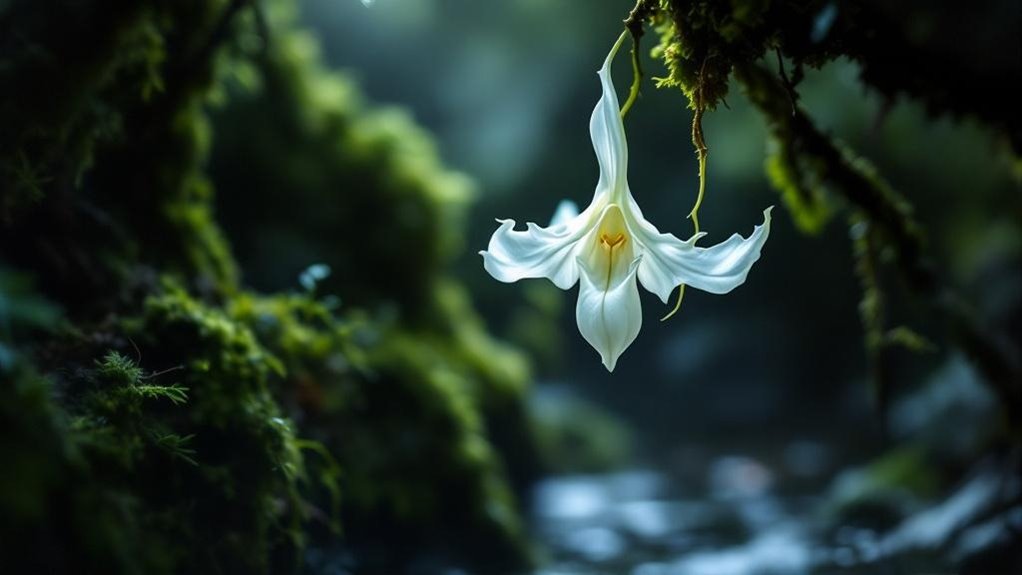
Lore gathers around the Ghost Orchid because its pale, suspended bloom seems to hover more than grow, and that observational effect has shaped a cultivated meaning built on mystery, love, and beauty. Known scientifically as *Dendrophylax lindenii*, it appears in the shaded swamps of Florida and Cuba with such rarity that people often read it as a sign of presence held in tension with absence, a living form that can be seen and still remain elusive.
When you consider its cultural symbolism, you see why the Ghost Orchid endures as an elusive treasure; it suggests beauty that resists possession, love that avoids stagnant certainty, and mystery that deepens through distance.
Because it lacks chlorophyll and depends on fungi and tree hosts, its survival itself reinforces lore, while *The Orchid Thief* fixed its aura in modern imagination.
Why Rothschild’s Slipper Signals Luxury
Because rarity alone doesn’t create prestige unless beauty and difficulty sustain it, Rothschild’s Slipper, *Paphiopedilum rothschildianum*, has come to signal luxury through a cultivated union of scarcity, visual distinction, and time.
You recognize why the Rothschild’s Slipper Orchid can symbolize luxury: rarity limits access, Borneo confines it, and fifteen stagnant years may pass before first bloom.
| Trait | Effect |
|---|---|
| Native range | Restricted, exclusive |
| Price | Often near $3,000 |
| Bloom time | Patience becomes prestige |
| Appearance | Mottled beauty stands apart |
| Meaning | Wealth and status |
Its striped green-white petals, observational symmetry, and exacting needs elevate desire beyond commerce; when collectors pursue it, they pursue proof of cultivated attention, endurance, and discernment, which is why this flower continues to symbolize exclusivity.
How to Gift a Rare Orchid Wisely
How, then, do you give a rare orchid without reducing it to a mere expensive object; you begin by studying the species itself, its cultivated history, and the meaning attached to it, so the gift aligns with the recipient’s taste and the occasion rather than resting on rarity alone.
From there, you choose the appropriate color with observational care, since purple signals admiration, while yellow suggests happiness and friendship, and each shade sharpens the plant’s unique symbolism.
You should also avoid stagnant presentation; place the orchid in a high-quality pot or formal arrangement that reflects respect for its rarity.
To make it a thoughtful gift rather than a fleeting display, include a tailored care guide, and reserve the gesture for anniversaries, graduations, or other milestones that justify such a cultivated offering.
Frequently Asked Questions
What Is the Rarest Kind of Orchid?
You’d usually find Rothschild’s Slipper Orchid called the rarest orchid, since it grows only in limited Bornean rainforest habitat and takes about 15 years to bloom. You should also note Ghost Orchids rank among the rarest.
What Do Different Orchids Symbolize?
Coincidentally, you’ll find orchids symbolize love, beauty, refinement, and strength. You can read white as purity, purple as admiration and royalty, pink as grace and femininity, and yellow as joy, friendship, gratitude, and positivity.
Why Are Ghost Orchids Illegal?
Ghost orchids are illegal to harvest or sell because they’re extremely rare and endangered. You’d threaten their survival by removing them from fragile habitats. Laws protect Florida and Cuba populations from poaching, habitat loss, and extinction.
What Does Baking Soda Do for Orchids?
Baking soda helps your orchids fight fungus, deter pests, and balance potting media pH. You can use a diluted spray to support leaves and roots, but don’t overdo it, or you’ll make the mix too alkaline.
Conclusion
When you consider the most unusual orchids, you see more than rarity; you recognize cultivated forms that resist the stagnant patterns of ordinary blooms, and you understand why their meanings endure. Their strange structures, like quiet signals moving through mist, suggest refinement, mystery, endurance, or costly distinction, depending on the species. If you give one, you should match its symbolism to the moment, because an uncommon orchid carries observational weight, and its message remains long after first notice.