
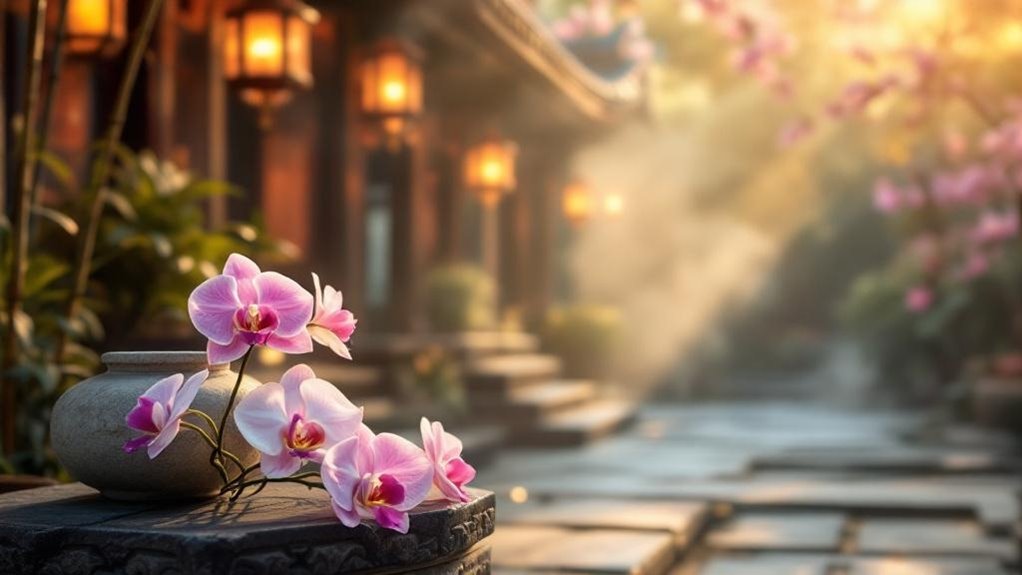
In much of Asia, you can regard orchids as culturally sacred rather than universally holy, because they carry cultivated meanings of virtue, reverence, harmony, and status in philosophy, ritual, and formal gift-giving; in China they signal refined character and moral order, in Japan achievement, dignity, and sympathy, and across Southeast Asia they appear in Buddhist and Hindu offerings, weddings, funerals, and healing rites. Their color also shapes meaning, and the distinctions become clearer ahead.
- Key Takeaways
- Are Orchids Sacred Flowers in Asia?
- Common Orchid Meanings Across Asia
- Orchids in Chinese Culture and Philosophy
- Orchids in Japan: Respect, Wealth, and Grace
- Orchids in Southeast Asian Rituals
- Are Orchids Used in Worship?
- Why Orchids Seem Spiritual in Asia
- Orchid Color Meanings in Asia
- When Orchids Are Given in Asian Etiquette
- Orchids vs. Lotus and Peony Symbolism
- Choosing Orchids by Meaning
- Frequently Asked Questions
- Conclusion
Key Takeaways
- Orchids are often treated as spiritually significant in Asia, symbolizing purity, reverence, refinement, and noble character.
- They are used in religious offerings and rituals across Southeast Asia, especially in Buddhist and Hindu ceremonies.
- In Chinese culture, orchids represent moral cultivation, harmony, family unity, and the refined virtues praised by Confucian tradition.
- In Japan, orchids symbolize respect, achievement, dignity, and noble beauty, making them important gifts for formal occasions.
- Orchids are not universally “sacred,” but many Asian traditions honor them as auspicious, ceremonial, and spiritually meaningful flowers.
Are Orchids Sacred Flowers in Asia?

How, then, should you understand the orchid’s status in Asia: not as a uniformly sacred flower in every tradition, but as a cultivated symbol of reverence, moral refinement, and ritual value whose meaning shifts by region and practice.
If you look across Asia, you find orchids treated with esteem because their beauty supports the symbolism of flowers tied to virtue, discipline, and admiration; in China, they suggest cultivated character, while Confucian thought links them to purity and innocence.
In Thailand and Southeast Asia, you see orchids placed in Buddhist offerings, where ritual use grants them religious weight without making every species or practice strictly sacred.
Japan adds another layer, associating orchids with elegance and bravery, and medicinal and healing uses elsewhere show practical respect rather than stagnant worship alone.
Common Orchid Meanings Across Asia
Across much of Asia, orchids carry a cluster of meanings that remains remarkably consistent despite regional differences; you see them linked to refinement, nobility, friendship, and cultivated beauty, because their poised form and restrained elegance have long made them apt symbols for qualities that societies wish to admire rather than display in a stagnant or merely decorative way.
| Meaning | Why you notice it |
|---|---|
| Refinement | orchids symbolize cultivated taste |
| Nobility | they suggest rank and dignity |
| Friendship | they express respect in gifts |
| Purity and Spiritual | offerings reflect cultural significance |
You also find them among popular flowers in ceremonies, where they signal good taste, prosperity, fertility, and moral worth; across Asia, these observational meanings endure because orchids unite grace with discipline, making admiration feel earned, not merely ornamental or superficial.
Orchids in Chinese Culture and Philosophy
In Chinese culture, these broader Asian associations take on a more explicit moral and philosophical shape, because the orchid doesn’t merely signify beauty and refinement; it stands for cultivated character, good taste, and the kind of integrity that remains visible without becoming stagnant or ostentatious.
When you look at how orchids represent virtue in China, you see why Confucius praised them; he treated their quiet elegance as an observational model for noble character, linking outward grace with inward discipline.
Confucius praised the orchid as a living image of noble character, where quiet elegance reflects inward discipline.
In art, the orchid joins the Four Gentlemen, so you read it as part of a cultivated moral vocabulary shaped by harmony and restraint.
You also find it in medicine and ritual, where it suggests healing, fertility, and auspicious order, while its prestige makes it a popular choice for gifts and ceremonial decoration.
Orchids in Japan: Respect, Wealth, and Grace

Something of the orchid’s Japanese meaning rests in its long association with rank and disciplined beauty, because these flowers didn’t circulate as ordinary ornaments but were historically reserved for nobles and warriors. That exclusivity helped bind them to wealth, prosperity, and cultivated status.
When you consider Japan’s observational aesthetic, you see why orchids are often read as signs of elegance, purity, and dignity rather than stagnant luxury alone. The Neofinetia falcata, known as the samurai orchid, joins bravery to peace, allowing you to recognize a cultivated ideal that balances strength with restraint.
When you present orchids in Japan, you communicate respect and admiration with unusual clarity; for that reason, they remain a popular gift for milestones, formal exchanges, and occasions requiring measured grace and esteem.
Orchids in Southeast Asian Rituals
Several Southeast Asian traditions place orchids within ritual life rather than mere decoration, and that placement gives the flowers a cultivated sacredness; in Buddhist and Hindu settings, they often appear in offerings and ceremonies as signs of fertility and reverence, because their refined form, careful growth, and fleeting bloom suit acts meant to honor divine order without stagnant display.
In Thailand, you see Cattleya orchids marking religious ceremonies and temple offerings, while in Indonesia you encounter orchids valued for attracting positive energy and signaling spiritual growth.
In Bali, you find them woven through births, weddings, and funerary rites, which makes their role observational as well as symbolic. Among indigenous communities, certain orchids also enter healing practices for medicinal and spiritual purposes.
Even orleans appears in regional plant trade language around ceremonial flowers today.
Are Orchids Used in Worship?
How often do orchids move beyond ornament and enter worship as deliberate offerings; across much of Southeast Asia, they do so with a cultivated sacred role, appearing at temples, shrines, and household altars where worshippers present them as signs of respect, fertility, beauty, and devotional order.
When you observe these flowers in Thailand, you see them placed before images, offered at shrines, or arranged near monks, where their flower meaning supports reverence, purity, and the transient nature of life.
In Hindu practice, you may find orchids within sacred displays, where their delicate beauty suggests divine creation without becoming stagnant symbolism. Although also used in weddings, their worship use remains distinct; you encounter orchids as disciplined offerings that shape visual harmony, mark devotion, and affirm an observational sense of spiritual balance in ritual space.
Why Orchids Seem Spiritual in Asia

Because orchids join cultivated beauty with unusual endurance, they often seem spiritual across Asia rather than merely decorative; in Thailand and Indonesia, you see them carried into offerings where fertility, beauty, and divine blessing converge, and that ritual use gives the flower an observational weight beyond ornament.
Across Thailand and Indonesia, orchids enter offerings as beauty made durable, bearing fertility, blessing, and spiritual presence beyond ornament.
You also notice their resilience, since they flourish where conditions turn difficult, and that endurance supports their spiritual significance in cultural contexts that distrust stagnant comfort and honor perseverance.
In Buddhist settings, you can read orchids as reminders of mindfulness and enlightenment, with inner beauty emerging through disciplined attention.
In China, you find them treated as sacred flowers tied to morality, family harmony, and virtuous living, while across courts and ceremonies, their refinement signals nobility, restraint, and the respect owed to elevated character and continuity.
Orchid Color Meanings in Asia
When you look at orchid colors across Asia, you find that meaning doesn’t sit on the surface alone, since each hue carries a cultivated social and ceremonial weight that guides where the flower appears and what it quietly communicates; white orchids signal purity, innocence, and reverence, so they move with ease between weddings and funerals, where both union and mourning require restraint rather than spectacle.
You also see purple orchids linked to royalty, admiration, and respect, which gives them an observational dignity when honoring esteemed figures; yellow orchids resist stagnant interpretations, because they point toward happiness, good fortune, and new beginnings in celebratory settings.
Pink orchids carry femininity, grace, and gratitude with steadier softness, while red orchids express desire, passion, and strength, especially where love asks for visible symbolic emphasis.
When Orchids Are Given in Asian Etiquette
Color guides interpretation, but etiquette determines the moment of exchange, the relationship it affirms, and the cultivated restraint expected of the giver; across much of Asia, orchids aren’t handed over casually, since they mark occasions where respect, achievement, sympathy, or collective belonging need an observational form. You give them in Japan to honor status; for graduations, promotions, and new milestones, they’re popular symbols of success. In Chinese settings, they often wish for harmony, family unity, and refined conduct. At funerals, white orchids convey sympathy without stagnant display. In Thailand, you present them in religious and cultural ceremonies, where abundance and national pride matter.
| Setting | Meaning | You give |
|---|---|---|
| Japan | Respect | Formal honors |
| Graduations, promotions | Achievement | New success |
| Funerals | Sympathy | White orchids |
Orchids vs. Lotus and Peony Symbolism

Although orchids, lotus blossoms, and peonies all hold honored places in Asian symbolism, they don’t speak to the same values; in Chinese culture, orchids point to elegance, refinement, friendship, and the cultivated personal qualities of respect and integrity, while the lotus directs attention toward purity, spiritual awakening, and rebirth, rising unstained from muddy waters and consequently carrying a more observational, moral force in Buddhist and Hindu settings.
When you compare orchids with peonies, the contrast shifts from inner character to public status; the peony, China’s king of flowers, represents wealth, honor, and visible prosperity, whereas orchids suggest admiration, beauty, luxury, and good taste without the same emphasis on rank.
In Chinese culture, lotus symbolism also extends to harmony and marital happiness, while orchids remain tied to personal virtue rather than stagnant material display.
Choosing Orchids by Meaning
Selection matters with orchids, because in much of Asia the flower doesn’t function as a neutral ornament but as an observational sign of cultivated feeling; in Chinese tradition, where Confucius compared orchids to virtuous people, giving one can suggest refinement, nobility, and friendship rather than stagnant display.
While in Japan certain orchids carry associations with wealth, prosperity, and the dignified status once reserved for royalty and warriors.
When you’re choosing the right orchid, color adds depth to intent; white symbolizes purity and reverence, so it’s often given for sympathy or ritual use, while purple signals admiration and respect, yellow suggests happiness and new beginnings, and pink can express love.
In Southeast Asia, orchids also appear in offerings, where selection conveys fertility, spiritual regard, and careful judgment on solemn occasions.
Frequently Asked Questions
What Do Orchids Symbolize in Asia?
In Asia, you’ll find orchids symbolize refinement, nobility, friendship, wealth, prosperity, devotion, and national pride. They can also represent beauty, abundance, growth, and luxury, while in some traditions, they’re linked to virtue and honor.
Why Do Chinese Like Orchids?
You like orchids in Chinese culture because they represent beauty, refinement, nobility, and integrity. You also value their ties to Confucian virtue, family harmony, elegant art traditions, and traditional medicine, which deepen their appeal.
Which Country Is Famous for Orchids?
You’d most often hear Thailand called famous for orchids, though Singapore, the Philippines, Indonesia, and Malaysia also stand out. You’ll find Thailand celebrated as the “Orchid Kingdom,” with remarkable diversity and over 1,200 native species.
Which Flower Represents Asia?
Asia’s emblematic flower is the lotus; you can picture it rising from muddy water like a monk finding clarity. You’ll also see orchids revered regionally, but the lotus most widely represents purity, awakening, and transcendence.
Conclusion
So, if you came looking for a simple yes or no, orchids make that hope seem almost sacred itself; across Asia, you find not one fixed holiness but a cultivated web of meanings, shaped by philosophy, etiquette, ritual, and color, never quite stagnant, always observational in what each culture values. You understand them best when you stop asking whether they’re universally sacred, and start seeing how they quietly carry respect, refinement, memory, and intention from place to place.