
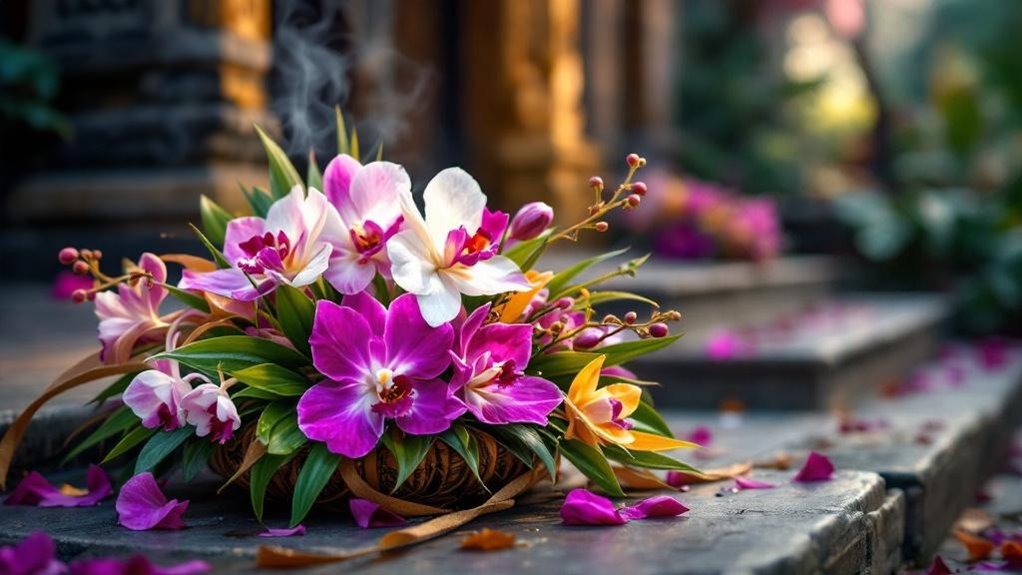
In temple offerings, you place orchids on the altar as cultivated signs of purity, reverence, and inward discipline; their refined form, fresh condition, and restrained fragrance support prayer, meditation, and observational calm while avoiding anything coarse or spiritually stagnant. You’ll also find that color shapes meaning, with pink suggesting grace, green prosperity and longevity, and purple admiration or wealth, while regional customs guide placement, quantity, and pairing, and the sections below clarify those distinctions and proper practice.
- Key Takeaways
- What Do Orchids Mean in Temple Offerings?
- Why Orchids Are Placed on Temple Altars
- Orchids in Taoist and Buddhist Temple Offerings
- What Orchids Symbolize in Temple Worship
- Which Orchid Colors Have Sacred Meanings?
- How Temples Choose Orchids for Offerings
- How Orchid Offerings Differ From Incense and Food
- How Orchids Shape Temple Atmosphere
- How Orchid Offerings Vary by Region
- Why Donghua Zen Temple Offers Orchids
- How to Offer Orchids Respectfully at a Temple
- Common Orchid Offering Mistakes
- Frequently Asked Questions
- Conclusion
Key Takeaways
- Orchids in temple offerings symbolize purity, elegance, spiritual refinement, and reverence for deities and ancestors.
- Their form and fragrance support meditation, prayer, and a serene ritual atmosphere.
- Color meanings matter: yellow for friendship, green for health, pink for love, and purple for wealth.
- Respectful offerings use fresh, premium orchids placed according to temple customs with quiet reflection or prayer.
- Avoid wilted, artificial, or overcrowded arrangements, as they diminish the dignity and spiritual meaning of the offering.
What Do Orchids Mean in Temple Offerings?

Because temple offerings are meant to embody inward discipline as much as outward reverence, orchids carry a meaning that extends beyond cultivated beauty; in Buddhist and Taoist settings, they signify purity, humility, and a refined order of devotion that resists anything excessive or stagnant.
When you place an orchid flower within this observational ritual language, you acknowledge ideals that different cultures and religions have shaped similarly, though Chinese culture gives the bloom particular moral weight.
In Taiwanese practice, you also encounter associations with fertility and prosperity, yet these don’t cancel spiritual restraint; instead, they suggest harmony between material continuity and ethical reverence.
Its fragrance supports meditation and prayer, its form suggests perfect beauty without ostentation, and in Zen traditions such as Donghua, you see how calm order becomes a devotional sign.
Why Orchids Are Placed on Temple Altars
When you place orchids on temple altars, you present more than cultivated beauty; you affirm symbolism rooted in purity, elegance, and prosperity, qualities that suit the observational stillness of sacred space and keep devotion from feeling stagnant.
In temple halls, these flowers serve as sacred altar offerings, their form and fragrance refining the atmosphere during prayer and ceremony while expressing respect to deities and ancestors.
You can also see their importance in enduring practice, where the careful selection of thousands of premium orchids each year confirms their place as fitting tributes within religious life and community tradition.
Symbolism Of Orchids
Reverence shapes the place of orchids on temple altars, where their cultivated beauty and near-perfect form symbolize spiritual refinement, enlightenment, and the disciplined pursuit of inner clarity; in Taiwanese Buddhist practice, they’re often presented to honor the Buddha, and their quiet presence helps establish an observational atmosphere that resists the stagnant distractions of ordinary life.
When you see an orchid arranged before the altar, you encounter more than decoration; flowers help direct attention toward purity, humility, and simplicity, qualities aligned with Zen discipline and sustained devotion. Its restrained elegance suggests love and beauty without excess, and you’re invited to contemplate a bond with the divine that feels ordered rather than dramatic.
This symbolism endures through long temple traditions, including those shaped by Wengyuan’s orchid cultivation, where religious meaning and cultural continuity reinforce one another.
Sacred Altar Offerings
An altar framed with orchids presents a cultivated offering rather than mere ornament, and temples place these flowers there because their elegance, purity, and humility accord with the spiritual principles the setting is meant to uphold.
When you see orchid plants arranged before sacred images, you witness an observational practice of devotion; worshippers present them as signs of respect, appreciation, and disciplined reverence, not as stagnant decoration.
At places such as Donghua Zen Temple, offerings to the Buddha use orchids to deepen the serene atmosphere through fragrance and form, while in Taiwanese practice you can recognize them as mediators between physical presence and spiritual focus.
During rituals, temples select thousands of premium potted orchids for altars, and that scale of care shows how seriously communities maintain continuity, reinforce cultural ties, and shape worship through cultivated surroundings.
Beauty, Purity, Prosperity
Symbolism governs much of what appears on a temple altar, and orchids remain there because they gather several valued meanings into one cultivated offering: perfect beauty, purity of intention, and the wish for prosperity.
In Taiwanese temples, you see them arranged with observational care, their elegance refining worship, their fragrance preventing the space from feeling stagnant, and their presence signaling gratitude, reverence, and disciplined hope.
- You read beauty in orchids as a reminder that devotion should be carefully cultivated, not casually displayed.
- You read purity in their form and scent, which support a serene, undistracted state of worship.
- You read prosperity and good luck in the offering, expressing thanks while inviting blessing.
- At Donghua Zen Temple, you read orchids as sacred gifts to the Buddha, reinforcing Zen values through quiet visual order.
Orchids in Taoist and Buddhist Temple Offerings
Across Taoist and Buddhist temple practice, orchids appear as cultivated offerings because they express beauty, purity, and spiritual grace without excess, and that restraint suits the observational, inward character of worship.
When you enter Taiwanese temples, you often find orchids placed with care, their ordered forms fitting ritual spaces where nothing should feel stagnant or overstated; they serve as fitting tributes across varied devotional settings.
In Taiwanese temples, orchids rest in careful order, their restrained beauty offering quiet tribute without excess.
At places such as Donghua Zen Temple, the offering of orchids to the Buddha has continued over time, and that continuity joins floral practice to religious atmosphere.
You experience their presence not as display, but as quiet cultivation: fragrance settles the air, color steadies attention, and the flowers connect Zen-inflected discipline with temple offering through elegance, humility, and a composed sense of spiritual relation.
What Orchids Symbolize in Temple Worship

Reverence takes visible form when orchids enter temple worship, because they don’t merely decorate the altar; they signify perfect beauty, fertility, and thoughtful regard. Their cultivated presence honors both deities and ancestors while expressing the bond between giver and recipient in a manner that feels measured rather than extravagant.
- You observe beauty disciplined by ritual, not stagnant display, which suits temple order.
- You acknowledge fertility and continuity, especially in Taiwanese practice, where offerings link family hopes to worship.
- You recognize thoughtfulness, since an orchid suggests careful selection, restraint, and relational awareness.
- You enter a more serene, observational space; at Donghua Zen Temple, elegance, purity, fragrance, prosperity, and good fortune work together, shaping worship into an atmosphere that feels composed, inward, and spiritually receptive for all present there.
Which Orchid Colors Have Sacred Meanings?
Several orchid colors carry cultivated sacred meanings in temple offerings, and you can read them not as stagnant decoration but as an observational language of intention: yellow conveys friendship and well wishes, so it suits rituals shaped by goodwill; green expresses health, strength, longevity, and prosperity, which aligns closely with the hopes often placed before deities and ancestors; pink introduces love, femininity, grace, and happiness, deepening the emotional register of the offering without disturbing its restraint; and purple signifies wealth, royalty, and admiration, making it especially fitting when worshippers want to show elevated respect.
Because orchids include more than 27,800 recognized species, you encounter remarkable color variety without losing symbolic precision.
In temple settings, that diversity lets you register distinct intentions through color alone, while keeping the offering composed, legible, and reverent for all.
How Temples Choose Orchids for Offerings
Because temple offerings must remain spiritually legible as well as visually composed, monks and caretakers don’t choose orchids by appearance alone; they select them for cultivated associations with beauty, purity, and spiritual significance, qualities that align closely with Zen Buddhist ideals and keep the floral display from becoming stagnant ornament.
Temple orchids signify more than beauty, carrying purity and spiritual meaning that keep offerings contemplative rather than merely decorative.
You can observe this clearly at Donghua Zen Temple, where orchids support serenity through fragrance, elegance, and disciplined placement.
You should note that temples rely on local growers, who supply up to 10,000 premium pots each year for rituals.
You can see Wengyuan’s role as foundational, since its orchid farms sustain continuity between community labor and devotional practice.
You understand the final choice through arrangement; each orchid is positioned to preserve sacred ambiance and reinforce observational attention in worship.
How Orchid Offerings Differ From Incense and Food

While incense and food address spirits through function, orchids enter the altar by another route; they don’t greet through smoke or sustain through nourishment, but present cultivated beauty as a visible discipline, one that suggests purity, humility, and elegance in a form the eye can hold without distraction.
When you place incense, you establish contact; when you set food, you offer respect through nourishment and memory, often through favored snacks. But when you present orchids, you foreground observational care, symbolism, and restraint. Their role isn’t functional in the ordinary sense, and that difference matters: orchids embody thoughtfulness directly, not through use, and they align with Zen ideals by refusing excess, avoiding stagnant display, and carrying cultural meanings, including love, prosperity, heritage, and beauty, into the ritual space.
How Orchids Shape Temple Atmosphere
As you enter Donghua Zen Temple, you notice how orchids, placed as sacred offerings in the halls, steady the air with cultivated fragrance and refined form, and you understand why their presence helps prevent the atmosphere from feeling stagnant.
You see their careful arrangements in the sacred hall, and you recognize that this observational order, shaped by long practice, supports a serene setting that honors the Buddha while guiding your senses toward stillness.
You also find that, through their elegance, purity, and humility, orchids express Zen in visible form; they align worship with nature and give the temple’s atmosphere its quiet, spiritually elevating character.
Fragrance And Serenity
Stillness settles differently in a temple where orchids have been placed with care, their cultivated forms and delicate fragrance shaping the air into something more observational than decorative; arranged as sacred offerings, they lend elegance without excess, and they steady the atmosphere so meditation and prayer don’t feel imposed on the space but naturally invited by it.
- You breathe their fragrance, and the mind resists becoming stagnant.
- You recognize purity and humility, qualities orchids quietly mirror.
- At Donghua Zen Temple, tradition and Zen discipline meet through these offerings.
- You sense nature and devotion working together, which deepens reverence.
Because orchids calm without demanding attention, you enter worship more attentively; their presence refines perception, supports contemplation, and confirms that serenity in sacred space is often cultivated through restraint, continuity, and natural grace.
Sacred Hall Arrangements
That serenity becomes more legible in the sacred halls of Donghua Zen Temple, where orchids are arranged as offerings with cultivated precision, shaping the atmosphere through placement, fragrance, and form; set before altars and within worship spaces, they create an observational calm that supports chanting and meditation without letting the environment feel stagnant or merely ornamental.
As you enter, you notice how these arrangements guide attention without demanding it, affirming a tradition that values elegance, purity, and humility; the temple’s annual selection of 10,000 premium orchid pots shows deliberate care, linking local orchid culture to ritual practice.
Their fragrance settles into the hall rather than dominating it, and their living forms quietly mark a bond between nature and spiritual devotion, so the entire space feels ordered, receptive, and aesthetically complete for worshippers.
Zen Through Orchids
Because orchids are offered to the Buddha at Donghua Zen Temple not merely as decoration but as cultivated expressions of reverence, they shape the atmosphere in distinctly Zen ways, drawing your attention toward elegance, purity, and humility while keeping the worship space from feeling stagnant or overly designed; their fragrance moves quietly through the hall with the cadence of Buddhist chants.
This pairing of scent and sound supports an observational calm suited to meditation and reflection.
- You encounter reverence embodied in living form.
- You sense nature guiding disciplined attention inward.
- You recognize humility without austerity or display.
- You understand, as Master Wanxing teaches, orchids affirm Zen.
How Orchid Offerings Vary by Region
Although orchid offerings share a broad symbolism of purity, beauty, and spiritual elevation, their regional forms don’t remain stagnant; local growing conditions, temple customs, and cultural priorities shape which species are cultivated, how they’re arranged, and what meanings worshippers emphasize.
You can observe these differences clearly:
| Region | Practice | Emphasis |
|---|---|---|
| Taiwan | Native orchids | Purity, beauty |
| Wengyuan | Mass cultivation | Steady supply |
| Chinese rituals | Gifted orchids | Prosperity, fertility |
| Temples | Local arrangements | Regional custom |
When you compare regions, you see Taiwan favoring Taiwanese species, because native flowers carry observational intimacy and cultural continuity; in Wengyuan, where more than 100 million plants are cultivated yearly, abundance supports temple demand; elsewhere, ritual gifting ties orchids to blessings, weddings, prosperity, and fertility, so arrangements follow local priorities.
Why Donghua Zen Temple Offers Orchids

At Donghua Zen Temple, you can see why orchids remain the offering of choice: they embody purity, humility, elegance, and balanced beauty, qualities cultivated in Zen practice and kept free from anything stagnant or excessive.
You also notice how their fragrance settles into the temple halls and supports a calm, observational atmosphere, while the temple’s long-standing custom gives these arrangements the weight of local tradition rather than mere decoration.
Through its work with nearby farmers and its cultural events, the temple connects orchid offerings to community life and sustainability, so you understand the practice as both a Zen expression and a shared regional commitment.
Zen Values In Orchids
Serenity takes visible form in the orchids offered at Donghua Zen Temple, where their cultivated elegance, purity, and humility align with Zen values and give worship a quiet observational focus; rather than serving as mere decoration, these flowers carry a disciplined symbolic weight, reinforcing the temple’s serene atmosphere and guiding visitors away from the stagnant habits of distraction toward reflection.
- You see elegance disciplined, not displayed, and your attention steadies.
- You encounter purity without excess, which supports inward clarity.
- You recognize humility in restrained beauty, and reverence deepens.
- You understand, as Master Wanxing teaches, that orchids suggest perfection without possession, beauty without grasping, and practice without ornament.
Through these offerings, you don’t simply observe flowers; you enter a Zen language of form, silence, and careful intention.
Local Tradition And Community
Tradition gives Donghua Zen Temple’s orchid offerings their public meaning, because the practice doesn’t arise from symbolism alone; it also grows from a cultivated relationship between the temple and Wengyuan, the largest production base for Chinese orchids, where local farmers supply flowers that carry both devotional and communal weight.
When you observe the temple selecting 10,000 premium pots each year, you see more than ritual decoration; you see a steady exchange that supports rural development, resists stagnant separation between sacred life and local industry, and affirms orchids as an observational sign of shared identity.
Through retreats, exhibitions, and other temple events, you encounter orchid culture as a civic language, one that links Zen discipline, agricultural labor, and public participation, while inviting domestic and international visitors into a community shaped by reverence and continuity.
How to Offer Orchids Respectfully at a Temple

A respectful orchid offering begins with three deliberate choices: select premium blooms whose cultivated elegance, purity, and humility suit the spiritual atmosphere; make certain they’re fresh, since stagnant or fading flowers can weaken the care your gesture is meant to convey; and place them only in the designated offering area, where their presence accords with the temple’s observances and the deity or spirit being honored.
- You should pause afterward for quiet reflection or prayer, allowing gratitude to settle.
- You should watch local practice carefully, since observational restraint shows reverence.
- You should let the orchids speak through presentation, not display, because devotion appears in measured action.
- You should align your intention with the temple’s rhythm, so the offering becomes both personal and properly situated within inherited spiritual custom.
Common Orchid Offering Mistakes
Even when your intention is steady and respectful, several avoidable errors can diminish the meaning of an orchid offering. Choosing blooms with no recognized cultural significance, presenting wilted flowers that reflect poor care, or substituting artificial orchids for fresh ones can weaken the cultivated symbolism the act is meant to carry.
You should select varieties associated with accepted spiritual meanings, because observational tradition matters, and random choices can make the tribute feel detached. You must also tend the flowers carefully before presenting them; inadequate water, poor light, and stagnant handling produce decline that signals neglect rather than reverence.
You shouldn’t overcrowd the altar, since excess reduces the elegance and distinct presence of each orchid. Pairing orchids with culturally approved offerings, such as incense or spirit money, gives your act fuller ceremonial coherence and appropriate ancestral respect.
Frequently Asked Questions
What Does an Orchid Symbolize Biblically?
Biblically, you can see an orchid symbolizing beauty, purity, love, and God’s creative splendor. Its elegance may also suggest royal favor and resilience, while its fragile bloom can remind you that life’s earthly beauty doesn’t last.
What Does an Orchid Symbolize Spiritually?
Spiritually, you can see an orchid as symbolizing beauty, purity, love, fertility, abundance, and inner growth. It invites you to deepen your connection, trust transformation, and honor the sacred balance between earthly life and divine energy.
What Flower Is Sacred in Buddhist Temples?
In Buddhist temples, you’ll find the lotus regarded as the sacred flower. It symbolizes purity, enlightenment, and divine creation. You may also see orchids offered, but they’re admired more for beauty, devotion, and atmosphere.
What Are Orchids Used for in Witchcraft?
You use orchids in witchcraft for love, attraction, healing, and prosperity spells. You can add them to sachets, potions, or altars. Their colors shape intentions, while their delicate beauty supports emotional balance and nurturing energy.
Conclusion
When you place orchids on a temple altar, you participate in a cultivated language of reverence, one that joins beauty to discipline, intention to humility; their form and color carry observational meaning, shaped by region, tradition, and doctrine, and they remind you that worship turns stagnant when gesture loses understanding. If you offer them with care, restraint, and accuracy, the orchid becomes a quiet bridge, like still water holding the reflection of what devotion asks of you.