
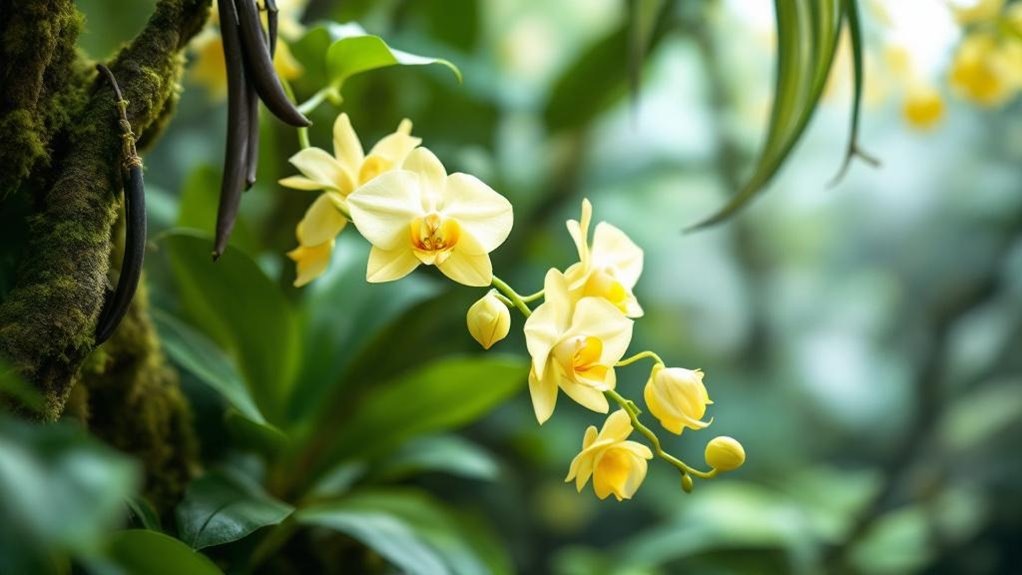
Yes, you’re looking at an orchid when you use vanilla, because it comes from the cured seed pods of *Vanilla planifolia*, a cultivated tropical vine in the orchid family. You’d recognize glossy green leaves, greenish-yellow flowers that last one day, and climbing stems with aerial roots; outside Mexico, successful bean production usually depends on careful hand pollination, skilled labor, and long curing, which helps explain its stagnant supply, high cost, and endangered wild status.
- Key Takeaways
- Why Vanilla Is an Orchid
- What the Vanilla Orchid Looks Like
- Where Vanilla Orchids Grow Naturally
- How Vanilla Orchid Vines Climb
- How Vanilla Orchid Flowers Bloom
- Who Pollinates Vanilla in the Wild?
- Why Vanilla Needs Hand Pollination
- How Edmond Albius Changed Vanilla
- How Long Vanilla Beans Take
- When Vanilla Beans Are Harvested
- How Vanilla Beans Are Cured
- Where Most Vanilla Is Grown
- Why Vanilla Is So Expensive
- Why Wild Vanilla Orchids Are Endangered
- How to Make Vanilla Extract at Home
- Frequently Asked Questions
- Conclusion
Key Takeaways
- Yes, vanilla comes from Vanilla planifolia, a tropical vining orchid native to Mexico and Central America.
- Unlike common orchids, vanilla produces edible seed pods called beans, which are used for flavoring.
- Vanilla orchids climb with aerial roots and can grow up to 30 meters in warm, humid forests.
- Each vanilla flower lasts one day and must be pollinated quickly to produce a bean.
- Most cultivated vanilla is hand-pollinated, making it one of the most labor-intensive and expensive spices.
Why Vanilla Is an Orchid
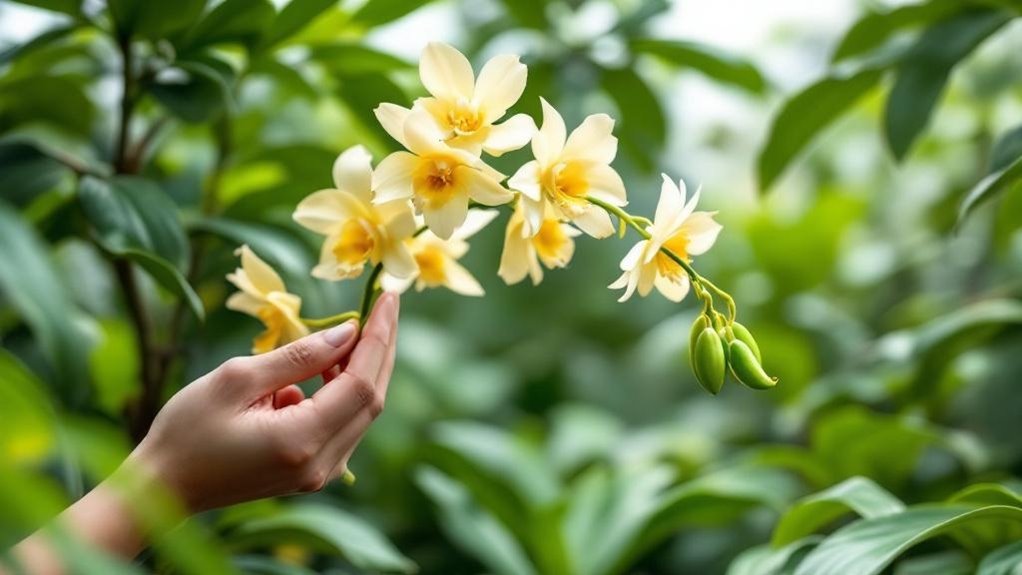
Vanilla’s identity begins with its botany: the plant that gives you vanilla, *Vanilla planifolia*, isn’t merely orchid-like but a true vining orchid native to Mexico and parts of Central America, and its structure, growth habit, and reproduction place it firmly within that family.
You can trace that classification through the plant’s life cycle, because vanilla orchids bloom briefly, only once each year across a two-month window, and they set beans only when precise pollination occurs.
In the wild, that dependence isn’t stagnant or general; only certain native Euglossa and Eulaema bees perform the task, which reveals the specialized reproductive pattern typical of orchids.
You also see orchid adaptability in cultivated vines that may reach 30 meters, and in the observational fact that vanilla remains among the few economically important orchids worldwide.
What the Vanilla Orchid Looks Like
As you observe the vanilla orchid more closely, you’ll notice glossy, bright green leaves, typically 8 to 25 centimeters long, arranged along the vine and remaining viable for three to four years, which gives the plant a sustained, unstagnant appearance.
Its greenish-yellow flowers, about 5 centimeters across, open in clusters of 12 to 20 buds, yet each bloom lasts only one day; if pollination occurs, you later see long, slender pods developing, then maturing over eight to nine months.
Where Vanilla Orchids Grow Naturally
Seen in the wild rather than under cultivated conditions, the vanilla orchid belongs to the tropical belt of Mexico, Central America, and parts of northern South America, including Colombia and Brazil, where lowland moist forests provide the steady heat, humidity, and filtered light the vine requires.
There, you find Vanilla planifolia in observational settings shaped by warm temperatures of 20 to 30°C, annual rainfall above 2000 millimeters, and soils that drain well rather than remain stagnant, while still holding nutrients, especially calcium and potassium, within a pH range of 6.0 to 7.0.
Outside this narrow ecological band, you won’t usually see strong natural populations, because the species depends on a precise combination of climate, forest structure, and specialized pollinators, conditions that only parts of its native range reliably sustain year after year.
How Vanilla Orchid Vines Climb
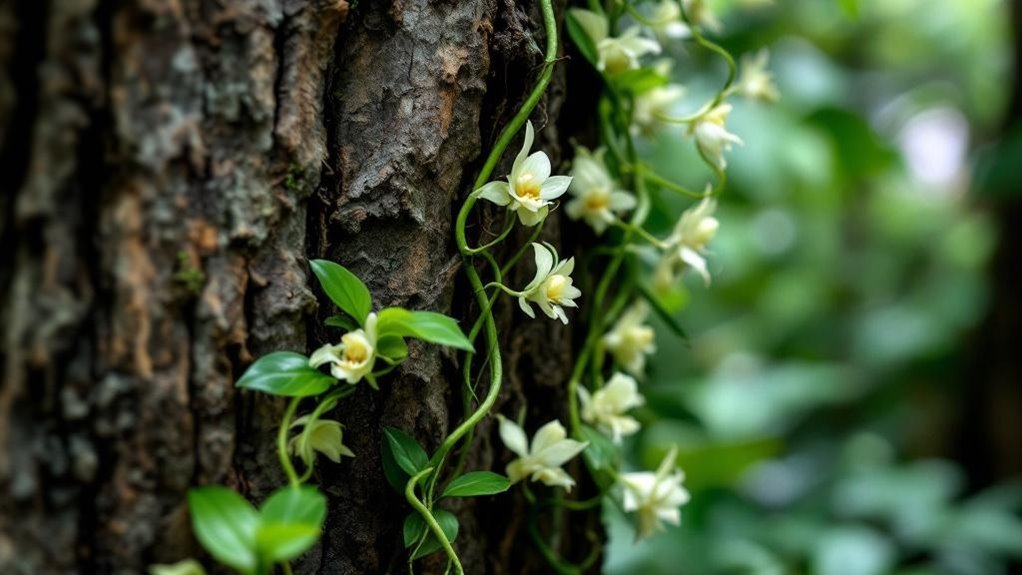
Climbing steadily through the forest understory, the vanilla orchid vine relies on a combination of flexible, thick stems and fleshy aerial roots, which press against bark, branches, or any stable support, allowing the plant to ascend toward filtered light without investing energy in a rigid trunk of its own.
As you observe it, several traits shape that ascent:
- Thick stems extend long distances, sometimes nearing 30 meters, and cling to trees efficiently.
- Fleshy aerial roots anchor each section, absorb moisture and nutrients, and help prevent stagnant conditions around cultivated supports.
- Young growth follows a zig-zag pattern, an observational advantage that improves light capture for photosynthesis.
When you cultivate vanilla from cuttings, you use this natural climbing habit, providing shade, moisture, and structure so the vine attaches securely and continues upward.
How Vanilla Orchid Flowers Bloom
Once the vine has secured itself and matured along its support, you can see how its flowering habit governs vanilla production; the orchid forms axillary clusters that usually hold 12 to 20 buds, and when they open, each greenish-yellow flower measures about 5 centimeters across, presenting a brief observational window within a flowering season that lasts only about two months each year.
| Feature | Significance |
|---|---|
| Buds | 12–20 |
| Color | Greenish-yellow |
| Width | 5 cm |
| Open time | One day |
| Season | Two months |
You’ll notice vanilla flowers open in the morning, then fade by afternoon, so stagnant timing sharply limits cultivated fruit set. Because floral structures block spontaneous self-pollination, cross-pollination is required; without it, pod formation remains rare, and Edmond Albius’s 1841 hand-pollination method became essential worldwide.
Who Pollinates Vanilla in the Wild?
When you look at vanilla in the wild, you find that Vanilla planifolia depends chiefly on native bee pollinators, especially certain Euglossa and Eulaema species, because they transfer pollen between flowers and make pod formation possible.
You also notice why pollination stays rare and observationally fragile: self-pollination succeeds only about 1% of the time, and in places where these bees aren’t present, cultivated production becomes stagnant unless people intervene by hand.
Since each flower opens in the morning and fades by afternoon, you can see how this one-day window sharply limits success, requiring pollination to occur within a single, narrow span.
Native Bee Pollinators
Although vanilla is now cultivated across the tropics, in the wild Vanilla planifolia depends chiefly on native orchid bees, especially certain Euglossa and Eulaema species, which can navigate the flower’s physical barriers and transfer pollen in the brief span the bloom remains viable.
As you observe vanilla in its indigenous range, especially Mexico, you can trace pod production to native bee pollinators.
- Each flower opens in the morning and fades by afternoon, so these bees must work within a narrow, observational window.
- Outside that native range, including Europe, their absence left cultivated vines stagnant until growers developed hand-pollination.
- When Euglossa and Eulaema visit successfully, you see the essential link between local ecology and vanilla reproduction; without them, pod set remains uncommon in the wild.
Why Pollination Is Rare
Because vanilla planifolia can’t reliably fertilize itself, successful pollination stays rare in the wild, with fruit set hovering near 1 percent, and that scarcity reflects a precise ecological bottleneck rather than a general failure to flower. In Mexico, you depend on a narrow group of native bees, especially Euglossa and Eulaema, to pollinate blossoms; when their visits stay infrequent, most flowers remain stagnant and uncultivated.
| Factor | Effect | Result |
|---|---|---|
| Self-incompatibility | Prevents easy fertilization | Low fruit set |
| Specialized bees | Limited observational visits | Few flowers pollinate |
| Habitat loss | Shrinks pollinator presence | Wild rarity grows |
You can see why cultivated vanilla usually needs hand-pollination: clustered flowers don’t guarantee success, because the orchid’s reproductive system relies on uncommon timing, place, and pollinator behavior within a restricted native ecology.
One-Day Flower Window
That bottleneck becomes even sharper once you look at the flower itself, since Vanilla planifolia opens its blossoms in the morning and gives each one only a single day to receive pollen, a narrow window that leaves little room for stagnant visits or missed timing.
- In the wild, you depend on specialized bees, especially Euglossa and Eulaema, because Vanilla’s floral structure blocks easy self-pollination, so success stays near 1%.
- You still get repeated opportunities, since each axillary cluster carries roughly 12–20 buds, and those blooms stagger your chances across a flowering period.
- Outside Vanilla’s native range, where those native pollinators aren’t present, the one-day flower window becomes a cultivated obstacle; in Europe and similar regions, you must rely on hand-pollination instead, an observational solution to ecological absence.
Why Vanilla Needs Hand Pollination
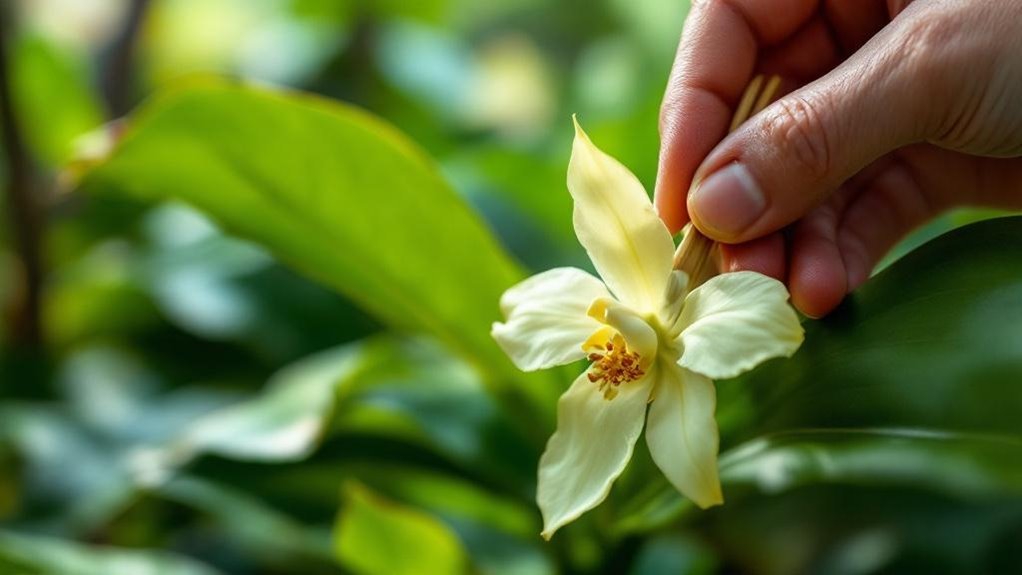
While vanilla orchids are self-fertile, they still need hand pollination in cultivation, since a thin membrane in the flower keeps the male and female structures from meeting on their own, and in the wild that leaves successful pollination at roughly a 1 percent rate. Because each bloom opens in the morning and fades by afternoon, you must hand pollinate quickly to secure pods.
| Factor | Effect | Result |
|---|---|---|
| Membrane | Blocks contact | Low natural set |
| One-day bloom | Limits timing | Manual work |
| Missing bees | No pollinators | Reliable yields |
Outside Mexico, cultivated vines usually lack Melipona bees, so pollen transfer becomes a trained human task, not a stagnant hope. If pollination succeeds, each pod then needs eight to nine months to mature, making skilled, observational labor central to harvest planning and commercial yield.
How Edmond Albius Changed Vanilla
You can trace vanilla’s global cultivation to Edmond Albius, who, at 12, used an observational method in 1841 to hand-pollinate the orchid by lifting the flower’s barrier and transferring pollen with a small tool, ending years of stagnant European efforts that produced no beans outside Mexico.
As you consider Albius’s pollination breakthrough, you see how this simple, cultivated technique made reliable fruit production possible in new regions, including Madagascar, which later became a leading producer because growers could repeat his method by hand.
You should also note the imbalance in his legacy; although his work transformed the vanilla industry, he received neither financial compensation nor meaningful recognition during his lifetime.
Albius’s Pollination Breakthrough
Because vanilla orchids produced flowers but no beans outside their native range, cultivation on Réunion remained stagnant until 1841, when Edmond Albius, a 12-year-old slave with observational skill and cultivated practical knowledge from pollinating watermelons, devised a simple hand-pollination method that changed the crop’s future.
You can trace the breakthrough to three practical steps:
- He lifted the flower’s membrane.
- He transferred pollen by hand.
- He pressed male and female parts together.
With Edmond Albius’s method, growers bypassed the missing native pollinators that had blocked bean production for centuries, and vanilla vines finally fruited reliably.
You can see why this mattered: hand pollination turned a botanical curiosity into an agricultural system, and it allowed producers on Réunion and beyond to supply rising global demand consistently.
Legacy And Recognition
Although Edmond Albius received neither payment nor lasting recognition in his lifetime, his observational insight and cultivated practical method altered vanilla cultivation more decisively than the work of far better known botanists.
By showing growers how to lift the flower’s membrane and move pollen by hand, he solved the stagnant problem that had defeated European efforts for centuries, made reliable fruiting possible wherever labor could replace the orchid’s missing native pollinators, and laid the foundation for vanilla’s rise from a rare botanical puzzle to one of the world’s most valuable spices.
Even as others, including Jean Michel Claud Richard, claimed credit and left Albius largely erased from the history he’d changed.
When you use vanilla extract, you’re benefiting from Albius’s 1841 method, discovered at twelve; without it, global vanilla cultivation wouldn’t have become commercially dependable or enduring.
How Long Vanilla Beans Take
While vanilla is often treated as a simple flavor, the cultivated bean asks for a long, highly managed timeline, and nearly every stage depends on careful human intervention rather than a stagnant natural process.
If you trace vanilla beans from vine to finished ingredient, you see an observational sequence shaped by patience, climate, and labor.
- You begin with a cutting, and under ideal conditions, it usually needs 2 to 3 years before it can bear fruit.
- The orchid, *Vanilla planifolia*, blooms annually for about two months, yet each flower lasts one day, so growers must hand-pollinate quickly.
- After pollination, the developing bean remains on the vine for 8 to 9 months; after picking, curing through fermentation and drying takes several additional weeks.
When Vanilla Beans Are Harvested
Once the pods have matured for roughly eight to nine months after pollination, growers harvest vanilla when the clusters begin to yellow, a visible sign that the beans have reached the ripe stage needed for curing and that delaying further can compromise consistency in flavor development.
If you observe how vanilla grown for commercial use is managed, you’ll notice that growers commonly remove whole clusters rather than separate beans, because that method keeps picking orderly and supports uniform handling afterward.
Before that stage, the cultivated vine must spend two to three years growing from meter-long cuttings before it can bear fruit at all, and each flower opens for only one day, so successful harvest reflects precise, observational timing from pollination onward, not stagnant waiting.
That timing determines whether the crop enters processing at its proper maturity.
How Vanilla Beans Are Cured
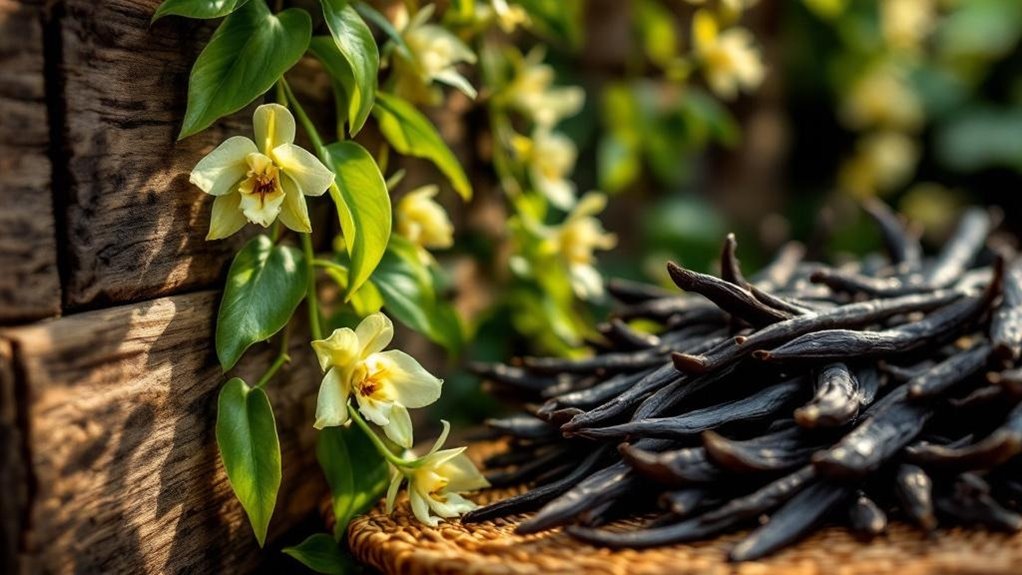
You can recognize the right harvest timing when vanilla bean clusters turn yellow and ripe, because that observational cue signals the cultivated pods are prepared for curing and won’t remain stagnant in their development.
You then begin a two-step process, blanching the beans in hot water to stop the flower and start fermentation, then drying them so their flavor and aroma can steadily emerge over several weeks.
If you manage the sweating at night and sun drying by day with care for about two weeks, you shape both the quality and the market value of the beans, because careful curing yields a stronger, more refined flavor profile.
Harvest Timing
How do growers know the moment is right to harvest vanilla, when the vine’s long cultivated effort has finally reached maturity; they watch for the bean clusters to turn yellow, a clear observational sign that the pods are ripe after roughly eight to nine months of development following pollination.
In places such as the Dominican Republic, you can see why timing matters; if pods are taken too early, their curing potential remains stagnant, and the final beans won’t develop full depth.
- Yellowing clusters signal maturity.
- The wait usually lasts 8–9 months.
- Correct harvest timing supports proper curing.
Once you harvest at the right stage, you preserve the pod’s capacity to transform through curing, which will gradually turn green beans dark brown, aromatic, and suitable for flavoring, while protecting their essential oils.
Fermentation And Drying
Begin the curing stage by wrapping the harvested vanilla beans and keeping them in a warm environment, because fermentation must start while the pods still hold the moisture and essential oils that support their transformation. This controlled period, which can last from several weeks to several months, prevents the flavor from remaining stagnant while encouraging the cultivated development of vanillin compounds.
You then manage fermentation and drying with an observational rhythm; at night, you sweat the beans, and by day, you place them in the sun for about two weeks, steadily lowering moisture without stripping volatile oils.
As vanillin forms and concentrates, the pods darken to deep brown, remain supple, and reach a cured length of roughly 15 to 23 centimeters, signaling that they’re prepared for extract and other vanilla uses.
Where Most Vanilla Is Grown
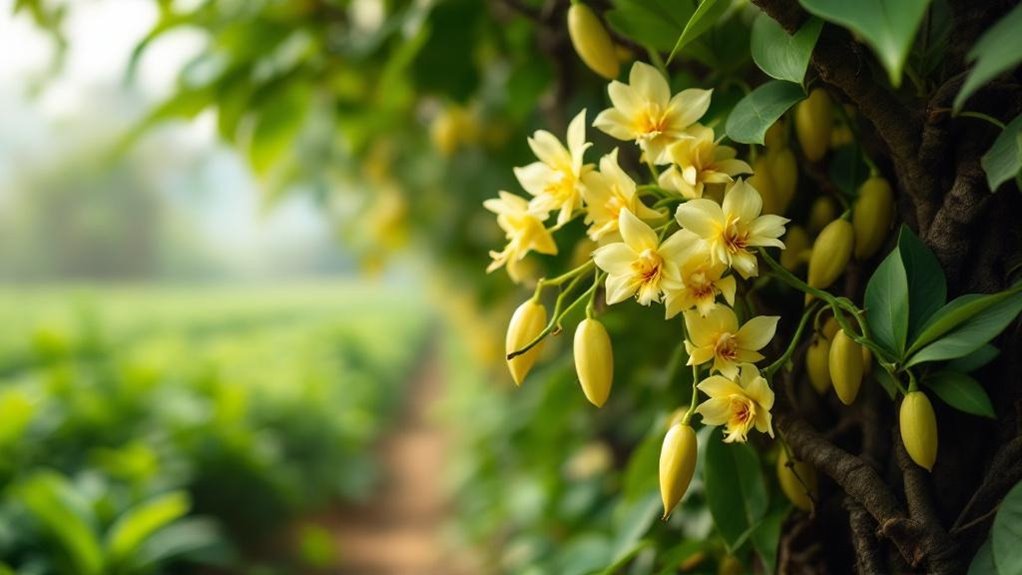
Across the vanilla trade, one country dominates the map: Madagascar produces roughly 80 percent of the world’s supply, a position it holds because its tropical climate suits the orchid well and because cultivation there can rely on the intensive hand labor the crop demands.
- In Madagascar, vanilla thrives where temperatures stay near 20–30°C and rainfall exceeds 2000 mm annually.
- In Mexico, vanilla holds historical importance and still supplies about 5 percent, supported by native pollinators absent elsewhere.
- In Tahiti, Indonesia, and parts of Central America, you find cultivated vanilla in tropical lowland moist forests, where observational growing conditions remain favorable.
Outside Mexico, growers must hand pollinate each flower, because the necessary bees aren’t present; without that labor, production would become stagnant in many regions.
Why Vanilla Is So Expensive
Madagascar’s dominance in supply helps explain the next point: vanilla stays expensive because the crop is slow, exacting, and unusually dependent on human labor at nearly every stage.
When you look at vanilla planifolia, you see an orchid that grows only in cultivated tropical conditions, with flowers that open for one day and rarely pollinate naturally, so growers must hand-pollinate each bloom with observational precision.
You also face long delays: each bean matures on the vine for eight to nine months, then enters a careful curing process that develops flavor gradually.
Meanwhile, demand from the flavoring industry remains high, supplies turn stagnant, and prices can climb above $600 per kilogram. Limited genetic diversity further constrains reliable production, which keeps vanilla scarce and costly worldwide today.
Why Wild Vanilla Orchids Are Endangered
Although cultivated vanilla is familiar worldwide, wild Vanilla planifolia has become endangered in its native range because the forests that support it are being converted for agriculture and urban development. The orchid’s reproductive biology leaves little margin for disturbance.
You can trace its decline through three observational pressures:
- Habitat conversion removes the humid forest structure the vine needs, leaving populations isolated and stagnant.
- Its natural pollinator, including certain bee species, is also declining, so already-rare reproduction becomes even less reliable.
- Natural pollination succeeds only about 1% of the time, and when numbers fall, genetic diversity narrows, which weakens resilience to disease and environmental change.
That combination explains why the IUCN classifies wild vanilla as Endangered, and why careful conservation remains necessary for long-term survival and recovery.
How to Make Vanilla Extract at Home
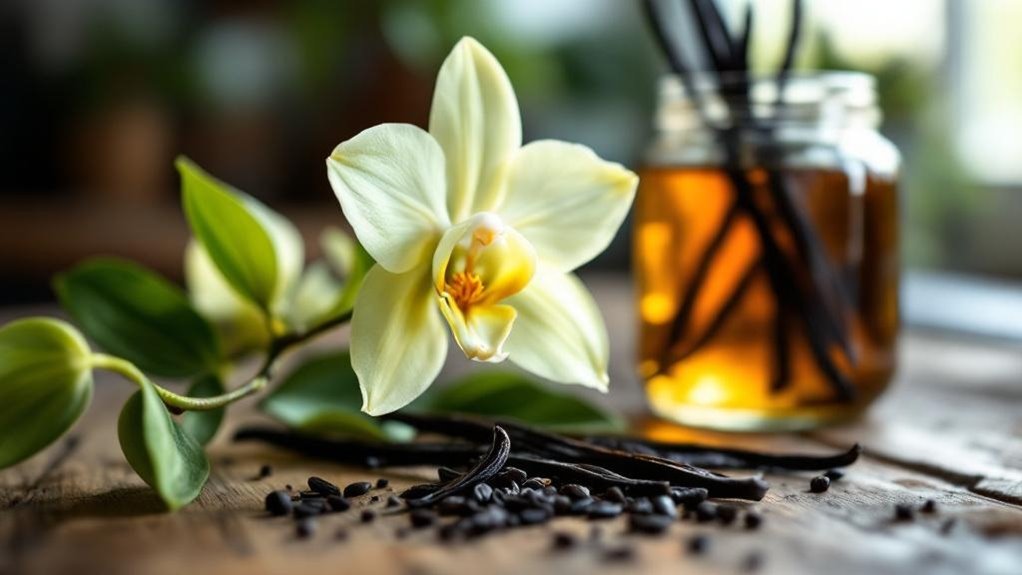
You can make vanilla extract at home with little effort if you choose a plain alcohol such as vodka, bourbon, rum, or brandy, gather 4 to 6 cultivated vanilla beans, and use a sealed 8-ounce jar that won’t leave the mixture exposed or stagnant.
Slice the beans lengthwise to expose the seeds, place them in the jar, cover them completely with alcohol, and seal it tightly; then store the jar in a dark, cool place for at least eight weeks, shaking it occasionally so the infusion develops with steady, observational consistency.
As the flavor deepens over time, you’ll have an extract you can store indefinitely and use as a cost-effective alternative to store-bought vanilla.
Choose Beans And Alcohol
When making vanilla extract at home, start with the two elements that determine nearly everything that follows: the beans and the alcohol, because even a careful infusion can’t compensate for stale ingredients or a stagnant base.
Your observational choices here matter more than any later adjustment, whether you prefer cultivated Madagascar beans or floral Tahitian ones, and even if your imagination drifts toward far places like the Chagos Archipelago.
- Choose 4–6 high-quality beans; supple, fragrant pods deliver richer, steadier flavor.
- Use plain alcohol at 70% strength or higher; vodka is neutral, while bourbon, rum, and brandy add character.
- Select with purpose; quality beans and a clean base create a balanced extract, aromatic, dependable, and worth the patience that follows in the jar.
Prep And Steep
A simple preparation sets the entire infusion on a reliable course: split 4 to 6 whole vanilla beans lengthwise, place them in a clean sealed jar, and
Store And Use
After the steeping period has passed, store the sealed jar in a cool, dark place and draw from it as needed, because vanilla extract doesn’t decline on any practical household timeline and, in fact, develops a fuller, more integrated character with age as the alcohol continues its slow observational work on the beans.
- Use it in cakes, custards, sauces, and coffee; a small measure carries cultivated depth.
- Keep the vanilla beans submerged; add more alcohol when levels fall, and the jar won’t grow stagnant.
- Choose homemade extract over many commercial versions, which may rely on wood pulp or coal tar rather than straightforward ingredients.
Because you began with split vanilla beans and plain spirits, you retain a cleaner, more natural flavor, and each passing month generally improves balance and aromatic complexity in daily cooking.
Frequently Asked Questions
Is Vanilla Actually an Orchid?
Yes, you’re looking at an orchid: vanilla comes from Vanilla planifolia. You get flavorful pods from this tropical climbing plant, whose brief-lived flowers often need hand pollination outside Mexico, where it originally evolved and thrives.
Does Vanilla Flavor Come From an Orchid Plant?
Like bottled sunshine, yes—you get vanilla flavor from an orchid plant. It comes from cured pods of Vanilla planifolia, a Mexican orchid. You’ll find its rich taste develops after careful pollination, maturation, and curing.
What Is a Fun Fact About Vanilla?
A fun fact about vanilla is that you get it from orchid pods, not typical beans. Each flower blooms for just one day, so growers must quickly hand-pollinate them to produce the vanilla you enjoy.
Where Did the Vanilla Orchid Come From?
You’ll find the vanilla orchid originally came from Mexico and Central America, where it grew in tropical lowland forests. You can thank the Aztecs for cultivating it first, long before Europeans carried vanilla elsewhere in 1519.
Conclusion
When you look at vanilla again, you can see more than flavor; you can trace an orchid vine climbing through humid air, cultivated by careful hands, blooming briefly, and yielding pods only through patient labor. Its cost reflects that exacting path, and its endangered wild roots remind you how easily richness becomes stagnant when care falls away. In that quiet complexity, vanilla stands less like a pantry staple than a green thread sewn through forest light, memory, and work.