
You can trace vanilla from the Totonac of Mexico, who cultivated it as a sacred and medicinal orchid, to Aztec xocolatl, where it signaled elite status and softened cacao’s bitterness; after Spaniards carried it to Europe, production stayed stagnant because pollination depended on a Mexican bee, until Edmond Albius’s 1841 hand method made global farming possible. Today, labor, curing, and the contrast between natural and synthetic vanilla explain its enduring power, with more context just ahead.
- Key Takeaways
- How the Vanilla Orchid Began in Mexico
- Why the Totonac Considered Vanilla Sacred
- How Aztecs Used Vanilla in Xocolatl
- How the Vanilla Orchid Reached Europe
- Why the Vanilla Orchid Stayed Rare
- Why Pollinating Vanilla Was So Difficult
- How Edmond Albius Transformed Vanilla
- How Madagascar Became the Vanilla Leader
- Why Vanilla Farming Takes So Much Labor
- How Vanilla Beans Are Cured and Processed
- How Natural and Synthetic Vanilla Differ
- Why Vanilla Remains a Global Flavor Power
- Frequently Asked Questions
- Conclusion
Key Takeaways
- The vanilla orchid originated in Mexico, where the Totonac cultivated it for ritual, medicinal, and social uses long before European contact.
- The Aztecs adopted vanilla to flavor xocolatl, linking it with elite ceremony, wealth, and royal hospitality.
- Spanish conquistadors brought vanilla to Europe in the 16th century, where it became a prized exotic flavor among elites.
- Global cultivation expanded after Edmond Albius developed hand-pollination in 1841, overcoming vanilla’s dependence on Mexico’s native pollinators.
- Madagascar later became the leading producer, while vanilla’s labor-intensive farming and complex flavor sustained its global premium status.
How the Vanilla Orchid Began in Mexico
In Mexico, the vanilla orchid’s history begins with the Totonac people of Mesoamerica, who’d cultivated Vanilla planifolia by around 1115 and had already recognized that its pods held both flavor and medicinal value; from that early observational knowledge, vanilla became more than a plant, because it was woven into local practice, exchange, and status.
From there, you can trace how the vanilla orchid moved beyond Totonac cultivation and into wider Mesoamerican use, especially after the Aztecs adopted it for xocolatl, a cacao drink sharpened with chili and reserved for elites; within that society, vanilla pods signaled luxury, wealth, and rank.
When Spanish conquistadors encountered this use in the 16th century, they carried vanilla to Europe, where cultivation remained stagnant until 19th-century hand-pollination methods finally succeeded there.
Why the Totonac Considered Vanilla Sacred
Because the Totonac linked vanilla to sacred legend as well as cultivated experience, they didn’t regard the orchid as an ordinary crop; they treated it as a plant marked by spiritual meaning, social distinction, and quiet authority within ritual life.
In Totonac belief, vanilla orchids carried the tears of a princess who loved a mortal, so you can see why purity, beauty, and loss shaped the history of vanilla.
- sacred origin in legend
- medicinal and ritual value
- luxury reserved for rulers
You also find that the dark pod’s fragrance and restorative uses kept it from becoming stagnant commerce; it moved instead through ceremonies, observances, and elite exchange.
How Aztecs Used Vanilla in Xocolatl
Goblets of xocolatl carried vanilla into Aztec ritual and royal life, where the orchid’s fragrance softened cacao’s bitterness, deepened the drink’s cultivated richness, and marked it as a beverage fit primarily for elites during ceremonies and formal exchange.
You can see how vanilla shaped this sacred chocolate drink, called “bitter water,” by lending aroma, balance, and prestige; mixed with cacao, corn, and spices, it suggested stamina and liveliness, not stagnant indulgence.
| Element | Role |
|---|---|
| Vanilla | Softened bitterness |
| Cacao | Formed the base |
| Corn | Added body |
| Spices | Increased complexity |
| Ceremony | Confirmed status |
When Montezuma II served xocolatl to Hernán Cortés, you observe an observational record of royal custom, where vanilla and cacao together signaled luxury, ritual meaning, and disciplined social distinction.
How the Vanilla Orchid Reached Europe
One imperial encounter carried the vanilla orchid from Mesoamerican ritual into European awareness, when Hernán Cortés met the Aztecs in 1519 and Spanish conquistadors observed Vanilla planifolia already embedded in xocolatl, a cultivated drink of cacao and vanilla whose fragrance and balance distinguished it from stagnant luxury and helped explain its early appeal abroad.
You can trace Europe’s first knowledge of the vanilla plant to that observational moment, because Spanish conquistadors carried both reports and beans across the Atlantic, where courts and merchants recognized a refined, cultivated flavor rather than a curiosity alone.
- Cortés encountered vanilla through Aztec xocolatl.
- Spanish records linked aroma with elite consumption.
- Atlantic transport turned local practice into European taste.
From there, you see vanilla enter Europe as empire translated indigenous knowledge into commerce and prestige.
Why the Vanilla Orchid Stayed Rare
Although Europeans quickly valued vanilla’s cultivated aroma, the vanilla orchid stayed rare for centuries, chiefly because Vanilla planifolia depended on a highly specialized pollination system tied to its native Mexico, where the Melipona bee could perform the delicate transfer that growers elsewhere couldn’t reproduce.
As you trace vanilla production beyond Mexico, you see repeated failures in Europe and other colonies, not from lack of interest, but from a stagnant biological barrier that kept vines flowering without yielding beans.
Even after hand-pollination emerged in 1841, rarity didn’t vanish at once; you still needed a narrow tropical climate, careful shade, rich humidity, and sturdy supports for climbing vines.
This observational pattern explains vanilla’s high value: cultivation spread slowly, labor remained exacting, and global supply expanded only when modern methods finally stabilized production.
Why Pollinating Vanilla Was So Difficult
You can see why vanilla remained so difficult to cultivate outside Mexico: the orchid depended on the tiny native Melipona bee, and in places without that specialized pollinator, bean production stayed stagnant for years.
You also have to account for the flower’s exacting anatomy, which makes successful pollination unusually difficult without precise contact between its reproductive structures, a fact early European growers observed without fully understanding.
Only when hand-pollination was recognized as essential, and then successfully carried out by Edmond Albius in 1841, could you trace the breakthrough that made global vanilla production possible.
Specialized Native Pollinators
Because Vanilla planifolia evolved alongside the Melipona bee in Mexico, its flowers depended on a highly specialized native pollinator whose behavior and anatomy matched the orchid’s delicate structure. That dependence made vanilla cultivation elsewhere effectively stagnant for centuries.
When you trace vanilla’s early spread, you see why cultivated vines outside Mexico stayed unproductive; the Melipona bee couldn’t survive beyond its native habitat, so observational growers lacked a working native pollinator.
- In Mexico, Melipona bees enabled natural reproduction.
- In Madagascar, their absence prevented pod formation.
- In 1836 and 1841, Morren and Albius advanced hand-pollination.
Without those developments, especially Albius’s practical method, you wouldn’t see vanilla become a global crop, because successful bean production depended not simply on moving plants, but on replacing an ecological partnership that didn’t travel with them abroad.
Orchid Flower Anatomy
That dependence on a native bee makes more sense once you look at the vanilla flower itself, whose anatomy is unusually exacting; Vanilla planifolia bears a hermaphroditic flower with both male and female parts present, yet they aren’t arranged in a way that makes casual fertilization likely, and the structure effectively demands a pollinator whose movements match the orchid’s narrow internal geometry.
When you study orchid flower anatomy, you see why success remained rare: a single stigma and paired stamens sit within a cultivated, constricted floral column, and the bloom opens for just one day, leaving only a stagnant, observational interval for fertilization.
Outside Mexico, where Melipona bees weren’t present, fruit set failed because no substitute insect reliably matched that geometry. That difficulty explains the later reliance on hand-pollination across tropical plantations worldwide.
Hand-Pollination Breakthrough
For centuries, pollinating vanilla remained difficult for one plain reason: the orchid depended on the Melipona bee, a native Mexican pollinator whose movements fit the flower’s cultivated internal geometry.
Outside Mexico that exact partnership simply wasn’t present, so European growers could raise vines but couldn’t reliably produce beans.
You can trace the breakthrough through three observations:
- in 1836, Charles Morren recognized hand-pollination as the necessary answer;
- in 1841, Edmond Albius devised a precise manual method;
- his technique lifted vanilla cultivation beyond Mexico, ending stagnant production.
How Edmond Albius Transformed Vanilla
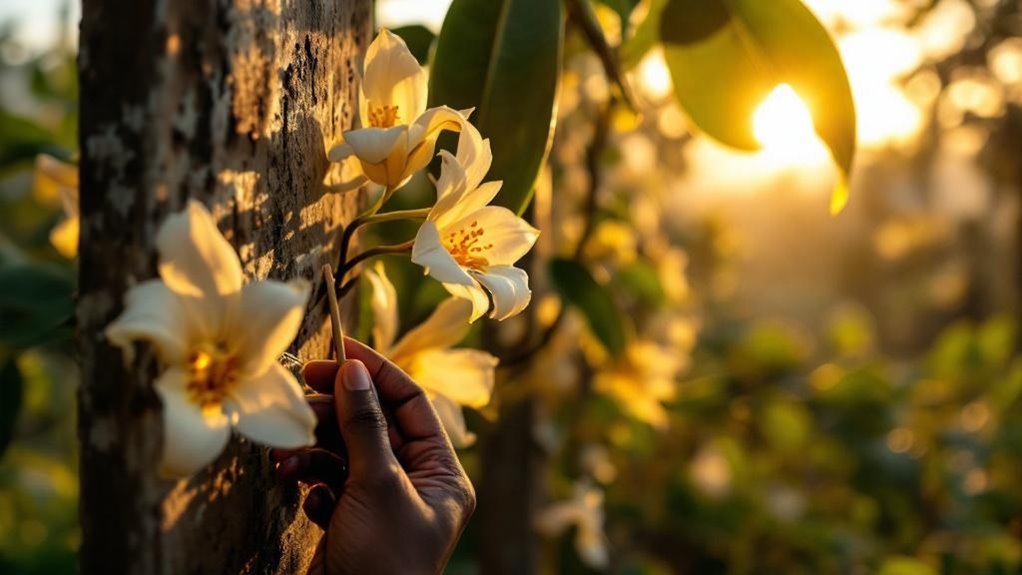
Reshaping the future of vanilla cultivation, Edmond Albius devised in 1841, when he was only 12, a simple hand-pollination method that ended the industry’s stagnant dependence on Mexico and made broader production possible.
As you trace his observational technique, you see how a slender stick lifted the flower’s lip, moved pollen from anther to stigma, and reliably produced cultivated pods, a practical advance that altered the vanilla industry with remarkable efficiency.
You also see the injustice: Edmond Albius received no financial reward, and after emancipation he endured hardship while others benefited from his labor.
His achievement was later obscured by false claims from Jean Michel Claud Richard, yet his method spread rapidly across plantations, and his quiet ingenuity remains the decisive turning point in vanilla’s modern cultivation history worldwide.
How Madagascar Became the Vanilla Leader
You can trace Madagascar’s rise to a single practical shift in 1841, when Edmond Albius’s hand-pollination method made vanilla cultivation reliable beyond its native range and turned what had been a stagnant limitation into a cultivated system of production.
You then see why the Bourbon Islands, and Madagascar in particular, advanced so quickly; the climate, volcanic soil, and careful labor created beans with a complex profile that observational accounts and markets alike came to value.
Today, you can measure that leadership plainly, because Madagascar supplies roughly 70% of the world’s vanilla, and despite climate and price pressures, it remains central to the premium trade.
Hand-Pollination Breakthrough
Although vanilla orchids had been cultivated outside Mexico for decades, production remained stagnant because the plant’s native pollinators, the Melipona bees, didn’t exist in those new environments; that changed in 1841, when Edmond Albius, a 12-year-old enslaved boy on Réunion Island, devised an observational hand-pollination method that transferred pollen from the male part of the flower to the female part by hand, making pod formation possible where it had previously failed.
You can trace Madagascar’s rise to that precise intervention because growers could finally cultivate vanilla reliably.
- hand-pollination replaced absent bees
- Edmond Albius solved a biological barrier
- labor demands remained high
As plantations multiplied, demand expanded in the late nineteenth century, yet vanilla never became simple; you still need exact growing conditions, careful harvesting, and skilled pollination, which explains why Albius’s method remains indispensable today.
Bourbon Islands Expansion
Once hand-pollination made reliable pod set possible beyond Mexico, Madagascar and the Bourbon Islands moved quickly from experimental cultivation to commercial leadership, because growers could finally overcome the stagnant barrier that had limited vanilla abroad. The region’s volcanic soils, humid air, and tropical rhythms produced beans with a rich, sought-after profile that buyers increasingly preferred.
You can trace this Bourbon expansion to Edmond Albius’s 1841 method, which let cultivated orchids fruit without Melipona bees; with that constraint removed, Madagascar’s planters scaled production steadily. By the late nineteenth century, the island supplied most of the world’s vanilla.
You also see why these beans earned distinction: difficult, labor-intensive cultivation, careful curing, and observational knowledge shaped a consistent, aromatic character that made Madagascar vanilla a premium standard for global buyers everywhere.
Madagascar Market Dominance
From that Bourbon Islands expansion, Madagascar emerged not simply as another successful growing region but as the center of the vanilla trade, because hand-pollination removed the stagnant biological limit that had confined cultivation abroad. The island’s humid climate, volcanic soils, and disciplined cultivated practices supported both scale and quality at the same time.
You can trace Madagascar’s dominance through several observational factors:
- it now supplies over 70% of global vanilla;
- Bourbon vanilla developed a sweet, creamy profile prized worldwide;
- rising natural-vanilla demand brought growth, despite price swings and harvest risks.
As you follow this history, you see how Madagascar turned technique into market power, replacing dependence on Melipona bees, expanding production through the nineteenth century, and securing a leading role that still defines modern vanilla commerce and culinary standards globally.
Why Vanilla Farming Takes So Much Labor
Because vanilla orchids rarely encounter their natural pollinators outside Mexico, farmers must hand-pollinate each flower themselves. That single requirement shapes nearly every other part of cultivation; each bloom opens for just one day, so growers can’t let the work become stagnant or observational, since any missed flower means one less bean.
That makes vanilla unusually labor-intensive, because hand-pollination demands precision, timing, and daily attention across cultivated vines.
You also wait years before the plants reward that effort; vanilla vines generally need three to five years to mature, so farmers invest steady care long before any return appears.
Even harvest doesn’t reduce the burden, because workers must hand-pick each bean at the proper moment, judging ripeness carefully to protect quality, and every stage depends on attentive, repeated human judgment and patience.
How Vanilla Beans Are Cured and Processed
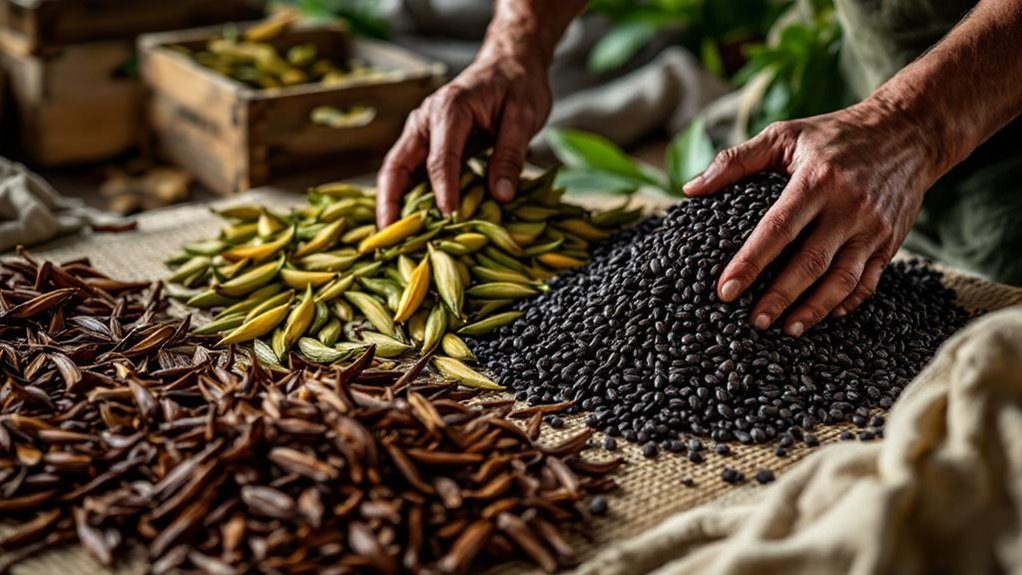
Several deliberate stages turn a harvested vanilla pod into the dark, fragrant bean used in cooking, and the process doesn’t simply preserve the crop; it coaxes out the flavor compounds that fresh beans haven’t yet fully developed.
You begin the curing process by blanching pods in hot water, an observational step that initiates aroma formation. Then you alternate sun exposure by day with blanket-wrapped warmth at night, preventing stagnant conditions while enzymes work through cultivated tissues for weeks.
- Hot-water blanching starts transformation.
- Sun and warmth sustain enzyme activity.
- Dark drying reduces moisture, then grading determines use.
Afterward, you dry beans for months in a dark, warm space, concentrating flavor. Over five to eight months, they become suitable for varied vanilla products, then sorted by size, moisture, and quality, which shapes culinary value and price.
How Natural and Synthetic Vanilla Differ
As you compare natural and synthetic vanilla, you can trace the first to the cultivated vanilla planifolia orchid, whose cured beans develop 250 to 300 flavor notes.
While the second centers on vanillin, first synthesized from lignin in 1858 and scaled because it offers a more consistent, less stagnant supply.
You can also observe how production realities shape the market; natural vanilla depends on labor-intensive growing and curing, with Madagascar supplying more than 70% of the world’s crop, so price volatility remains an observational constant.
In use, you’ll find a clear division, since natural vanilla is favored for gourmet products that depend on authentic aroma and layered flavor, while synthetic vanilla serves food and fragrance manufacturers that need cost-effective uniformity.
Source And Production
Two distinct production paths define vanilla in modern use: natural vanilla comes from the cultivated orchid, most often *Vanilla planifolia*, whose flowers must be pollinated by a narrow range of insects or, more commonly in commercial growing, by hand.
That labor-intensive process makes each bean the result of careful agricultural work rather than a stagnant industrial supply; synthetic vanilla, by contrast, centers on vanillin first synthesized in 1858, usually produced from lignin or guaiacol, and it gives manufacturers a cheaper, more consistent flavoring that can be scaled with ease.
- Natural source depends on orchid cultivation and careful pollination.
- Synthetic production uses industrial feedstocks with controlled output.
- Market swings can make natural supply costly and limited.
When you compare source and production, you see why sourcing standards matter greatly globally.
Flavor And Market Use
Where natural vanilla enters the picture, flavor becomes the clearest dividing line, because beans from the cultivated orchid carry a layered profile of roughly 250 to 300 distinct notes, while synthetic vanilla usually delivers vanillin in a more singular, controlled form; that difference shapes market use directly, since chefs, artisanal food makers, and premium fragrance houses value natural vanilla for depth, nuance, and an observational sense of authenticity.
Whereas large-scale manufacturers rely on synthetic vanilla because it costs less, remains more shelf-stable, and gives them consistent results across products that can’t absorb the price volatility caused by climate pressure and labor shortages in natural production.
When you choose pure vanilla extract, you usually choose complexity, yet you also accept luxury pricing; when you choose synthetic vanilla, you gain reliability for broad distribution and stagnant inventory management.
Why Vanilla Remains a Global Flavor Power
Why does vanilla continue to hold such influence in the global pantry, even in an age of engineered flavors and accelerated food production; the answer lies in its unusual reach and cultivated versatility, since you’ll find it shaping desserts, beverages, baked goods, and savory formulations across both domestic and industrial kitchens, while its aroma still signals familiarity, quality, and finish in ways few other flavorings can match.
- You see its history supporting trust and broad use worldwide.
- You find real vanilla driving premium demand despite synthetic vanillin.
- You watch Madagascar shape supply, while climate and labor keep markets unstable.
Even with affordable vanillin from lignin and guaiacol, you don’t see natural vanilla become stagnant; instead, observational consumer preference, organic sourcing, and production innovation preserve its premium place and global authority today.
Frequently Asked Questions
What Is the History of the Vanilla Orchid?
You can trace the vanilla orchid to Mexico’s Totonac people around 1115. Spaniards carried it to Europe, but cultivation spread globally only after Edmond Albius’s 1841 hand-pollination method, making Madagascar today’s leading producer worldwide.
Does Vanilla Flavor Come From an Orchid Plant?
Yes—ironically, that humble scoop owes its magic to an orchid. You get vanilla flavor from cured seed pods of Vanilla planifolia, a tropical orchid. After months of curing, the beans develop the sweet, complex taste you know.
Where Did Vanilla Flavor Originate?
You can trace vanilla flavor to Mexico’s tropical rainforests, where Vanilla planifolia first grew. The Totonac people cultivated it earliest, and later the Aztecs used it in chocolate before Spaniards carried it to Europe.
Is Madagascar or Tahitian Vanilla Better?
Imagine warm custard swirling on your tongue: you’ll prefer Madagascar vanilla for bold, creamy sweetness in baking. Choose Tahitian when you want floral, fruity elegance. Neither’s universally better—you’ll pick based on the flavor experience you’re chasing.
Conclusion
When you trace the vanilla orchid from sacred Totonac cultivation to modern food science, you see why its influence endures; its value never rested on abundance, but on rarity, labor, and cultivated complexity. What other flavor moves so directly from ritual drink to global industry, yet resists becoming stagnant? You recognize, through that observational history, a plant shaped by human hands at every stage, and a flavor whose meaning remains broader than sweetness alone, even now.