
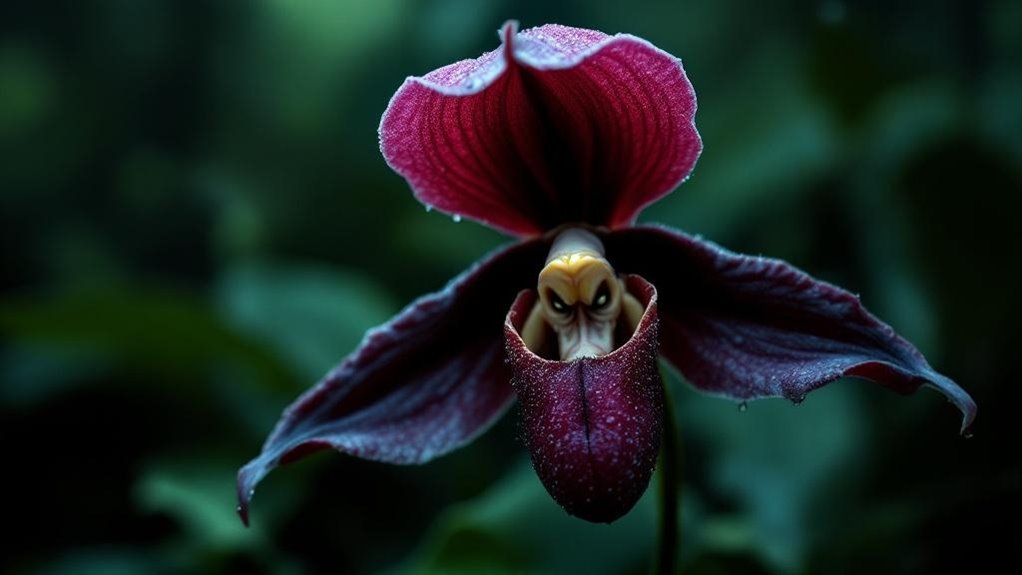
You experience the Dracula orchid as dark because its name, taken from Latin for “little dragon,” joins fang-like sepals, face-like markings, and a faint stagnant mushroom scent into one cultivated gothic image; named by Carlyle A. Luer in 1978, it carries both botanical precision and folkloric weight. Its symbolism comes from that union of observational strangeness and evolutionary mimicry, where beauty serves deception, pollination, and mystery; the fuller meaning becomes clearer just ahead.
- Key Takeaways
- What Does “Dracula Orchid” Mean?
- Who Named the Dracula Orchid?
- Why the Dracula Orchid Sounds So Dark
- What Makes Dracula Orchid Flowers Look Gothic?
- Why Do Some Dracula Orchids Look Like Faces?
- How Scent and Mimicry Add to the Mystery
- How Folklore Shaped Its Symbolism
- Why the Dracula Orchid Feels Beautiful and Sinister
- What the Dracula Orchid Means Today
- Frequently Asked Questions
- Conclusion
Key Takeaways
- “Dracula” means “little dragon” in Latin, named for the orchid’s long, fang-like sepals and clawed, menacing form.
- The name feels dark because the blooms look gothic, with bat-like silhouettes, warty textures, and deep reds, purples, or pale ghostly whites.
- Many Dracula orchids have face-like flowers, especially the monkey-faced Dracula simia, which makes them seem uncanny, theatrical, and slightly eerie.
- Their faint mushroom scent and decay-like associations strengthen the sinister impression, even though these traits evolved to attract fungus gnat pollinators.
- Symbolically, Dracula orchids blend beauty with the macabre, representing mystery, enchantment, and nature’s ability to make strangeness feel captivating.
What Does “Dracula Orchid” Mean?
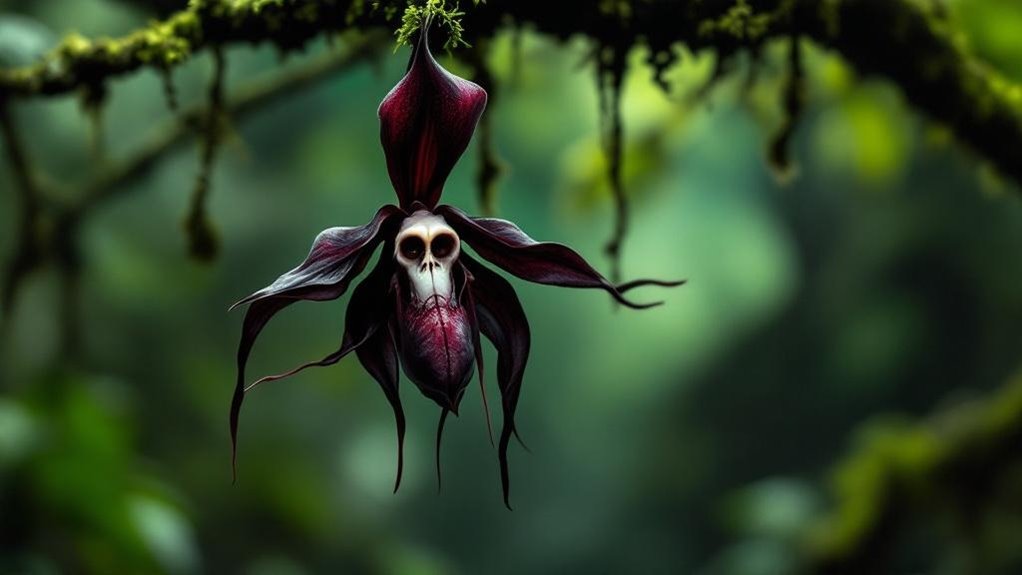
Names matter, and in the case of the Dracula orchid, the name does more than identify a plant; it frames how you observe its form, its cultivated mystique, and its place in orchid lore.
“Dracula” comes from Latin for “little dragon,” a reference to the elongated, fang-like spurs that define many of the flowers, and the term suits the genus because its blooms often carry a dark, gothic allure rather than the bright, stagnant beauty people sometimes expect from ornamental orchids.
When you hear Dracula, you’re meant to notice shape before color, posture before delicacy; Dracula orchids often resemble faces or figures, which deepens their observational power and reinforces their eerie reputation.
Dracula invites you to see silhouette before hue, figure before fragility, as the bloom’s uncanny forms intensify its eerie charisma.
Species such as the monkey-face form show how little dragon imagery joins strangeness, precision, and cultivated fascination in this genus.
Who Named the Dracula Orchid?
You can trace the name Dracula Orchid to botanist Carlyle A. Luer, who established the genus in 1978, giving the plant a cultivated taxonomic identity and separating it from more stagnant classifications.
As you consider why he chose it, you can see that “Dracula,” from the Latin for “little dragon,” suits the orchid’s fang-like spurs and its observational aura of beauty edged with menace.
You also notice how Luer’s naming carries a quiet echo of Transylvanian folklore, which strengthens the orchid’s dark imagery without obscuring its botanical precision.
Carlyle A. Luer
Taxonomist Carlyle A. Luer gives you the clearest entry point into the Dracula orchid, because his observational work recognized its unique morphological characteristics and separated it from look-alike orchids with cultivated precision.
When you trace Carlyle A. Luer through orchid taxonomy, you see a classifier who noticed the elongated, fang-like sepals, linked the form to the Latin sense of “little dragon,” and treated that image as a serious descriptive cue rather than stagnant ornament.
You also benefit from Luer’s broader framework, because he organized these orchids into three subgenera, which lets you follow their diversity and evolutionary relationships with greater accuracy; his classifications strengthened scientific knowledge of epiphytic and terrestrial species, and they encouraged further study of ecological interactions and mimicry that deepen the Dracula orchid’s dark symbolic pull.
Naming In 1978
A decisive shift came in 1978, when botanist Carlyle A. Luer established the Dracula Orchid genus, and you can trace that decision to its unique floral morphology, which set these species apart within an already vast orchid family.
He chose “Dracula” from Latin for “little dragon,” and you can see why; the elongated sepals suggest dragon-like forms, while many blooms present faces or ghostly figures that resist any stagnant, purely decorative reading.
In observational terms, Luer’s naming did more than label a cultivated curiosity; it differentiated a coherent group and framed its visual character with unusual precision.
The resulting gothic aesthetic wasn’t accidental, because the flowers’ eerie symmetry, shadowed tones, and spectral impressions naturally supported a darker name, one that still shapes how you interpret their symbolism today, with clarity.
Why the Dracula Orchid Sounds So Dark
Because its name draws on the Latin *Dracula*, or “little dragon,” the Dracula orchid sounds dark before you even see it. That impression deepens when the flower’s elongated sepals, warty surfaces, and face-like structure come into view. The genus carries a cultivated gothic atmosphere that feels less invented than observational, shaped by forms that seem animal, archaic, and faintly unnatural rather than merely decorative.
You hear that darkness more clearly because Carlyle A. Luer formalized the genus in 1978 within a cultural field already haunted across the northern hemisphere by Bram Stoker’s Dracula. Even when each bloom rises on a single stalk, the effect feels both visual and olfactory, as if mist, cloud forest air, and the simian suggestions of species like *D. simia* keep the name suspended above the plant like stagnant legend.
What Makes Dracula Orchid Flowers Look Gothic?
When you look at a Dracula orchid, you notice how its elongated sepals trail outward like dragon tails, and that cultivated, fang-like structure gives the flower a distinctly gothic silhouette.
You also see face-like floral markings, sometimes resembling a monkey’s features, which turn the bloom from merely unusual into something observational, uncanny, and faintly theatrical.
These dark reds, purples, and mottled whites don’t just prevent the flower from appearing stagnant; they reinforce its mysterious character while also helping attract the pollinators that its strange form is built to serve.
Dragon-Tailed Sepals
Shadow and silhouette define much of the Dracula orchid’s gothic presence, and its dragon-tailed sepals do most of that visual work; stretched into long, tapering extensions that can reach several inches, they pull the flower outward into a cultivated exaggeration, giving the bloom a warty, observational texture that feels less botanical than folkloric.
As you study how these flowers grow, you see why the effect feels so dark: deep reds and purples settle across the surface like stagnant light, while the elongated sepals suggest mythical tails rather than petals. In some species, including Dracula vampira, small spurs sharpen that impression, adding a restrained fang-like detail without overwhelming the form.
The result is a bloom that appears composed by legend, its silhouette carrying the weight of the orchid’s unsettling visual identity and symbolism.
Face-Like Floral Markings
| Feature | Image |
|---|---|
| Central markings | Watchful eyes |
| Curved lip | A mouth in shadow |
| Deep reds, purples | Cultivated gloom |
| Clustered blooms | Ghostly visages |
When you observe those markings, you don’t just see resemblance; you register design, because warty sepals, stagnant colors, and clustered terminal flowers turn each bloom into an observational study in gothic form, while fungal mimicry, which draws fungus gnats, deepens the orchid’s dark intelligence and enigmatic presence there.
Why Do Some Dracula Orchids Look Like Faces?
Why do some Dracula orchids look like faces; the resemblance isn’t accidental, but an observational effect shaped by evolution, in which cultivated patterns of color, the flower’s long tail-like sepals, and the careful arrangement of its inner structures create a face-like image that draws the attention of pollinators, especially fungus gnats.
When you see species like D. simia, you’re noticing morphology refined for reproductive success, because animal-like features can make the bloom more visually compelling within dim, stagnant forest habitats, where small pollinators respond to strong contrasts and memorable forms.
You can also read this face-like structure as part of the orchid’s darker symbolism; its dramatic contours, shadowed tones, and almost expressive symmetry connect beauty with the macabre, giving the flower a quiet intensity that feels uncanny, deliberate, and symbolically charged to human observers.
How Scent and Mimicry Add to the Mystery
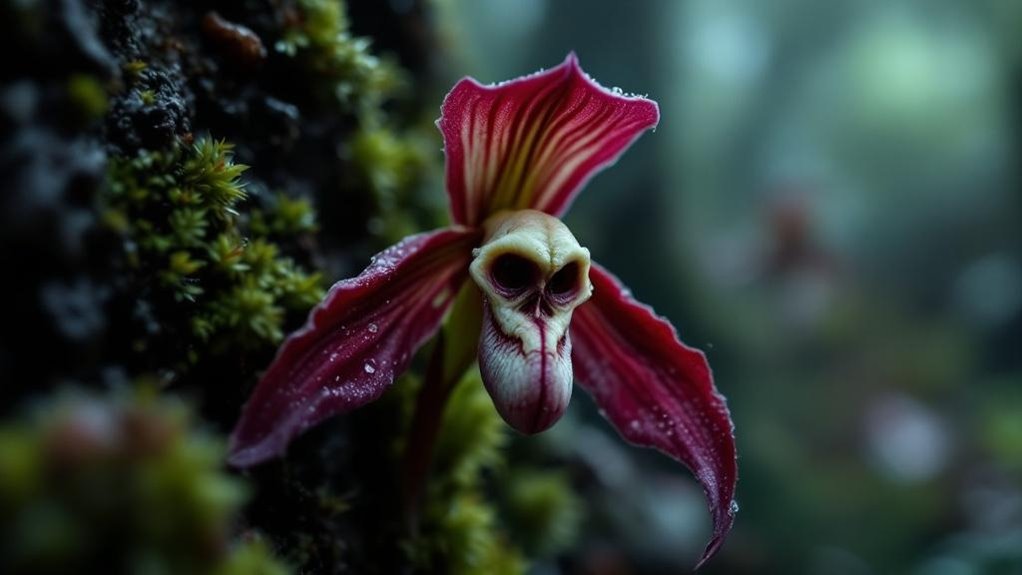
Perhaps the deepest layer of mystery in Dracula orchids comes from what you can’t immediately see, because the flower doesn’t rely on appearance alone; it emits a faint mushroom scent that attracts fungus gnats, its primary pollinators. This olfactory cue works with its cultivated patterns, elongated sepals, and animal-like forms to create a convincing illusion within dim, stagnant forest habitats.
When you look closer, you can see how scent and structure operate together as a studied strategy rather than ornament. Mimicry helps the plant secure pollination by deceiving insect visitors, and research in Ecological Entomology supports that visual and olfactory signals function as linked adaptations.
You also notice how warty textures and face-like forms, including the monkey-faced effect in Dracula simia, deepen the orchid’s observational strangeness.
How Folklore Shaped Its Symbolism
Although the Dracula orchid belongs first to botany, its symbolism has been shaped just as decisively by folklore, because the genus name, derived from the Latin for “little dragon,” carries old associations with mythical creatures while modern readers can’t separate it from the gothic shadow of Bram Stoker’s *Dracula*; together, those influences frame the flower as a cultivated emblem of terror and allure rather than a mere observational curiosity.
When you encounter its fang-like spurs and face-like blooms, you read them through inherited stories, not stagnant description alone; folklore teaches you to see dragons, spirits, and nocturnal presences where taxonomy sees structure.
Stoker’s novel intensifies that reading, binding the orchid to mystery and the supernatural, while many cultures also cast it as a sign of luxury, secrecy, and adaptability within cloud forests’ unpredictable conditions.
Why the Dracula Orchid Feels Beautiful and Sinister
Because the Dracula orchid presents itself through contradiction, you don’t experience it as merely exotic; you register a cultivated tension between elegance and menace, where velvety petals, dark reds and purples, and intricate facial patterns invite close observational attention even as the name “Dracula,” or “little dragon,” and the bloom’s elongated, fang-like spurs pull the mind toward gothic and predatory imagery.
When you look longer, that tension deepens; flowers like D. vampira suggest faces or figures, so beauty arrives with a faintly macabre presence.
Many species also release a slight mushroom scent, closer to stagnant forest decay than perfume, which reinforces the sinister atmosphere while serving a precise biological function by luring fungus gnats.
Through color, structure, scent, and inherited Transylvanian associations, you perceive beauty and danger held in deliberate balance.
What the Dracula Orchid Means Today
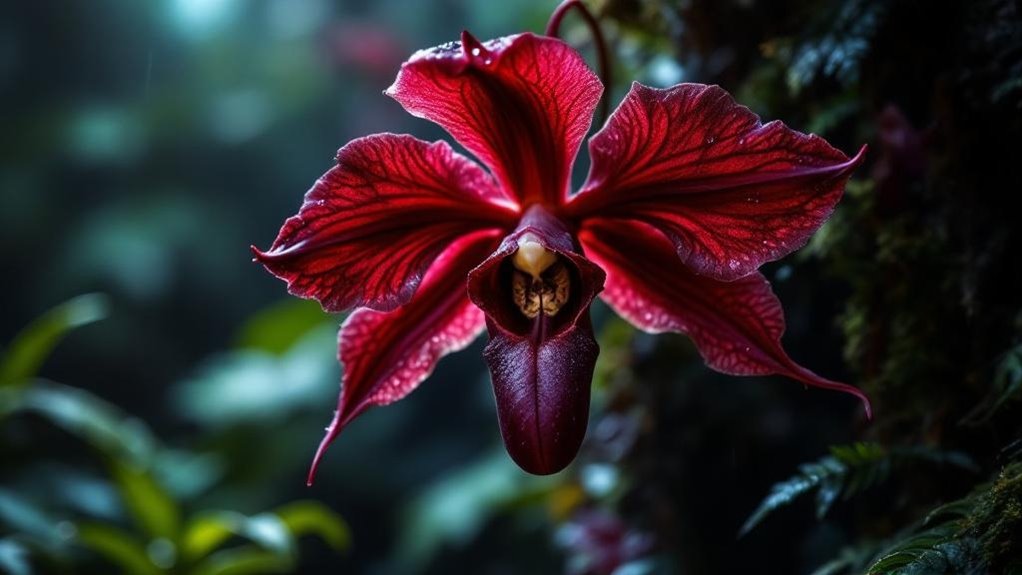
Today, the Dracula orchid stands as a modern emblem of cultivated mystery, its name, meaning “little dragon,” still carrying gothic and Transylvanian echoes, while its face-like blooms and shadowed coloration keep it tied to a visual language in which beauty and darkness remain inseparable.
| Meaning | Modern effect |
|---|---|
| Mystery | You read allure |
| Face-like form | You notice tension |
| Resilience | You see adaptability |
| Art symbol | You sense enigma |
| Therapeutic presence | You gain calm |
Today, you encounter it as more than an observational curiosity; it suggests resilience in humid, shaded habitats, refuses stagnant interpretations, and enters art and literature as a sign of enigma, allure, and disciplined survival. In your space, it can steady emotion, refine atmosphere, and offer exotic sophistication.
Frequently Asked Questions
What Do Dracula Orchids Symbolize?
Dracula orchids symbolize mystery, allure, and eerie beauty. You can see luxury, sophistication, and even a touch of terror in them. They also remind you to value rare species and support conservation of threatened biodiversity worldwide.
What Do Dark Orchids Symbolize?
Dark orchids symbolize mystery, allure, power, and transformation. You see their deep hues suggest luxury and sophistication, while their rarity and unusual beauty can remind you that rebirth and wonder often emerge from darkness and change.
What Makes a Dracula Orchid Unique?
You find Dracula orchids unique for their dragon-like, often animal-faced flowers, warty textures, and cool-cloud-forest habitat. They grow in tufted clumps without pseudobulbs, and their unpredictable blooms keep you watching for striking, unusual surprises.
Why Are They Called Dracula Orchids?
They’re called Dracula orchids because you’ll notice their long, fang-like spurs and dragon-wing sepals inspired the Latin name for “little dragon.” You can thank botanist Carlyle A. Luer, who officially named the genus in 1978.
Conclusion
When you consider the Dracula orchid, its darkness feels less invented than observed, a coincidence of name, form, scent, and history that settled into one cultivated impression; its batlike petals, watchful face, and forest-born stillness gather meanings that never seem forced. You see why it appears beautiful and sinister at once, because symbolism often grows where resemblance meets atmosphere, and where something rare emerges from stagnant shade carrying a presence language was already prepared to name.