
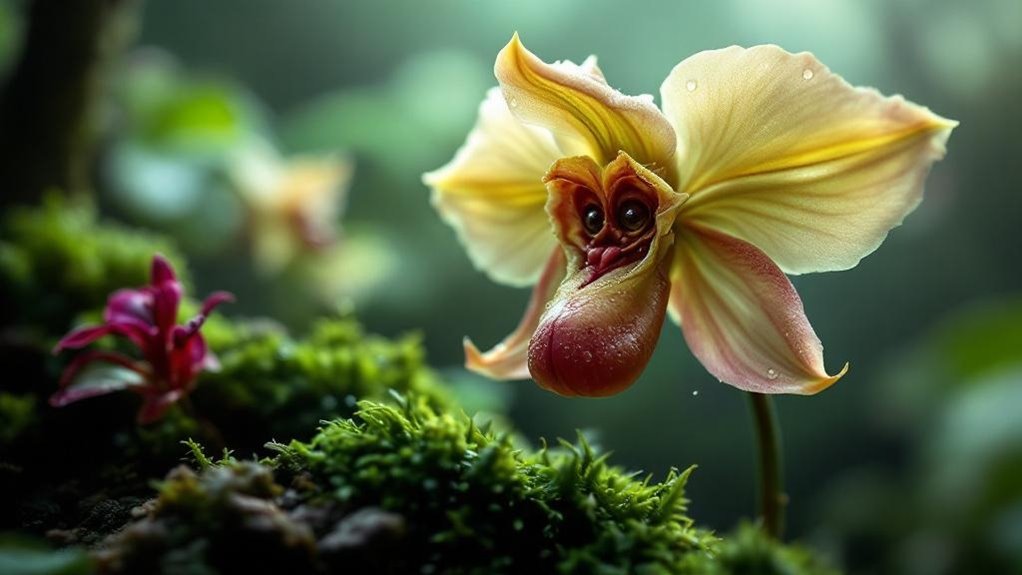
You can understand the Monkey Face Orchid, *Dracula simia*, as a cultivated symbol of individuality, transformation, and quiet good fortune; its unusual monkey-like bloom, orange-like fragrance, and rare cloud-forest habitat have encouraged observational folklore in which it appears as a forest spirit or omen of change. In local and modern meanings alike, it suggests beauty with resilience, careful stewardship, and respect for biodiversity, especially as deforestation and stagnant conservation efforts continue to threaten its survival.
- Key Takeaways
- What Is the Monkey Face Orchid, Really?
- What Does the Monkey Face Orchid Symbolize?
- Why Do Monkey Face Orchid Myths Exist?
- What Does Local Lore Say About It?
- Is the Monkey Face Orchid Seen as a Good Omen?
- Why Does the Monkey Face Orchid Symbolize Change?
- What Are the Spiritual Meanings of the Monkey Face Orchid?
- Why Does the Monkey Face Orchid Look So Magical?
- Where Does Dracula Simia Grow in the Wild?
- Why Is the Monkey Face Orchid So Rare?
- What Does the Monkey Face Orchid Smell Like?
- How Is the Monkey Face Orchid Used in Art?
- Can You Grow a Monkey Face Orchid at Home?
- Why Protecting the Monkey Face Orchid Matters
- Frequently Asked Questions
- Conclusion
Key Takeaways
- The Monkey Face Orchid symbolizes individuality, rare beauty, resilience, and deep admiration in relationships and personal growth.
- In Andean belief, it represents transformation and is sometimes seen as a living spirit of the cloud forest.
- Its monkey-like face inspires myths, wonder, and symbolic meaning through human pattern recognition and rarity.
- Many communities treat its bloom as a good omen, associated with luck, joy, favorable energy, and coming change.
- Its meaning also includes stewardship, reminding people to protect biodiversity and conserve threatened cloud forest habitats.
What Is the Monkey Face Orchid, Really?
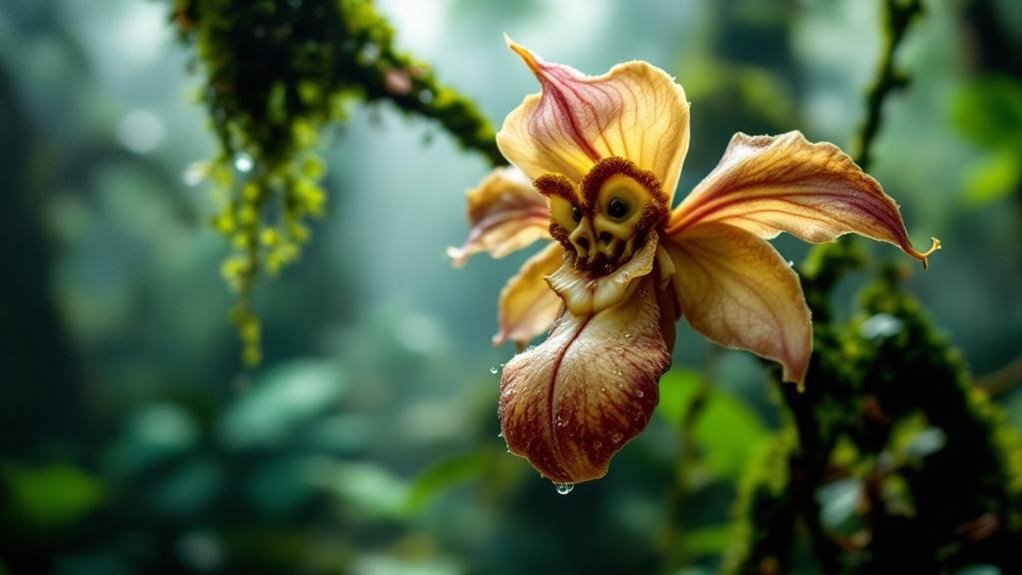
Although its name encourages folklore, the Monkey Face Orchid is a real species, Dracula simia, a rare orchid from the cool, mist-laden cloud forests of southeastern Ecuador and Peru, where it grows at elevations of roughly 3,000 to 6,000 feet and develops flowers whose structure closely resembles a monkey’s face.
If you examine monkey face orchids closely, you’ll notice eyes, a nose, and a mouth-like pattern; that resemblance is botanical, not mythical, and it reflects the unusual floral architecture common within Dracula simia’s genus. You may also detect a scent like ripe oranges, which adds an observational detail beyond appearance.
Because these orchids evolved in cool, humid cloud forests with low, indirect light and moving air, they’re difficult to keep cultivated elsewhere, especially where heat, dryness, or stagnant conditions prevail for long.
What Does the Monkey Face Orchid Symbolize?
Symbolically, the Monkey Face Orchid stands for individuality first, because its observational strangeness is inseparable from its identity. That rare, cultivated appearance encourages you to read it as a living emblem of singularity rather than conformity.
Beyond that, this rare orchid lets you associate beauty with resilience; orchids actually carry longstanding meanings of love, strength, and admiration, so you can see in its form a quieter sign of deep affection rather than stagnant display.
Because it demands patience, skill, and commitment to grow well, you may also read it as a symbol of disciplined care, whether in relationships or personal development.
Its orange-like fragrance and alluring structure suggest charm, joy, and positivity, while its vulnerable conservation status reminds you that admiration should mature into stewardship and protection of biodiversity itself.
Why Do Monkey Face Orchid Myths Exist?
You can see why these myths persist when the orchid presents an uncanny floral resemblance to a monkey’s face, because observational minds rarely leave
Uncanny Floral Resemblance
Because the Monkey Face Orchid presents a bloom that seems to arrange eyes, a nose, and a mouth into a distinctly primate expression, myths arise almost automatically, as human observation is cultivated around pattern recognition and rarely remains stagnant when confronted with a form that appears uncannily familiar.
In Ecuador and Peru, you see why Dracula simia became the Monkey Face Orchid; “Dracula” means little dragon, and the name joins animal imagery with observational wonder.
- You register a face, and your mind assigns presence, intention, and mystery.
- You interpret nature’s artistry as meaningful, so stories gather around the bloom.
- You sense difference among orchids, and quiet reverence replaces ordinary botanical notice.
That resemblance, more than decoration, invites symbolic readings, encouraging mystical associations without requiring anything beyond the flower’s visible structure alone.
Rarity Fuels Folklore
Once a flower seems to present a face, rarity gives that impression staying power; Dracula simia grows mainly in the cloud forests of Ecuador and Peru
What Does Local Lore Say About It?
In Andean folk beliefs, you find the Monkey Face Orchid treated as more than a rare flower; it marks transformation, reflects a cultivated bond between people and the cloud forest, and resists any stagnant reading of nature as passive or silent.
You also encounter strong spiritual symbolism, because communities in Ecuador and Peru regard its face-like form as an observational sign of the forest spirit, a messenger that may offer luck, announce change, or sharpen wisdom when you sit nearby in reflection.
In legends of discovery, you see why its continued presence matters; each sighting carries meaning, reinforces resilience, and reminds you that local lore often turns attention toward protection of a fragile environment.
Andean Folk Beliefs
Although the Monkey Face Orchid is known today for its unusual resemblance to an animal face, Andean folk beliefs place it within a broader spiritual landscape, where it’s often treated as a living sign of the forest’s presence, a cultivated reminder that animals, plants, and people exist within the same order rather than in stagnant separation.
Among indigenous communities, you encounter the Monkey Face Orchid as an observational emblem of the forest spirit, a rare bloom said to guard wildlife, steady human conduct, and affirm balance.
- You read it as good fortune, because its appearance suggests positive energy.
- You understand its rarity through tales calling it a gift from the gods.
- You receive its playful form as reassurance, since local lore says it brings quiet joy and wonder in cloud forests.
Spiritual Symbolism
Because local lore treats the Monkey Face Orchid as more than an unusual bloom, you can read its spiritual symbolism as a cultivated expression of kinship between people and the living forest; its animal-like face doesn’t merely invite curiosity, it suggests that nature observes, responds, and carries a presence that isn’t stagnant or mute.
In Ecuador and Peru, you’re told that seeing one may invite good luck, prosperity, and positive energy, while its expression, as vivid as ripe oranges in memory, reflects playful wisdom attributed to jungle spirits.
Orchids Are Among the forest’s most observational signs, and this one, in particular, implies that hidden beauty can guide insight, creativity, and steadier attention.
If you cultivate it, local belief says you deepen your spiritual symbolism and strengthen your bond with earth itself.
Legends Of Discovery
When local storytellers describe the monkey face orchid’s discovery, they don’t frame it as a simple botanical encounter; they treat it as a moment when the forest reveals its playful but observational spirit, since the bloom’s animal-like face suggests a presence that isn’t stagnant and doesn’t pass unnoticed.
You’re told the Latin name, *Dracula simia*, mattered less than what the flower signaled: good fortune, cultivated harmony, and a healthy forest.
In Ecuador and Peru, lore says you find it only when your intentions remain pure, and that its rare appearance guards balance, quietly resisting damage intensified by European trade over several years.
- You feel reassured by its link to prosperity.
- You recognize the forest’s health in its presence.
- You sense nature watching, not merely blooming.
Is the Monkey Face Orchid Seen as a Good Omen?
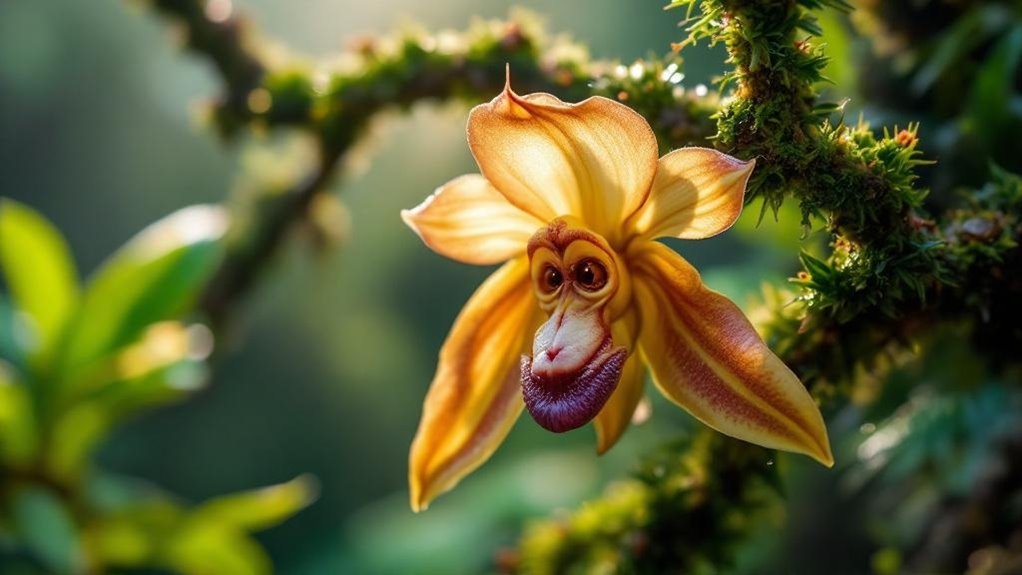
Why is the Monkey Face Orchid so often treated as a good omen; in practice, the belief grows less from formal folklore than from the plant’s cultivated image as something rare, beautiful, and quietly arresting, qualities that many cultures already associate with orchids as symbols of love, strength, and prosperity.
When you encounter Dracula simia, especially in cool temperatures where its mystique feels more observational than staged, you’re likely to read its unusual face-like bloom as playful rather than stagnant, a sign of joy, luck, and favorable energy.
Among collectors, you may also see it as a mark of good fortune, since rarity often suggests prestige, abundance, and careful stewardship.
Its exotic presence in gifts or arrangements reinforces that impression, so you’re encouraged to interpret the flower as an auspicious, quietly affirming emblem.
Why Does the Monkey Face Orchid Symbolize Change?
Although the Monkey Face Orchid is often admired for its cultivated novelty, it also symbolizes change in a more observational sense, since it survives in shifting high-altitude cloud forests where moisture, temperature, and light rarely remain stagnant.
That endurance makes the flower a natural emblem of adaptation rather than permanence.
- You see resilience in its survival, even as disturbed habitats keep testing what can endure.
- You notice beauty emerging through rarity and strangeness, which suggests transformation can produce unexpected forms.
- You understand its slow bloom as a lesson in patience; meaningful change usually unfolds gradually, with care.
Its monkey-like face also recalls folklore that links monkeys with adaptability, while conservation efforts remind you that preserving this orchid requires human habits to change, thoughtfully, now.
What Are the Spiritual Meanings of the Monkey Face Orchid?
When you consider the spiritual meanings of the Monkey Face Orchid, you can see it as a symbol of curiosity, because its unusual form invites an observational mindset; it asks you to notice what others might ignore and to remain open to quiet wonder.
You can also read it as rare beauty and mystery, since its singular appearance and uncommon presence suggest that individuality is cultivated in hidden places, far from anything ordinary or stagnant.
In that way, the flower reminds you that what’s uncommon often carries a deeper presence, and that mystery doesn’t obscure meaning; it preserves it.
Symbol Of Curiosity
Few flowers express curiosity as clearly as the monkey face orchid, whose unusual, face-like bloom immediately invites observational attention and turns a passing glance into a more cultivated act of inquiry; in spiritual terms, it represents the impulse to look closer, to question what seems familiar, and to resist a stagnant way of seeing the world.
- You learn that playfulness and inquiry belong together, because the flower’s expressive form reminds you that spiritual growth begins when you explore rather than assume.
- You see perseverance rewarded, since its demanding cultivation suggests knowledge comes through patience, discipline, and continued attention.
- You’re reminded to stay adaptable; thriving in difficulty, while carrying a faint orange fragrance, it teaches that discovery often appears where conditions are least welcoming, yet quietly nourishing to the spirit.
Rare Beauty And Mystery
Because its bloom appears both familiar and improbable, the monkey face orchid carries a spiritual meaning of rare beauty and mystery, asking you to regard transformation not as disruption but as a cultivated unfolding in which strangeness reveals value that a stagnant eye would miss.
When you encounter it, you’re reminded that beauty often arrives through change, and that love, strength, and emotional complexity can coexist without contradiction; its face-like petals introduce an observational sense of wonder, yet they also steady you, suggesting that creativity and quiet laughter belong within a serious life.
Because the plant is rare and endangered, it further instructs you in preservation, asking for reverence toward what can’t be easily replaced, while its orange-like fragrance adds another layer, linking mystery with liveliness, sweetness, and a disciplined appreciation of nature’s hidden abundance.
Why Does the Monkey Face Orchid Look So Magical?
Although its appearance seems almost invented, the Monkey Face Orchid, or *Dracula simia*, looks magical for plainly observable reasons: its petals and long sepals align in a way that suggests eyes, a nose, and a mouth, producing a remarkably lifelike monkey visage that feels more cultivated than accidental, even though it arises from natural floral structure.
- You notice the face first, and that observational shock lingers.
- You catch a ripe-orange fragrance, which deepens the sense that nothing here is stagnant or ordinary.
- You understand its rarity and difficulty in cultivation, and that knowledge turns beauty into quiet reverence.
Together, these qualities make the flower seem less like a novelty and more like evidence of nature’s disciplined imagination, where form, scent, and scarcity combine with unusual precision and enduring visual power.
Where Does Dracula Simia Grow in the Wild?
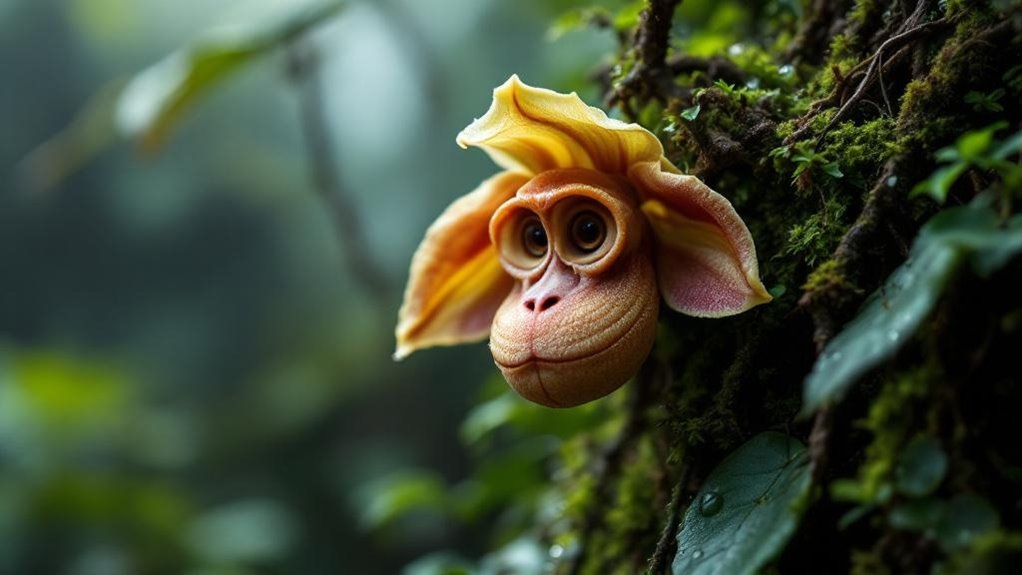
If you look for Dracula simia in the wild, you’ll find its native range in the Andean cloud forests of southeastern Ecuador and Peru, where cultivated certainty gives way to observational limits and the plants remain rare.
You’d expect it between roughly 3,000 and 6,000 feet, in cool, mist-heavy habitats with high humidity and low light; those conditions keep the air from turning stagnant and support the stable microclimates the species requires.
As you consider its Ecuador and Peru distribution, you’ll notice that deforestation and agricultural expansion steadily narrow those mountainous refuges, which is one reason wild specimens are so difficult to spot.
Native Cloud Forest Range
Mist is the natural companion of Dracula simia, which grows wild in the Andean cloud forests of southeastern Ecuador and Peru, where cool mountain air, persistent moisture, and filtered light create the narrow set of conditions this orchid requires.
You find it in humid forest corridors, not cultivated gardens, where dense canopy cover softens the sun, prevents stagnant heat, and sustains the observational stillness this species favors.
Its native range remains limited, which makes each surviving population feel quietly singular; when forests disappear, so does the living context the orchid needs.
- You picture veiled branches, and the image settles your attention.
- You recognize that rarity often depends on intact places.
- You understand habitat loss in Ecuador and Peru doesn’t merely reduce numbers; it erases relationships, patterns, and continuity in the wild.
Elevation And Climate
Because Dracula simia evolved within a narrow mountain band, it grows wild mainly between 3,000 and 6,000 feet in southeastern Ecuador and Peru, where elevation moderates the air, keeps temperatures near 50 to 75°F, and sustains the cool, humid stability this orchid can’t replace elsewhere; you can observe that its survival depends on mist, filtered light, and constant moisture rather than cultivated warmth or stagnant heat.
| Factor | Wild range | Why it matters |
|---|---|---|
| Elevation | 3,000–6,000 ft | Keeps conditions cool |
| Temperature | 50–75°F | Prevents stress |
| Humidity/light | 70–100%, low light | Supports growth, limits sun damage |
If you compare other settings, you’ll find that this observational pattern stays consistent: without high humidity and shaded montane air, Dracula simia rarely remains vigorous, and it seldom thrives beyond those mountain conditions.
Ecuador And Peru Distribution
That narrow climatic band also defines where Dracula simia appears in the wild: you find it in the Andean cloud forests of southeastern Ecuador and adjacent Peru, usually between 3,000 and 6,000 feet, where mountain slopes create cool, humid, mist-laden pockets that remain far more stable than cultivated settings or stagnant lowland air.
- You notice how its range feels secluded, shaped by cloud forest microclimates that quietly sustain delicate growth.
- You understand why observational records remain limited; deforestation fragments these forests, and each lost slope narrows possibility.
- You see that Peru and Ecuador don’t merely host the species; they hold the precise elevation, moisture, and temperature balance it requires.
Its remaining distribution is consequently fragmented, and your clearest picture comes from Andean habitats still intact today.
Why Is the Monkey Face Orchid So Rare?
| Threat | Effect | Feeling |
|---|---|---|
| Deforestation | Forests shrink | Quiet loss |
| Mining | Habitat fragments | Unease |
| Urban growth | Range narrows | Restraint |
| Illegal collection | Wild plants vanish | Sadness |
You can also observe a wider pattern: nearly seventy percent of *Dracula* species face extinction pressure, and because habitats remain small, fragmented, and observationally fragile, conservation determines whether this orchid endures within cloud-forest biodiversity today.
What Does the Monkey Face Orchid Smell Like?
What, then, does the Monkey Face Orchid smell like when you encounter it in bloom; most growers and observers describe a clear, pleasant fragrance reminiscent of ripe oranges, a cultivated citrus note that softens the flower’s already unusual presence and gives it an appeal that isn’t merely visual.
- You notice an orange-like scent, clean rather than stagnant, and it steadies your first observational response.
- You encounter that fragrance whenever flowers open, because this orchid isn’t bound to one narrow blooming season.
- You experience a fuller impression; the monkey-like face engages your sight, while the scent deepens rarity, desirability, and collector interest.
That combination matters, because you don’t merely inspect Dracula simia, you register it through more than one sense, and that quiet completeness explains why enthusiasts continue to seek it.
How Is the Monkey Face Orchid Used in Art?
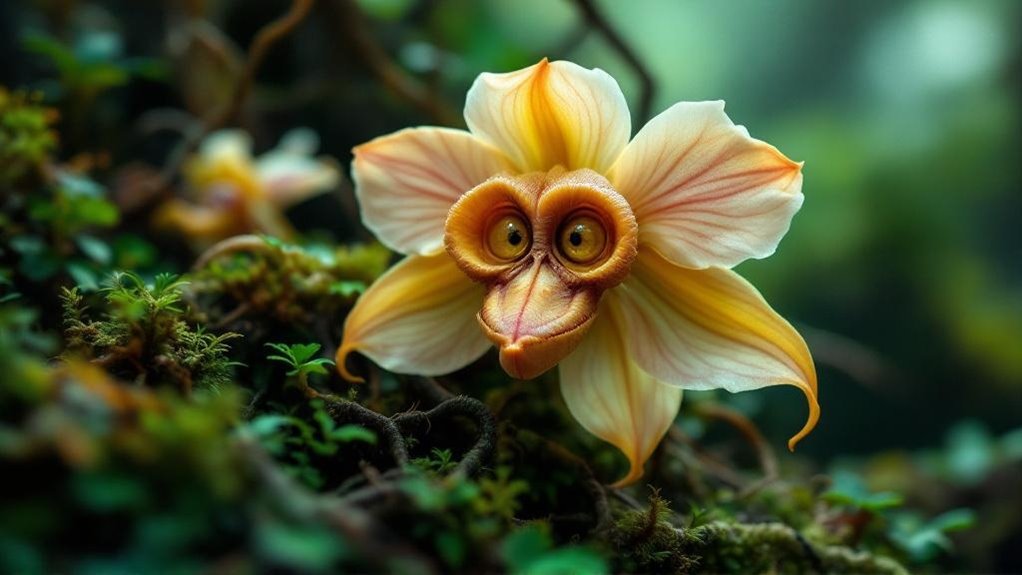
In art, the Monkey Face Orchid serves as more than a botanical curiosity; its observational precision, unusual symmetry, and cultivated strangeness make it a compelling subject for botanical illustration, fine-art painting, sculpture, and nature photography, where artists can study and reinterpret the flower’s monkey-like features without reducing it to novelty.
You see it rendered in watercolor, carved into sculpture, and translated into digital compositions, because its rare form carries both visual discipline and symbolic weight; artists often use it to represent biodiversity, conservation, and the fragile habitats that shouldn’t become stagnant through neglect.
Its orange-like fragrance also enters representation, encouraging you to imagine nature as multisensory rather than purely visual.
Through social media, you encounter floral arrangements and decor projects that borrow its likeness, extending awareness while preserving the orchid’s distinct, almost ceremonial presence in contemporary visual culture.
Can You Grow a Monkey Face Orchid at Home?
Yes, you can grow a Monkey Face Orchid at home, but only if you’re prepared to recreate the cool, humid, low-light conditions of its cloud forest origin with unusual consistency, because Dracula simia doesn’t tolerate stagnant warmth, dry air, or irregular care for long.
- You’ll need humidity near 70 to 100 percent, temperatures around 50 to 75°F, and filtered light; without that cultivated balance, decline comes quietly.
- You should use a well-draining, moss-based medium, often inside a terrarium or cool greenhouse, because this epiphytic orchid needs moisture around its roots, never waterlogging.
- You must water consistently with distilled or rainwater, monitor conditions with observational discipline, and accept that blooming may take years, which teaches patience more than confidence.
Why Protecting the Monkey Face Orchid Matters
Because its appeal can distract from its precarity, protecting the Monkey Face Orchid matters for more than preserving an unusual bloom; it means defending a narrow Andean cloud forest habitat where moisture, elevation, shade, and airflow remain so finely balanced that deforestation, mining, and illegal collection can unravel entire orchid communities with quiet speed.
When you protect Dracula simia, you also protect a genus in which nearly 70 percent of 133 species face extinction, largely from habitat loss and overcollection.
Its rarity gives you a cultivated symbol for plant conservation, much as pandas focus attention on wildlife. That observational power matters; it can redirect interest away from stagnant admiration and toward preservation, supporting groups like Fundación EcoMinga, sustainable farming, and stronger resistance to extraction and illicit trade.
Frequently Asked Questions
What Do Monkey Orchids Symbolize?
Monkey orchids symbolize uniqueness, resilience, playfulness, and nature’s creativity. You can see refinement, curiosity, and strength in them, while their rarity also reminds you to value conservation, protect fragile habitats, and appreciate life’s vivid sweetness.
Are Monkey Face Orchids Rare?
Yes, you’ll find monkey face orchids are rare because they grow naturally only in limited Ecuador and Peru cloud forests. You can’t easily cultivate them either, and habitat loss plus illegal collection make them scarcer.
Why Put Cinnamon on Orchids?
Like a healer’s dust, you put cinnamon on orchids because it fights fungus, protects fresh cuts, and discourages some pests. You’ll also support healthier roots and soil naturally, as long as you use it sparingly.
What Does an Orchid Mean Spiritually?
Spiritually, an orchid means you’re honoring beauty, love, wisdom, and inner strength. You see thoughtfulness, deep connection to nature, and the power of uniqueness. It reminds you to value growth, intimacy, perseverance, and elegance.
Conclusion
When you consider the monkey face orchid, you see more than an unusual bloom; you encounter a cultivated meeting of biology, symbolism, and local memory, shaped by observational wonder rather than stagnant fantasy. Its myths persist because people search for meaning in forms that mirror themselves, and its value endures because rarity, habitat, and beauty are tightly linked. If you protect what seems strange, you also preserve the delicate conditions that allow mystery, and life, to remain.