
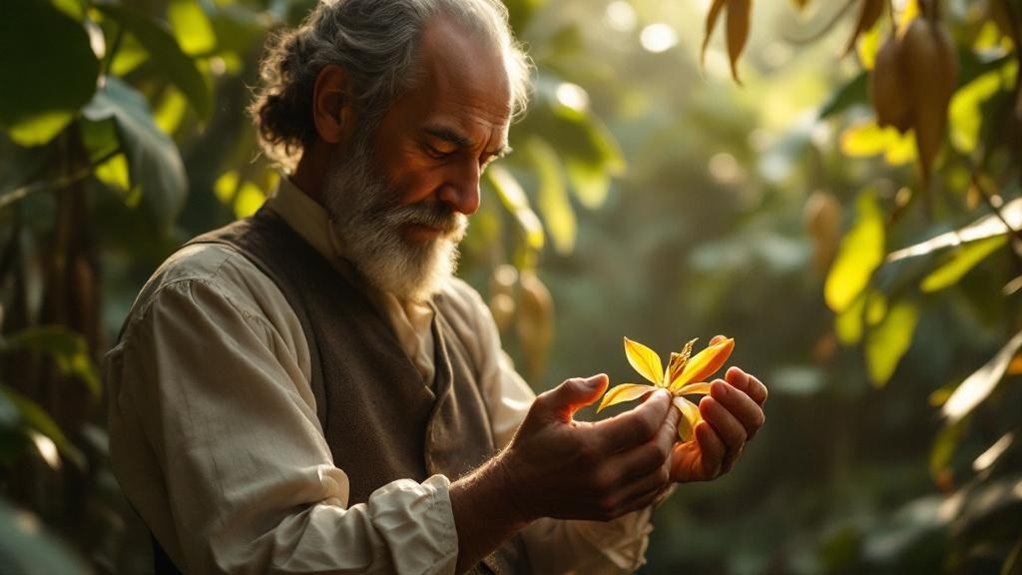
You can trace vanilla’s global rise to Edmond Albius, a 12-year-old enslaved boy on Réunion who, in 1841, discovered a simple hand-pollination method that lifted the flower’s barrier and joined its reproductive parts before the bloom closed. Before that, vanilla remained a stagnant Mexican crop, tied to a native bee and unreliable yields. His observational breakthrough made vanilla widely cultivated across the tropics, though he was scarcely rewarded; his full story reveals far more.
- Key Takeaways
- Why Edmond Albius Changed Vanilla History
- What Vanilla Was Like Before Albius
- Why Vanilla Grew Only in Mexico
- Why Vanilla Flowers Were Hard to Pollinate
- How Edmond Albius Grew Up on Réunion
- How Albius Discovered Hand Pollination
- How Hand Pollination Worked
- Why Albius’s Method Worked So Well
- How Albius Changed Vanilla Farming
- Why Réunion Led Early Vanilla Production
- How Vanilla Spread to Madagascar
- How Vanilla Reached Other Tropical Regions
- How Albius Changed the Spice Trade
- Why Albius Was Never Properly Rewarded
- What Hardships Shaped Albius’s Life
- How Edmond Albius Is Remembered Today
- Frequently Asked Questions
- Conclusion
Key Takeaways
- Edmond Albius, a 12-year-old enslaved boy on Réunion, invented manual vanilla pollination in 1841.
- He used a thin stick to lift the rostellum and press the flower’s male and female parts together.
- His method solved vanilla’s pollination problem outside Mexico, where native Melipona bees were absent.
- This breakthrough enabled large-scale vanilla farming in Réunion, Madagascar, Indonesia, and French Polynesia.
- Albius transformed vanilla into a global crop, though his contribution was recognized only long after his death.
Why Edmond Albius Changed Vanilla History
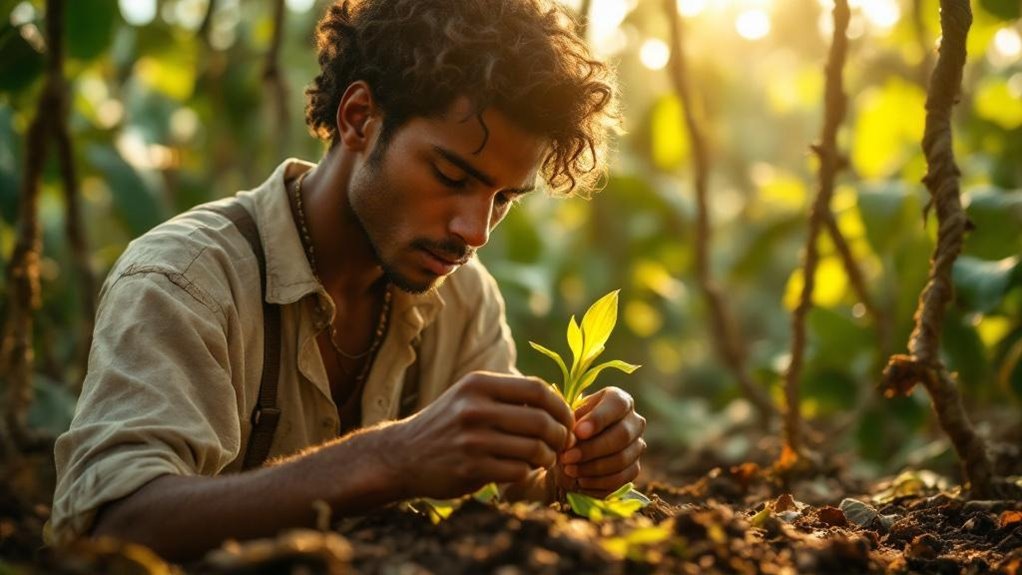
Although vanilla had long been cultivated outside Mexico, its production remained stagnant because growers couldn’t reliably pollinate the orchid by hand. That limitation changed in 1841 when Edmond Albius, only 12 years old, devised a precise manual technique that joined the flower’s male and female parts with a fine stick.
If you trace vanilla’s modern history, you can see why Edmond Albius altered it so decisively. His observational method made artificial pollination practical, repeatable, and scalable, which let cultivation move beyond isolated experiments into sustained agricultural production across Réunion and then into Madagascar, Indonesia, and French Polynesia.
You also see his influence in market terms because the technique supported the rise of Madagascar, which supplied 40 percent of global vanilla by 2017, even though Albius himself died poor and largely unrecognized.
What Vanilla Was Like Before Albius
To see why Albius’s method mattered so much, you have to picture vanilla before 1841, when the orchid was cultivated far beyond Mexico yet remained stubbornly stagnant as a crop, because outside its native range it lacked the Melipona bee that pollinated it naturally.
You’d find vanilla production constrained by biology and geography; growers could raise vines, watch flowers open, and still harvest almost nothing.
In Europe, demand persisted because vanilla flavored chocolate, yet supply stayed narrow, expensive, and largely reserved for elite tables.
Observational advances did appear, especially Morren’s artificial pollination experiments, but those methods remained tied to greenhouses and offered no practical path for field cultivation.
Why Vanilla Grew Only in Mexico
You can see why vanilla remained rooted in Mexico: the Vanilla planifolia orchid depended on a native partnership with the Melipona bee, and without that precise pollinator, natural pod formation stayed largely impossible.
When you trace its spread through Spanish colonial routes, you find an observational pattern of failure, because the vines could be cultivated in other tropical regions, yet fruiting remained stagnant in the absence of the bee.
Until pollination methods changed in the 19th century, this orchid pollination barrier kept overseas vanilla from becoming a reliable crop.
Native Bee Partnership
Because vanilla’s delicate flowers evolved alongside a single native pollinator, Vanilla planifolia remained rooted in Mexico for centuries; the orchid depends on the Melipona bee, and without that specific partnership the blossoms don’t set seed pods, which kept cultivation elsewhere stagnant despite observational efforts to transplant it across the tropics.
If you trace vanilla’s early history, you see a native bee partnership shaping geography, trade, and agriculture; Spanish explorers carried the orchid to other tropical colonies, yet cultivated vines produced no viable crop because Melipona bees weren’t present beyond Mexico.
That exclusive relationship made natural production local, reliable, and difficult to reproduce abroad, so vanilla stayed tied to its homeland until 1841, when Edmond Albius’s hand-pollination method finally replaced the missing ecological partner and opened cultivation in Réunion, Madagascar, and later other regions.
Orchid Pollination Barrier
Why did vanilla remain effectively confined to Mexico for so long, even after Spanish explorers carried the orchid across the tropics? If you trace the barrier carefully, you find a precise biological dependency: Vanilla planifolia evolved with the native Melipona bee, and that bee alone routinely navigated the flower’s structure, transferring pollen across its natural partition and enabling fertilization.
When you move the orchid beyond Mexico, you remove that partnership, and cultivated vines become observational curiosities rather than reliable crops; they grow, they flower, yet fruiting remains stagnant because the necessary pollinator is absent.
For centuries, that absence kept vanilla geographically limited despite colonial transport and horticultural effort. Only in 1841 did Edmond Albius provide a practical answer, because his artificial pollination technique replaced the missing bee and opened cultivation in places such as Madagascar.
Failed Overseas Fruiting
Although Spanish explorers carried vanilla vines across the tropics, the plant’s overseas future remained stagnant for a simple biological reason: cultivated orchids could grow vigorously and flower abundantly, yet outside Mexico they almost never set pods, since Vanilla planifolia had evolved within a pollination system tied to the native Melipona bee, and that precise partner wasn’t present in places like Réunion or Madagascar.
If you examine this failed overseas fruiting closely, you see that cultivation itself wasn’t the obstacle; the missing step was the pollination process, an observational fact that kept vanilla agriculture stagnant beyond Mexico.
In Réunion, Madagascar, and similar colonies, growers could maintain healthy vines and promising blossoms, yet fruit rarely followed.
Only when Edmond Albius introduced effective artificial pollination did you get dependable pod formation and a viable global vanilla industry.
Why Vanilla Flowers Were Hard to Pollinate
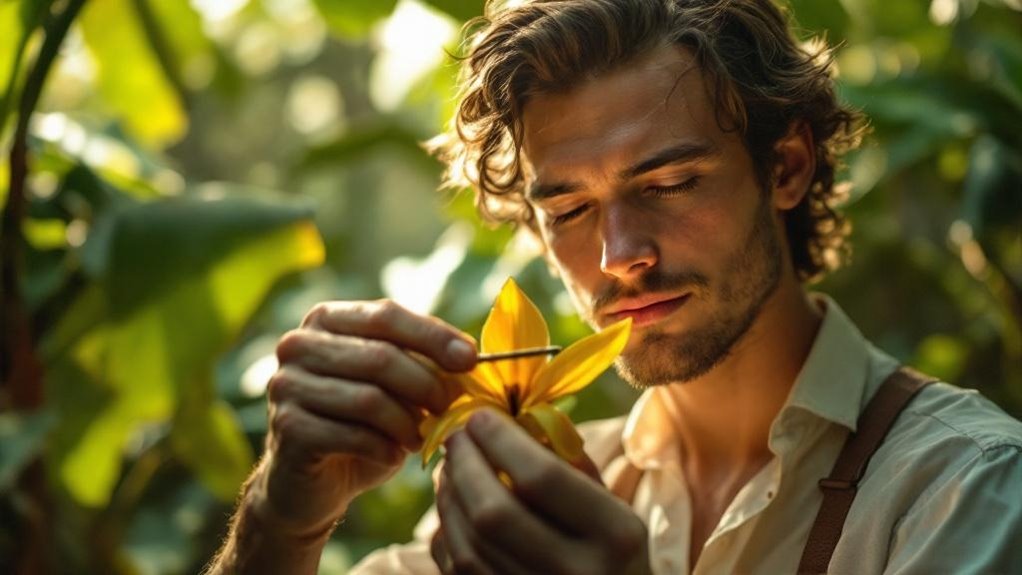
You can see why vanilla remained so difficult to cultivate beyond Mexico, because Vanilla planifolia depended on Melipona bees native to that region, and without those pollinators, fertilization stayed stagnant in other climates.
You also have to account for the flower’s structure, since a shield-like membrane separates the male and female parts, creating an observational barrier that prevents easy natural contact even though the flower is hermaphroditic.
When you add the flower’s brief daily blooming window, which lasts about twenty-four hours, you can understand why vanilla production outside Mexico remained limited until hand pollination changed the outcome.
Mexico’s Native Pollinators
Because Vanilla planifolia evolved in Mexico, its pale, short-lived flowers depended on a very specific relationship with native Melipona bees, whose size and behavior allowed them to lift the flower’s delicate barrier and carry pollen from one bloom to another with reliable precision.
You can trace vanilla’s early limits to that observational fact: without the Melipona bee, cultivated vines outside Mexico stayed stagnant, even after Spanish transfers.
| Place | Pollinator | Result |
|---|---|---|
| Mexico | Melipona bee | Beans formed |
| Caribbean | None native | Flowering, no fruit |
| Indian Ocean | None native | Yields failed |
That dependence shaped the industry for centuries; when growers moved vanilla into other tropical colonies during the 16th century, they carried the plant but not its pollinating partner, so expansion remained constrained until artificial pollination changed global production forever.
Floral Barrier Structure
What made vanilla so difficult to pollinate wasn’t merely the absence of the right bee, but the flower’s own architecture, which blocks easy fertilization through a thin floral barrier called the rostellum; this flap separates the male and female organs, prevents routine self-pollination, and requires a precise external movement to lift or displace it before pollen can reach the stigma.
When you examine vanilla’s bloom, you see why pollinating Vanilla demanded more than chance contact, because the reproductive column is tightly arranged, observationally efficient against accidental fertilization, yet stagnant without intervention.
The flower opens for only about twenty-four hours, so cultivated growers faced a narrow interval in which the rostellum had to be moved aside and pollen pressed onto the stigma.
Without that exact action, the blossom simply withered, unfertilized, and the vine produced no pod at all.
Limits Outside Mexico
That floral design became even more consequential once vanilla left Mexico, where Vanilla planifolia had evolved alongside the Melipona bee. In its native range, that insect could negotiate the flower’s obstructive structure and bring about pod formation, but in other tropical colonies introduced by Spanish explorers from the sixteenth century onward, the same cultivated vines remained largely stagnant, flowering without fruit because the needed pollinator wasn’t present.
You can trace the observational problem clearly: growers had healthy vines, regular blossoms, and almost no beans, because natural transfer between the flower’s male and female parts rarely occurred without that specific bee.
Experiments with artificial pollination appeared by 1836, yet they stayed mostly inside greenhouses and didn’t scale.
Edmond must enter this history because his 1841 method finally let you cultivate vanilla productively beyond Mexico.
How Edmond Albius Grew Up on Réunion
On the humid fields and garden edges of Sainte-Suzanne, Réunion, Edmond Albius spent his childhood under slavery, and the island’s cultivated landscapes shaped him as surely as its oppressive social order constrained him; born in 1829, he grew up in a world where labor was extracted without consent, yet close observational contact with plants, seasonal rhythms, and managed estates gave him an early education in the practical workings of tropical agriculture.
On Réunion Island, you can see how Ferréol Bellier-Beaumont’s instruction in horticulture and botany drew disciplined attention from stagnant conditions, shaping a mind trained by cultivated ground rather than formal schooling.
After emancipation in 1848, he received the surname Albius, yet freedom didn’t secure stability; you watch poverty, neglect, and insecure work narrow his prospects, while recognition remains distant during his lifetime.
How Albius Discovered Hand Pollination
From that cultivated but stagnant world of plantation labor and garden instruction came Albius’s defining insight: in 1841, when he was only 12, he worked out a hand pollination method for the vanilla orchid by using a thin stick or needle to lift the flower’s membrane and bring its male and female parts into contact, a simple observational act that solved a problem growers outside Mexico hadn’t been able to overcome.
You can see why this mattered: vanilla cultivation beyond Mexico had remained constrained because the native Melipona bee wasn’t present elsewhere.
Albius’s hand pollination technique removed that barrier with unusual economy. Once cultivators recognized the method’s reliability, Réunion’s production rose sharply; soon Madagascar, Indonesia, and French Polynesia adopted it, and vanilla moved steadily from rarity toward global cultivation and broader access.
How Hand Pollination Worked
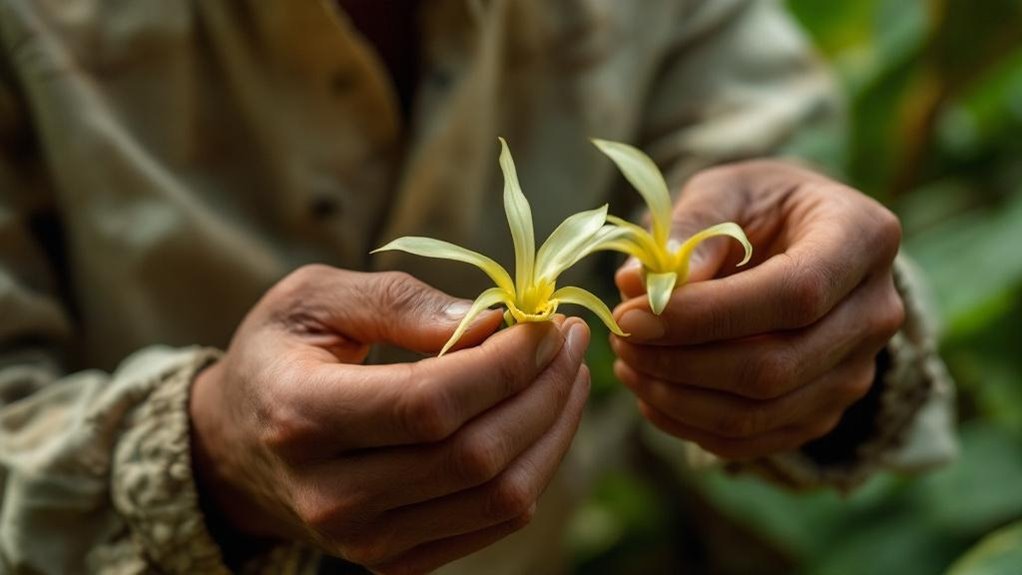
You can understand Albius’s method by following three precise actions: you lift the flower’s thin membrane with a fine stick, you bring the pollen into contact with the stigma, and you complete the work before the bloom turns stagnant at day’s end.
As you observe the process, you see why this cultivated, observational technique overcame the absence of native pollinators, because each flower had to be fertilized by hand with exact timing and a steady touch.
You also see why the method spread so effectively, since fast daily hand pollination made large vanilla harvests possible in places far beyond Mexico.
Lifting The Flower Membrane
Using a slender stick or needle, Edmond Albius lifted the vanilla flower’s thin membrane, the barrier that kept the anther and stigma apart, then pressed those reproductive parts together so fertilization could occur; the motion was observational rather than forceful, precise rather than elaborate, and it solved the stagnant problem that had limited cultivated vanilla outside Mexico, where the plant’s native pollinators weren’t present.
When you focus on lifting the flower membrane, you see why his method mattered: he didn’t depend on rarity, chance, or specialized insects, because the step could be done quickly, repeated reliably, and taught across plantations.
Joining Pollen And Stigma
How, then, did the essential joining occur once the membrane had been lifted? You press the male anther toward the stigma with a fine stick or needle, and in that controlled contact, you pollinate vanilla flowers by imitating the observational work of Mexico’s native bees, whose absence elsewhere had left vanilla cultivation stagnant beyond its homeland.
| Action | Result |
|---|---|
| Lift anther | Pollen exposed |
| Press to stigma | Fertilization enabled |
| Mimic native bees | Artificial pollination succeeds |
| Repeat on orchids | Yields increase |
Fast Daily Hand Pollination
Once growers understood the motion, the work became remarkably fast and repeatable: with a fine stick or needle, they lifted the flower’s membrane, brought the anther into contact with the stigma, and completed in seconds the joining that natural pollinators had performed only in vanilla’s native habitat.
You can see why hand pollination spread quickly after 1841; it replaced a stagnant dependence on Melipona bees with a cultivated, observational routine that workers could repeat daily across many blossoms.
By making Vanilla planifolia fertile outside Mexico, you opened production in Réunion, Madagascar, and Indonesia, where consistent labor mattered more than native insects.
That practical shift altered supply, lowered rarity, and moved vanilla from luxury toward common use, establishing the commercial foundation of the modern global trade, with lasting agricultural consequences worldwide.
Why Albius’s Method Worked So Well
Because the vanilla flower’s structure keeps its male and female parts separated by a thin membrane, Albius’s method worked so well precisely because it addressed that barrier directly.
This allowed a cultivator to lift the membrane with a fine stick or needle and bring the pollen into contact with the receptive stigma in a controlled, repeatable motion; in effect, he reproduced the essential action that native pollinators performed in Mexico, but he did so in a way that didn’t depend on a specific bee species or a narrow ecological setting.
- You see a careful lift.
- You see pollen placed exactly.
- You see fertilization without bees.
- You see cultivated reliability.
That observational precision prevented stagnant failure beyond Mexico; it let growers succeed where natural pollinators couldn’t, consistently, season after season, with little waste.
How Albius Changed Vanilla Farming
You can see how Albius changed vanilla farming through his hand-pollination breakthrough, because at just 12 he used a simple tool to fertilize Vanilla planifolia by hand, overcoming the stagnant limits that had tied cultivation to Mexico and its native Melipona bee.
As you follow the effects of that observational shift, you find vanilla cultivated across Madagascar, Indonesia, and other tropical regions, where growers could finally produce the crop reliably without depending on a single natural pollinator.
You can also trace how this method reshaped the market; as production expanded, vanilla moved from a rare luxury toward a more widely available ingredient, and Madagascar rose to dominate global exports.
Hand Pollination Breakthrough
Although vanilla vines had been cultivated far beyond Mexico, production remained stagnant for a simple biological reason: without the native Melipona bees that pollinated Vanilla planifolia in its original habitat, the flowers rarely set fruit, and commercial farming couldn’t advance.
You can trace the change to 1841, when twelve-year-old Edmond Albius devised hand pollination, using a fine stick to lift the flower’s membrane and press its parts together, making fertilization reliable and observational rather than accidental.
- A single blossom could now become a pod.
- Cultivated vines no longer depended on absent bees.
- Réunion’s yields rose quickly under disciplined practice.
- Vanilla shifted from rare luxury toward accessibility.
Global Cultivation Expansion
Once Edmond Albius made manual pollination reliable in 1841, vanilla cultivation no longer remained tied to Mexico’s ecology.
Growers could establish productive plantations across the tropics; with fertilization turned into a disciplined, observational task rather than a stagnant gamble, regions such as Madagascar, Indonesia, and French Polynesia began cultivating vanilla at scale, adapting the method to local conditions and, over time, producing distinct varieties that broadened the global market.
Through Edmond Albius’s discovery of manual pollination, you can trace vanilla’s shift from a rare European luxury to a globally available spice.
Madagascar eventually led exports, supplying about 40 percent of world vanilla by 2017, while Indonesia and French Polynesia strengthened flavor diversity.
You can also see how hand pollination remained essential, sustaining steady production for culinary uses worldwide.
Why Réunion Led Early Vanilla Production
Few agricultural shifts were as decisive as Réunion’s early embrace of vanilla cultivation, because Edmond Albius’s artificial pollination method, developed there in 1841 when he was only 12, solved the stagnant problem that had kept vanilla production outside Mexico observational rather than truly productive; without the Melipona bee that naturally pollinated the orchid in its native region, growers elsewhere couldn’t cultivate reliable harvests.
But Réunion adopted Albius’s hand-pollination technique and quickly turned a fragile botanical curiosity into the first large-scale vanilla industry.
On Réunion Island, you can trace that leadership through:
- dependable hand pollination
- sharply improved yields
- organized plantation labor
- vanilla’s rising commercial value
You see how cultivated method, not luck, made Réunion the early model; it proved vanilla could sustain agriculture and cuisine globally.
How Vanilla Spread to Madagascar
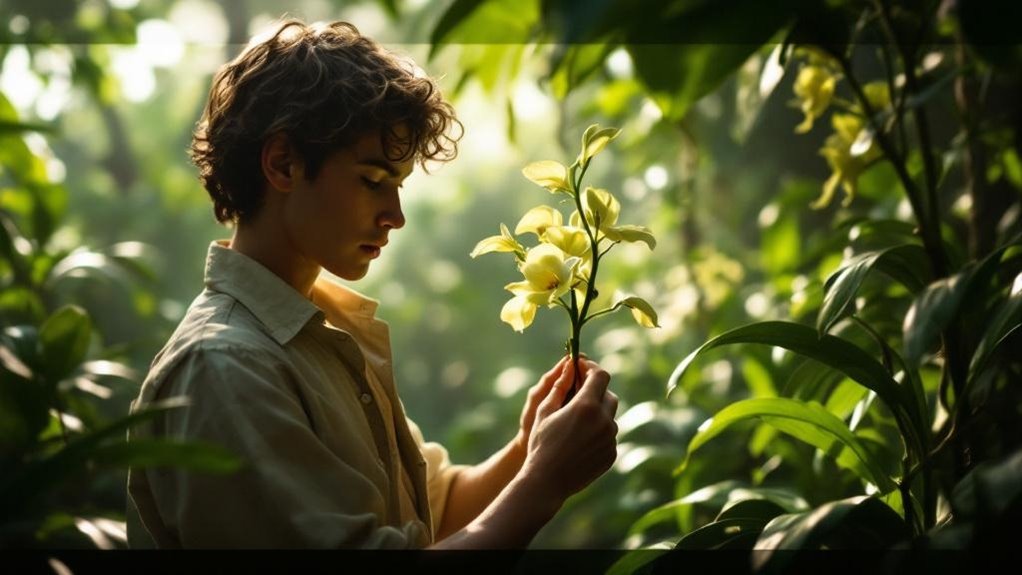
Réunion’s success with hand pollination did more than establish an early vanilla industry; it created the cultivated model that carried vanilla to Madagascar in the 19th century, where growers faced the same stagnant barrier that had limited production elsewhere, namely the absence of the native Melipona bee.
Once vanilla arrived, you can see why Albius’s method mattered: without that bee, natural pollination failed, so cultivating vanilla depended on deliberate human work.
Without the native bee, vanilla could not set fruit naturally, making cultivation an exacting act of human intervention.
Growers applied the technique to Vanilla planifolia, and Madagascar’s climate and soils rewarded that precision with steady expansion. By the late 19th century, the island had become a significant producer, not by chance, but because observational practice turned a biological limitation into an agricultural system.
Over time, that cultivated system supported Bourbon vanilla and helped Madagascar command an estimated 40 percent of world supply by 2017.
How Vanilla Reached Other Tropical Regions
As Spanish explorers carried vanilla beyond Mexico, they extended the orchid’s geographic reach but not its immediate productivity. This was because the plant still faced the same stagnant barrier in every new tropical setting: without the native Melipona bee, pod formation rarely occurred, and cultivation remained more theoretical than dependable.
You can trace the vanilla orchid across tropical colonies, where growers observed promise but little yield until hand pollination made cultivated expansion practical, measured, and reliable.
- Madagascar, where Bourbon vanilla developed a rich, sweet profile
- Indonesia, where plantations broadened commercial cultivation
- French Polynesia, where the crop adapted to island conditions
- Global kitchens, where vanilla became broadly accessible
From this wider distribution, you see how observational persistence turned a regional plant into an internationally cultivated ingredient, no longer confined to elite households alone.
How Albius Changed the Spice Trade
Edmond Albius’s manual pollination method, introduced in 1841, altered the spice trade at its structural core, because it solved the stagnant reproductive barrier that had kept vanilla cultivation unreliable outside Mexico and turned an observational possibility into a cultivated system that growers could repeat with precision.
You can trace that shift here:
| Change | Trade effect |
|---|---|
| Pollination solved | Cultivation spread |
| Madagascar expanded | Exports increased |
| Indonesia adopted method | Supply stabilized |
| Vanilla became accessible | Demand broadened |
As production grew, the vanilla industry moved from rarity toward scale; Madagascar eventually supplied 40% of global vanilla by 2017, and you can see how Albius’s technique reorganized profitability, redirected cultivation, and made vanilla an everyday flavoring rather than a narrowly held luxury across world markets.
Why Albius Was Never Properly Rewarded
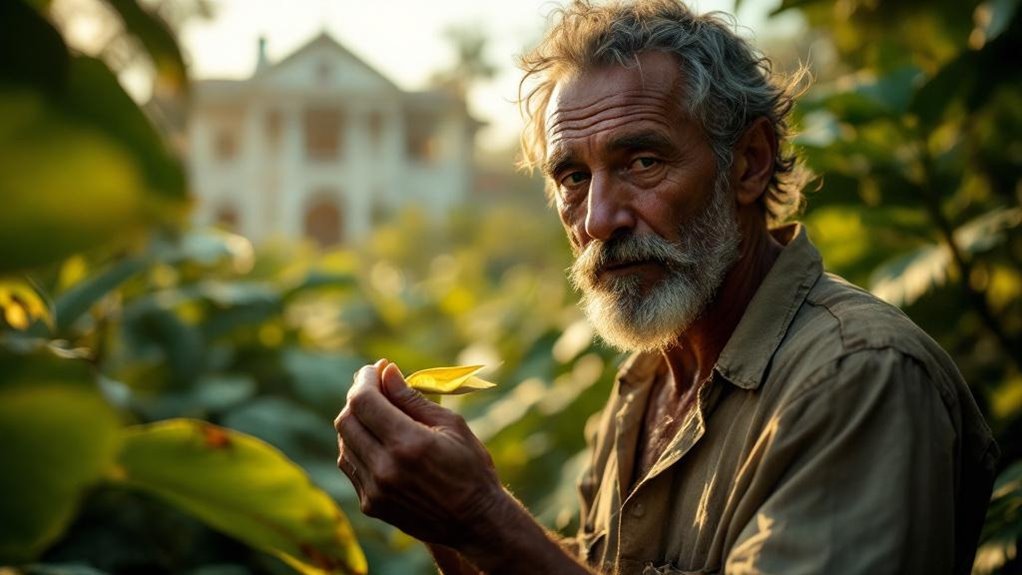
Although his observational insight transformed vanilla from a stagnant botanical problem into a cultivated system that growers could reproduce across the tropics, Albius never shared in the wealth that followed, because he developed the method as an enslaved child, lacked legal and economic power over its use, and lived within a colonial order that extracted value from his labor while reserving recognition for others.
You can see why Edmond Albius remained unrewarded:
- He invented the technique at twelve, without status.
- Emancipation didn’t erase barriers to advancement.
- European figures received more notice and authority.
- Vanilla fortunes grew elsewhere, while his name faded.
Even when advocates sought recognition, historical bias persisted, and Edmond Albius lived in poverty until 1880, his method enriching industries that treated his authorship as incidental, rather than foundational to global vanilla.
What Hardships Shaped Albius’s Life
That lack of reward grew out of a life shaped from the beginning by coercion, precarity, and exclusion; born in 1829 in Sainte-Suzanne on Réunion, Albius spent his childhood in slavery, where any observational gift or cultivated skill existed inside a stagnant social order that treated his labor as property rather than as the work of a thinking individual.
After emancipation in 1848, you don’t find security in his story; you see continued hardships, unstable work, and poverty that narrowed his choices and kept survival central.
You also confront the added injury of wrongful imprisonment after a robbery accusation, a punishment that exposed how vulnerable a poor Black laborer remained, even after legal freedom, until Bellier-Beaumont’s advocacy secured early release.
How Edmond Albius Is Remembered Today
Legacy now frames Albius as the unsung hero of the vanilla industry, because the manual pollination method he developed at age twelve changed vanilla from a plant constrained by geography into a crop that could be cultivated at scale far beyond Mexico.
When historians and agriculturalists assess how vanilla became a global commodity, they return to his observational skill and practical ingenuity, noting that production in Réunion, Madagascar, and Indonesia rests on the hand-pollination process he introduced, a method whose reach remains visible in figures such as Madagascar’s 40 percent share of world vanilla production in 2017.
- You see Edmond Albius honored in agricultural histories.
- You note recognition came long after his death.
- You confront how poverty kept his life materially stagnant.
- You understand his method still governs vanilla cultivation.
Frequently Asked Questions
What Does the Name Edmond Albius Mean?
Edmond likely comes from Old English and means “rich protector” or “fortunate guardian.” You can read Albius as related to Latin albus, “white.” Together, you’d understand the name as suggesting a prosperous, bright, protective person.
Are There Monuments Dedicated to Edmond Albius?
Yes—wouldn’t you expect at least one? You can find tributes to Edmond Albius on Réunion Island, including commemorative plaques and public recognition in Saint-Suzanne. You won’t see many grand monuments, but his legacy remains honored locally.
How Long Does a Vanilla Orchid Flower Stay Open?
A vanilla orchid flower usually stays open for just one day, sometimes only a few hours. You need to pollinate it quickly, or you’ll miss the chance for that bloom to produce a vanilla bean.
What Is the Difference Between Vanilla Extract and Vanilla Flavoring?
Ironically, you’d think they’re twins, but vanilla extract comes from real vanilla beans soaked in alcohol, while vanilla flavoring usually uses synthetic vanillin. You’ll get richer, deeper taste from extract; flavoring tastes simpler and cheaper.
Which Countries Produce the Most Vanilla Today?
You’ll find Madagascar produces the most vanilla today, followed by Indonesia, Uganda, Papua New Guinea, and Mexico. If you’re buying vanilla, those countries dominate global supply, though quality, flavor, and harvest volumes can vary yearly.
Conclusion
When you trace vanilla’s path, you see Edmond Albius standing at its center like a quiet hinge on which an empire turned; with one cultivated, observational method, he moved vanilla from stagnant rarity to a crop that perfumed continents, enriched colonies, and reordered trade with almost tidal force. You also see the measure of injustice, because the hand that liberated this immense abundance was left largely unrewarded; his legacy endures, immense, plain, and instructive today.