
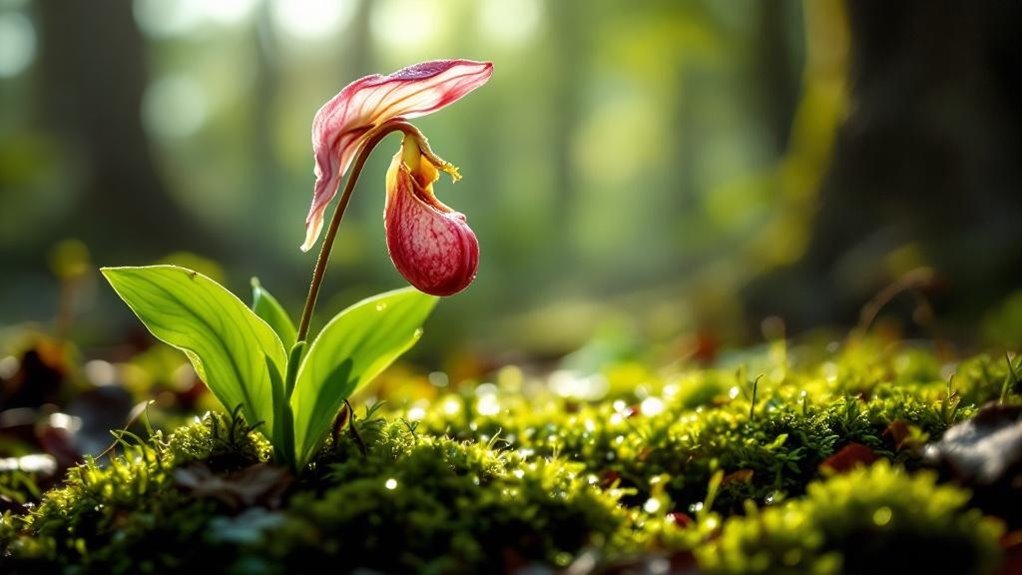
You can understand the lady’s slipper orchid as a cultivated symbol of courage, healing, and cultural memory, shaped by the Ojibwe legend of a maiden who crossed winter ice to find medicine for her brother; her lost moccasins became flowers, so the bloom came to signify sacrifice, renewal, and communal duty. Its pouch-like form explains the name, while its protected status reflects slow growth, observational stewardship, and a refusal to let meaning become stagnant over time.
- Key Takeaways
- What Does the Lady’s Slipper Symbolize?
- Why Is It Called Lady’s Slipper?
- What Is the Ojibwe Lady’s Slipper Legend?
- How Did the Maiden Cross the Ice?
- Why Does Lady’s Slipper Symbolize Courage?
- How Was Lady’s Slipper Used as Medicine?
- How Do Native Traditions Honor Lady’s Slipper?
- What Other Indigenous Stories Explain Lady’s Slipper?
- What Is the Venus Myth of Lady’s Slipper?
- How Did Lady’s Slipper Symbolism Change Over Time?
- What Do Lady’s Slipper Colors Mean?
- Where Do Lady’s Slipper Orchids Grow?
- Why Are Lady’s Slipper Orchids Protected?
- How Are Lady’s Slipper Orchids Being Conserved?
- Can You Grow Lady’s Slipper at Home?
- How Should You Respect Lady’s Slipper in the Wild?
- Why Does Lady’s Slipper Still Matter Today?
- Frequently Asked Questions
- Conclusion
Key Takeaways
- Lady’s slipper symbolizes compassion, sacrifice, healing, and resilience, especially in Indigenous traditions that link the flower to hope and renewal.
- In Ojibwe legend, a maiden crosses a frozen lake for medicine, and her lost moccasins become lady’s slipper flowers.
- The flower represents communal duty, courage, and endurance, honoring women’s strength and the sacrifices made for family and village survival.
- Also called the moccasin flower, lady’s slipper reflects Native cultural memory and identity through stories preserved across generations.
- Its pouch-shaped bloom inspired its name, while yellow, pink, gold, and rose varieties carry meanings like healing, hope, wisdom, and renewal.
What Does the Lady’s Slipper Symbolize?
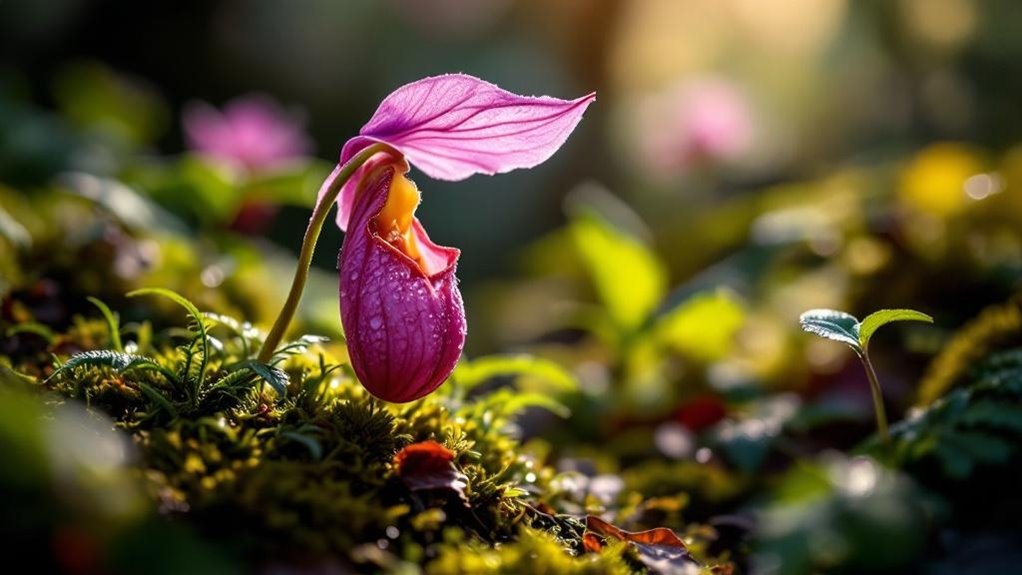
Meaning gathers around the Lady’s Slipper Orchid in layered ways, and its symbolism reaches beyond cultivated beauty into compassion, sacrifice, healing, and cultural memory; among the Ojibwe, who know it as ma-ki-sin-waa-big-waan, the flower is closely tied to the duty to suffer for others when a community faces hardship, while in Native American legend it also carries hope and renewal through the story of a maiden who ventured out to save her village from illness.
When you consider the lady’s slipper orchid, you encounter more than an observational emblem of beauty; you see resilience shaped by medicine, survival, and remembrance.
Its medicinal uses strengthen its meaning as healing made visible, and its history resists stagnant interpretations, because the flower also reflects Native endurance, loss, and continuity under colonization.
Why Is It Called Lady’s Slipper?
Although the name sounds ornamental, “Lady’s Slipper” comes first from the flower’s form, because its pouch-like petal resembles a small slipper or sandal. That visual likeness shaped the common English name long before most people knew its botanical history.
If you look beyond that observational resemblance, you find the scientific name, Cypripedium, which links the orchid to Aphrodite through Cypris, her birthplace, while pedilon means sandal, reinforcing the lady’s slipper image.
You can also trace another name, moccasin flower, which reflects cultivated Native recognition of the bloom’s meaning, later displaced as European naming habits became dominant. Across regions, pink lady’s slipper and yellow lady’s slipper kept the same essential form, so color changed, but the slipper idea didn’t become stagnant at all there.
What Is the Ojibwe Lady’s Slipper Legend?
You encounter the Ojibwe lady’s slipper legend through a maiden’s winter journey, as she crosses a frozen lake to bring medicine to her sick brother and village, and you recognize that her resolve reflects courage, sacrifice, and a cultivated refusal to remain stagnant before suffering.
As deep snow and bitter cold strip away her moccasins, you see those losses take on observational meaning, because the path of hardship becomes the ground of transformation.
Where she walked, flowers rise in place of what she surrendered, and you understand the lady’s slipper as a quiet emblem of healing, hope, and communal care.
Maiden’s Winter Journey
Crossing a frozen lake in winter, the Ojibwe maiden at the center of the Lady’s Slipper legend undertakes a journey for medicine to save her sick brother, and in doing so she becomes a cultivated example of sacrifice joined to duty rather than a merely decorative figure in folklore.
As you follow the maiden’s winter journey, you observe cracking ice, deep snow, and a stagnant horizon; each obstacle clarifies why this moccasin flower story carries moral weight within Ojibwe teaching, because her resolve preserves family, then community, through deliberate action rather than ornament.
- You feel the cold press against responsibility.
- You witness courage remain steady, not loud.
- You understand illness as communal, never isolated.
- You carry quiet hope home with her.
Moccasins Become Flowers
When the maiden returns from her winter journey, the legend’s most enduring image comes into view: the moccasins she lost in snow and pain don’t remain as signs of deprivation, but become pink lady’s slipper flowers. This transformation gives the story its cultivated symbolic force, because it joins suffering to renewal, private endurance to communal survival.
You can read this change as the legend’s central observational claim: sacrifice doesn’t end in stagnant loss when it serves the village’s healing. The maiden’s bare, wounded path yields medicine, then beauty; her moccasins mark where courage entered the land and where compassion took visible form.
In Ojibwe tradition, ma-ki-sin-waa-big-waan carries that memory forward, reminding you that individual hardship can sustain community, and that renewal often grows from what was surrendered.
How Did the Maiden Cross the Ice?
You can see that the maiden crossed the ice by relying on her brother’s lessons, moving with cultivated care through deep snow and across a frozen lake that answered each step with observational warnings of cracking beneath her feet.
As exhaustion set in and the cold turned her bare, bloodied feet toward pain, she didn’t stop; she continued because her brother and village needed medicine, and that purpose kept fear from becoming stagnant.
In that steady passage, you recognize how courage worked not as sudden heroism but as determined endurance, which carried her home and prepared the way for hope and renewal.
Brother’s Lessons Remembered
Because her brother had cultivated in her an observational way of reading winter ground, the maiden didn’t step onto the frozen lake blindly; she remembered how to judge snowdrifts, how to avoid stagnant-looking patches that suggested weaker ice, and how to move with care even as the surface cracked beneath her.
You see her respect in every measured step; his lessons steady her through deep snow, fatigue, and the loss of her moccasins, until cold and blood mark her feet, yet not her purpose.
By trusting what he taught, you understand how courage can remain disciplined, how devotion to a village can mature into action, and how that endurance prepares the meaning later carried by lady’s slippers.
- Quiet respect endures.
- Strength grows through memory.
- Pain doesn’t erase purpose.
- Sacrifice leaves beauty.
Cracking Ice And Snow
Step by step, the maiden crossed the frozen lake by reading the surface as her brother had taught her, choosing the hard, wind-scoured stretches where the ice held firm, avoiding stagnant-looking patches and drifted areas that could conceal weakness beneath the snow.
You can see how her cultivated, observational care governs each movement; she doesn’t challenge winter blindly, but studies it, places her weight where the surface answers solidly, and adjusts when faint cracking warns of danger below.
In that measured passage, the lake becomes more than terrain, because every careful step joins physical judgment to duty, and the legend of lady’s slipper orchids later reflects this union of sacrifice and purpose.
Her crossing marks the legend’s turning point, showing that survival depended on knowledge, restraint, and unwavering commitment to her village.
Courage Through Exhaustion
Although the ice kept cracking beneath her and the cold steadily stripped away her strength, the maiden crossed the frozen lake by relying on cultivated discipline rather than impulse, recalling her brother’s teachings about how to move through snow, conserve effort, and place each step with observational care.
You see courage emerge not as sudden fire but as measured endurance; even after her moccasins were lost and her feet turned bloody against the stagnant winter surface, she kept moving because the medicine meant survival for others, and that duty ordered her pain.
Her return confirms that exhaustion can refine resolve, making bravery practical, resilient, and sustaining.
- You feel the cold narrowing every choice.
- You witness discipline steady the body.
- You recognize pain yielding to purpose.
- You understand courage as endurance.
Why Does Lady’s Slipper Symbolize Courage?
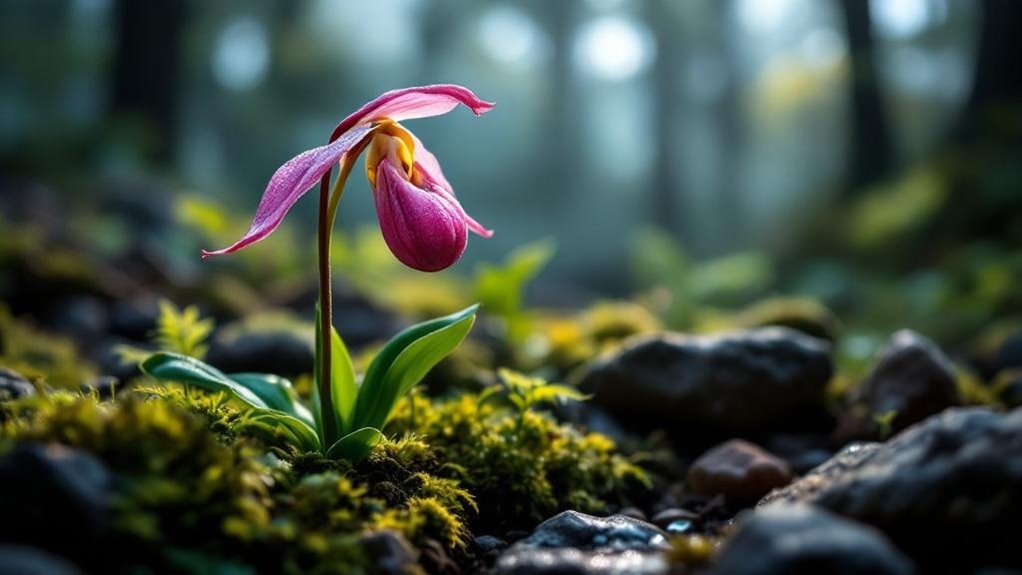
When you ask why the Lady’s Slipper symbolizes courage, the answer rests in the Ojibwe story of ma-ki-sin-waa-big-waan, where a young maiden crosses a frozen lake to bring medicine to her people, accepting danger, cold, and exhaustion rather than leaving her community without help; her act defines courage not as spectacle but as disciplined, selfless endurance, a form of quiet strength that moves forward under pressure and resists fear without becoming stagnant.
As you read the flower through this legend, you see an observational symbol of sacrifice, perseverance, and communal duty; the lost moccasins becoming pink blossoms suggest that courage leaves visible traces, and that renewal follows hardship.
The orchid’s meaning endures because communities remember brave acts, and through that cultivated memory, you recognize courage as legacy, hope, and steadfast responsibility.
How Was Lady’s Slipper Used as Medicine?
When you look at lady’s slipper as medicine, you find that Native American healers used it for fevers, headaches, menstrual cramps, and labor pains, with yellow lady’s slipper especially cultivated across tribes for its steady, observational value.
You also see that healers prepared remedies from the roots, gathering them in fall or early spring, then drying and grinding them, while tinctures were taken to ease insomnia, anxiety, and emotional tension before they grew stagnant.
You should also note the necessary caution; because these orchids require years to recover, modern harvesting can damage vulnerable populations and diminish a plant long respected for its medicinal role.
Traditional Healing Uses
Native healers valued lady’s slipper orchids, especially *Cypripedium parviflorum*, as a cultivated remedy for physical pain and nervous strain, using the plant to ease fevers, headaches, and menstrual cramps while also relying on its particularly calming action to settle the body and mind.
In these traditional healing uses, you can see how Native Americans respected *Cypripedium* for its medicinal properties, observing seasonal gathering times and recognizing that cypripedin in the underground stems supported relief from insomnia, anxiety, and emotional tension without becoming stagnant in purpose.
- You sense steady relief where pain once pressed.
- You recognize observational wisdom shaped by seasons.
- You feel the quiet assurance of a cultivated remedy.
- You witness calm restored to body and mind gently.
Root Preparations And Caution
Although the lady’s slipper orchid was respected for several medicinal purposes, healers most often prepared its roots—especially those of *Cypripedium parviflorum*—by harvesting them in fall or early spring, drying them carefully, and grinding them into powder for tinctures and related remedies used for fevers, headaches, menstrual cramps, and even labor pains.
This cultivated process reflected observational knowledge about timing and potency, and it also aligned with the plant’s calming reputation, since cypripedin in the root was valued for easing anxiety and emotional tension despite its bitter taste and strong odor.
You should approach this history with caution, because modern harvesting can damage already stagnant populations. These orchids regrow slowly over many years, so repeated collection threatens their survival, and careful respect now matters as much as their once-valued medicinal role.
How Do Native Traditions Honor Lady’s Slipper?
Preserved in oral tradition and seasonal storytelling, the Lady’s Slipper Orchid holds an honored place in Indigenous culture, especially among the Ojibwe, who know it as *ma-ki-sin-waa-big-waan*, or “moccasin flower,” a name that reflects a cultivated spiritual bond rather than a merely observational interest in the plant.
You encounter lady’s slipper as a vessel of teaching, not a stagnant object; winter gatherings preserve accounts of a maiden who endures hardship to seek healing medicine, and her path instructs you in bravery, sacrifice, compassion, and communal duty.
Through this careful retelling, you see cultural identity carried forward, and resilience affirmed.
- You remember courage shaped by service.
- You recognize women’s endurance without embellishment.
- You inherit respect for healing and care.
- You witness heritage sustained through spoken memory.
What Other Indigenous Stories Explain Lady’s Slipper?
Beyond the Ojibwe account, you find that many Indigenous nations hold their own cultivated explanations for the lady’s slipper, and these stories don’t treat the flower as a stagnant curiosity or a merely observational detail in the landscape; they present it as a sign through which people remember how hardship, healing, kinship, and right conduct remain bound together.
When you compare these traditions, you see recurring lessons: courage sustains community, suffering can yield renewal, and the lady’s slipper marks survival rather than ornament.
Some nations connect the moccasin flower to ancestral footsteps and inherited duty, so the plant carries memory of land, lineage, and conduct. Others emphasize hope after trial, reading its reappearance as evidence that people endure winter, loss, and uncertainty together; through storytelling, the flower keeps cultural remembrance active and unifying.
What Is the Venus Myth of Lady’s Slipper?
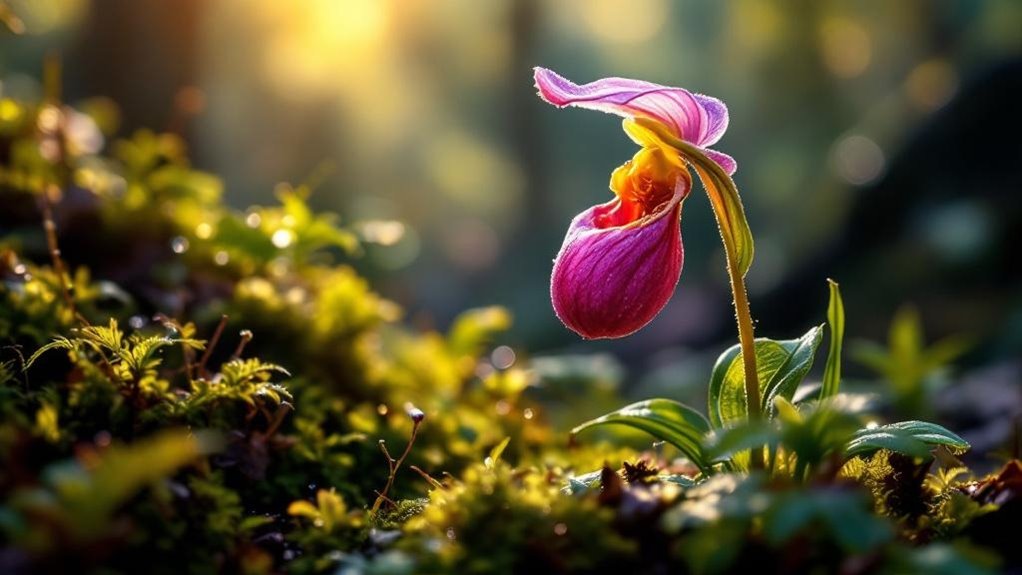
You can trace the Venus myth of the lady’s slipper to Venus, or Aphrodite, and Adonis, whose shelter in a cave during a storm casts the flower within an observational tradition of love, beauty, and cultivated desire.
As Venus fled the weather, she lost a slipper, and when a mortal later found it, the legend says it transformed into the orchid, whose pouch-like bloom preserves that lost object in botanical form rather than leaving it stagnant in myth.
Through this account, you can see why the lady’s slipper came to signify love, transformation, and femininity, because its unusual shape ties natural beauty to divine affection with calm, lasting force.
Venus And Adonis
Classical legend ties the lady’s slipper orchid to Venus and Adonis, holding that Venus, fleeing a storm with her mortal lover and seeking shelter in a cave, lost one of her golden slippers as she escaped, and that the abandoned slipper was later found by a mortal and transformed into a flower.
You can read this myth as an observational link between divine beauty and cultivated nature; Venus’s golden slipper becomes the orchid’s glowing pouch, and its form suggests romance shaped by danger, motion, and memory rather than stagnant ornament.
- You sense love persisting under pressure.
- You see beauty entering the natural world.
- You recognize the flower as Venus’s quiet emblem.
- You understand why the lady’s slipper signifies devotion.
Through Adonis, the legend grounds desire in mortal experience, giving the blossom significance beyond appearance alone.
Lost Slipper Legend
How does the Venus myth of the lady’s slipper explain the flower’s symbolism so clearly; it presents Aphrodite, or Venus, fleeing a storm with Adonis, losing one golden slipper as they seek shelter in a cave, and leaving behind an object that nature reshapes into bloom, so the orchid’s pouch appears not as a stagnant ornament but as a cultivated sign of love tested by uncertainty.
When you read the lost slipper legend, you see why the flower carries themes of love, loss, and transformation across cultures; the golden, slipper-shaped petal preserves Venus’s beauty, while its origin in hardship suggests that devotion can survive disorder and emerge refined.
You can also read the myth in observational terms, because a lost object becomes natural form, joining human longing to landscape and giving adversity a measured, enduring grace there.
How Did Lady’s Slipper Symbolism Change Over Time?
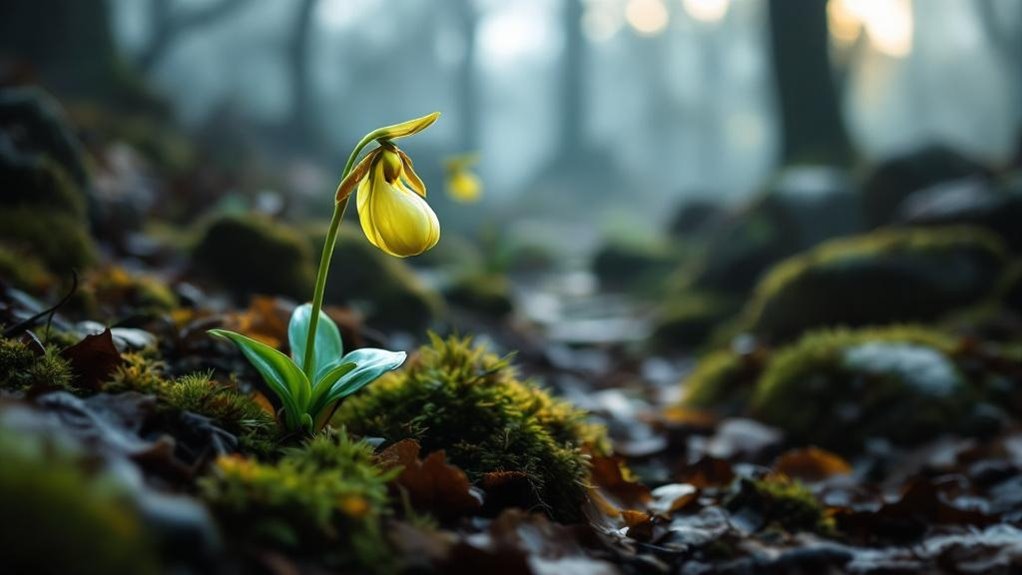
Although the lady’s slipper has long carried associations with beauty and rarity, its symbolism changed markedly during European colonization, when the older name “moccasin flower” gave way to “lady’s slipper.”
The shift recast the orchid through a cultivated European lens rather than an Indigenous one. You can trace that change through cultural appropriation; as names shifted, meaning grew less observational, more stagnant, and Native heritage was obscured.
Poets then recast the flower as an emblem of death, isolation, and cultural loss, especially in response to colonization’s pressure on Indigenous memory. In Elaine Goodale Eastman’s “The Moccasin Flower,” you encounter pride beside separation, beauty beside grief, and that duality still shapes interpretation.
- Quiet beauty shadowed by erasure
- Pride held against isolation
- Loss carried within a renamed flower
- Memory enduring through altered language
What Do Lady’s Slipper Colors Mean?
Meaning gathers differently around Lady’s Slipper colors, and you can’t separate those shades from the cultural settings that gave them significance; across Native American traditions, color has never been merely decorative, but observational, relational, and tied to distinct teachings about season, medicine, endurance, and renewal.
You read yellow as healing, because Indigenous practice cultivated that association through medicine; you read pink lady’s slipper as beauty that withstands hardship, and as hope returning after stagnant winter.
| Color | Imagery |
|---|---|
| Yellow | warm remedy |
| Pink | spring endurance |
| Gold | quiet wisdom |
| Rose | renewal after loss |
These variations matter because each appearance can carry a different narrative weight among tribes; the flower’s color doesn’t fix one universal meaning, but reflects diverse relationships between season, story, and recovery.
Where Do Lady’s Slipper Orchids Grow?
Across two broad habitat patterns, lady’s slipper orchids settle where moisture, shade, and soil chemistry remain in careful balance; they thrive in moist pine and hardwood forests with acidic, well-drained ground.
You’ll most often find them in quiet woodland openings or along shaded edges where the air stays cool and the forest floor doesn’t turn stagnant.
If you travel through the northeastern United States and Canada, you may observe pink lady’s slippers; farther across eastern North America and into the Rockies, yellow forms appear, often in small clusters during May and June, when these native orchids flower and bees begin their cultivated, observational rounds.
- You notice stillness beneath the canopy.
- You find reassurance in recurring clusters.
- You sense the hush of shaded ground.
- You recognize belonging in native orchids.
Why Are Lady’s Slipper Orchids Protected?
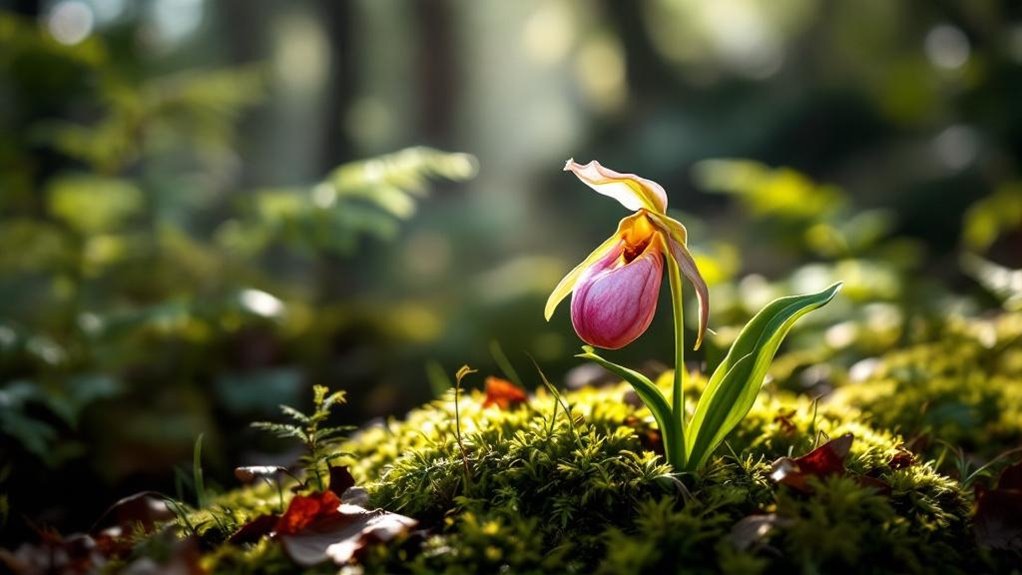
Because lady’s slipper orchids mature slowly and depend on narrow, cultivated relationships with shade, moisture, soil chemistry, and pollinators, they’re protected in many regions where even modest disturbance can unsettle populations that may need up to a decade to reach flowering size; in places such as New England, species like the pink lady’s slipper are listed as endangered or otherwise protected, and laws prohibit digging, harvesting, or transporting them because removal from the wild rarely succeeds and often damages the stagnant balance of their native habitat.
When you understand their long development, you can see why legal protection matters; overharvesting, careless transplanting, and habitat loss reduce already limited populations, and federal, state, and local rules restrict collection and movement so native stands remain observationally stable over time.
How Are Lady’s Slipper Orchids Being Conserved?
A practical conservation approach combines law, habitat stewardship, propagation, and public education, all of which matter for lady’s slipper orchids because you can’t separate the plant from the cultivated conditions that sustain it.
Organizations such as the North American Orchid Conservation Center work with ecologists to protect and restore native sites, monitor populations, and support observational records that help land managers respond to stagnant or declining trends before losses become permanent.
- You’re protected by laws that forbid uprooting lady’s slipper populations.
- You see habitats restored before subtle environmental shifts become irreversible.
- You support public learning through Go Orchids and local ecological awareness.
- You witness seedlings tended, then returned to the wild in careful reintroductions.
In the UK, conservationists use last-resort methods to rebuild declining populations steadily.
Can You Grow Lady’s Slipper at Home?
Can you grow lady’s slipper at home; yes, but you’ll need cultivated plants from specialized growers rather than specimens taken from the wild, since wild collection is discouraged, often illegal, and rarely successful once these orchids are uprooted from the fungal networks and site conditions that sustain them.
If you want a lady’s slipper to persist, you must recreate its forestlike setting with cool shade, acidic, well-drained soil, and steady moisture that never turns stagnant, because the plant declines quickly when heat, drought, or saturation disrupts root function.
You should also recognize the observational patience this orchid demands; seedlings may need a decade before flowering, and successful cultivation depends on mycorrhizal fungi that support nutrient uptake.
With regular, precise care, cultivated plants can grow, though they remain exacting and never truly simple.
How Should You Respect Lady’s Slipper in the Wild?
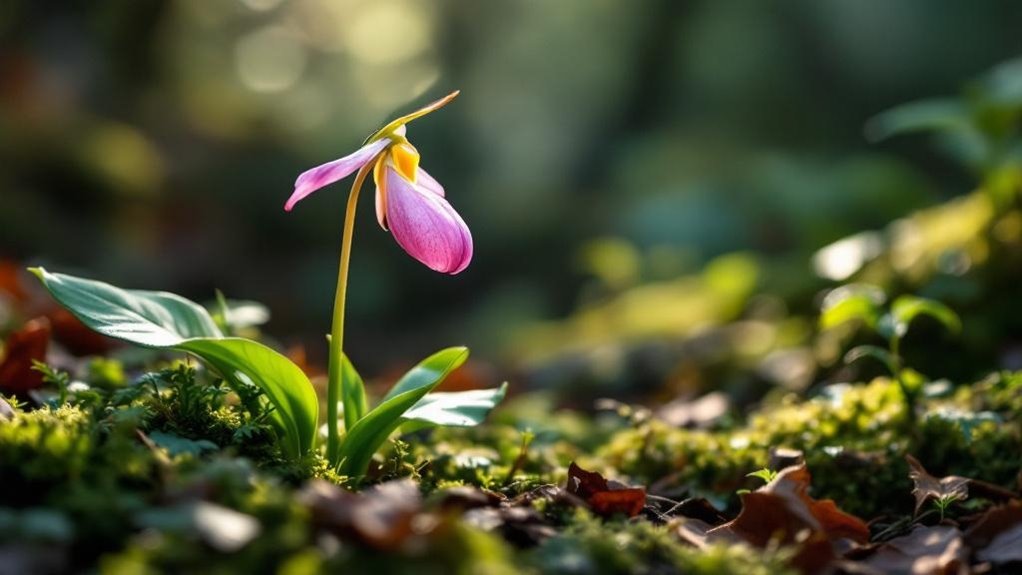
Once you move from the question of cultivated care to wild encounter, the standard becomes restraint; you shouldn’t pick, dig, or handle lady’s slipper orchids, since they’re protected wildflowers whose survival depends on highly specific habitat conditions that don’t travel with the plant.
You show respect by remaining on designated trails through moist pine and hardwood forests, where one careless step can damage roots, fungi, and stagnant microhabitats; you observe quietly from a distance, keeping your presence observational rather than intrusive.
- Let the flower remain where it belongs.
- Trust distance as a form of care.
- Learn Native cultural meanings with respect.
- Support conservation work that protects habitat.
You can deepen that respect by joining local efforts, including those linked to the North American Orchid Conservation Center, and by teaching others measured regard.
Why Does Lady’s Slipper Still Matter Today?
Although lady’s slipper may seem like a quiet woodland flower, it still matters because it gathers several living concerns into one image: for many Native communities, especially through the Ojibwe story of the girl who crossed a harsh landscape to bring medicine home, it remains a cultivated symbol of endurance, duty, and hope; for conservationists, it marks how easily beauty depends on fragile ecological relationships that modern disturbance can unravel; and for anyone attentive to language and history, the shift from “moccasin flower” to “Lady’s Slipper” exposes how colonial naming can obscure Indigenous meaning while leaving the plant itself as an observational record of cultural loss.
You also see its relevance in healing traditions, where remembered medicinal uses resist stagnant thinking, and in conservation work, where preserving Lady’s Slipper protects native biodiversity for future generations.
Frequently Asked Questions
What Does the Lady Slipper Symbolize?
It symbolizes strength, healing, resilience, courage, and renewal. You can see it as a sign of selfless sacrifice, hope after hardship, cultural identity, and the enduring beauty that emerges when you survive loss and adversity.
What Is the Story Behind the Lady Slipper Orchid?
Ironically, you trace the lady slipper orchid to an Ojibwe tale: a girl crosses a frozen lake for medicine, loses her moccasins, and they become flowers, so you remember bravery, sacrifice, hope, and family love.
Why Are Lady Slipper Orchids Illegal in the US?
Lady slipper orchids are illegal to pick or dig up in many U.S. states because you’d harm protected, slow-growing native plants. They’re endangered or threatened, recover poorly after disturbance, and laws stop overharvesting and population decline.
What Is the Myth of the Orchid Flower?
You see the orchid myth as a lantern in snow: an Ojibwe maiden risks winter to bring medicine home, and when her moccasins fall away, they bloom into orchids, teaching you sacrifice, healing, and hope.
Conclusion
When you consider the lady’s slipper, you see more than a rare flower; you see an allegory of careful passage, in which beauty survives because courage moves quietly, memory remains cultivated, and respect prevents devotion from becoming stagnant possession. Its legend, symbolism, and fragile habitat ask you to observe rather than seize, to protect rather than claim; in that discipline, you recognize why this orchid still matters, and why its meaning endures with steady, observational force.