
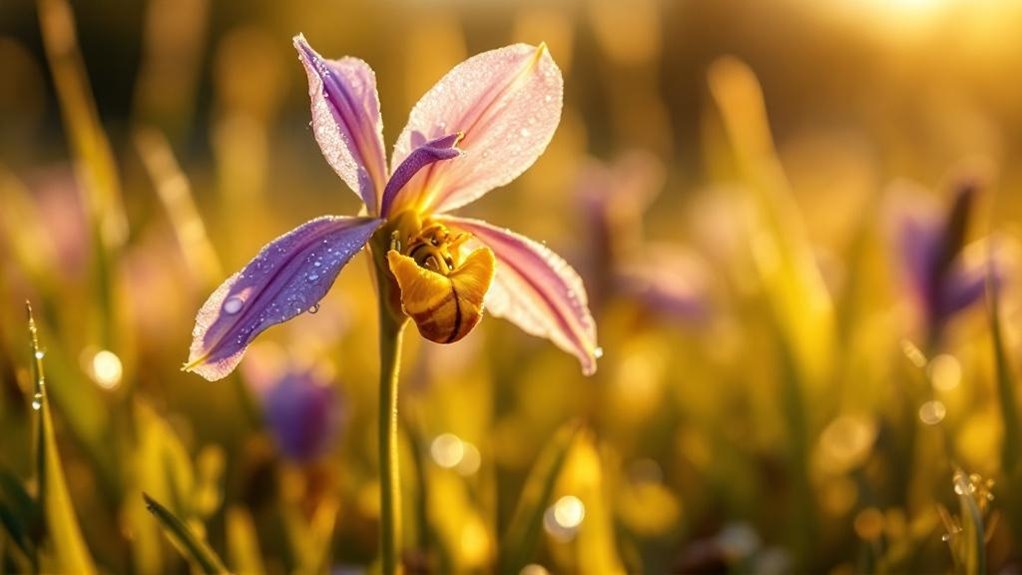
You can understand the Bee Orchid as a symbol of attraction, fertility, and rarity, because its cultivated-looking bloom imitates a female bee with striking observational precision; in folklore, it suggests virility, good luck, and nature’s balanced order, while in modern symbolism it also represents ecological interdependence, resilience, and refined beauty. Its deceptive pollination deepens those meanings, showing how desire, imitation, and survival can coexist without nature becoming stagnant, and there’s more to notice in its story.
- Key Takeaways
- What Does the Bee Orchid Symbolize?
- Bee Orchid Colors and Visual Symbolism
- How Bee Orchid Mimicry Shapes Meaning
- The Bee Orchid and Its Bee Relationship
- Why Bee Orchid Pollination Inspires Wonder
- Why the Bee Orchid Feels So Alluring
- Bee Orchid Meanings in Love and Desire
- Bee Orchid Folklore Across Europe
- Bee Orchid as a Symbol of Interconnection
- Spiritual Meanings of the Bee Orchid
- Bee Orchid in Christian Symbolism
- Bee Orchid in Gardens and Wild Places
- Modern Meanings of the Bee Orchid
- When Bee Orchid Imagery Makes a Meaningful Gift
- Bee Orchid Symbolism in Art and Tattoos
- Frequently Asked Questions
- Conclusion
Key Takeaways
- Bee Orchid symbolizes uniqueness, allure, fertility, and desire because its flower mimics a female bee with remarkable precision.
- Its deceptive pollination, called pseudocopulation, represents attraction, survival, and the complex interplay between instinct, imitation, and reproduction in nature.
- In Greek folklore, Bee Orchid was linked with fertility and virility, reflecting its strong associations with sexuality and reproductive power.
- British folklore often treated Bee Orchid as a sign of good luck, rarity, and the mysterious elegance of wild landscapes.
- Spiritually, Bee Orchid suggests divine intelligence, ecological interdependence, and the delicate balance between beauty, purpose, and natural design.
What Does the Bee Orchid Symbolize?
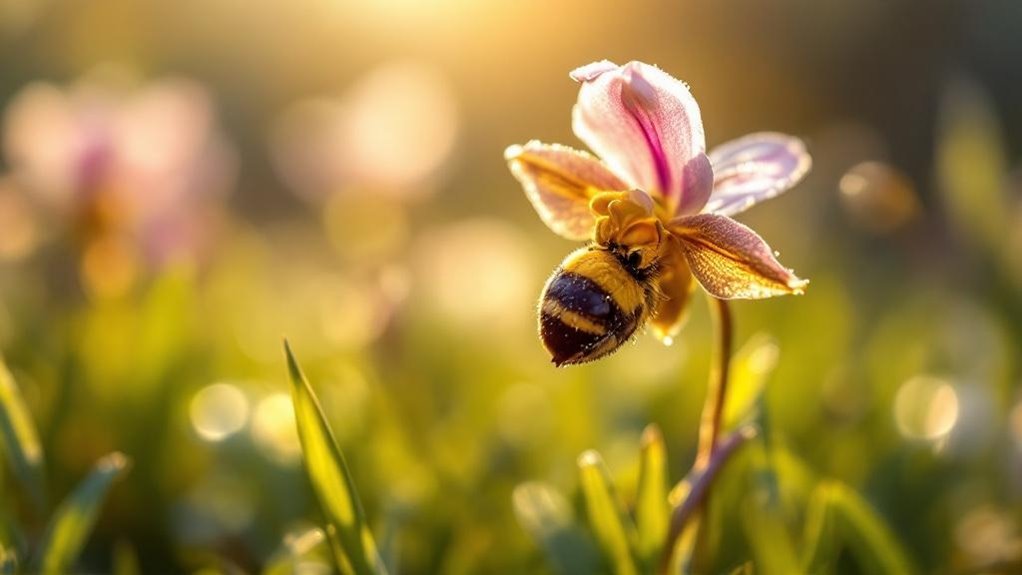
The Bee Orchid symbolizes uniqueness, attraction, and the intricate relationships that sustain the natural world; its form is highly distinctive, and its survival depends on a cultivated strategy of mimicry that reflects both observational precision and biological interdependence.
When you consider Bee Orchids, you see a plant that signifies allure, fertility, and desire because it imitates female bees, even through pheromones, drawing male pollinators into a stagnant pattern that still serves renewal.
You also encounter a longstanding emblem of rarity and elegance, since orchids have historically represented luxury, refinement, and the exceptional beauty of natural design.
In spiritual interpretation, you may read the Bee Orchid as evidence of divine intelligence, because its intricate structure and exacting pollination method suggest creation shaped through purposeful, interconnected order in nature.
Bee Orchid Colors and Visual Symbolism
Color carries much of the Bee Orchid’s symbolic force, because you don’t simply notice a purple or pink bloom, you encounter a cultivated visual strategy in which soft outer petals frame a darker, patterned labellum that resembles a female bee’s abdomen, and that resemblance gives the flower its observational power as well as its meaning.
When you study the Bee Orchid, you see how shifting shades, from pale pink to deeper purple, resist anything stagnant, because light, weather, and habitat alter intensity while preserving the flower’s central visual message.
The contrast between gentler petals and the darker center suggests fertility, sexuality, and selective allure in cultural readings, and you can understand why orchids broadly carry those associations. Here, color doesn’t merely decorate form; it directs your attention, shapes interpretation, and reinforces the Bee Orchid’s symbolic precision.
How Bee Orchid Mimicry Shapes Meaning
When you consider the Bee Orchid’s bee-like floral deception, you see more than a cultivated visual trick; you recognize an observational lesson in how appearance and scent can shape meaning through attraction, imitation, and measured disguise.
As male bees respond to the flower’s labellum and fragrance, you can connect its pollination strategy to symbolism centered on fertility, cooperation, and the quiet power of survival within ecosystems that never remain stagnant.
You also see, in nature’s ingenious resemblance, why the Bee Orchid has come to suggest beauty, allure, and the delicate balance between authenticity and imitation.
Bee-Like Floral Deception
Because its flower doesn’t merely resemble a bee but stages a precise act of deception, the Bee Orchid carries symbolism shaped by mimicry, cultivated attraction, and the quiet intelligence of evolutionary design; its labellum imitates the form of a female bee while its scent echoes her pheromones, drawing male bees into pseudocopulation, and in that encounter the orchid secures pollinia that will be carried to another bloom.
- You witness bee-like floral deception as beauty serving strategy.
- You read its cultivated mimicry as observational, not stagnant.
- You see intricate design emerge without conscious planning.
In symbolic terms, the flower asks you to regard nature as exacting and layered; appearance and scent work together, not as ornament, but as adaptive language, and that union gives the Bee Orchid meanings of complexity, interdependence, and disciplined, persuasive form.
Pollination And Symbolism
That deception reaches its full symbolic force in pollination, where the Bee Orchid’s bee-like form and pheromone mimicry don’t merely attract attention but direct reproductive exchange, making the flower a cultivated emblem of seduction, illusion, and ecological interdependence; as male bees respond to what they perceive as a receptive mate and attempt pseudocopulation, the orchid secures the transfer of pollinia, and this act gives its meaning a layered shape, suggesting that desire often follows signs that are precise rather than transparent, that beauty can operate as strategy rather than stagnant display, and that fertility and renewal may arise through complex, observational forms of contact rather than open invitation.
| Sign | Action | Meaning |
|---|---|---|
| Scent | Lures bees | Interdependence |
| Contact | Transfers pollinia | Fertility |
| Illusion | Prompts mating | Desire |
Nature’s Ingenious Resemblance
Although the Bee Orchid appears delicate and ornamental, its meaning is shaped by a highly observational form of resemblance: the trilobed labellum imitates a female bee’s abdomen, the flower releases pheromone-like scents, and together these signals guide male bees into pseudocopulation, where pollinia attach and move to another bloom.
- You see cultivated form serving survival.
- You recognize scent and shape working together.
- You read interdependence, not stagnant ornament.
In Bee orchid (Ophrys apifera), mimicry becomes symbolism; you witness a flower that doesn’t persuade through beauty alone, but through precise adaptation, and that precision suggests nature’s layered intelligence.
As male bees respond without reflection, you’re reminded that meaning can arise from instinctive exchange, evolutionary refinement, and, for some, divine design, quietly revealing an ordered world through living resemblance and patient reproductive success.
The Bee Orchid and Its Bee Relationship
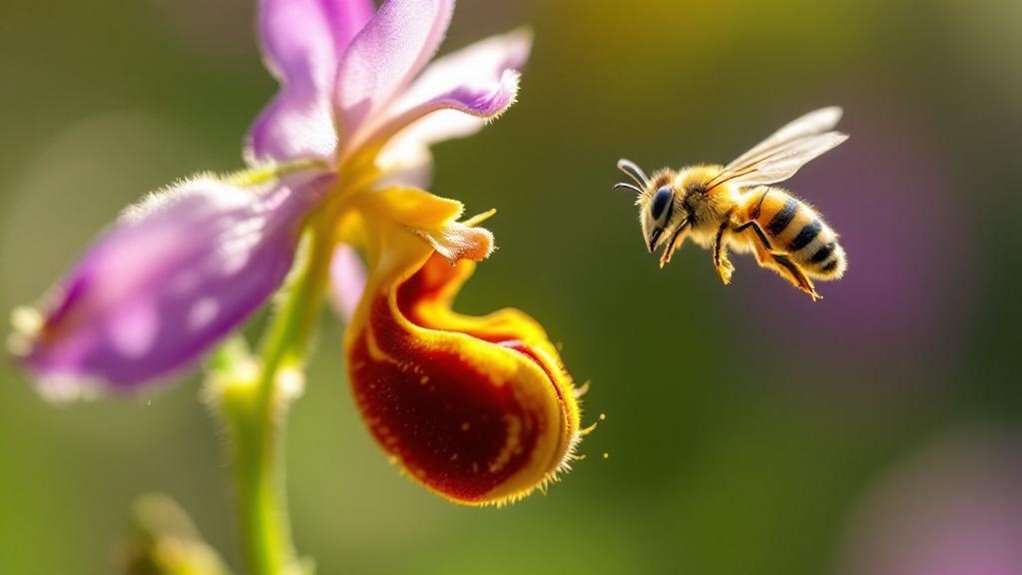
When you look closely at the Bee Orchid, you see that its bond with bees isn’t incidental but cultivated through a highly specialized form of deception called pseudocopulation, in which the flower mimics both the shape and chemical signals of a female bee.
You observe an observational partnership, not a stagnant accident; the labellum resembles a female abdomen, and male Bee pollinators, often Eucera longicornis, respond by attempting copulation, thereby carrying pollen between flowers. Its reproduction depends on specific bee species, which shows how cultivated traits arise through selection and why stable ecosystems matter.
| Feature | Effect |
|---|---|
| Labellum shape | Attracts male bees |
| Chemical mimicry | Triggers mating response |
| Pollen placement | Enables transfer |
| Specific partners | Limits reproductive success |
Why Bee Orchid Pollination Inspires Wonder
When you observe the Bee Orchid, you see a cultivated illusion at work, its bee-mimicking form and chemical signals guiding male bees with remarkable precision, and that observational detail alone explains much of its symbolic power.
You also see pollination as an intricate dance rather than a stagnant process, because the flower’s structure and scent draw in specific bees, prompt pseudocopulation, and secure pollen transfer without conscious design.
As you consider this relationship, you recognize why it inspires wonder; it joins deception, dependence, and adaptation into one quiet expression of natural complexity.
Bee-Mimicking Design
Because its strategy depends on precision rather than chance, the Bee Orchid presents one of the more observational examples of evolutionary design: it has cultivated a labellum that resembles the body of a female bee and releases pheromones that closely match her scent, drawing male bees into pseudocopulation and turning instinct into a pollination mechanism.
- You see bee-mimicking design fused with chemical persuasion.
- You recognize Ophrys apifera as adaptive, not decorative.
- You understand why stagnant views of plants fail.
When you examine this orchid closely, you notice how form and scent align with unusual exactness, creating a persuasive signal that male bees read as biological truth; in that alignment, natural selection appears less abstract, more legible, and quietly profound, because reproduction here depends on resemblance refined over generations, not on random attraction alone.
Pollination’s Intricate Dance
Although the Bee Orchid’s pollination may look almost theatrical at first glance, its effect depends on a precise sequence of physical and chemical cues, each cultivated through co-evolution, each guiding the male bee into pseudocopulation without reflection or choice; you observe sexually deceptive pollination at work, not as trickery alone, but as an observational study in adaptation.
Its trilobed labellum resembles a female bee’s abdomen, its scent sharpens the illusion, and the male responds through instinct rather than thought. As he attempts mating, pollinia fasten to his head, and when he searches again among flowers, he carries pollen onward with stagnant devotion to the same false promise.
You can’t miss the precision here; it reveals how deeply life forms shape one another, and why that interdependence inspires quiet wonder.
Why the Bee Orchid Feels So Alluring
If you look closely at the Bee Orchid, its allure becomes clear through a cultivated blend of form, scent, and strategy; the flower doesn’t rely on passive beauty alone, but on an observational precision that makes its petals and patterned lip resemble a female bee closely enough to draw male pollinators into contact.
- Visual mimicry guides attention.
- Pheromone scent deepens attraction.
- Cultural recognition sustains interest.
You notice how Bee Orchid blooms avoid stagnant beauty, because their large purple sepals and trilobed labellum create an exacting impression of life, while emitted scents imitate female bee pheromones and strengthen the deception.
This reproductive method, pseudocopulation, gives the plant an uncommon authority in nature, and its standing as Bedfordshire’s county flower adds historical weight, inviting admiration from botanists, naturalists, and anyone attentive to refined adaptation.
Bee Orchid Meanings in Love and Desire
When you consider the Bee Orchid in the context of love and desire, you see how attraction operates through cultivated beauty and precise mimicry, drawing response not by chance but by design.
Its resemblance to a female bee gives love through mimicry an observational force, suggesting that desire often begins where beauty, instinct, and longing meet, while never remaining stagnant.
In that way, the flower becomes a measured symbol of sensuality, fertility, and connection; it shows you that love can be intricate, persuasive, and quietly shaped by the forms that invite pursuit.
Desire And Attraction
Because its bloom is shaped and scented to imitate a female bee, the Bee Orchid has long symbolized desire and attraction, not as abstract ideals but as cultivated forces that guide pursuit, heighten attention, and expose how beauty can direct behavior with quiet precision.
In your reading of the Bee Orchid, desire and attraction become observational, embodied, and difficult to dismiss; you see allure working through appearance, scent, instinct, and response rather than stagnant fantasy alone.
- beauty directs attention and pursuit
- scent deepens temptation and longing
- romance carries complexity, not certainty
You also recognize why the Bee Orchid appears in gifts and arrangements: it conveys passion, yearning, and romantic intention with unusual clarity, while reminding you that attraction often joins beauty to pursuit, and seduction to consequence.
Love Through Mimicry
The Bee Orchid presents love not as a purely transparent feeling but as a cultivated exchange shaped by signals, imitation, and response; through a bloom that resembles and scents itself like a female bee, it turns attraction into an observational drama in which desire emerges through recognition, misrecognition, and pursuit.
When you read this floral symbol through love, you see how longing rarely stays stagnant or simple; it often depends on presentation, timing, and the willingness to move toward what seems to answer a private need.
The orchid’s deceptive pollination becomes an allegory for seduction, showing you that desire can arise from surfaces while still leading toward genuine connection, emotional insight, and a deeper awareness of intention.
In that sense, love asks for discernment, because attraction and truth don’t always arrive together.
Bee Orchid Folklore Across Europe
Across Europe, the Bee Orchid enters folklore as more than a botanical curiosity; it becomes a cultivated sign through which communities interpreted love, fertility, luck, and the balance between human life and the natural world.
- Greek traditions tied orchids to Orchis, so you encounter fertility and virility.
- In British folklore, you read the Bee Orchid as quiet good luck.
- Druidic rites treated it as nature’s balance, never stagnant, always observational.
Across Europe, this Bee Orchid folklore also acquired a divine register, because its unusual pollination suggested intentional design rather than accident; you see communities reading the flower as evidence that creation worked through subtle forms.
Although Aztec vanilla orchids stood outside Europe, their kinship reinforced older European associations with beauty, fertility, and prosperous harvests.
Bee Orchid as a Symbol of Interconnection
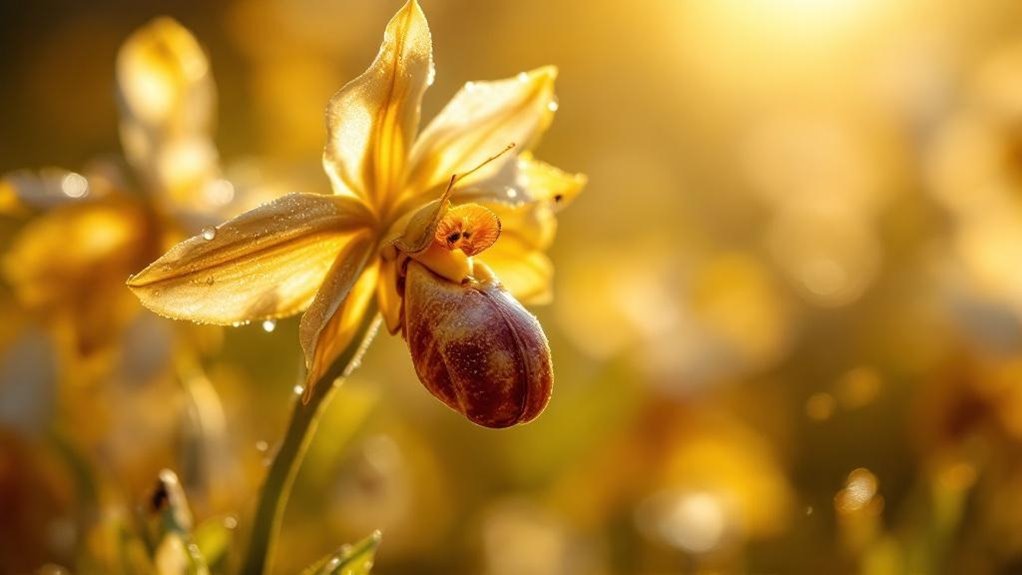
From those cultivated folklore readings, Bee Orchid symbolism moves naturally toward interconnection, since the flower’s meaning doesn’t rest in isolated beauty but in relationship; its patterned labellum mimics a female bee’s abdomen, its chemistry echoes mating signals through pheromones, and together these features show you a plant shaped in active correspondence with its pollinators rather than as a stagnant object of observation alone.
| Feature | Connection | Meaning |
|---|---|---|
| Labellum | Attracts bees | Reproductive link |
| Pheromones | Signal mating cues | Ecological balance |
When you read the bee orchid this way, you see interconnection as dependence, not ornament; reproduction needs pollinators, habitats need biodiversity, and the flower’s presence marks ecological health. Its beauty becomes observational evidence that species persist through responsive exchange.
Spiritual Meanings of the Bee Orchid
Reverence often gathers around the Bee Orchid because its form invites more than observational interest; you can read its bee-like labellum, its cultivated deception of pollinators, and its precise reproductive strategy as signs of a world ordered with unusual intricacy, where spiritual meaning emerges through relationship rather than stagnant display alone.
Its spiritual meanings become clearer when you attend to what it asks of you:
Its spiritual meanings deepen when you receive its quiet invitation to attention, patience, restraint, and relational beauty.
- notice design, patience, and restraint
- honor fertility, desire, and renewal
- recognize beauty as relational, not isolated
You encounter the Bee Orchid as a lesson in mindful attention; it joins love, beauty, and reproductive purpose, showing that creation works through dependence and response.
Its mimicry suggests that spiritual growth also requires timing, receptivity, and disciplined waiting, while its elegance quietly affirms interconnected life within a meaningful order.
Bee Orchid in Christian Symbolism
Seen through a Christian lens, the Bee Orchid becomes more than an observational curiosity; it stands as a quiet witness to God’s intelligent design. Its bee-like form and cultivated mimicry suggest that creation isn’t stagnant or accidental but ordered toward purpose, relation, and continuation.
As you consider the Bee Orchid, or Ophrys apifera, you can read its intricate resemblance to the female bee as a sign that divine wisdom works through complexity, drawing life forward with intention. This cultivated deception becomes, in Christian reflection, a figure for spiritual enlightenment, growth in faith, and the soul’s gradual awakening to providence.
Where some Christians notice red spotting, they may also discern an echo of Christ’s blood, sacrifice, and redemption. Meanwhile, the orchid’s bond with pollinators recalls Romans 1:20, revealing God through creation’s visible beauty.
Bee Orchid in Gardens and Wild Places
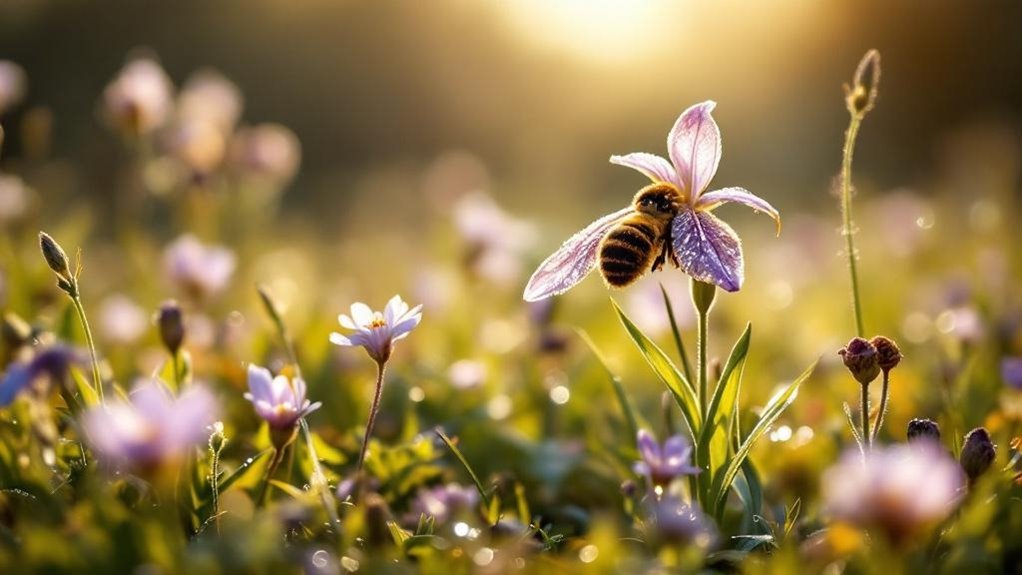
The Bee Orchid occupies a notable threshold between cultivated gardens and wild places, because it thrives in semi-dry turf, grasslands, open woodland, and even disturbed urban ground.
Yet it never becomes merely ornamental; wherever you encounter it, whether in a managed border or a roadside verge, its presence points to an ecology that isn’t stagnant but dynamically ordered, dependent on open light, suitable pollinators, and the mycorrhizal fungi that sustain its roots below the soil.
- In gardens, you observe restraint
- In verges, you notice persistence
- In both, bee orchid demands protection
You see bee orchid flower from spring into summer, its spikes carrying several bee-mimicking blooms.
You also recognize that habitat loss and illegal collecting reduce places where it can persist naturally.
Modern Meanings of the Bee Orchid
Today, you can read the Bee Orchid as a contemporary symbol of beauty, fertility, and cultivated resilience, because its precise mimicry and survival within changing habitats show how attraction and adaptability remain joined in the natural world.
You also see its cultural significance in modern life through observational views of ecology, design, and spirituality; its form suggests that nothing in creation is stagnant, and its long presence in folk practice gives that meaning unusual continuity.
As you consider modern interpretations, you recognize a flower that still signifies seduction, survival, and quiet wonder, while reminding you that ecological interdependence shapes both symbolic thought and lived experience.
Contemporary Symbolic Interpretations
Intricacy defines much of the Bee Orchid’s contemporary symbolism, because its cultivated deception, shaped through evolution rather than intent, directs attention to nature’s fine-grained beauty and to the observational precision of plant-pollinator relationships that never remain stagnant.
- You see intricate beauty expressed through adaptive form and fragrance.
- You recognize sexual deception as allure shaped by ecological necessity.
- You read resilience, fertility, and continuity in its reproductive strategy.
When you consider the Bee Orchid today, you encounter more than a curious flower; you witness evolution’s complexity made visible, where mimicry of female bees suggests attraction without sentiment, and where seduction serves survival.
Its symbolism now emphasizes adaptability, interdependence, and the delicate balance sustaining ecosystems, reminding you that nature persists through precise relationships, constant adjustment, and extraordinary, quietly resilient design across changing conditions.
Cultural Significance Today
Because modern culture increasingly reads ecological health through visible signs, the Bee Orchid has come to signify more than rare floral charm; it stands for biodiversity, observational respect for plant-pollinator systems, and a cultivated awareness that beauty in nature often depends on relationships too precise to remain stagnant.
When you encounter a Bee Orchid today, you often read it as evidence of ecological balance, since its presence suggests floral diversity and pollinator strength working together rather than declining apart.
Its elaborate mimicry also speaks to modern ideas of attraction, showing how appearance, desire, and response shape relationships in subtle ways.
In gardens, conservation projects, and urban planting schemes, the Bee Orchid represents your commitment to renewal, fertility, and sustained environmental care, linking aesthetic appreciation with practical stewardship and long-term ecological responsibility today.
When Bee Orchid Imagery Makes a Meaningful Gift
When you want a gift to carry more than surface beauty, Bee Orchid imagery offers a cultivated choice, one that suggests close observation, respect for complexity, and an awareness that nature rarely rests in anything stagnant or simple.
- For milestones, it conveys elegance, perfection, and earned distinction.
- In relationships, it quietly suggests attraction, fertility, and reciprocity.
- For reflective recipients, it honors biodiversity, rarity, and ecological care.
You give Bee Orchid imagery when you want symbolism that feels observational rather than sentimental, because its bee-like form points to intricate design, reproductive intelligence, and the layered beauty of creation.
It also suits moments of achievement, since many traditions connect this flower with refinement and near-perfection.
Because the plant is rare and protected in some places, its image can also remind someone to value conservation.
Bee Orchid Symbolism in Art and Tattoos
That same observational quality that makes Bee Orchid imagery a meaningful gift also gives it unusual force in art and tattoos, where its bee-mimicking form, cultivated symmetry, and intricate anatomy let artists explore beauty not as something stagnant or decorative, but as evidence of intelligent design within nature.
When you encounter bee orchid imagery in painting, illustration, or ink, you see more than ornament; you see attraction, reproduction, and the disciplined complexity of plant-pollinator exchange rendered visible.
In tattoos, the bee orchid often signifies sexuality, uniqueness, and your bond with the natural world, while its older associations with fertility and divinity let you express personal growth, spiritual refinement, and reverence for botanical diversity through color, detail, and carefully observed form.
Frequently Asked Questions
What Does the Bee Orchid Symbolize?
You can see the bee orchid symbolizes beauty, uniqueness, fertility, and connection in nature. Its bee-mimicking form shows life’s intricate design, so you might also read it as elegance, rarity, and even a sign of creation.
What Does Baking Soda Do for Orchids?
Like a gentle shield, baking soda helps your orchids fight fungus, deter pests, balance acidic soil, and brighten leaves. You should dilute it carefully, though—too much can choke roots and disrupt nutrient uptake badly.
How Rare Is a Bee Orchid?
You’ll find bee orchids relatively rare overall: they’re locally common in parts of southeastern England and southern Europe, but scarce elsewhere. You can see populations decline from habitat loss, overharvesting, environmental change, and fragile fungal dependence.
What Makes a Bee Orchid Unique?
You’d find a bee orchid unique because it mimics a female bee’s look and scent, tricking males into pseudocopulation for pollination. Its bee-shaped labellum, adaptable habitat range, and fungal partnership make its survival especially remarkable.
Conclusion
When you consider the bee orchid, you see more than an unusual flower; you encounter a cultivated symbol of adaptation, desire, and observational intelligence, shaped by mimicry, habitat, and survival. Its form resists stagnant interpretation, because it joins beauty with strategy, wildness with precision, and folklore with ecological fact. What better emblem could you choose when you want meaning that feels subtle, grounded, and enduring, rather than decorative alone or merely sentimental in passing?