
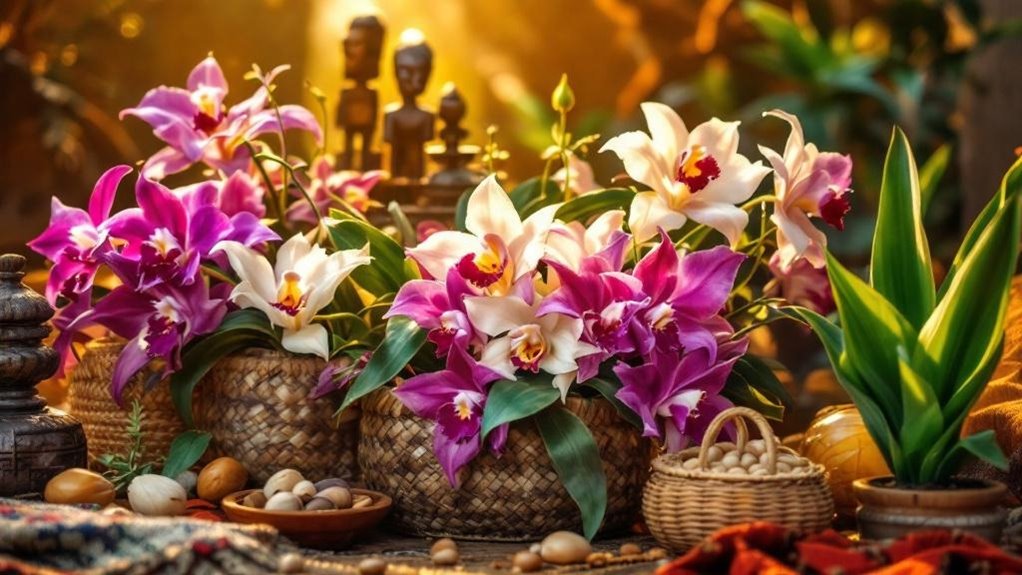
In African traditions, you’ll find orchids symbolizing beauty, love, fertility, and cultural dignity; their rarity gives them cultivated esteem, and their use in weddings, healing rites, and offerings ties social memory to spiritual continuity. You can also observe their regional importance in places such as Kenya, where orchids support local identity, eco-tourism, and biodiversity through pollinator relationships, even as habitat loss and overcollection create stagnant pressures that community conservation efforts now address, with more context ahead.
- Key Takeaways
- What Orchids Symbolize in African Cultures
- Why Orchids Matter in African Tradition
- Orchids as Symbols of Beauty and Love
- Spiritual Meanings of Orchids in Africa
- Orchids in African Healing Practices
- Orchids in Ceremonies and Celebrations
- Where Orchids Grow Across Africa
- How Orchid Habitats Shape Cultural Meaning
- The Leopard Orchid in African Culture
- Kenya’s Orchid Heritage as a National Symbol
- Orchids, Eco-Tourism, and Local Identity
- Threats to Orchids Across Africa
- Orchid Conservation and Community Action
- Why Orchid Conservation Matters in Africa
- Frequently Asked Questions
- Conclusion
Key Takeaways
- In many African traditions, orchids symbolize beauty, elegance, love, fertility, and social esteem.
- Orchids appear in weddings, birthdays, and communal celebrations as signs of prosperity, affection, and cultural continuity.
- Some species, especially the leopard orchid, are used in healing and spiritual rites linked to endurance, balance, and ancestral offerings.
- African orchids thrive across tropical regions like Kenya, Angola, Botswana, and Nigeria, where they support biodiversity and pollinators.
- Habitat loss and overcollection threaten wild orchids, making community conservation and sustainable cultivation increasingly important.
What Orchids Symbolize in African Cultures

Across many African cultures, orchids carry a cultivated symbolism of beauty and elegance, and their vivid colors, intricate forms, and observational rarity have also linked them with love, fertility, and refinement; in this way, they’re valued not merely as decorative flowers but as living expressions of social esteem, continuity, and the quiet dignity a community resists allowing to become stagnant.
When you consider African orchid species, you see symbols shaped by appearance, setting, and communal regard; their patterned petals suggest refinement, their scarcity deepens esteem, and their presence within celebrated landscapes strengthens associations with unity and inherited pride.
You can also note how the leopard orchid’s respected place in traditional medicine broadens symbolism beyond beauty alone, because healing use gives certain orchids an added meaning of care, endurance, and cultural memory.
Why Orchids Matter in African Tradition
You can see why orchids matter in African tradition when you observe how they embody cultivated beauty, echoing the colors, patterns, and refinement long valued in dress, art, and social expression.
You also find their importance in ritual and healing, because communities use orchids in ceremonies tied to love and fertility, and in traditional medicine, where species such as the leopard orchid serve practical purposes that keep symbolism from becoming stagnant.
You can also recognize orchids as markers of heritage and unity, since their presence in lived landscapes, cultural memory, and conservation efforts helps sustain a shared floral legacy across diverse African societies.
Symbols Of Beauty
Grace marks the place orchids hold in African tradition, where their cultivated forms and vibrant colors have long symbolized beauty, love, and fertility, not as stagnant ornaments but as living signs of harmony between human communities and the natural world.
You see symbols of beauty in orchids through:
- refined color and form
- love and fertility across communities
- Kenyan meadows shaping heritage
- shared pride through conservation
In Kenya, orchids deepen scenic landscapes, support eco-tourism, and strengthen cultural memory; as visitors move through orchid-filled meadows, you observe how floral presence reflects national pride and ecological awareness.
Across ethnic communities, you find a collective regard for orchids that encourages unity, because their beauty feels shared rather than owned.
Even the leopard orchid, noted for its striking appearance, shows how closely observational admiration and cultural practice remain linked.
Ritual And Healing
Beyond their cultivated beauty, orchids matter in African tradition because communities have long treated them as working plants as well as admired ones; their flowers and roots enter rituals of marriage, fertility, healing, and remembrance, and that use keeps them from becoming stagnant symbols detached from daily life.
You see this clearly in observational accounts of traditional medicine, where orchid extracts address varied ailments, and where the leopard orchid, Ansellia africana, holds a respected place for its reputed therapeutic value.
You also find orchids in love and marriage rites, where they mark fertility, beauty, and desired continuity between families. In spiritual practice, an orchid may accompany offerings to ancestral spirits, not as decoration alone, but as a cultivated medium through which you seek blessing, protection, and measured cultural continuity today.
Heritage And Unity
Because orchids carry meanings that extend across household practice, ritual memory, and cultivated display, they serve as quiet emblems of heritage and unity in many African societies, linking beauty, love, and fertility with shared customs that don’t become stagnant because they remain tied to daily life.
- You see beauty and fertility joined in custom.
- You recognize species as cultural markers.
- You notice Kenya’s pride in orchid heritage.
- You connect cultivation with eco-tourism and unity.
Across communities, you encounter orchids in medicine, ceremony, and observational appreciation, where vivid color and delicate form signal refinement and continuity; in Kenya especially, their proposed national status reflects cultivated national pride, while conservation efforts invite different ethnic groups to protect living heritage together, strengthening shared identity and environmental responsibility for future generations.
Orchids as Symbols of Beauty and Love
When you consider orchids in African symbolism, you see beauty in bloom as both an observational truth and a cultivated ideal; in Kenya, their vibrant colors reflect national pride and cultural heritage, while the leopard orchid stands as a quiet emblem of refinement and delicacy.
You also find that love and devotion aren’t stagnant abstractions here, because orchids have long marked affection, fertility, and good fortune, and people give them during special occasions to affirm bonds and shared feeling.
As you move into this subject, you can recognize how these flowers join aesthetic grace with social meaning, shaping celebrations, supporting unity across ethnic groups, and strengthening the landscapes that define Africa’s natural and cultural beauty.
Beauty In Bloom
Grace marks the orchid’s place in African symbolism, where its cultivated form and vivid color have long stood for beauty, love, and refinement. Its intricate bloom carries an observational weight that resists anything stagnant or merely decorative.
You see this esteem across regions:
- orchid flowers were used in art and celebration.
- Leopard orchids signify elegance, rarity, and cultural regard.
- Scenic orchid habitats strengthen eco-tourism and visual identity.
- Kenyan orchids reflect heritage, pride, and cultivated national taste.
When you consider African traditions, you find orchids linked with delicacy and fertility, not sentimentally, but through form, color, and presence. They refine ceremonies, deepen artistic expression, and lend landscapes a composed splendor, reinforcing beauty as something living, culturally observed, and quietly enduring across communities and generations alike.
Love And Devotion
From beauty as a cultivated ideal, orchids move naturally into the language of love and devotion, where their vivid color, refined structure, and observational presence give affection a visible form that doesn’t feel stagnant or merely ornamental.
In Kenyan culture, you encounter orchids as signs of beauty, love, fertility, and refinement; they carry national pride while also marking private attachment. Across African traditions, their colors support rituals of devotion, and when you offer them in gifts, you communicate affection with restraint, elegance, and intention rather than excess.
You also see how orchids suggest unity, because communities across ethnic lines value them in similar ways, and that shared regard strengthens connection.
In local folklore, their layered form becomes a metaphor for love itself, deep, delicate, and complex, and enduring.
Spiritual Meanings of Orchids in Africa
Although spiritual meanings vary across regions and communities, orchids in African symbolism often carry a cultivated sense of beauty, love, and fertility. This association gives them a quiet place in ceremonies and life passages where refinement matters as much as display.
You can read their symbolism through observational patterns such as:
- beauty and delicacy in intricate blooms
- love in celebratory floral choices
- fertility in unions and family milestones
- cultural pride in protected landscapes
Across communities, orchids suggest refinement rather than stagnant excess, and you see that meaning reinforced by vibrant color, careful form, and their presence in valued landscapes.
Orchids evoke refinement over excess, their vivid color and precise form deepening meaning within treasured landscapes.
When orchids appear in celebrations, you can interpret them as signs of affection, continuity, and hoped-for abundance. When communities conserve them, you also witness a declarative effort to preserve both biodiversity and inherited cultural memory.
Orchids in African Healing Practices

As you turn from spiritual meanings to healing practices, you see orchids used in traditional African medicine for their therapeutic properties, with cultivated knowledge guiding how roots, leaves, or other parts support remedies for varied ailments.
You also find ritual symbolism in these plants, especially in the leopard orchid, whose distinctive form and herbs-like fragrance give it a steady place in healing rites as well as an observational value among collectors.
When you consider these uses together, you recognize a tradition that hasn’t grown stagnant, because it binds indigenous knowledge to local flora and makes orchid preservation essential to both cultural heritage and community health.
Traditional Medicinal Uses
Because many African healing systems developed through close observational knowledge of local plants, orchids hold a cultivated place in traditional medicine, where several species are prepared as extracts or herbal mixtures to address infections, inflammation, and respiratory complaints. The leopard orchid, *Ansellia africana*, is especially notable, since healers use its flowers and pseudobulbs in remedies that reflect both practical treatment and symbolic value.
You see tropical orchids used in ways such as:
- extracts for infections
- mixtures for inflammation
- remedies for respiratory troubles
- roots supporting fertility treatments
In some communities, orchid roots enter aphrodisiac preparations intended to support fertility, while broader herbal concoctions address chronic conditions and stagnant weakness, sustaining well-being.
You also see why conserving native orchids matters, because medicinal practice, ecological continuity, and inherited plant knowledge remain closely linked.
Ritual Healing Symbolism
Within ritual healing, orchids carry more than medicinal utility; healers use them to frame illness and recovery within a symbolic order, where the leopard orchid and related species signify endurance, fertility, attraction, and restored balance.
Their herbal, honey-like fragrance is thought to steady the body and clarify the ritual space at the same time. You see ritual healing symbolism in orchids when healers pair roots, flowers, and scent with observational rites, because beauty can calm a stagnant mind, cultivate hope, and reinforce communal belief in renewal.
Their resilient growth supports practices that ask you to imagine health returning in measured stages, not abruptly. This symbolism also carries obligation; if habitat loss continues, you don’t merely lose plants, you lose cultivated knowledge, healing context, and continuity across generations within communities.
Orchids in Ceremonies and Celebrations
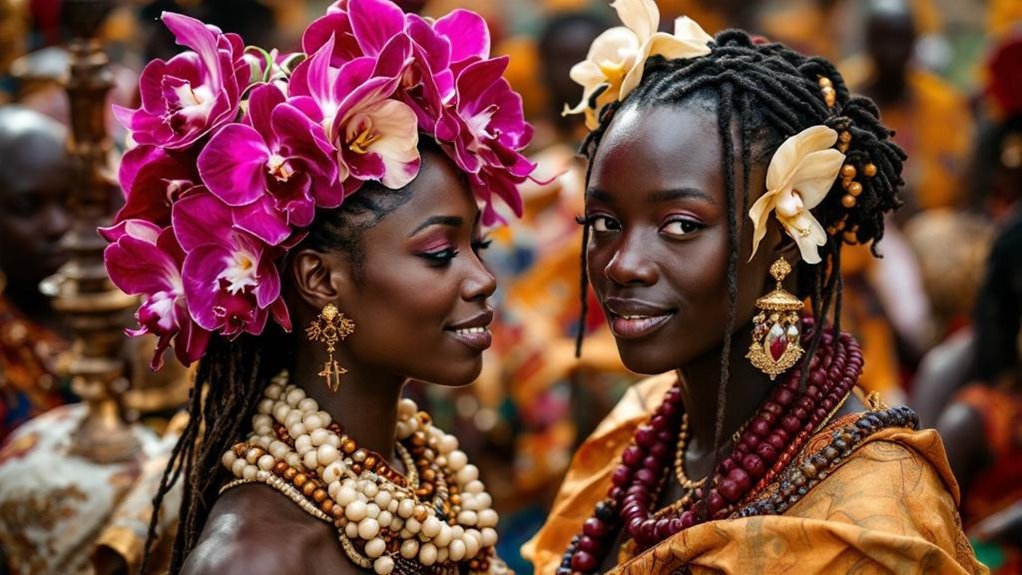
When orchids appear in ceremonies and celebrations across Africa, they do more than decorate a space; they signal values that communities have cultivated over generations, especially love, beauty, fertility, prosperity, and blessing.
You see their meaning clearly in public and family occasions:
- At weddings, orchids adorn bouquets and ceremonial spaces, affirming love and beauty.
- Leopard orchids often mark traditional celebrations, where their blooms suggest fertility and prosperity.
- During birthdays and anniversaries, orchids become gifts that carry blessings and steady good wishes.
- In Kenya and regional festivals, orchids strengthen unity, linking communities through shared artistic appreciation.
As you observe these uses, you recognize that orchids keep celebration from becoming stagnant; their colors, forms, and careful arrangements turn gatherings into observational records of heritage, artistry, and communal continuity across generations.
Where Orchids Grow Across Africa
The meanings orchids carry in African ceremonies rest on a visible botanical reality: these plants grow across a wide range of African landscapes, most often at lower elevations in coastal and riparian habitats, where many species anchor themselves on tree branches and draw moisture and nutrients from the air through cultivated aerial root systems.
If you trace their range, you find the greatest diversity in tropical Africa, including Kenya, Angola, Botswana, and Nigeria; you also see how climate, from equatorial jungles to drier zones, supports distinct species rather than a stagnant uniform flora.
In Kenya, observational records place orchids in the Aberdare Range, the Mau Escarpment, and on Mount Kenya, where higher conditions also sustain them. The leopard orchid, Ansellia africana, shows this pattern clearly, fastening to branches and thriving through aerial absorption there.
How Orchid Habitats Shape Cultural Meaning
Habitat gives orchids much of their symbolic force across Africa, because people don’t encounter these plants as a stagnant decorative presence but as living forms that persist along tropical coastlines, in riparian forests, and even in the cooler high-altitude zones of Kenya, where beauty appears inseparable from endurance.
You read each flower through place; resilience cultivated in the Aberdare Range and on Mount Kenya becomes pride, while Kenya’s 250 native species also suggest love and fertility across diverse communities.
- Coastlines frame beauty against exposure
- Highlands link endurance with dignity
- Medicinal uses connect flora and wellness
- Conservation protects meaning and memory
This observational bond supports eco-tourism and local esteem, yet when development and agricultural expansion diminish orchid habitats, you lose more than scenery; you weaken cultural identity, inherited practice, and the meanings people attach to these plants.
The Leopard Orchid in African Culture

Across much of Africa, the Leopard Orchid, *Ansellia africana*, holds a steady place in cultural symbolism because its spotted blossoms unite visual refinement with an unmistakable sense of strength, and its growth high on tree branches reinforces an observational reading of resilience rather than a stagnant idea of beauty.
When you encounter the Leopard Orchid in cultural traditions, you see more than ornament; you see a cultivated emblem of love, fertility, healing, and inherited pride. Its herbal, honey-like fragrance supports associations with medicine, and several communities use it in healing practices that link appearance with practical value.
You can also read its “trash-basket” habit, gathering support from branches, as evidence of adaptability. Because habitat loss and overcollection threaten it, protecting this orchid also protects meanings that many communities still recognize and sustain.
Kenya’s Orchid Heritage as a National Symbol
Emblem and inheritance meet in Kenya’s orchid heritage, where roughly 250 native species have helped position the orchid as an unofficial national flower, one that reflects the country’s colorful biodiversity while resisting any stagnant reading of beauty as mere decoration.
You can read this cultivated symbolism through several observational markers:
- Love, fertility, and refinement gather around orchid imagery.
- Diverse communities may see in it a quiet call to unity.
- Aberdare and Mount Kenya sustain orchids at 1,500–3,000 meters.
- Urban growth and deforestation diminish habitats and demand conservation.
When you regard the orchid as a national flower, you also recognize a living archive, one rooted in highland ecologies and cultural memory; its intricate blooms don’t merely adorn landscapes, they ask you to preserve a floral legacy that still shapes Kenya’s national imagination today.
Orchids, Eco-Tourism, and Local Identity
Many travelers encounter Kenya’s orchids first as part of the landscape’s cultivated appeal, where highland trails and meadow routes draw visitors not only with observational beauty but with a more layered sense of place; these flowers deepen eco-tourism because they give form to the country’s biodiversity, invite sustained attention to fragile environments, and distinguish trekking destinations from more stagnant versions of scenic travel that treat nature as backdrop alone.
As you move through orchid-rich regions, you see how preservation supports local identity, since these flowers carry cultural memory and national pride, while eco-tourism channels visitor interest into community income, conservation work, and sustainable land use.
When residents guide walks, manage habitats, and interpret orchid landscapes, they strengthen belonging, affirm responsibility to place, and connect Kenya’s environmental stewardship with its cultural self-understanding for future generations.
Threats to Orchids Across Africa

Although orchids often appear resilient within Africa’s cultivated gardens and observational travel routes, their wild populations are declining as urban development and agricultural expansion steadily replace the forests, highland meadows, and wet habitats they require. This pressure grows more severe when collectors remove plants for ornamental trade or medicinal use, because species that depend on narrow ecological conditions don’t recover easily once local populations are thinned.
Wild African orchids decline as development and collection erode the specialized habitats they need to recover and persist.
You can trace these pressures across regions:
- In Madagascar, deforestation steadily narrows orchid range.
- In Ethiopia’s mountains, land conversion disrupts fragile habitats.
- Wild orchids face overcollection for medicine and ornament.
- Many species remain precarious where habitats become fragmented, stagnant.
As you consider African symbolism, you should also recognize that orchid diversity declines quietly when habitat loss and human extraction intersect across landscapes, undermining species persistence.
Orchid Conservation and Community Action
As urban development and agricultural land conversion continue to narrow orchid habitat in places such as Kenya, effective conservation depends on coordinated community action, cultivated awareness, and clear limits on extraction; without these measures, observational concern remains passive, and small wild populations decline toward stagnant isolation.
Through orchid conservation, you support habitat initiatives that teach ecological stewardship, encourage local monitoring, and strengthen preservation practices around remaining sites. You can see this approach in the Kenya Orchid Society, which advances awareness and promotes cultivation of native species, reducing pressure on wild plants while building practical knowledge.
You also need strict guidelines against overcollection for ornamental trade, because unmanaged demand weakens recovery. When communities, growers, and conservation groups cooperate across African countries, you help protect vulnerable orchids through shared standards, careful propagation, and consistent habitat protection.
Why Orchid Conservation Matters in Africa
You can see why orchid conservation matters in Africa when habitat loss from urban growth, deforestation, and agricultural expansion steadily reduces wild populations, and when collecting pressure keeps cultivated interest from becoming a stagnant threat to native species.
You also protect more than biodiversity, because orchids carry cultural meaning across many communities, reflecting beauty, unity, and national pride as part of a living heritage that shouldn’t be diminished.
When you support community conservation action, including observational education and local stewardship encouraged by groups such as the Kenya Orchid Society, you help sustain both ecological balance and cultural continuity.
Habitat Loss Threats
Because urban expansion and agricultural conversion continue to overtake forests, wetlands, and grasslands across Africa, native orchids are losing the specific habitats they need to persist. Their decline reflects more than a simple reduction in plant numbers; it signals a broader weakening of ecological relationships that depend on intact, cultivated, and observational understanding of place.
You can see habitat loss threats in several linked pressures:
- forests cleared for farms
- wetlands drained for settlement
- grasslands fragmented by roads
- stagnant protection where laws exist
When deforestation removes canopy, moisture shifts, pollinators disperse, and orchid populations contract.
You also face overcollection and habitat degradation, which place many species at risk of extinction. Effective conservation efforts, including awareness and sustainable cultivation promoted by groups such as the Kenya Orchid Society, help you protect orchids and the ecosystem balance they quietly support.
Cultural Heritage Protection
Habitat loss threatens more than orchid populations alone; it also erodes a cultivated body of meaning in which these plants symbolize beauty, love, and unity across diverse African communities. That symbolic presence helps bind local tradition to a broader shared identity.
When you support cultural heritage protection, you preserve living symbols as well as ecosystems; in Kenya alone, roughly 250 native orchid species anchor observational links between biodiversity, memory, and practice. If urban expansion, agricultural conversion, and overcollection continue, those links grow stagnant, and local traditions lose visible reference points.
You also sustain education through institutions such as the Kenya Orchid Society, which frames orchids as ecological and cultural assets. For nature lovers, protection strengthens eco-tourism, enriches landscapes, and keeps encounters with African flora connected to heritage, dignity, and continuity.
Community Conservation Action
While orchid conservation often appears to center on rare plants alone, its practical strength in Africa depends on community action, since local residents observe seasonal change, recognize early signs of habitat decline, and can interrupt overcollection before losses become stagnant and difficult to reverse.
Your community involvement protects biodiversity, especially in Kenya, where many of 250 native orchid species face pressure from habitat loss, urban growth, and agricultural expansion.
- You support habitat preservation with local groups.
- You encourage cultivated orchids over wild collection.
- You preserve beauty, heritage, and national pride.
- You strengthen eco-tourism through observational education.
When you back efforts such as those encouraged by the Kenya Orchid Society, you help connect ecological awareness with practical stewardship, and you reinforce sustainable livelihoods, cultural identity, and healthier ecosystems for future generations across regions.
Frequently Asked Questions
What Do Orchids Symbolize in Different Cultures?
You’ll find orchids symbolize love, beauty, fertility, luxury, and refinement across cultures; they can also represent strength, good fortune, respect, and healing. In some traditions, you’d give them to honor relationships, celebrate milestones, or invite blessings.
Are Orchids Native to Africa?
Yes—Africa hosts about 250 native orchid species, so you can confidently say orchids are native there. You’ll find them from coastal forests to mountain habitats, with standout species like the leopard orchid growing widely.
What Do Flowers Symbolize in African Culture?
In African culture, you see flowers symbolize beauty, love, life, healing, and spiritual connection. They mark weddings, births, and memorials, and they can express blessings, unity, pride, resilience, and the emotional messages communities share.
What Is Kenya’s National Flower?
Kenya doesn’t have an official national flower, but you’d often hear the leopard orchid, Ansellia africana, called its unofficial one. You can see why: it reflects Kenya’s biodiversity, natural beauty, and strong horticultural pride today.
Conclusion
When you consider orchids in African symbolism, you see more than cultivated beauty; you see observational evidence of how plants carry memory, belief, and livelihood across regions, resisting stagnant views of tradition as fixed. In Cameroon, for example, community-led orchid walks have linked forest protection with local income, showing how cultural respect can support conservation. If you value orchids as symbols and living species at once, you help sustain both regional identity and ecological continuity.