
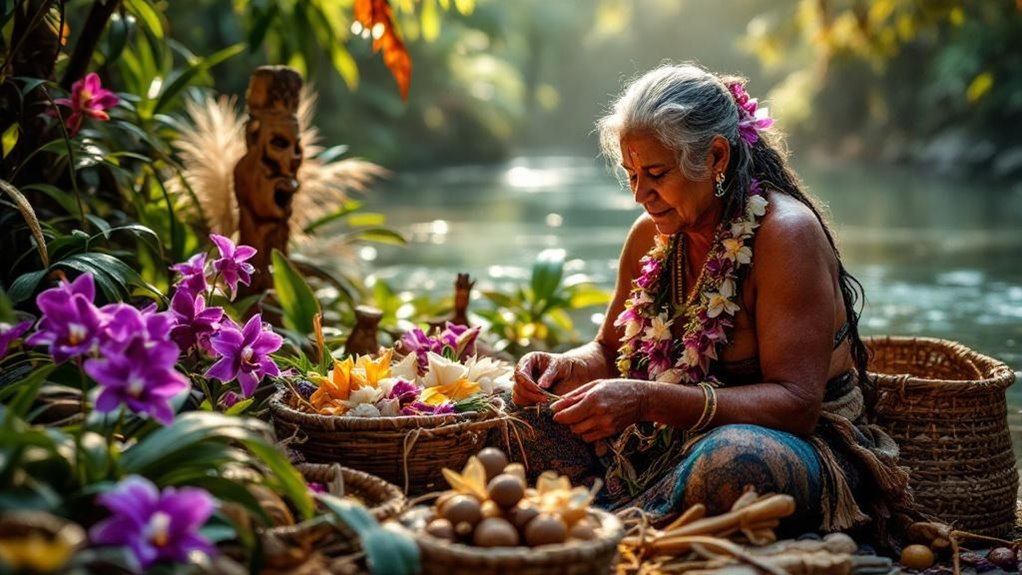
In South American Indigenous traditions, you find orchids understood through observational knowledge rather than stagnant symbolism; they’re cultivated and named as signs of fertility, healing, place, and spiritual presence. Quechua and other local names preserve terrain, weather, and medicinal memory, while ritual and daily use tie orchids to continuity across generations. Colonial collecting weakened many of these relationships, yet collaborative conservation now shows how cultural knowledge still guides protection, and what follows makes that clearer.
- Key Takeaways
- What Orchids Mean in Indigenous Traditions
- How Indigenous Peoples Named Andean Orchids
- Quechua Orchid Names and Their Meanings
- How Orchid Names Preserve Place and Memory
- Orchids in Ritual, Healing, and Daily Life
- Orchids in Colombian Indigenous Culture
- Why Cattleya Trianae Became a National Symbol
- How Colonial Collecting Changed Orchid Traditions
- How Orchid Science Works With Indigenous Knowledge
- Why Indigenous Orchid Knowledge Is at Risk
- Orchid Conservation Through Culture and Community
- Frequently Asked Questions
- Conclusion
Key Takeaways
- Orchids symbolize beauty, fertility, healing, and sacred presence in many South American Indigenous traditions.
- Indigenous names encode observation, habitat, use, and memory, linking orchids to landscape and cultural identity.
- Quechua orchid names preserve ecological knowledge, describing form, weather, terrain, and regional meaning.
- Colonial collecting and modern habitat loss have disrupted orchid traditions, medicinal access, and intergenerational knowledge transmission.
- Collaborative conservation with Indigenous communities protects orchids while sustaining traditional knowledge, rituals, and local livelihoods.
What Orchids Mean in Indigenous Traditions
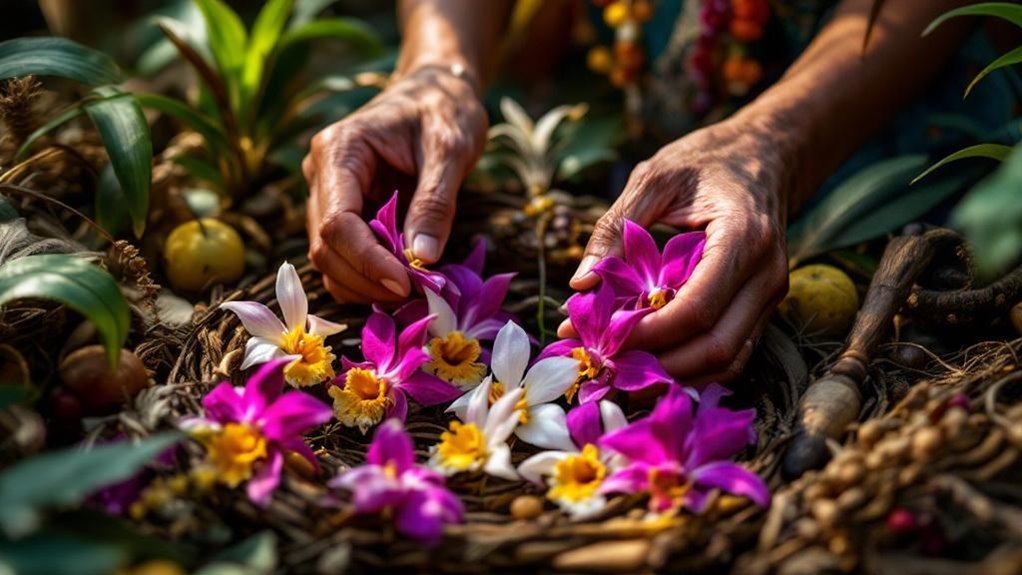
Meaning, in many Indigenous traditions, isn’t assigned to orchids casually; it’s cultivated through close observation of land, season, and use. So these flowers have long stood as symbols of beauty and fertility in South American communities, while also carrying social and ceremonial weight that reaches beyond ornament.
You see orchids as more than decoration; they mark relationships between people, place, and spirit. Their meanings emerge through observational practice rather than stagnant symbolism. Across regions shaped by remarkable orchid diversity, communities tie certain blooms to healing, ceremony, and continuity, using them in medicinal preparations and ritual settings that affirm balance with nature.
Their presence in indigenous languages reflects careful attention to form, habitat, and usefulness, showing that cultural knowledge and ecological knowledge have long developed together, and still require preservation today.
How Indigenous Peoples Named Andean Orchids
As you consider how Indigenous peoples named Andean orchids, you can see that Quechua names carry careful observational meaning; a name such as *Masdevallia chuspipatae*, “the top of a fly,” shows how closely cultivated attention linked plant form to language.
You also notice that these names often preserve landscape in plant names, because they mark place, terrain, and local features rather than treating orchids as stagnant objects apart from their surroundings.
In this way, naming works as cultural memory, and you can trace how medicinal use, oral tradition, and ethnobotanical recordkeeping have sustained that knowledge across generations.
Quechua Orchid Meanings
Because Quechua naming traditions arise from close, cultivated observation of mountain ecologies, many Andean orchids carry names that do more than identify a plant; they situate it within a lived landscape, a cultural memory, and an ecological role that never stood apart from daily life.
When you examine orchid species named through Quechua, you see how indigenous people encoded observational knowledge within language, resisting any stagnant separation between science and memory.
In Telipogon, names like antisuyuensis, “region of the sunrise,” and phuyupatamarcensis, “town above the clouds,” show how classification can preserve cultural heritage while guiding attention to habitat and significance.
You can read these names as compact records, shaped by community knowledge, and their inclusion in formal taxonomy acknowledges local expertise while keeping Andean botanical understanding visible within modern scientific practice today.
Landscape In Plant Names
Andean orchid names also map the land itself, and when indigenous communities named these plants, they often fixed each species within a specific terrain, weather pattern, or remembered place rather than treating it as an isolated specimen. You can trace observational knowledge through Quechua-rooted names that place orchids on Andean slopes, above clouds, or within smoky valleys, and each designation carries cultural significance without becoming stagnant description.
| Name | Landscape | Feeling |
|---|---|---|
| antisuyuensis | sunrise region | quiet orientation |
| phuyupatamarcensis | town above clouds | lifted calm |
| kosñipatensis | smoky terrain | grave wonder |
| Quechua roots | cultivated belonging | steady respect |
Naming As Cultural Memory
When Indigenous peoples of the Andes named orchids, they didn’t label plants as isolated specimens; they recorded observational knowledge in a cultivated form of memory, tying each species to a slope, a valley, a weather pattern, or a remembered settlement, so the name carried both description and relation at once.
As you follow these names, you see how Indigenous knowledge joined form and place; an orchid’s shape, color, or flowering habit could enter the name, yet geography often anchored meaning more firmly.
Telipogon antisuyuensis, from Quechua, means region of the sunrise, and it preserves orientation, travel, and settlement within botanical speech.
When you keep such names in use, you resist stagnant forgetting, because they conserve plant identity and cultural inheritance together.
Documenting each orchid name now supports biodiversity conservation while retaining the cultural memory those names still hold.
Quechua Orchid Names and Their Meanings
As you consider Quechua names in orchid taxonomy, you can see that they don’t function as stagnant labels; they preserve cultivated knowledge of Andean places, histories, and ecological relationships within the scientific record.
When you encounter names such as *Telipogon antisuyuensis*, “region of the sunrise,” or *Telipogon phuyupatamarcensis*, “town above the clouds,” you observe that meaning stays tied to place, and that taxonomy can carry an observational map of local landscapes.
You also find that this practice gives quieter recognition to Indigenous heritage, because when taxonomists retain Quechua terms, they acknowledge local knowledge and help sustain linguistic memory alongside botanical description.
Quechua Names In Taxonomy
Although orchid taxonomy often appears technical and observational, many species names, especially within *Telipogon*, carry cultivated links to Quechua language and thought, preserving local geography, memory, and cultural reference in a form that won’t become stagnant within scientific record.
When you examine Quechua names in taxonomy, you see indigenous knowledge entering scientific language without losing its local authority; *Masdevallia chuspipatae*, “the top of a fly,” marks a high Yungas setting, while *Telipogon antisuyuensis* signals “region of the sunrise.”
You also encounter *Telipogon phuyupatamarcensis*, “town above the clouds,” and *Telipogon kosñipatensis*, whose wording may suggest smoky conditions. These names do more than label orchids; they acknowledge that local communities observed, named, and interpreted these plants long before formal classification, and taxonomy now records that inheritance with greater respect.
Meanings Tied To Place
Several Quechua orchid names tie meaning directly to place, and in doing so they show that taxonomy doesn’t merely classify a plant’s form, it preserves an observational record of landscape, altitude, weather, and human settlement within the name itself; *Telipogon antisuyuensis*, “region of the sunrise,” anchors the species in a cultivated regional identity that mattered long before scientific description, while *Telipogon phuyupatamarcensis*, “town above the clouds,” links the orchid to an Andean cultural landscape shaped by elevation and habitation.
- You see names map cloud forests and villages.
- You recognize orientation, altitude, and settlement.
- You find *Masdevallia chuspipatae* retaining precise local observation.
- You understand each species name preserves heritage.
Through these names, you read biodiversity beside memory; place remains active, never stagnant, within naming.
How Orchid Names Preserve Place and Memory
Many orchid names do more than identify a species; they preserve an observational record of place, language, and memory, carrying indigenous knowledge into botanical science without letting it become stagnant or detached from the landscapes that cultivated it. You see this when indigenous names echo environmental features, origins, and local memory; Telipogon antisuyuensis and T. phuyupatamarcensis map Quechua presence onto scientific records.
| Orchid | Preserved memory |
|---|---|
| Telipogon antisuyuensis | Quechua geography |
| T. phuyupatamarcensis | place-linked identity |
| Masdevallia chuspipatae | local language survives |
When you read Masdevallia chuspipatae, “the top of a fly,” you witness how taxonomy can retain local identity. South American taxonomists increasingly restore such naming practices, and each name continues to bind orchid, homeland, and cultural heritage within botanical science today, across generations.
Orchids in Ritual, Healing, and Daily Life
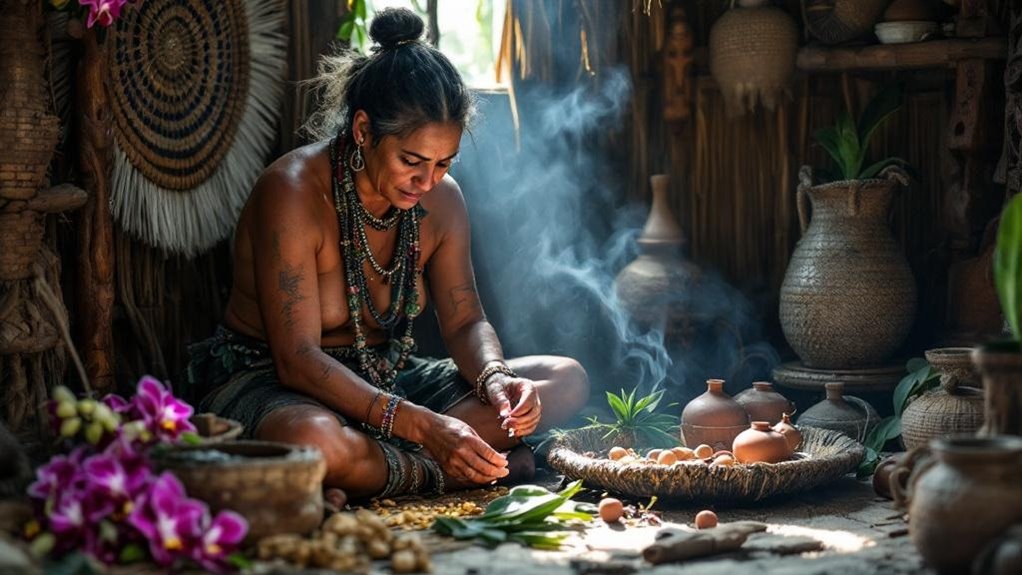
As orchids moved through indigenous life in South America, they didn’t remain confined to observation or naming; communities cultivated them as signs of beauty and fertility, carried them into ritual settings as plants with sacred force, and used them in daily practice because their value was understood as both spiritual and practical.
You can trace that value through practice:
- You see orchids marking beauty, fertility, and observational ties to continuity.
- You find ritual use, where species such as Cattleya trianae signaled sacred presence.
- You encounter healing, since local orchids treated respiratory and digestive complaints.
- You notice daily application, because Andean poultices eased wounds, muscle pain, and stagnant soreness, while Vanilla planifolia flavored foods and supported stimulant rites, joining household use to ceremonial meaning without separating body from spirit.
Orchids in Colombian Indigenous Culture
Before colonial records began to classify Colombia’s flora, Indigenous peoples across the region had already cultivated precise, enduring relationships with orchids, naming distinct species in their own languages, reading their forms through close observational knowledge, and placing them within systems of medicine, ritual, and kinship that didn’t separate practical use from spiritual meaning; in that context, orchids mattered not simply because they were beautiful, but because they were understood as agents of fertility, healing, and continuity, their value reinforced through repeated use in remedies and ceremonial settings.
You can trace this legacy through communities that still prepare orchid-based remedies, preserve names that describe form and function, and resist stagnant categories imposed from outside; today, ethnobotanists and more than one Colombian botanist document that knowledge so indigenous peoples retain authority over living traditions.
Why Cattleya Trianae Became a National Symbol
- You see *Cattleya trianae* bloom in May and June, near independence commemorations.
- You recognize its colors in civic symbolism.
- You find it in art, literature, and education.
- You understand how it resists stagnant national imagery through living biodiversity.
How Colonial Collecting Changed Orchid Traditions
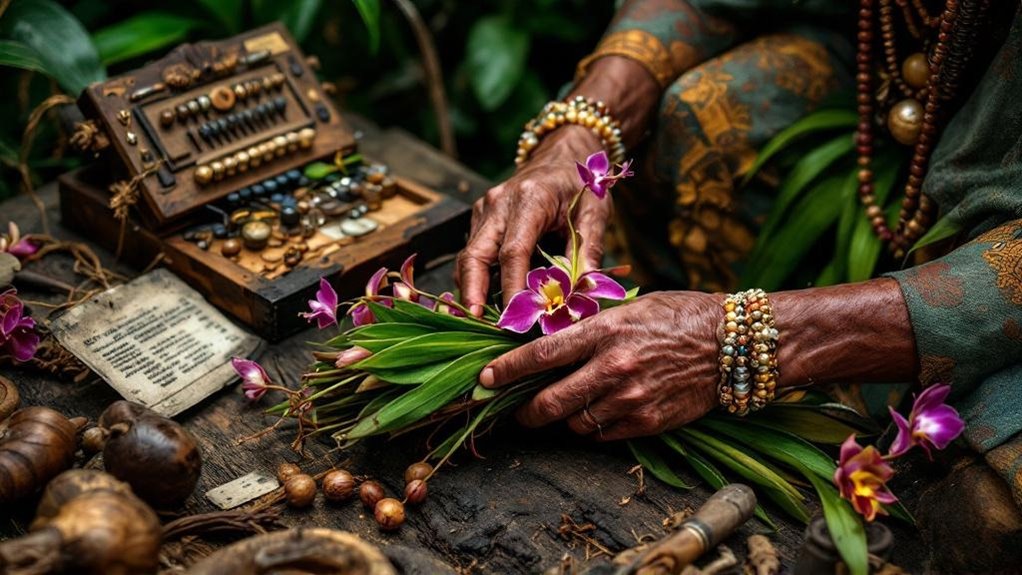
When Spanish conquest reshaped South America in the 1500s, orchids moved in colonial records from cultivated beings embedded in indigenous ritual, medicine, and observational knowledge to specimens valued for extraction and exchange. This shift altered not only who controlled these plants but also how their meaning was preserved.
Jesuit missionaries and later naturalists described unusual flowers for European audiences while rarely crediting the local systems of naming, use, and habitat knowledge that had long sustained them.
You can trace how colonial collection practices redirected orchids toward European horticulture, leaving indigenous knowledge increasingly unrecorded. By the eighteenth and nineteenth centuries, demand hardened into orchid mania; collectors stripped habitats, and communities such as the Shaur saw cultivation practices transformed by figures like Father Andreetta.
Local names, uses, and cultural significance often became stagnant or disappeared.
How Orchid Science Works With Indigenous Knowledge
You can see orchid science work most responsibly when researchers recognize that Indigenous communities cultivated precise, observational knowledge long before formal botany, and when plant naming begins to reflect Indigenous languages alongside scientific classification.
As ethnobotanists document medicinal uses and ecological roles recorded across South America, you can trace how collaborative naming practices honor local knowledge while correcting a stagnant tradition that once ignored those contributions.
You also find that conservation becomes more durable when scientists and Indigenous groups shape it together, because traditional knowledge guides sustainable use, habitat care, and species protection in ways that purely technical systems often can’t sustain alone.
Collaborative Plant Naming
Although orchid taxonomy often appears purely technical, it becomes more accurate and more ethically grounded when scientists work with Indigenous communities, because local names often preserve observational detail about a plant’s habitat, form, seasonality, and cultural meaning that formal classification alone can miss.
You can see this clearly in collaborative plant naming:
- Many species retain indigenous names, linking each American orchid to place and memory.
- Names such as *Telipogon antisuyuensis*, “region of the sunrise,” carry geographic and historical meaning.
- Taxonomists who document indigenous names improve precision, because local terminology reflects cultivated knowledge, not stagnant guesswork.
- Shared nomenclature acknowledges Indigenous expertise before European contact and strengthens respectful scientific practice.
When you follow these naming partnerships, you see classification become fuller, more accurate, and more accountable to the landscapes and peoples who know orchids best.
Traditional Knowledge In Conservation
Because orchid conservation depends on close, repeated attention to habitat, seasonality, and plant behavior, scientists increasingly work with Indigenous communities whose cultivated knowledge has long tracked these patterns through medicinal use, ritual practice, and observational care; that partnership gives conservation a broader evidence base, since traditional ecological knowledge often identifies subtle ecological changes, sustainable harvesting limits, and culturally important species relationships that a stagnant survey model might overlook.
| Indigenous knowledge | Conservation value |
|---|---|
| Medicinal orchid use | Tracks species traits |
| Ritual significance | Protects sacred habitats |
You can see traditional knowledge guiding ethnobotanists, who document uses respectfully, strengthen orchid science, and support biodiversity planning. When researchers collaborate with communities, you get better habitat protection, more sustainable land management, and conservation that respects living cultural practice. Such work also sustains intergenerational memory.
Why Indigenous Orchid Knowledge Is at Risk
As cultural change and environmental destruction advance together, Indigenous orchid knowledge grows more vulnerable, since the teachings that once moved through daily observation, cultivated practice, and seasonal ritual now face interruption from habitat loss, social displacement, and increasingly stagnant patterns of cultural transmission.
You can see this risk in four pressures:
- Industrial agriculture narrows orchid habitat and weakens indigenous knowledge rooted in place.
- Commercial orchid production encroaches on forests, reducing access to species used in medicine.
- Younger people migrate to cities, so observational teachings pass less often between generations.
- Climate change and loss of biodiversity diminish orchids’ presence and their cultural meaning.
Ethnobotanists document these traditions because the record preserves scientific value, yet documentation can’t fully replace living practice, reciprocal learning, or daily contact with changing landscapes.
Orchid Conservation Through Culture and Community
Where indigenous communities sustain ceremonial practice, observational teaching, and cultivated use of local orchid species, conservation tends to remain active rather than stagnant, since the plants are protected not only as biological resources but also as carriers of medicinal knowledge, spiritual meaning, and collective memory tied to specific landscapes.
When you look across South American communities, you see orchid conservation working through continuity: elders teach uses, healers preserve remedies, and rituals reaffirm why habitats matter.
You also see indigenous organizations documenting names, practices, and ecological patterns, so knowledge survives pressure from land loss and cultural disruption.
When communities support sustainable cultivation, you help connect protection with livelihood, reducing harvest pressure on wild populations while sustaining local economies.
In this way, culture doesn’t merely accompany conservation; it directs it, giving orchids durable protection rooted in identity, land stewardship, and intergenerational responsibility.
Frequently Asked Questions
Are Orchids Native to South America?
Yes, you can find many orchids native to South America. You’re looking at one of the world’s richest orchid regions, with about 4,270 species adapted to habitats ranging from Andean cloud forests to Amazon rainforests.
Why Are Lady Slipper Orchids Illegal in the US?
They’re illegal because you’d endanger vulnerable wild populations by collecting or trading them. You can’t legally remove many lady slipper orchids because federal and state laws protect threatened species from habitat loss, over-collection, and extinction.
What Do Orchids Symbolize in Colombia?
In Colombia, you see orchids as a living flag: they symbolize national pride, beauty, and identity. Through Cattleya trianae, you glimpse independence, cultural heritage, and nature’s brilliance, with colors echoing the nation’s spirit and celebrations.
What Do Orchids Mean in Indian Culture?
In Indian culture, you’d see orchids symbolize beauty, love, fertility, and spirituality. People also value them in medicine, festivals, art, and gifts, where they express healing, heritage, respect, admiration, elegance, and natural diversity.
Conclusion
When you follow orchids through South American Indigenous traditions, you see more than flowers; you see cultivated memory, observational science, and living ties between language, land, and care. Their names hold mountains, rivers, and ancestors, and their uses in ritual and healing keep knowledge from turning stagnant. If you listen closely, among damp cloud forests and high Andean light, you can recognize how cultural continuity, not collection alone, offers the surest path for orchid conservation.