
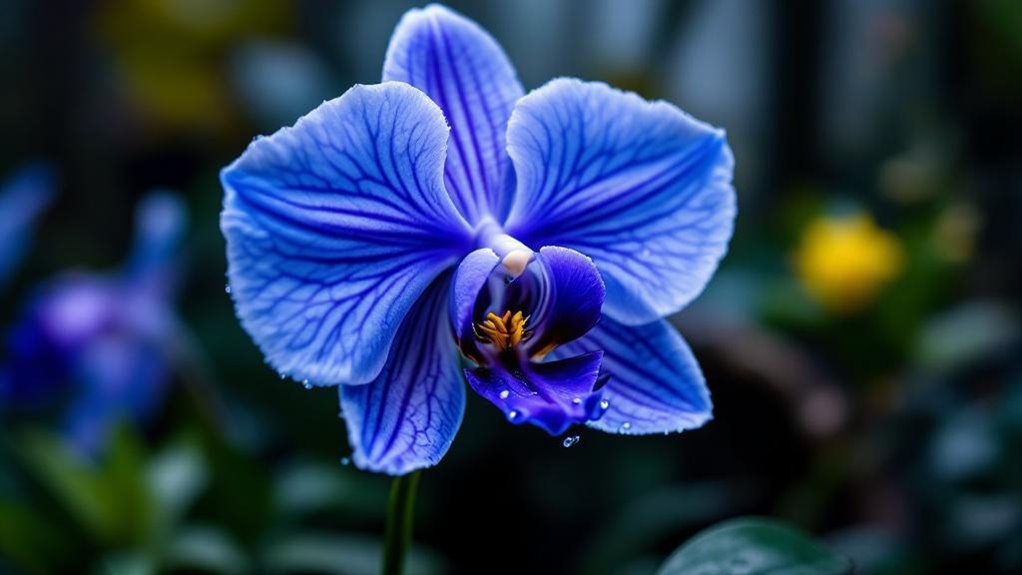
A blue orchid tells you that rarity, cultivated beauty, and quiet imagination matter; its unusual color suggests distinction, loyalty, and refined feeling, while also implying a love or admiration that stays steady rather than stagnant. Because true blue orchids are scarce in nature and many are dyed or hybridized, you also read them as symbols of the uncommon and carefully shaped. In gifts or weddings, they signal trust, sincerity, and singular elegance; the fuller meaning becomes clearer just ahead.
- Key Takeaways
- What Is the Blue Orchid Meaning?
- Why Are Blue Orchids So Rare?
- Are Blue Orchids Naturally Blue?
- Which Blue Orchid Varieties Are Most Known?
- Blue Orchid Meaning in Love
- Blue Orchid Meaning in Loyalty and Trust
- Blue Orchid Spiritual Meaning
- Blue Orchid Meaning in History and Culture
- What Different Blue Shades Symbolize
- Blue Orchids vs. Other Orchid Colors
- When Should You Gift Blue Orchids?
- What Blue Orchids Mean in Weddings
- How to Choose Blue Orchids for a Gift
- Frequently Asked Questions
- Conclusion
Key Takeaways
- Blue orchids symbolize rarity, uniqueness, and refined beauty, making them emblems of the unusual and deeply distinctive admiration.
- They also convey loyalty, trust, sincerity, and enduring love that remains steady through change and pressure.
- Their imaginative meaning comes from their uncommon color, which feels mysterious, creative, and outside ordinary floral symbolism.
- True blue orchids are rare in nature; many sold commercially are dyed or hybridized rather than naturally blue.
- Shade affects meaning: light blue suggests peace, medium blue reflects loyalty, and dark blue evokes wisdom and mystery.
What Is the Blue Orchid Meaning?

Distinctive by nature, the blue orchid represents rarity and cultivated beauty, and its meaning begins with the simple fact that you rarely encounter true blue blooms in the natural world; because of that uncommon presence, it has come to symbolize uniqueness, refinement, and a quiet form of distinction that doesn’t fade into the stagnant background of more familiar flowers.
When you consider Blue Orchids, you also encounter tranquility, sophistication, and an observational sense of calm that suits elegant spaces and thoughtful gifts. The meaning of orchid deepens further through associations with loyalty, trust, sincerity, and steady admiration, which give these blooms emotional weight without excess.
In some traditions, blue petals also suggest masculinity and strength; in arrangements featuring blue dendrobium or blue phalaenopsis, you see beauty shaped into something poised, imaginative, and enduring.
Why Are Blue Orchids So Rare?
You can see their rarity in two quiet facts: orchids rarely produce a true blue pigment in nature, and among more than 35,000 varieties, only a small number, such as blue dendrobium and blue vanda, show natural blue coloration.
You’ll also find that most blue orchids sold in cultivation are hybrids or dyed specimens, because the genetic traits and environmental conditions needed for authentic blue blooms remain narrow and observational rather than broad or stagnant.
As a result, when you encounter a naturally blue orchid, you’re seeing one of the few native expressions of that color, shaped by limited varieties and specific habitats, especially in the Philippines.
Natural Pigment Scarcity
Although blue flowers seem familiar in cultivated arrangements, truly blue orchids remain rare in nature because most orchid species don’t produce the anthocyanin pigment combinations needed to create a stable blue hue.
Without that genetic capacity, breeders face stagnant limits that conventional hybridizing rarely overcomes.
When you encounter blue orchids in commerce, you’re often seeing dyed white blooms rather than naturally blue specimens, which reflects this pigment scarcity more than any lack of horticultural effort.
That scarcity shapes their rarity and symbolic appeal; you read unusual color as evidence of exception, and the market reinforces that perception.
From an observational standpoint, the few authentic examples remain prized because nature seldom supplies the biochemical basis for lasting blue coloration, so even skilled cultivation can only work within strict inherited limits.
Their uncommon presence sustains admiration.
Limited Native Varieties
Because so few orchid species develop a naturally blue bloom, the number of native blue orchids remains sharply limited, and that narrow base explains why truly blue forms are so rarely encountered outside specialized habitats and cultivated collections.
When you look at blue orchids in trade, you’re usually seeing hybrids or dyed flowers rather than stable native species, which reinforces their rarity across the orchid family.
One notable exception, the rare blue dendrobium from the Philippines, shows how restricted this color remains in nature, tied to narrow ranges rather than widespread populations.
That limited occurrence shapes your observational sense of their meaning; you read uniqueness and quiet beauty in them because nature offers so few authentic examples.
Even blue phalaenopsis and blue vanda, common in cultivated markets, often reflect human intervention, not stagnant wild abundance or continuity.
Are Blue Orchids Naturally Blue?
While blue orchids do exist in nature, they’re uncommon, and most of the vivid blue blooms you see in floral shops aren’t naturally blue at all; they’re usually cultivated hybrids or white orchids that have been dyed to produce a more uniform, saturated color.
Most blue orchids in shops aren’t naturally blue, but dyed or cultivated for a more vivid, uniform color.
When you encounter blue orchids in arrangements, you’re usually seeing human intervention rather than a stagnant natural pattern, because true blue pigmentation appears in only a small number of orchids and remains tied to specific growing conditions.
Their rarity shapes their meaning, since you associate scarce color with distinction, beauty, and quiet value. Naturally blue forms appear mainly in the Philippines, where some blooms show a more observational consistency and brilliance than dyed flowers can sustain.
Even then, cultivated plants may still be altered, so you can’t assume every striking blue bloom reflects an untouched origin.
Which Blue Orchid Varieties Are Most Known?
Which blue orchid varieties tend to stand out most clearly when you survey the cultivated forms in floristry and collection, and why do certain names recur so consistently?
You’ll usually encounter blue dendrobium, blue vanda, and blue phalaenopsis, because each presents a distinct cultivated advantage; florists value blue dendrobium for strong color impact, though truly pure forms remain relatively rare, while hybrids appear more often in arrangements and displays.
You’ll see the blue vanda cited repeatedly because its brilliant blue tones, broad presence, and large growth habit create an observational sense of rarity without seeming stagnant or artificial.
Blue phalaenopsis remains widely known for different reasons; its blooms last well, its care is comparatively straightforward, and growers in tropical regions, especially the Philippines, cultivate these orchids successfully where full sunlight supports steady flowering and healthy plant development.
Blue Orchid Meaning in Love
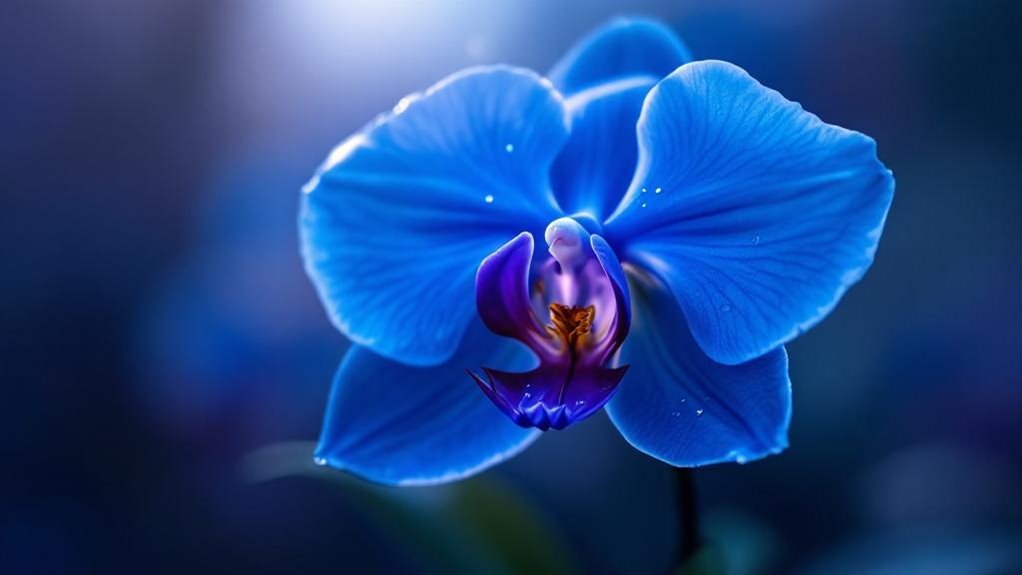
When you give or receive a blue orchid in love, you signal loyal and lasting affection; its blue tones suggest devotion, its history suggests strength, and together they frame commitment as something steady rather than stagnant.
You also recognize rare and unique devotion, because blue orchids are uncommon and cultivated with care, making them a fitting emblem for a bond you regard as singular and deeply valued.
Just as importantly, you invite a peaceful romantic connection; the flower’s calm color and elegant presence create an observational sense of tranquility, reminding you that love can remain refined, secure, and enduring.
Loyal And Lasting Love
A blue orchid speaks to loyal and lasting love with unusual precision, because its rarity suggests a bond that isn’t interchangeable, its cultivated beauty reflects steady admiration, and its calm color carries an observational sense of peace that helps relationships resist stagnant habits and needless strain.
When you give blue orchids, you affirm trust, sincerity, and devotion; you show that your relationship deserves patience, respect, and consistent care rather than dramatic display.
Their serene tone supports harmony, helping you value quiet understanding over avoidable conflict, while their longstanding association with strength and resilience reminds you that enduring love holds its shape through pressure, change, and uncertainty.
In this way, blue orchids become a clear emblem of loyal and lasting love, expressing admiration that remains steady, deliberate, and convincing across time, not merely in ideal moments.
Rare And Unique Devotion
Blue orchids extend the idea of lasting love by pointing to devotion that feels distinctly rare, because their unusual color and cultivated elegance suggest that your attachment isn’t generic, interchangeable, or easily repeated.
- You give Blue Orchids when admiration goes beyond appearance, because they acknowledge a partner’s exceptional qualities with observational precision and steady regard.
- Their uncommon hue reflects loyalty that doesn’t become stagnant under pressure; instead, it marks resilience, depth, and a bond strengthened through mutual respect.
- They also imply that love can remain inspired and enlarging, since their enchanted presence suggests devotion that encourages growth, understanding, and a more deliberate partnership.
In this way, Blue Orchids represent a form of love you recognize as singular, cultivated, and enduring, without needing extravagance or repetition.
Peaceful Romantic Connection
Because romantic love depends on more than attraction, blue orchids speak to a connection that feels composed, loyal, and deliberately nurtured, joining admiration with tranquility so your affection appears not only deep but also steady under ordinary strain.
When you give a blue orchid, you suggest that your bond resists the stagnant habits that weaken intimacy; you affirm individuality, cultivated trust, and an observational awareness of your partner’s inner life.
Because orchids can symbolize love, this flower carries beauty without shallowness, serenity without distance, and devotion without display. Its unusual rarity further marks your relationship as singular, while the blue tone reinforces loyalty, calm, and spiritual depth.
In this way, blue orchids support romance by making commitment feel elegant, peaceful, and consciously sustained through changing seasons and ordinary pressures alike.
Blue Orchid Meaning in Loyalty and Trust
Steadiness defines the blue orchid’s meaning in loyalty and trust, since its uncommon presence in nature has long encouraged people to associate it with relationships that endure strain, resist stagnant habits, and remain cultivated through consistent care.
- When you give a blue orchid, you signal loyalty and trust with observational clarity; its rarity suggests devotion that isn’t casual, convenient, or easily replaced in difficult seasons.
- Across cultures, this flower has represented fidelity, and that history strengthens its message; you aren’t offering decoration alone, but a cultivated emblem of sincerity, appreciation, and durable commitment.
- In personal and professional bonds, blue orchids express trust with unusual precision; their vivid color and uncommon character reflect how rare, demanding, and sustaining reliable allegiance becomes over time, and through trials.
Blue Orchid Spiritual Meaning
Spiritual symbolism shapes the blue orchid’s meaning through its link to growth, enlightenment, and disciplined inner awareness. Since its uncommon presence in nature has led many people to see it as a sign that your path toward higher consciousness won’t be ordinary, stagnant, or easily completed.
When you consider the blue orchid, you encounter a quiet emblem of spiritual growth. Its rarity suggests that genuine awakening asks for cultivated patience, observational clarity, and resilience rather than easy certainty.
Its calm color reinforces inner peace, helping you focus on balance, steadiness, and the removal of mental excess. It also speaks to devotion and loyalty, reminding you that spiritual strength deepens through sustained commitment to yourself and to others.
In this reading, the blue orchid also signals abundance, not as excess, but as a favorable alignment.
Blue Orchid Meaning in History and Culture

When you trace blue orchid meaning through history, you find ancient symbolic roots in Greece, where rarity suggested masculinity and strength, and in Aztec culture, where orchids held cultivated value in elixirs and remedies rather than stagnant ornament.
You also see how the Victorian fascination with exotic flowers turned rare blue orchids into observational markers of status and wealth, reinforcing their place in cultural memory.
Across cultures, you can recognize a steadier meaning as well, since blue orchids have come to suggest peace, tranquility, and, in Chinese tradition, spiritual growth and enlightened admiration.
Ancient Symbolic Roots
A blue orchid carried unusual meaning long before modern floral symbolism took shape, because its scarcity made it an observational marker of beauty, distinction, and cultivated power across very different societies; in ancient Greece, blue-toned petals were associated with masculinity and strength, not as a stagnant decorative preference but as a reflection of how rare forms in nature often gained social weight and symbolic authority.
- You can see why ancient Greeks treated uncommon color as status made visible, with the blue orchid suggesting disciplined force and admired presence.
- In Mesoamerican thought, orchids entered ritual life; Aztecs used them in fertility rites and life-enhancing elixirs, giving rarity a sacred function.
- Across traditions, you find serenity, devotion, and spiritual awareness attached to blue blooms, because uncommon beauty often invited contemplative meaning.
Victorian Orchid Fascination
Victorian culture carried that older respect for rarity into a more visible social theater, and during the period of orchidelirium, blue orchids came to signify cultivated wealth, refined taste, and the observational power to possess what most people could only admire at a distance.
If you stood in an affluent parlor, the blue orchid functioned as evidence of status, patience, and access; it wasn’t merely decorative, because collectors invested in difficult breeding, commissioned expeditions, and resisted stagnant taste through novelty.
You can also see how Victorian botanists and gardeners shaped meaning through records, sketches, and cultivation notes, turning fascination into methodical knowledge. As they pursued elusive varieties, they reinforced the flower’s association with love, mystery, and beauty, and you understand why these blooms suited an age that valued elegance, control, and exquisite display.
Cross-Cultural Blue Meanings
Across cultures, the blue orchid gathers meaning from the unusual status of blue itself, and because the color appears so rarely in nature, people have repeatedly treated the flower as a sign of uniqueness, cultivated value, and occasions set apart from ordinary life.
- In ancient Greece, you see the blue orchid linked with masculinity and strength, its rarity reinforcing status rather than stagnant ornament.
- Among the Aztecs, you find orchids in potent elixirs, and blue varieties carried mystical force, deepening their cultural significance through ritual use.
- Across many traditions, you encounter loyalty, devotion, tranquility, and peace in the blue orchid; when you give it, you signal steady attachment, spiritual growth, and an observational respect for what remains uncommon, refined, and quietly set apart within human exchange and memory.
What Different Blue Shades Symbolize
Because blue orchids appear in a cultivated range of tones rather than a single stagnant color, each shade carries a distinct symbolism, and those differences shape how the flower is perceived in both personal gifts and observational design.
In blue orchid color symbolism, light blue suggests tranquility and peace, so you read it as calm, restorative, and quietly serene.
Light blue in orchid symbolism conveys tranquility and peace, giving the bloom a calm, restorative, and quietly serene presence.
When you encounter medium blue, you see loyalty and trust, which makes it suitable when you want admiration to feel sincere rather than ornamental; it communicates steadiness without excess.
Dark blue carries greater depth and mystery, and you may associate it with wisdom, strength, and inward reflection, especially in contemplative settings.
Because naturally blue orchids remain rare, every hue also suggests uniqueness, and the spectrum from pale sky blue to deep azure strengthens their exotic, differentiated presence.
Blue Orchids vs. Other Orchid Colors
Among orchid colors, blue stands apart as the rarest and most observationally striking. When you compare it with more common hues, you don’t read it in the same emotional register; blue orchids suggest tranquility, devotion, uniqueness, and a cultivated sophistication.
In contrast, pink orchids lean toward grace and femininity, white toward purity and innocence, red toward love and passion, yellow toward warmth and friendship, and purple toward royalty.
- You notice that a blue orchid appears less often in nature, so rarity shapes meaning.
- You also see that this orchid color is often dyed, unlike more naturally stable shades.
- You read blue dendrobium and blue phalaenopsis as calm and refined, never stagnant; by contrast, red intensifies emotion, yellow broadens it, and purple elevates it toward ceremony and status in perception.
When Should You Gift Blue Orchids?

A blue orchid suits five kinds of moments especially well: anniversaries and birthdays, when you want to mark someone’s unique beauty and cultivated elegance; achievements and personal milestones, when admiration and affection need a form that feels observational rather than routine; housewarmings, where its association with peace and tranquility supports a new home without seeming stagnant; significant relationships or reconciliations, when loyalty and trust matter more than display; and corporate events or appreciation days, when its sophistication and quiet creativity leave a lasting impression on clients, colleagues, or professional partners.
You give a blue orchid when you want symbolism to feel deliberate, not ornamental; it carries refinement, steadiness, and good fortune without excess.
In each setting, it communicates respect for individuality, confidence in continuity, and appreciation that remains composed.
What Blue Orchids Mean in Weddings
In weddings, blue orchids carry a meaning that feels more intimate than decorative; they suggest love shaped by rarity, beauty tempered by composure, and a bond that doesn’t rely on familiar symbols to appear sincere.
Their cultivated presence keeps the atmosphere from feeling stagnant, while the blue orchid meaning remains clear, observational, and refined.
- You signal a rare kind of love, one that values distinction without abandoning elegance.
- You create contrast by pairing them with white lilies or soft pink roses, and that contrast steadies the entire aesthetic rather than overwhelming it.
- You extend their meaning into crowns, boutonnieres, and focal arrangements, where their uncommon hue reinforces sophistication, supports varied palettes, and quietly reflects a union defined less by convention than by singular, lasting character.
How to Choose Blue Orchids for a Gift
When you choose blue orchids as a gift, start with the variety, because blue dendrobium and blue phalaenopsis each present a distinct kind of elegance; both carry the blue orchid meaning of beauty, strength, and uniqueness, yet their form, scale, and cultivated presence shape the impression differently.
Next, inspect the plant closely; you want vibrant petals, sturdy stems, and no stagnant signs of stress, because a healthy blue orchid holds its shape longer and communicates care through its observational quality.
If you prefer an arrangement, pair a stunning blue orchid with white lilies or pink roses, which soften the composition without diluting its rarity.
You can also choose names such as Ocean Breeze or Blue Mystique, since those cultivated labels reinforce the gift’s unusual character and quietly honor someone distinctly special.
Frequently Asked Questions
What Does a Blue Orchid Symbolize?
A blue orchid symbolizes rarity, uniqueness, tranquility, and admiration. You give it to express deep affection, loyalty, elegance, and spiritual growth. Its unusual beauty also suggests resilience, strength, and a touch of luxury in meaningful moments.
Why Are Blue Orchids Rare?
Blue orchids are rarer than a unicorn’s whisper because nature seldom produces true blue pigments in orchids. You’ll usually find hybrids or dyed blooms instead, while naturally blue varieties grow only in limited regions like the Philippines.
What Is the Rarest Color Orchid?
You’ll usually find blue orchids are the rarest color, especially naturally occurring ones like blue vanda or dendrobium. Most “blue” orchids you see aren’t truly blue—they’re hybrids or dyed white blooms sold commercially.
What Does the Blue Orchid Mean in the Bible?
As the saying goes, you won’t find a direct biblical meaning for blue orchids; instead, you can see them reflecting God’s beauty, uniqueness, and creation. Their blue hue may suggest heaven, peace, and spiritual insight.
Conclusion
In the end, when you choose or receive a blue orchid, you recognize more than beauty; you acknowledge rarity, cultivated imagination, and a refusal to accept the stagnant and ordinary. Its meaning stays observational yet clear in love, gifting, and ceremony, because uncommon color carries uncommon intention. As the saying goes, still waters run deep; a blue orchid does the same, offering quiet distinction, measured symbolism, and a lasting impression that doesn’t depend on excess.