
You find the strangest orchid folklore where rarity and form concentrate belief: the Ghost Orchid carries swamp wishes and unattainable longing, Lady’s Slipper ties romance to the cost of human desire, White Egret holds cultivated associations with departed souls, and the Western Underground Orchid suggests hidden worlds and endurance. Region shapes each meaning, from China’s scholarly ideals to Andean spirit faces; if you continue, you’ll see how biology, history, and conservation keep these stories from turning stagnant.
- Key Takeaways
- Why Rare Orchids Feel Mythic
- How Region Shapes Orchid Folklore
- Rare Orchids Linked to Love and Longing
- Ghost Orchid Legends in Swamp Folklore
- Lady’s Slipper Orchid Legends and Protection
- Bee Orchid Folklore and Floral Deception
- Monkey Orchid Myths and Animal Spirits
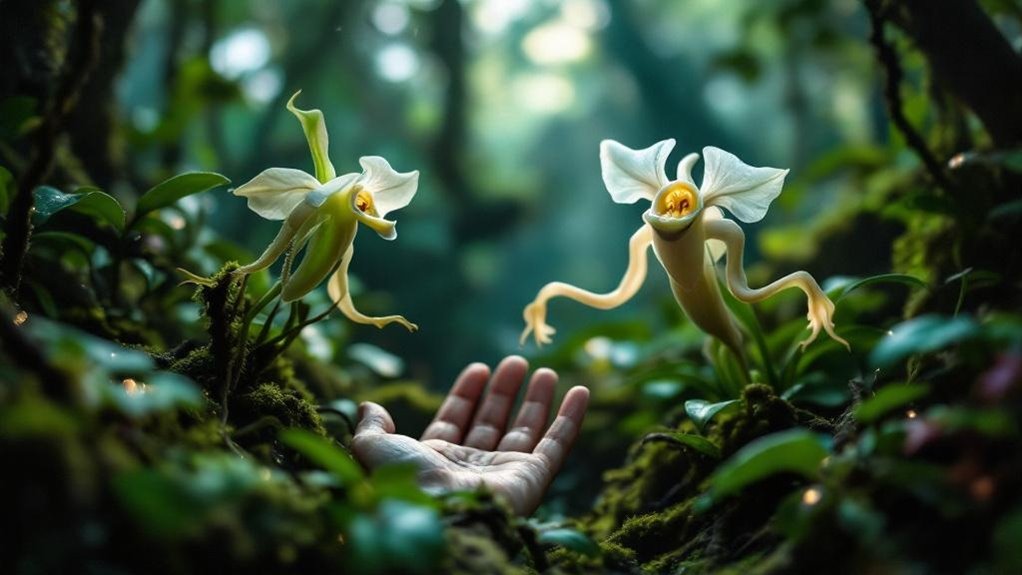
- Flying Duck Orchid Folklore in Australia
- White Egret Orchid Symbolism and Souls
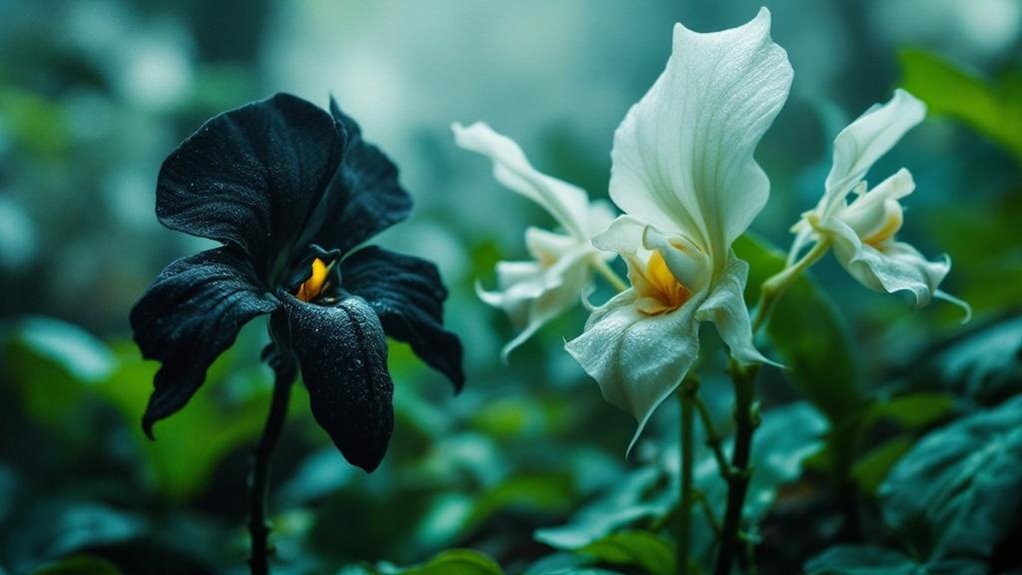
- Black Orchid Omens in Story and Culture
- Underground Orchid Myths of Hidden Worlds
- Protect Rare Orchids, Don’t Collect Them
- Frequently Asked Questions
- Conclusion
Key Takeaways
- Ghost Orchid folklore portrays it as a wish-granting swamp spirit, symbolizing unattainable desire, mystery, and good fortune.
- White Egret Orchid in Japanese tradition represents departed souls, purity, and the fragility of life.
- Lady’s Slipper Orchid is tied to romance and luck, but its over-collection became a cautionary tale about desire.
- Monkey Orchid is linked in Andean folklore to spirit faces and guardianship, deepening its eerie, affectionate mystique.
- Bee Orchid inspired strange myths through its bee-like form and scent, which trick male bees into attempted mating.
Why Rare Orchids Feel Mythic

Because rare orchids appear only under narrow conditions and often resist ordinary cultivation, they tend to feel less like familiar flowers and more like figures from folklore; you don’t simply see them, you encounter them through absence, rumor, and brief, observational traces in remote habitats.
Rare orchids arrive less as flowers than as folklore, glimpsed through scarcity, distance, and the uncertainty of remote encounter.
Their forms deepen that effect: the leafless Ghost Orchid seems almost disembodied, the Monkey Orchid mirrors a face you recognize, and the Flying Duck Orchid suggests motion where everything else appears stagnant.
You read mythic force in these plants because rarity concentrates attention, and unusual structure invites projection. The Lady’s Slipper Orchid carries the shadow of orchidelirium, so desire itself becomes part of its legend, while the White Egret Orchid’s cultivated delicacy and pale symmetry encourage spiritual readings.
In rare orchids, appearance, scarcity, and human longing converge into durable folklore.
How Region Shapes Orchid Folklore
Although orchid forms can seem universally uncanny, the folklore around them is shaped first by region, where local landscapes, religious habits, artistic traditions, and patterns of human attention determine what people think they’re seeing when they encounter a rare bloom.
In China, you read the orchid through cultivated refinement, poetry, and scholarly ideals; in Japan, festival tradition turns rarity into perseverance.
In Ecuador, the Monkey Orchid invites an observational reading of spirit faces, because mountain forests and local belief keep the supernatural near ordinary life.
In Greece, the Bee Orchid enters mythic interpretation through Aphrodite, showing how classical stories organize even botanical detail.
Across these regions, folklore doesn’t arise from a stagnant image alone; you see each orchid recast by place, and place teaches you what strangeness means, and why it endures there.
Rare Orchids Linked to Love and Longing
Place shapes what a rare orchid seems to mean, yet love and longing give those local readings a shared emotional structure; across very different traditions, people return to orchids as figures for desire that remains just out of reach, for devotion tested by distance, and for affection refined by rarity rather than made stagnant by familiarity.
You can trace that pattern through the Ghost Orchid, whose elusive bloom turns unattainable desire into an observational emblem, and through the Lady’s Slipper, long cultivated in legend as a charm for romance and favorable fortune.
The Monkey Orchid, with its uncanny face, invites a quieter reading, where affection meets mystery without resolution; the Flying Duck suggests love proven through sacrifice, while the Dove Orchid preserves an image of purity, steadfastness, and devotion under conditions of distance and uncertainty.
Ghost Orchid Legends in Swamp Folklore

Where the cypress shadows deepen and water blurs the edge between rooted land and moving reflection, the Ghost Orchid enters swamp folklore as more than a rare bloom, for in Florida and Cuba it has been cultivated in story as a sign of good fortune, a prize granted only to those fortunate enough to encounter it in the wild, and an observational emblem of a landscape that seems to hold itself slightly apart from ordinary time.
When you follow these legends, you find a flower said to embody the swamp’s spirit, linking stagnant earth to the supernatural; some stories say it grants wishes, others that unseen guardians protect it, and together they cultivate reverence.
Even modern protection efforts draw strength from that tradition, because when you treat the Ghost Orchid as living folklore, you more readily accept its vulnerable place.
Lady’s Slipper Orchid Legends and Protection
As you consider the Lady’s Slipper Orchid, you can trace how its slipper-shaped bloom cultivated folklore around fairies, femininity, beauty, and medicinal belief, and how that observational record reveals the plant’s long hold on human imagination.
You can also see how desire turned destructive, as over-collection once drove it to apparent extinction in England and a kind of orchid obsession, not stagnant admiration, helped justify poaching that now requires close monitoring and police patrols.
If you follow its story into the present, you’re brought to habitat and stewardship, where protection depends on leaving wild populations undisturbed so they can recover and persist within their natural ground.
Folklore And Symbolism
Although its delicate form might suggest only ornament, the Lady’s Slipper Orchid has long carried a cultivated weight in folklore, appearing as a sign of love, protection, and quiet good fortune.
Its pouch-like bloom has invited observational tales in which fairies shelter inside or wandering souls are held in a brief, mysterious pause rather than left stagnant in the wild.
When you encounter Lady’s slipper traditions, you see more than decorative myth; you enter a record of values, where beauty suggests guardianship, and rarity deepens symbolic force.
In several Native American accounts, the flower carries healing associations tied to women’s endurance and empowerment, so its presence can suggest feminine strength expressed through patience, survival, and care.
Its symbolism persists because you recognize in its form a preserved union of tenderness, secrecy, and watchful shelter.
Poaching And Protection
That same folklore that cast the Lady’s Slipper Orchid as a guarded treasure also helped make it vulnerable, because romantic stories about its rarity and beauty fed a cultivated desire to possess what should have remained undisturbed.
In England, the result was severe enough that Cypripedium calceolus was declared extinct by 1917, largely through poaching driven by the collector obsession often called orchidelirium.
When you trace its history after rediscovery in the 1930s, you can see why protection remains strict; legends didn’t simply fade, and the observational appeal of a flower once treated as myth still attracts illegal collectors.
During flowering periods, police patrols and CCTV serve as practical barriers against poaching, reinforcing that protection preserves more than a single species, because if such losses become accepted, biodiversity itself grows poorer, more fragile, and increasingly stagnant.
Habitat And Stewardship
Stewardship begins with habitat, because the Lady’s Slipper Orchid has never depended on secrecy alone but on very specific woodland conditions, stable soils, and a restrained human presence. Folklore may have cast the flower as a fairy’s shoe and encouraged an observational fascination with its form, yet its survival has always rested on whether people leave intact the shaded, undisturbed places where it can persist.
When you consider why these Orchids vanished from England by 1917, you see that cultivated desire, collection, and damaged habitat worked together, leaving even rediscovered plants exposed to poaching, stagnant land management, and gradual disturbance.
Effective conservation initiatives consequently protect sites as much as specimens, pairing patrols and possible CCTV with public restraint. Because if you preserve woodland structure and limit interference, you protect legend without sacrificing the flower.
Bee Orchid Folklore and Floral Deception
As you turn to the Bee Orchid, you encounter a cultivated folklore of seduction, one shaped by careful observational truths: the flower mirrors the look and scent of a female bumblebee, and male bees answer the signal, carrying pollen as they attempt to mate with the bloom.
You can see why the bee-mimic pollination myth settled so firmly in European tradition, because this orchid’s deception appears almost intentional, yet it serves a precise reproductive purpose during the late April to June pollination season rather than any stagnant fantasy of chance.
In folklore, you find that beauty and strategy remain closely joined here, and the Bee Orchid stands as a quiet emblem of nature’s intricate, competitive arrangements.
Bee-Mimic Pollination Myth
Although folklore often casts the Bee Orchid as a bloom with an almost deliberate cunning, its so-called bee-mimic pollination myth rests on an observational truth: Ophrys apifera secures reproduction by deception, not by offering nectar, shaping its petals and velvety lip into the cultivated likeness of a female bumblebee and releasing scent cues that male bees read as sexual signals.
When you examine this sexual deception closely, you see no stagnant superstition, but an evolved system in which visual pattern, texture, and pheromonal suggestion direct male bees toward repeated contact with the flower.
Each mistaken approach transfers pollen, and each return improves fertilization, so the orchid prospers without nectar; the bee-mimic pollination myth endures because the plant’s method appears almost calculated, though it’s simply adaptive biology at work.
Folklore Of Seduction
From that observational account of mimicry, the Bee Orchid enters folklore not as a stagnant emblem of trickery, but as a cultivated figure of seduction, a flower whose beauty seems to persuade while its structure and scent quietly direct male bees toward error.
You see how its flowers resemble a female bumblebee, and that resemblance, refined by natural selection, supports a precise reproductive strategy; males attempt to mate, pollen adheres, and the orchid offers no nectar at all.
In the folklore of seduction, you encounter not fantasy but an ecosystem’s disciplined exchange, timed to early spring, when emerging bumblebees heighten the plant’s chances of contact.
Beauty here doesn’t merely decorate survival; it governs behavior, manipulates instinct, and reveals how adaptation can turn attraction itself into an instrument of successful pollination in nature.
Monkey Orchid Myths and Animal Spirits
When the Monkey Orchid, or *Dracula simia*, appears in Andean folklore, it carries more than an unusual likeness to a monkey’s face; it stands as a cultivated sign of the forest’s unseen life.
Local tradition links it to animal spirits that watch over wildlife and maintain a careful, observational bond between people and the rainforest.
- You see the monkey orchid as a guardian emblem, where rarity suggests fortune and respect.
- You notice its orange-like scent, believed to draw animal spirits through stagnant air.
- You read its monkey face as a reminder that biodiversity has playful, watchful forms.
- You understand the myth’s purpose; it binds spiritual meaning to rainforest preservation, and it teaches that beauty, habitat, and wildlife guardianship remain inseparable within Andean memory and local practice there.
Flying Duck Orchid Folklore in Australia

As you turn to Flying Duck Orchid folklore in Australia, you encounter Aboriginal tales that connect Caleana major to ancestral presence and to the land itself, where its duck-shaped bloom carries meanings of creativity, transformation, and cultivated attentiveness to seasonal change.
You can also trace the duck-shaped bloom myth to careful, observational readings of native ducks, because communities saw in the flower a likeness to motion in mid-flight and shaped that resemblance into stories that resisted stagnant ways of seeing the natural world.
When the orchid blooms in spring, you recognize why these traditions treat it as a quiet sign of renewal and as a reminder that its survival depends on precise conditions, which reinforces a respectful balance between people and country.
Aboriginal Tales
Although the Flying Duck Orchid is a small ground orchid native to Eastern and Southern Australia, its cultivated place in Aboriginal storytelling is far larger, because its flower, shaped with such observational precision that it appears like a duck in mid-flight, has long invited readings that connect land, animal life, and ancestral presence.
- You encounter flowers in aboriginal tales as signs that ancestral beings remain near.
- You see the orchid linked to ducks’ spirits, carrying communication between natural and spiritual spheres.
- You note its flowering season aligns with culturally significant times, so communities read it within practice, memory, and country.
- You understand its form inspires admiration; it reflects nature’s beauty without becoming stagnant, and it reinforces enduring ties between people, place, and the living world, across generations.
Duck-Shaped Bloom Myth
Because its blossom presents such an exact, observational likeness to a duck in mid-flight, the Flying Duck Orchid has cultivated a distinct place in Australian folklore, where you find the flower read not merely as a curiosity of form but as a sign that land and wildlife exist within a shared symbolic order; in Aboriginal storytelling, that duck-shaped bloom often carries themes of transformation, seasonal return, and ecological balance.
Its appearance during the period associated with ducks’ breeding activity strengthens the sense that plant and animal life move in relation rather than in isolation. In eastern and southern Australia, you encounter this species as more than a botanical rarity; you see how cultural narratives resist stagnant categories, linking biodiversity, human life, and conservation through one small orchid’s persistent image.
White Egret Orchid Symbolism and Souls

When the White Egret Orchid opens, its fringed petals create the cultivated likeness of a white bird lifting into still air.
That visual resemblance has shaped its symbolism across cultures, where people read purity, grace, and a distinctly spiritual presence in the flower rather than mere ornament.
- You see the white egret orchid as an observational emblem of purity and spiritual significance, because its wings suggest ascent, not stagnant display.
- In Japanese folklore, you encounter souls of the departed; the bloom guides them toward peace, serenity, and remembered continuity.
- During ancestor festivals, you find blessings and good fortune attached to it, as offerings honor loved ones with disciplined reverence.
- Its delicate form reminds you that life remains fragile, memories require cherishing, and divine connection often appears through brief, ethereal beauty.
Black Orchid Omens in Story and Culture
Where the White Egret Orchid suggested release and spiritual passage, the Black Orchid enters folklore as a cultivated sign of mystery, its dark purple to near-black tones inviting observational readings that move beyond beauty and toward omen, transformation, and the uneasy border between visible life and whatever doesn’t remain stagnant beyond it.
When you encounter Prosthechea cochleata in story and culture, you meet black orchid omens shaped by caution; some traditions treat its presence as a warning of major change, so gardeners handle it with reverence, and artists use it to suggest death, afterlife, or messages carried through altered perception.
Among exotic flowers, it stands apart because its darkness invites supernatural interpretation, yet several Indigenous readings steady that fear, presenting the orchid instead as resilience made visible, a sign that hardship can be endured and transformed into lasting form.
Underground Orchid Myths of Hidden Worlds
Although the Western Underground Orchid never presents itself in the open manner expected of flowering plants, Rhizanthella gardneri has cultivated a place in folklore precisely through concealment. Its entire life unfolding beneath the soil, dependent on subterranean fungal networks and fungus gnats, invites observational myths about hidden worlds that operate beyond ordinary human notice.
- You read the Western Underground Orchid as a sign that stagnant earth shelters unseen ecosystems.
- You connect its symbiotic relationship with fungi to legends of secretive spirits below.
- You interpret its brief flowering as transformation, rebirth, and a return to silence.
- You regard any discovery as hidden treasure, because rarity and concealment suggest nature guards deeper knowledge.
These myths persist because you can’t watch its full life, only infer its buried patterns.
Protect Rare Orchids, Don’t Collect Them
The same observational habit that turns hidden orchids into folklore should also restrain possession, because rare species such as the Ghost Orchid, the Monkey Orchid, and the Lady’s Slipper Orchid don’t endure admiration that becomes removal; they depend on intact habitats, stable fungal and insect relationships, and the cultivated balance of local ecosystems, all of which over-collection steadily weakens.
| Action | Result | Your role |
|---|---|---|
| Wild collecting | Population decline | Refuse purchase |
| Illegal trade | Ecosystem damage | Report sellers |
| Habitat loss | Extinction risk | Support reserves |
| Sustainable propagation | Reduced pressure | Buy nursery-grown |
You protect rare orchids when you reject stagnant collecting habits and support conservation efforts; England’s lost Lady’s Slipper shows what private desire can erase, while ethical choices preserve biodiversity and native habitats for patient, continuing observation.
Frequently Asked Questions
What Is the Rarest Orchid in the World?
You’d usually call the Ghost Orchid the rarest orchid in the world, though some experts argue for Australia’s Western Underground Orchid. You’ll find both incredibly endangered, elusive, and threatened by habitat loss, collection, and environmental change.
Why Are Ghost Orchids Illegal?
Right off the bat, you can’t legally collect ghost orchids because they’re endangered and protected by law. You’d harm fragile habitats, fuel over-harvesting, and threaten pollination, so authorities impose fines and penalties to safeguard survival.
What Does the Bible Say About Orchids?
The Bible doesn’t mention orchids specifically. You can connect orchids to broader flower imagery, like Matthew’s lilies and Song of Solomon’s blossoms, where Scripture highlights beauty, God’s provision, and life’s fleeting nature rather than naming orchids.
What Is the Mythical Medusa Orchid?
A million legends couldn’t outshine it: you’d call the mythical Medusa orchid *Dendrobium medusae*, a Southeast Asian rainforest flower with snake-like blooms, vivid purple-white tones, and folklore tying it to transformation, power, beauty, and intimidation.
Conclusion
When you consider these rare orchids, you see why folklore gathers around them like mist; their forms resist ordinary explanation, and each region has cultivated meanings from local weather, belief, and memory. You’re left with an observational truth: the stranger the flower, the more readily people place it between love and loss, omen and protection, surface and hidden world. Because their habitats are fragile, often shaded, wet, or stagnant, you should protect them where they grow, and never collect them.