
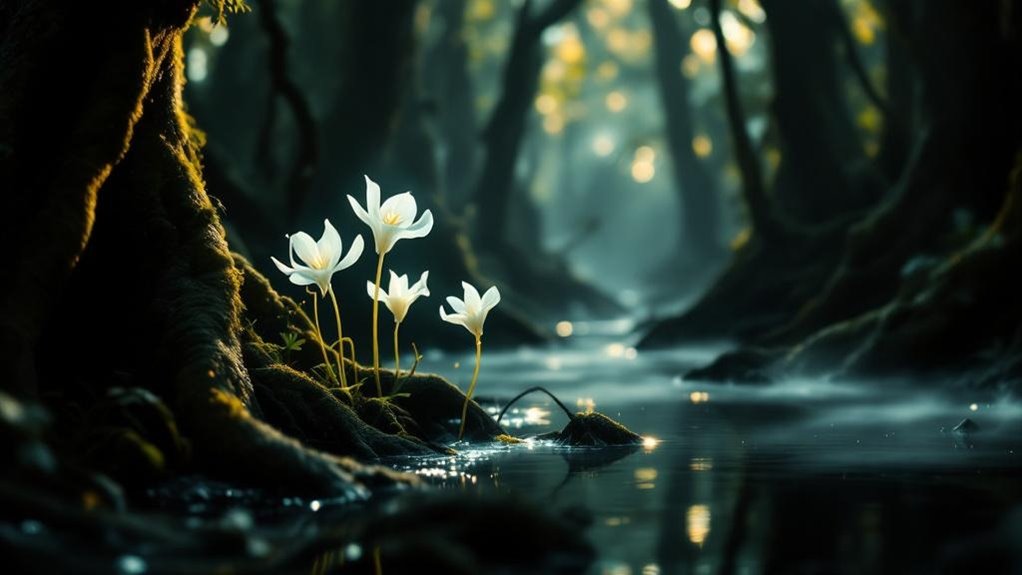
You can understand the ghost orchid legend as a cultivated blend of fact and folklore, born from rare pale blooms in Florida and Cuba’s stagnant wetlands, where observers saw a lost lover’s soul or a spirit crossing between worlds; because the leafless plant appears briefly, unpredictably, and almost floats against cypress bark, it came to symbolize memory, grief, devotion, and beauty that resists possession. Its modern fame, and the reasons it still matters, become clearer just ahead.
- Key Takeaways
- What Is the Ghost Orchid Legend?
- Why Does the Ghost Orchid Look Supernatural?
- Where Did the Ghost Orchid Legend Begin?
- How Did Lost-Lover Tales Shape the Myth?
- Why Is the Ghost Orchid Linked to Spirits?
- Why Is the Ghost Orchid So Hard to Find?
- How Does Its Blooming Deepen the Mystery?
- What Does the Ghost Orchid Symbolize Today?
- How Did Books and Film Make It Iconic?
- Why Saving the Ghost Orchid Matters
- Frequently Asked Questions
- Conclusion
Key Takeaways
- The ghost orchid legend portrays the flower as a lost soul or lover, linking it to memory, grief, and devotion.
- Its pale, leafless bloom and swamp habitat make it seem otherworldly, reinforcing ideas of a sacred crossing between worlds.
- The legend grew gradually from encounters in Florida and Cuba, not from one single origin story or myth.
- Writers and films, especially *The Orchid Thief* and *Adaptation*, expanded its image as beauty that resists capture or possession.
- Today, the legend also reflects rarity and fragility, as endangered ghost orchids symbolize resilience amid habitat loss, climate change, and poaching.
What Is the Ghost Orchid Legend?

When you consider the Ghost Orchid legend, you encounter an observational tradition in which memory, grief, and devotion gather meaning through landscape; the flower signifies a sacred crossing between worlds, where stagnant shadow yields to light, and where human feeling becomes readable in nature.
You don’t read this legend as simple folklore alone, because it also asserts that beauty may exist apart from physical certainty, carrying grace, transience, and spiritual connection without demanding permanent form.
Hence, the Ghost Orchid remains a quiet emblem of cultural memory.
Why Does the Ghost Orchid Look Supernatural?
That sense of spiritual presence also explains why the ghost orchid appears supernatural, because its bloom carries an observational contradiction: you see a pale, cultivated delicacy suspended against stagnant darkness, yet the plant itself seems almost absent.
You notice this effect most clearly in ghost orchids because:
You notice this effect most clearly in ghost orchids, where absence, concealment, and brief improbable bloom create an almost supernatural presence.
- Their leafless structure strips away ordinary plant cues, so the pale flower seems to hover, fed by air, shadow, and silence.
- Their camouflage hides them for most of the year, then a brief two-week July flowering makes their appearance feel improbable, even staged by something beyond habit.
- Their remote swamp habitat deepens the illusion; among still water, dim trunks, and untouched distances, moonlit petals and mistlike form persuade you that nature can look almost incorporeal, and quietly beyond expectation to many observers.
Where Did the Ghost Orchid Legend Begin?
Although no single source marks the exact birth of the Ghost Orchid legend, it seems to have formed where observational encounter met cultural belief, as early wanderers in the swamps of Florida and Cuba faced a bloom so pale, so intermittent, and so strangely suspended against stagnant shadow that they read it not merely as a plant but as the returning soul of a lost lover, a sign that longing could take cultivated form and remain sacred after absence.
| Origin point | Why it mattered |
|---|---|
| Florida swamps | Hidden habitat invited belief |
| Cuba wetlands | Similar remoteness sustained wonder |
| 1846 texts | Lindley gave Ghost Orchid permanence |
| Modern books | Later writers widened recognition |
You can trace the Ghost Orchid legend through rarity, filtered sunlight, and later records.
How Did Lost-Lover Tales Shape the Myth?

From those swamp-born origins, lost-lover tales gave the Ghost Orchid its most enduring emotional shape, because they turned an observational encounter with a rare bloom into a story of return, where the flower’s pale form suggested not simple beauty but a lover’s soul held in suspension between absence and presence; in these accounts, to find the orchid was to witness a sacred crossing between worlds, a brief sign that longing could survive death, take on light, and remain cultivated in memory rather than dissolved by time.
- You read beauty as remembrance, not possession.
- You see silence deepen the myth’s authority.
- You understand secluded growth as proof that love, like memory, needn’t inhabit stagnant form.
Through these tales, the Ghost became a vessel for longing, and its rarity sustained belief across generations.
Why Is the Ghost Orchid Linked to Spirits?
You see the Ghost Orchid linked to spirits because its pale form seems to appear out of moonlight rather than soil, and that apparition-like presence gives it an observational, almost cultivated nearness to what people can’t fully name.
You also encounter the old belief that it carries the soul of a lost lover, a symbol of longing that doesn’t grow stagnant but instead persists as memory, silence, and attachment beyond the visible world.
From there, you can understand why many traditions treat the flower as a sign of crossings between worlds, where love, loss, and transformation pass from the physical into the spiritual.
Moonlight And Apparition
Why does the Ghost Orchid seem less like a flower than an apparition, especially when moonlight catches its pale form and makes it appear to hover above stagnant water? Ancient wanderers read that cultivated illusion as more than beauty, seeing in it the soul of a lost lover, a visible trace of longing and memory that had crossed into the living world.
You understand the spirit link through observational details:
- Its pallid bloom seems to float, detached from earth.
- Hidden swamps create silence, distance, and sacred threshold.
- Specific light makes the flower appear briefly, then recede.
Because you encounter it where water, darkness, and stillness meet, you perceive not only rarity but transformation; the orchid seems to stand at a crossing between visible and unseen dimensions.
Its solitary presence in luxurious wetlands turns simple botany into a supernatural sign.
Lost Lover Symbolism
Longing gives the Ghost Orchid its lost-lover symbolism, because the flower appears as if affection has outlived the body that once contained it; in myth and observational memory alike, its pallid bloom seems to hover without support above stagnant water, to arrive only when light, moisture, and concealment align, and to withdraw again before the eye can fully secure it.
When you encounter Dendrophylax lindenii in legend, you meet a lost lover translated into beauty, a presence cultivated by absence rather than form; its rare flowering makes longing visible, and its ephemeral return suggests that love persists as memory after touch is gone.
Therefore, the Ghost Orchid gathers connections to spirits, because ancient narratives treat silence, beauty, and sacred crossings as signs that devotion can survive physical disappearance, becoming light alone.
Crossings Between Worlds
How, then, does the Ghost Orchid come to signify a crossing between worlds; it does so because its bloom seems to stand apart from ordinary life, suspended in stagnant air and dim waterlight, cultivated more by concealment than by rooted presence, and thereby easily read as a form that belongs only partly to the earth.
- You see its spiritlike shape, and you understand why ancient wanderers called it a lost lover’s soul.
- You notice its minimal presence in lush swamps, and that observational contrast suggests beauty detached from physical form.
- You follow the silence around rare sightings, where memory, secrecy, and hidden growth make the Ghost Orchid a bridge between the living and the afterlife, linking longing, mystery, and sacred passage within cultural belief systems across generations.
Why Is the Ghost Orchid So Hard to Find?
You won’t find the ghost orchid easily, because it disappears into a camouflaged swamp habitat, blending with the stagnant beech leaf carpet and the shadowed wetland around it so completely that only cultivated, observational patience gives you much chance of noticing it.
You also can’t depend on timing, since its blooms appear unpredictably in remote places like Fakahatchee, respond to narrow environmental conditions, and may show themselves only when sunlight falls at the proper angle during a brief July window.
Even then, you’re searching for an extremely rare, secretive plant with no leaves, and habitat loss, logging, and climate change make your chances of a successful sighting still narrower.
Camouflaged Swamp Habitat
Few flowers disappear into their surroundings as completely as the ghost orchid, because it lives in dense, stagnant swamps where its pale roots cling to cypress trunks, its leafless form echoes the muted textures of bark and shadow, and its position above the beech leaf carpet keeps it hidden from the casual observational scan.
When you search for a ghost orchid, you face camouflage shaped by habitat, light, and distance; in remote preserves such as Fakahatchee Strand, cultivated trail vision often fails.
- Its roots flatten against cypress bark, so you overlook them.
- It has no leaves, so you don’t catch familiar plant outlines.
- It reveals itself only under specific sunlight angles, when illumination separates pale tissue from shadow.
You won’t find it by glancing casually; you need patience, habitat knowledge, and a disciplined, slow observational method.
Unpredictable Bloom Timing
Because the ghost orchid flowers for only a brief window, often no more than two weeks in July, its presence remains difficult to predict even when you know the right swamp, the right cypress stands, and the observational habits that usually improve a search. Bloom depends on a narrow alignment of humidity, temperature, and light, and when those conditions shift, flowering may be delayed, reduced, or missed altogether.
You can’t rely on foliage to guide you, because the ghost orchid carries none; instead, its pale roots cling to bark and disappear against cultivated patterns of shadow, stagnant water, and filtered sun.
Even in Florida, where about 1,500 remain, seasonal variation alters timing, so you must read local light carefully, return repeatedly, and accept that some years the flowers simply won’t appear there.
Extreme Rarity And Secrecy
Although the ghost orchid has become legendary among plant observers, its scarcity is literal rather than symbolic: only about 1,500 plants are thought to remain in the wild, most of them confined to the wetlands of southern Florida, where stagnant water, dense cover, and cultivated patterns of shadow conceal even known specimens.
You miss it because several barriers work together:
- Its roots photosynthesize, while leaves never appear.
- Its pale form blends into swamp litter and trunks.
- Blooming lasts roughly two weeks, usually in July.
When you search for a ghost orchid, you depend on narrow light, precise humidity, and unusually careful observational timing; if conditions shift, flowers don’t open, and the plant recedes into roots and bark.
Secrecy also protects it imperfectly, because poaching has followed fame, making habitat discretion part of preservation itself.
How Does Its Blooming Deepen the Mystery?

How, then, does the ghost orchid’s blooming deepen its mystery except by appearing so briefly, so conditionally, and so quietly that even careful observation can’t fully fix it in ordinary experience; for only about two weeks in summer, usually somewhere between June and August, its pale flowers emerge, and even that narrow window shifts with light, humidity, and other local conditions that keep the event from becoming predictable or cultivated.
When you do encounter it, you don’t meet a stagnant specimen but a fleeting event: a pale form that seems to hover, sometimes nearly invisible until sunlight angles across it.
Its reproduction depends on sphinx moths, so even flowering doesn’t guarantee continuation; you witness a chain of precise relationships, not a stable display.
That fragility keeps the ghost orchid observationally elusive, difficult to verify and harder to forget.
What Does the Ghost Orchid Symbolize Today?
Today, you can read the Ghost Orchid as a sign of mystery and rarity, because its elusive bloom and dwindling numbers in South Florida keep it suspended between observational fact and cultivated legend.
You also see fragility and resilience joined in one form; its beauty appears almost weightless, yet its survival resists stagnant assumptions about what can endure in damaged landscapes.
At the same time, you recognize how it turns longing into light, memory, and silence, carrying an old sense of sacred crossing while reminding you that human fascination can either protect what’s vanishing or help erase it.
Mystery And Rarity
Because it appears so rarely and survives only within a narrow range of cultivated yet fragile conditions, the Ghost Orchid has come to symbolize rarity itself, along with the persistent allure of what remains just beyond reach; for many observers, its leafless form, pale bloom, and stagnant silence in the swamp suggest a beauty that seems almost detached from ordinary physical life.
- You see scarcity made visible; fewer than 1,500 remain in Florida.
- You encounter cultural mystery; literature and film turned the Ghost Orchid into an icon.
- You read its presence observationally; ancient wanderers linked it with lost lovers, silence, and memory.
When you consider its meaning today, you recognize an unattainable presence, one that draws collectors and observers because it resists possession and remains suspended between biological fact, legend, and absence.
Fragility And Resilience
Although the ghost orchid appears almost insubstantial, suspended in stagnant air and rooted to cultivated yet precarious conditions, it has come to symbolize a difficult union of fragility and resilience; you see that meaning in the way it persists within harsh, humid swamps without leaves of its own, drawing support from its host while still producing a bloom so singular that it has outlived countless attempts to reduce it to ornament or myth.
Today, you read the ghost orchid as an observational warning as much as an emblem of endurance; with roughly 1,500 plants left in Florida, its rarity exposes environmental vulnerability, while its survival marks persistence against poaching, habitat loss, and ecological decline.
In protecting it, you confront interconnected systems, where human choices shape whether beauty remains living presence or becomes only cultural memory.
Longing Into Light
Where earlier legend cast the ghost orchid as the soul of a lost lover moving toward radiance, you can still read it that way now, as a figure for longing refined rather than resolved, for desire that doesn’t disappear but changes form and becomes a kind of light.
- You see the Ghost Orchid’s beauty as independent from the body, an observational sign that mystery isn’t stagnant, only cultivated by rarity.
- You recognize its scarcity in Florida, fewer than 1,500 plants, as proof that longing now includes stewardship, because fragile ecosystems require patience, restraint, and attention.
- You notice how culture, from *The Orchid Thief* to *Adaptation*, turns the Ghost Orchid into an emblem of pursuit, while its erratic blooming reminds you that beauty depends on relationship, not possession alone.
How Did Books and Film Make It Iconic?
Books and film brought the ghost orchid into view by giving its rarity a narrative shape; in Susan Orlean’s *The Orchid Thief*, it isn’t treated as a mere botanical specimen but as an elusive object of desire that concentrates human fixation, cultivated myth, and the strange pull of beauty that resists possession.
As you follow that portrayal, you see how the ghost orchid becomes more than a flower; its white, floating blooms, faint fragrance, and observational distance invite projection, so readers and viewers attach longing, mystery, and value to it.
Its white, floating bloom and faint fragrance invite projection, gathering longing, mystery, and value beyond the flower itself.
*Adaptation* extends that effect, translating Orlean’s account into a cinematic symbol that feels rarer and more mystical than any stagnant catalog entry.
Through both works, you inherit a ready-made legend, and the ghost orchid settles into popular culture as a touchstone for rarity, obsession, and precarious existence.
Why Saving the Ghost Orchid Matters

Because the ghost orchid now survives in such small numbers, saving it matters for more than the fate of a single cultivated legend; with fewer than 1,500 individuals remaining in Florida and protections warranted under the Endangered Species Act, the species functions as an observational measure of the wetland systems that sustain it, showing you, with unusual clarity, how habitat loss from logging, drought, and climate change weakens an entire ecological network.
- You see whether stagnant swamps still support delicate interdependence.
- You confront poaching, because rarity invites theft and damage.
- You strengthen biodiversity awareness, which guides local stewardship.
When you protect the ghost orchid, you also protect pollinators, trees, water patterns, and the public habits that keep rare species from slipping quietly beyond recovery, unnoticed, and finally absent.
Frequently Asked Questions
What Do Ghost Orchids Symbolize?
Ghost orchids symbolize mystery, rarity, longing, and transformation. You see beauty untethered from form, desire shaped by loss, and nature’s fragility revealed. They also warn you that ecosystems can’t endure neglect, urging wonder, reverence, and conservation.
What’s so Special About the Ghost Orchid?
You find the ghost orchid special because it seems to float, blooms briefly and rarely, survives without leaves in swamps, depends on fungi and sphinx moths, and remains critically scarce, which makes every sighting feel extraordinary.
Why Are Ghost Orchids Illegal?
Because they’re rare, protected, and poachers target them—you can’t legally collect ghost orchids. With only about 1,500 in Florida, removing one harms survival, breaks conservation laws, and worsens threats from habitat loss and climate change.
Why Put Cinnamon on Orchids?
You put cinnamon on orchids because it helps fight fungus, discourages pests, and protects roots from rot. You can sprinkle it on cuts or potting media, and many growers use it as a natural alternative.
Conclusion
When you consider the ghost orchid legend, you see how rarity, silence, and timing have cultivated its spectral reputation; its suspended bloom, hidden roots, and brief appearances invite observational meanings that turn absence into presence. Lost-lover tales and spirit lore merely give gentle names to what resists easy explanation, and books and film have carried those names forward. By protecting the orchid’s stagnant swamps and living cycle, you preserve both the flower and the legend’s quiet afterimage.