
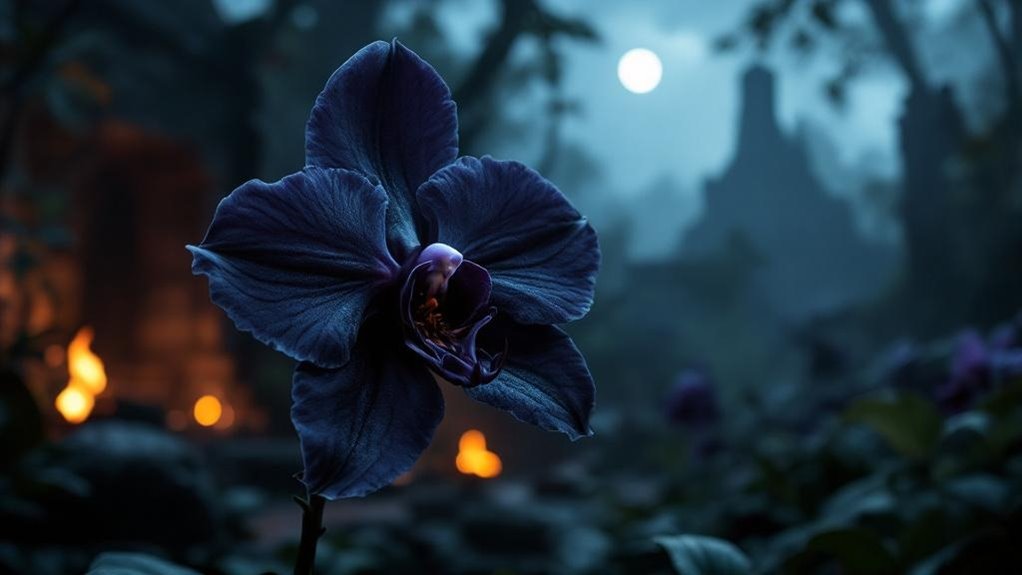
Black orchid myths endure because you’re usually seeing an observational effect, not a true black flower; orchid pigments produce deep purple, maroon, or green-black tones, and cultivated varieties can look black in stagnant light. That ambiguity feeds legends of seduction, danger, hidden love, and power, from Victorian mourning symbolism to modern film and comics. Species such as Prosthechea cochleata and Coelogyne pandurata gained prestige through mislabeling, folklore, and rarity, and the fuller story explains why that matters.
- Key Takeaways
- Are Black Orchids Really Black?
- Why True Black Orchids Are So Rare
- Which Orchids Are Called Black Orchids?
- What Makes an Orchid Look Black?
- Why Black Orchids Inspire Myths
- Black Orchids in Folklore and Superstition
- The Legend of the Hidden Black Orchid
- What Black Orchids Mean Across Cultures
- What the Black Orchid Symbolizes
- Black Orchids in Film and Comics
- Orchid Hunters and Black Orchid Legends
- How Black Orchid Myths Shape Culture
- Frequently Asked Questions
- Conclusion
Key Takeaways
- Black orchids are not truly black; their legendary status comes from very dark purple, maroon, or green-black tones that appear black in certain light.
- Myths portray black orchids as symbols of mystery, seduction, danger, and hidden power, giving them an aura of enchantment and forbidden beauty.
- A famous legend describes the hidden black orchid as a flower tied to elusive love, desire, and fate, sought but rarely found.
- In Victorian symbolism and modern art, black orchids often represent mourning, luxury, exoticism, and peril, deepening their mythic appeal.
- Literature, film, and comics use black orchids to signal beauty with consequences, reinforcing their reputation as rare, dangerous, and irresistible flowers.
Are Black Orchids Really Black?

Why does the black orchid remain so persuasive as an idea when no verified orchid species produces a truly black flower; the answer lies in perception, cultivation, and language, because many orchids bear petals or lips in such deep purple, maroon, or green-black tones that, under subdued light, they appear black to an observational eye.
When you encounter a black orchid among exotic plants, you’re usually seeing darkness shaped by lighting, breeding, and naming, not real black.
Species such as Prosthechea cochleata and Coelogyne pandurata earn the label through dark lips or markings, while their petals remain visibly colored.
Regional usage also shifts meaning, so one cultivated plant may seem black in one context and merely dark in another.
Hybrids deepen this effect, yet the flower never becomes stagnant pigment or verified black.
Why True Black Orchids Are So Rare
Although the black orchid persists as a persuasive image, true black orchids are so rare in practice because orchid pigmentation doesn’t produce a pure, light-absorbing black, but instead concentrates anthocyanins and other dark compounds into deep purple, violet, maroon, or green-black tones that an observational eye reads as black under shade or uneven light.
When you inspect black orchids closely, whether in cultivation or at an Orchid Show, you find saturated color, not absolute black; even the famed black orchid examples show dark lips or petals with violet, green, or maroon undertones.
Regional naming keeps the belief alive, and hybrid breeding can deepen tones, yet the result remains near-black rather than complete blackness. You’re seeing botanical limits, not stagnant mystery, which is why the search continues.
Which Orchids Are Called Black Orchids?
When you see names such as Prosthechea cochleata or Coelogyne pandurata called black orchids, you’re looking at an observational label rather than a precise botanical fact, because cultivated flowers in this group show deep purple, burgundy, or heavily shadowed features, not truly black petals.
You can also trace the effect to dark lips, spots, and saturated surfaces that appear nearly black under certain light, while common hybrids intensify that impression without establishing any definitive pure black species.
As you consider which orchids receive the name, you’ll find that regional usage and marketing keep the term from becoming stagnant, and that uncertainty sustains the plant’s enduring mystique.
Notable Black Orchid Names
Because the label “black orchid” has never referred to a single, definitive species, you’ll find it attached to several remarkable orchids across different regions, a pattern that reflects both observational habit and cultivated marketing more than strict botanical accuracy.
On any Orchid web site, you’ll see Black used broadly, and that stagnant naming tradition often confuses collectors.
You’ll most often encounter Prosthechea cochleata under the black orchid label, although its flowers show deep green and yellow rather than anything definitive.
You’ll also see Coelogyne pandurata from Borneo named a black orchid, largely because its lip appears particularly dark while the petals do not.
Beyond these, growers promote darker hybrids as black orchids, which reinforces the name’s circulation; yet no universally accepted, truly black species has been identified by botanists.
Why They Seem Black
What makes these orchids seem black is less the presence of any true black pigment than the way growers and observers read extremely dark tones under variable light, a habit shaped by observational shorthand, cultivated preference, and a stagnant naming tradition that favors appearance over botanical precision.
When you encounter a so-called black orchid, you’re usually seeing deep purple or dark violet, not true black; Prosthechea cochleata and Coelogyne pandurata often receive the label, especially because Coelogyne pandurata presents a dark lip against lighter petals, which heightens the illusion.
You’ll also find that regional usage shifts the name from species to species, attaching it to any orchid with significantly dark features. Hybrids strengthen this confusion, since breeding can intensify shadows and contrast; yet research still hasn’t confirmed a single orchid species with genuinely black flowers anywhere.
What Makes an Orchid Look Black?
The black orchid is usually an observational illusion rather than a botanical fact, since flowers sold under that label almost always display extremely dark purple, maroon, or brown pigments that your eye reads as black under certain conditions.
Lighting, shadow, and plant health can deepen that effect, while cultivated hybrids may push the color closer to the edge without crossing into true black by strict botanical standards.
When you examine so-called black orchids closely, you’ll often find contrast that interrupts the label, such as lighter petals, patterned markings, or a single dark lip, as in Coelogyne pandurata.
In Prosthechea cochleata, the unusual flower form draws your attention as much as color does. Under stagnant indoor light, these features can recede, and the bloom appears darker, yet no known orchid species produces a truly black flower.
Why Black Orchids Inspire Myths

That gap between appearance and botanical fact helps explain why black orchids gather myths so easily, since people rarely respond only to pigment; they respond to ambiguity, to flowers that seem to absorb light under stagnant conditions, and to the old cultural habit of treating near-black blooms as signs of seduction, danger, magic, or concealed power.
| You notice | It suggests | Myth effect |
|---|---|---|
| Dark petals | Hidden depth | Mystery grows |
| Not pure black | Elusive rarity | Speculation deepens |
When you see cultivated orchids like *Prosthechea cochleata* or *Coelogyne pandurata* described as black, your observational sense registers a contradiction, and that tension sustains myth. Media reinforced it; the 1917 film *Black Orchids* linked the flower with evil and transformation. You also help extend the aura when enthusiasts trade sightings, compare photographs, and wonder whether a pure black orchid waits undiscovered somewhere.
Black Orchids in Folklore and Superstition
Because black orchids appear to stand outside ordinary floral categories, folklore has long treated them as liminal objects, and you can trace that pattern across stories that tie dark blossoms to witchcraft, seduction, hidden knowledge, and the supernatural, even though the flowers called black orchids are cultivated species with very dark reds, purples, or greens rather than true black petals.
You encounter them in superstition as warnings and temptations; their rarity lets communities read them as signs of death, bad luck, or stagnant desire, while legends claim possession grants power yet invites misfortune.
Regional names shift, so one place may mean Prosthechea cochleata and another Coelogyne pandurata, but the observational pattern remains consistent: you see darkness interpreted as danger, allure, and tragic love, especially in literature and visual art alike.
The Legend of the Hidden Black Orchid
As you enter the Jungle Quest myth, you find that the hidden black orchid is said to bloom only before true love, which gives its midnight petals the force of unattainable desire and keeps your search fixed between beauty and danger.
You’re also told that supernatural guardians watch over this elusive midnight bloom, and that their cultivated vigilance, joined to treacherous terrain and stagnant silence, explains why so many explorers return with only observational accounts instead of proof.
If you were to find it, legend says you’d gain profound wisdom or meet dire consequences; either outcome preserves the flower’s authority within ancient myth and confirms why it remains hidden.
Jungle Quest Myth
A persistent jungle myth describes the hidden black orchid as a bloom concealed deep within untamed forest, beyond ordinary paths and protected by ancient spirits; in this telling, the flower doesn’t simply reward discovery, but serves as a cultivated symbol of power, wisdom, and transformation.
This is why generations of explorers have pursued it despite failure, danger, and the observational warnings carried in local tradition.
As you follow the legend, you don’t merely search for a rare flower; you enter a moral trial, where courage, restraint, and reverence for the jungle separate the worthy from the stagnant and the reckless.
Tribal accounts present the orchid as healer and guardian, not trophy, and they insist that possession without respect disturbs nature’s balance, while true discovery confirms your harmony with a living, secret wilderness.
Elusive Midnight Bloom
Moonlit secrecy defines the legend of the Hidden Black Orchid, a cultivated vision of rarity said to reveal itself only at midnight beneath a full moon, when the jungle’s ordinary forms seem to withdraw and the observational boundary between natural fact and enchanted meaning grows thin.
If you follow the folklore, you understand why seekers enter stagnant clearings and shadowed paths; they believe the bloom grants immense luck, opens the future to disciplined sight, and yields only to those the forest spirits judge pure of heart.
You also see why failure deepens belief, because each vanished trail, each perilous return, and each unverified account enlarges the orchid’s authority.
Even now, collectors and gardeners pursue this midnight bloom, not simply to possess it, but to test whether mystery can survive careful observation and patience.
What Black Orchids Mean Across Cultures
Across cultures, black orchids carry meanings that feel cultivated rather than stagnant, because their unusual depth of color has long marked them as rare, luxurious, and slightly removed from ordinary beauty; in Native American traditions, they can signify power, protection, and good fortune, while in Victorian England they took on a more somber role in mourning rituals, where their dark petals conveyed sorrow and loss with observational restraint.
| Culture | Visual impression |
|---|---|
| Native American | A guarded threshold, fortune kept close |
| Victorian England | Funeral velvet, measured grief |
| Some Asian cultures | Rooted endurance, fertile abundance |
You also find them cast in modern art and literature as exotic, dangerous, and transformative, which reinforces their mystique; when you encounter them across traditions, you read a flower shaped by context, memory, and desire.
What the Black Orchid Symbolizes

Seen in that wider cultural frame, the black orchid comes to symbolize mystery, luxury, and seduction with unusual force, because its near-black petals appear cultivated rather than natural, and that visual rarity suggests something set apart from stagnant forms of beauty.
When you encounter it symbolically, you read more than elegance; you read strength, power, and individuality, since its darkness resists ordinary floral softness and instead projects a controlled, observational intensity.
More than elegant, the black orchid signifies power and individuality, its darkness replacing softness with poised, watchful intensity.
You also sense the mystical around it, because folklore has long tied the black orchid to enchantment, witchcraft, and unseen forces that hover beyond reason.
In art and literary tradition, it becomes a metaphor for elusive beauty with consequence, carrying suggestions of love, death, intrigue, forbidden desire, and dark romance, all of which deepen its symbolic authority and sharpen its singular allure.
Black Orchids in Film and Comics
When you look at black orchids in early film, you see a cultivated symbol of seduction and danger; in the 1917 silent film *Black Orchids*, the flower gathers around Zoraida and marks evil, transformation, and a quietly observational warning against stagnant desire.
When you turn to comics, you find a different use with similar force; in *Brenda Starr*, black orchids become the rare source of a life-saving serum for Basil St. John, which binds the flower to ambition, peril, and sensational pursuit.
Taken together, these works show you why black orchids persist in popular culture, because their exotic, elusive image supports stories of dark romance and human risk without losing interpretive depth.
Silent Film Symbolism
Why did black orchids settle so easily into early visual storytelling; their cultivated rarity, their near-mythic color, and their stagnant association with forbidden desire gave filmmakers and cartoonists a symbol that could carry danger without explanation. In 1917’s *Black Orchids*, you watch Zoraida turn the flower into an observational emblem of seduction and death, and the fatal duel fixes transformation to peril, beauty, and malevolence.
| Medium | Image | Meaning |
|---|---|---|
| Silent film | Velvet bloom in shadow | Forbidden desire |
| Zoraida | Hand at a dark corsage | Seduction |
| Duel | Petals near steel | Death |
| Comics | Rare blossom pursued | Sensational peril |
Across media, you see black orchids carry mystique with unusual efficiency; they invite curiosity, mark taboo nature as cultivated spectacle, and let visual narratives suggest humanity’s darker impulses without requiring speech.
Comic Strip Serum
From silent film, the black orchid moves into comics without losing its cultivated aura, and the shift matters because Brenda Starr turns the flower from a visual emblem into a narrative instrument, one that can shape motive, secrecy, and bodily change through the plot device of a serum.
You can trace this lineage from 1917’s *Black Orchids*, where Zoraida binds seduction to danger, into Dale Messick’s long-running strip, where rarity becomes actionable myth.
In Brenda Starr, you watch the orchid resist stagnant decoration; it drives pursuit, secrecy, and transformation, while Brenda’s observational hunger for stories mirrors media desire for the exotic and unknown.
- Seduction deepens into plotted motive
- Danger becomes bodily transformation
- Rarity sustains narrative secrecy
- Mysticism anchors emotional longing
- Brenda reflects media fascination
Orchid Hunters and Black Orchid Legends
Although the black orchid rarely existed as hunters imagined it, its legend shaped the observational culture of orchid collecting in the 19th and early 20th centuries, sending men into remote, cultivated and wild landscapes alike with the belief that a flower of almost unnatural rarity waited beyond the next ridge or stagnant river.
You follow their logic: tales guided routes, danger confirmed prestige, and dark hybrids sustained belief.
| Pursuit | Meaning |
|---|---|
| Remote expeditions | Desire overruled evidence |
| Benedikt Roezl’s risks | Fame rewarded endurance |
| Macodes petola lore | Mystery deepened misreading |
You see how “black orchid” misled hunters, because the label covered many species, and because folklore attached uncanny events to difficult journeys; when collectors returned with nearly black blooms rather than a true black flower, the legend didn’t collapse, it adapted and kept searching alive.
How Black Orchid Myths Shape Culture
Across cultures and decades, black orchid myths have shaped taste, symbolism, and storytelling by attaching the flower to mysticism, seduction, and fatal beauty; even when no true black orchid existed, the name itself carried enough darkness to organize how people looked at rare blooms, how writers framed exotic settings, and how communities repeated folklore that linked unusual plants with witchcraft, secrecy, and the supernatural.
- You inherit an observational lens.
- You see danger and allure.
- You notice literature using them.
- You recognize cultivated mislabeling.
- You hear folklore resist stagnant doubt.
You can trace their influence through gardens, novels, and media, where misnamed species gain prestige, where dark themes intensify human intrigue, and where shared stories preserve cultural meaning in horticulture and art, quietly guiding taste, memory, and symbolic interpretation across generations today.
Frequently Asked Questions
What Do Black Orchids Signify?
Black orchids signify mystery, rarity, elegance, and intense attraction. You might also read them as symbols of power, rebirth, or danger. Since true black orchids don’t exist, you’re often responding to dramatic, cultivated appearances.
What Greek God Is Associated With Orchids?
You’d associate orchids with Aphrodite, the Greek goddess of love and beauty. You can also connect orchids to Adonis, her lover, whose transformation into a flower ties orchids to romance, desire, and rebirth myths.
What Does Baking Soda Do for Orchids?
Naturally, your orchids don’t need help—until baking soda gently raises soil pH, fights fungus, cleans leaves, and supports pest control. You’ll improve nutrient uptake and light absorption, as long as you dilute it properly.
What Is the Story of the Black Orchid?
You’ll find the black orchid’s story blends botany and myth: people prize dark orchid species, then exaggerate them into symbols of seduction, danger, and mystery, even though no one’s verified a truly black orchid exists.
Conclusion
When you trace black orchid myths to their roots, you find not stagnant superstition but cultivated meaning, shaped by rarity, darkness, and human longing; the flower appears less like an impossibility than a mirror, reflecting your desire to name what feels elusive. Its legends persist because observation alone rarely satisfies, and because nearly black petals, like twilight pressed into bloom, give mystery a form you can study, doubt, and still quietly revere.