
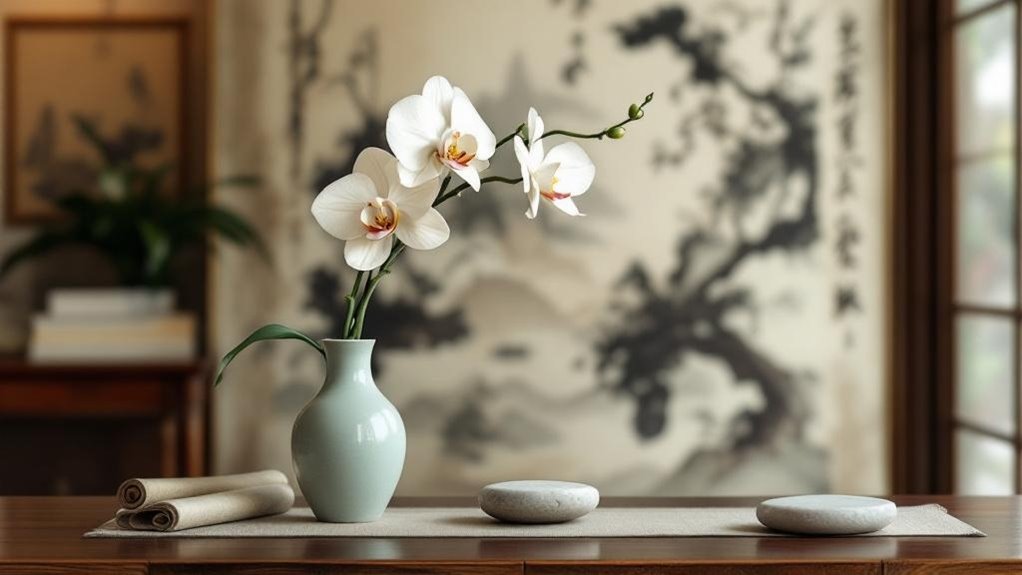
Confucius praised orchids because you see in them a cultivated character that doesn’t advertise itself: quiet fragrance, graceful form, restraint, and steadiness. In Chinese culture, those traits came to signify the junzi, the gentleman whose virtue appears through conduct rather than display; in poetry and ink painting, orchids consequently marked integrity, sincere friendship, and observational discipline. Their symbolism endured across East Asia because their beauty never hardened into stagnant ornament, and there’s more to trace in that legacy.
- Key Takeaways
- Why Confucius Praised Orchids
- How Orchids Became the Gentleman’s Flower
- Orchid Symbolism in Chinese Culture
- Why Orchid Fragrance Signaled Virtue
- How Orchid Paintings Reveal Character
- How Orchids Fit the Four Gentlemen
- How Scholars Used Orchids
- How East Asian Art Preserved Orchid Symbolism
- Why Orchids Still Mean Nobility
- Frequently Asked Questions
- Conclusion
Key Takeaways
- Confucius admired orchids because their quiet fragrance symbolized virtue that influences others without seeking attention or praise.
- Orchids came to represent the *junzi*, the cultivated gentleman who combines humility, integrity, restraint, and moral steadiness.
- In Confucian thought, orchid fragrance mirrors true character: subtle, disciplined, and revealed through conduct rather than display.
- Scholars and artists used orchids in poetry and painting to express purity, refined friendship, and self-cultivation.
- Their symbolism spread across East Asia, where orchids continued to embody discreet beauty, ethical refinement, and noble character.
Why Confucius Praised Orchids
Although Confucius lived in a world that valued ceremony and public reputation, he praised orchids for qualities that don’t announce themselves, because their subtle fragrance and graceful form suggested a cultivated character grounded in restraint rather than display; in his teachings, the orchid became a fitting image for the *junzi*, the gentleman whose moral integrity remains steady, modest, and observational, even when recognition is absent.
When you read Confucian thought closely, you see why the orchid represents righteousness: it remains humble, avoids stagnant vanity, and flourishes without demanding notice.
Confucius valued that quiet pattern because you can measure virtue not by spectacle, but by conduct, friendship, and steadiness under ordinary conditions; hence orchids in poetry and literature affirm refined character, moral excellence, and disciplined self-possession.
How Orchids Became the Gentleman’s Flower
From Confucius’s praise, the orchid moved steadily into a larger cultural role, because his admiration gave later scholars, painters, and poets a durable language for describing what a gentleman ought to be: cultivated without vanity, morally upright without display, and quietly steadfast in conditions that might leave lesser character stagnant.
As you trace that development, you see the orchid gain authority through repeated use in poetry and painting, where its delicate form and restrained fragrance supported an observational ideal of noble conduct. You also see why scholars embraced it: the flower’s refinement suggested humility rather than ornament, companionship rather than dominance, and virtue expressed through disciplined presence.
Over centuries, those cultural expressions fixed the orchid as the gentleman’s flower, not by forceful declaration, but by steady association with cultivated character and moral integrity.
Orchid Symbolism in Chinese Culture
Where orchid symbolism in Chinese culture becomes most revealing is in the way the flower gathers several ideals at once—moral integrity, cultivated grace, purity, fidelity, and renewal—without losing its restrained character; it doesn’t stand for virtue in an abstract or ornamental sense, but for virtue made visible through conduct that remains steady, refined, and unassuming.
When you trace the orchid through Chinese culture, you see why scholars treated it as a gentleman’s emblem: Confucius linked it with noble companionship, and later painters and poets, especially from the Song dynasty onward, used it to express refinement without display.
Within the Four Gentlemen, the orchid marks spring, so you read it as renewal shaped by discipline rather than stagnant ease; it also carries fidelity and friendship, turning personal virtue into social ethic in life.
Why Orchid Fragrance Signaled Virtue

Fragrance, more than the orchid’s form alone, helped make the flower a persuasive sign of virtue in Chinese thought, because its presence was real yet restrained, perceptible only through attentiveness and never through display; that quiet diffusion suited a Confucian moral vision in which integrity didn’t announce itself loudly but revealed itself through steady conduct, cultivated bearing, and modest influence.
When you encounter an orchid in this tradition, you’re meant to notice what isn’t stagnant or aggressive: a scent that rewards observational patience, suggesting high moral standards without spectacle.
Confucius treated orchids as companions to noble conduct, and their delicate fragrance made that lesson persuasive, because true virtue, like refined character, reaches others gently, remains disciplined under restraint, and leaves a lasting impression without demanding recognition or applause from anyone.
How Orchid Paintings Reveal Character
That same restrained excellence becomes visible in painting, because orchid images in Chinese art don’t merely record a plant’s appearance; they present a moral type, using the orchid’s slender leaves, delicate bloom, and unforced posture to suggest the nobility and modesty that Confucian thought prized in the cultivated gentleman.
| Feature | Meaning | Effect |
|---|---|---|
| Slender leaves | Modesty | You observe reserve |
| Faint fragrance | Inner strength | You infer depth |
| Fluid brushwork | Harmony | You see balance |
When you study an orchid scroll, you read character through form; Song painters, and later Chinese scholars, used observational restraint to avoid stagnant display, echoing Confucius, who treated the orchid as a sign of integrity, noble conduct, and quietly cultivated self-command.
How Orchids Fit the Four Gentlemen
Within the tradition of the Four Gentlemen, the orchid belongs to spring, and it holds that place because it expresses grace without display, subtlety without weakness, and a cultivated restraint that Chinese scholars recognized as the mark of noble conduct.
As you consider orchids beside bamboo, plum, and chrysanthemum, you see why they open the cycle: they suggest renewal without noise, moral refinement without stagnant rigidity, and inner beauty revealed through reserve.
Confucius praised them as signs of worthy companionship, so their place in this set isn’t merely seasonal; it’s ethical, observational, and philosophical.
In painting, their fluid leaves and spare monochrome blossoms reinforce that meaning, since disciplined brushwork mirrors humility, modesty, and quiet strength.
You recognize, then, that orchids complete the Four Gentlemen by making virtue visible without ostentation alone.
How Scholars Used Orchids

You can see how scholars used orchids to cultivate themselves, because the flower’s restraint, subtle fragrance, and quiet beauty reflected the integrity and noble conduct they believed a learned life required.
When you consider orchid ink painting, you find more than observational study of form; you see a disciplined practice that kept the mind from becoming stagnant, steadied the hand, and turned art into reflection on humility, grace, and personal virtue.
You also find that when scholars placed orchids in poetry and painting, they affirmed friendship and integrity, following Confucius’s praise of the flower as a sign of noble companionship and a cultivated character.
Scholar Self-Cultivation
Discipline shaped the scholar’s regard for the orchid, because Confucius had already cast it as a living emblem of modesty, virtue, and nobility.
Later literati adopted the flower not as an ornament of display but as a cultivated image of the gentleman they hoped to become.
In scholar self-cultivation, you treat the orchid as an observational guide, measuring character against its quiet presence, rejecting stagnant vanity, and choosing integrity instead.
- You value restraint, because the orchid suggests moral worth without ostentation.
- You honor friendship, because poems cast the flower as companionship grounded in ethical bonds.
- You cultivate it as practice, because tending living roots mirrors disciplined conduct, refined behavior, and the steady pursuit of virtue.
Through this cultivated symbol, you shape inward nobility with patience daily.
Ink Painting Practice
That inward discipline found a visible counterpart in ink painting, where scholars rendered orchids with fluid, controlled brushwork and used the act of painting to test the same restraint they admired in the plant itself; monochrome ink suited the subject because it refused decorative excess, drew attention to subtle line, spacing, and movement, and suggested fragrance and liveliness through understatement rather than display.
| Practice | Meaning |
|---|---|
| Ink orchid | Cultivated restraint |
| Orchid with plum | Inner beauty |
As you paint, you practice observational care; each stroke resists stagnant ornament, reflects refined character, and turns simplicity into discipline. You place orchids within balanced compositions, sometimes beside plum, to show knowledge of nature and to embody Confucian moral standards. In that meditative work, you don’t merely picture a flower; you cultivate inner beauty through measured attention.
Friendship And Integrity
Integrity shaped the scholars’ understanding of friendship, and the orchid gave that ideal a visible form; Confucian thought treated the flower’s quiet refinement, delicate structure, and unstated fragrance as signs of high moral standards, so its image came to stand for the kind of companion whose sincerity doesn’t need display and whose grace never slips into stagnant ornament.
- You see Confucius praise orchids because their modest beauty models virtue in friendship.
- You notice their cultivated delicacy suggests harmony, restraint, and sincerity between companions.
- You find them in poetry and painting, where they represent an ideal friend, dignified, graceful, and ethically steady.
When scholars kept orchids near the studio, you can read the gesture as observational and moral; the flower reinforced integrity, discouraged vanity, and reminded you that worthy companionship deepens character without demanding attention.
How East Asian Art Preserved Orchid Symbolism
You can see how East Asian art kept orchid symbolism alive through ink painting traditions, where cultivated, fluid brushwork rendered the flower’s quiet elegance and suggested the moral refinement Confucius associated with virtue and nobility.
As you look at Song dynasty paintings and later scholar art, you recognize that the orchid didn’t function as stagnant decoration; it carried the *junzi* ideal into visual form, joining observational study of nature with disciplined character.
You also find this symbolism extending across East Asia, especially in Korean *Sagunja* painting, where the orchid preserved its place as a steady emblem of grace, integrity, and learned self-cultivation.
Ink Painting Traditions
Restraint shaped the orchid’s place in East Asian ink painting, where scholars and artists treated the flower not as a decorative subject but as a cultivated emblem of nobility, self-command, and moral clarity, values closely aligned with Confucian ideals and especially resonant in the Song dynasty, when the orchid became one of the clearest visual signs of the *junzi*, or gentleman.
- In monochrome ink, you notice how disciplined brushwork prevents beauty from turning stagnant or merely ornamental.
- In traditional Chinese painting, alongside the plum blossom, the orchid rewards observational looking; shifting ink tones suggest grace, integrity, refinement.
- When you follow this tradition into modern East Asian art, you still see an unassuming flower carrying high standards, preserved through cultivated technique and quiet continuity.
Scholar Ideals In Art
From disciplined ink practice, the orchid moved naturally into the moral world of the scholar, where East Asian art preserved it as a cultivated sign of the *junzi*, the gentleman whose character Confucius praised for humility, self-command, and noble conduct.
When you look at Song dynasty paintings, you see why the orchid joined the Four Gentlemen; artists used fluid, observational brushwork to present beauty without display, and that restraint taught viewers how true learning rejects stagnant vanity.
Its leaves bend, its blossoms remain spare, and together they suggest moral integrity, quiet knowledge, and the virtue to withstand obscurity without surrendering principle.
In this tradition, you don’t merely admire a plant; you encounter a model of cultivated character, one that scholars returned to because subtle form could embody ethical seriousness more faithfully than ornament ever could.
Symbolism Across East Asia
Continuity best explains how orchid symbolism endured across East Asia, because artists and patrons didn’t preserve the flower as a mere decorative motif; they carried forward a cultivated moral language in which the orchid signified integrity, high standards, and noble conduct, values long associated with Confucian thought.
- In China, you see orchids linked to gentlemanly character, subtle fragrance, and moral companionship.
- In Song painting, you notice observational restraint; monochrome ink made virtue visible without stagnant ornament.
- In Korea, you find symbolism across East Asia preserved through celadon and later blue-and-white porcelain, where orchids retained refined ethical meaning.
As you follow these works across regions, you see continuity through adaptation, not dilution; artists preserved discreet beauty and philosophical depth, ensuring orchids remained emblems of gentility.
Why Orchids Still Mean Nobility
Although orchids appear delicate and almost reticent, they still signify nobility because Chinese culture has long read their modest form as evidence of cultivated virtue, high moral standards, and personal integrity rather than mere ornament. When you notice their quiet poise, you see inner beauty made visible, a dignity Confucius praised as the mark of noble companionship and disciplined moral conduct.
Their humility recalls the character of the plum; neither flower needs extravagance to assert worth, and both resist stagnant display. Since the Song dynasty, you can trace their persistent cultivation through painting, philosophy, and observational art, where slender leaves and restrained blossoms embody the junzi ideal.
In these images, orchids don’t merely decorate space; they instruct you in refined conduct, suggesting that true nobility remains subtle, steady, and ethically composed.
Frequently Asked Questions
What Did Confucius Say About Orchids?
Confucius said orchids reflect noble character: you see their quiet fragrance and delicate beauty as virtues of a true gentleman. He taught that, like worthy people, they don’t boast, yet they inspire harmony and respect.
What Do the 4 Gentlemen Flowers Mean?
The Four Gentlemen flowers show you four virtues: plum blossom means integrity, orchid means nobility, bamboo means resilience, and chrysanthemum means endurance. You also link them to seasons: winter, spring, summer, and autumn, respectively.
What Do Orchids Symbolize in Chinese Culture?
In Chinese culture, orchids symbolize integrity, virtue, humility, and faithful friendship. Look closer, and you’ll see more: they quietly reflect the noble character you should cultivate, valuing inner grace, loyalty, and moral strength over show.
Who Are the 4 Gentlemen of the Republic of China?
You know the Four Gentlemen of the Republic of China as plum blossom, orchid, bamboo, and chrysanthemum. They represent winter, spring, summer, and autumn, and they embody virtues like humility, resilience, elegance, and integrity.
Conclusion
You see the irony clearly: the orchid, rooted in silence and seeming fragility, became the cultivated measure of strength, because Confucius recognized that true nobility rarely announces itself, and scholars followed him, reading fragrance, brushwork, and restraint as observational signs of virtue. What looks delicate refuses stagnant display; what grows apart teaches character. That’s why the orchid still endures as the gentleman’s flower, not despite its quietness, but because of it.