
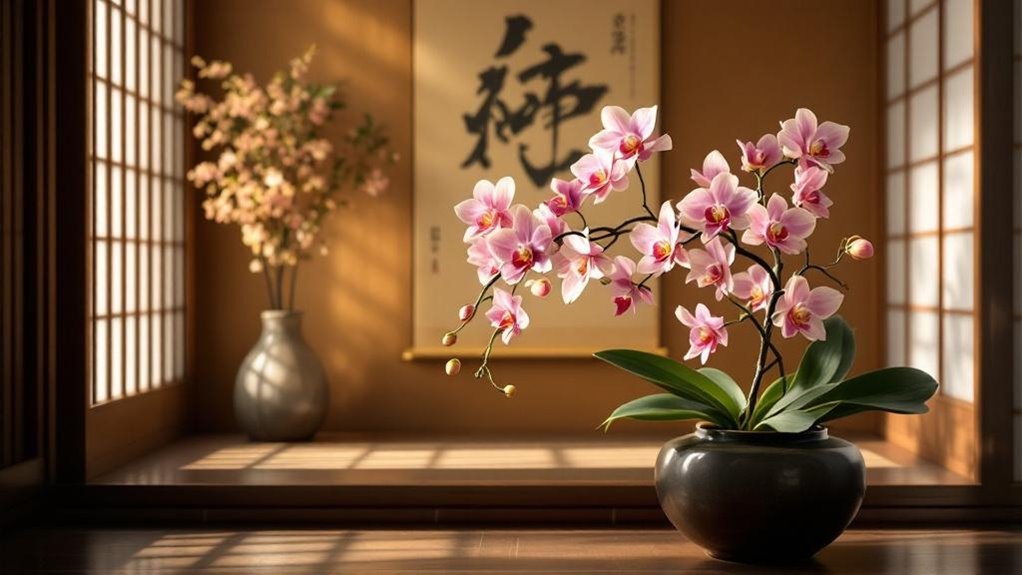
In Japan, you can regard orchids as sacred because they join beauty to social meaning; they signal honor, prosperity, fertility, and disciplined strength, and their cultivated presence is thought to invite good fortune into homes and businesses. The samurai orchid, Neofinetia falcata, deepened that status through associations with bravery, loyalty, wealth, and observational restraint. Even today, orchids mark ceremonies, milestones, and memorials with elegance, and their colors refine meaning in ways you’ll see next.
- Key Takeaways
- Why Are Orchids Sacred in Japan?
- How Did Orchids Come to Symbolize Honor?
- What Is the Samurai Orchid?
- Why Do Orchids Represent Luck and Prosperity?
- What Orchid Colors Mean in Japan
- Which Orchids Are Most Revered in Japan?
- When Do Japanese People Give Orchids?
- What Are the Rules for Gifting Orchids in Japan?
- How Do Japanese and Western Orchid Meanings Differ?
- Frequently Asked Questions
- Conclusion
Key Takeaways
- Orchids are sacred in Japan because they symbolize good fortune, prosperity, strength, and spiritual harmony in homes, ceremonies, and businesses.
- The Samurai orchid, Neofinetia falcata, is especially revered for representing bravery, loyalty, honor, and enduring prosperity.
- Different orchid colors carry ritual meanings, such as white for purity, pink for grace, purple for respect, and yellow for joyful beginnings.
- Orchids are prized gifts for openings, anniversaries, and memorials because they express respect, blessing, and cultivated goodwill.
- Their long-lasting blooms, clean indoor suitability, and elegant presence reinforce their sacred role as signs of auspicious energy.
Why Are Orchids Sacred in Japan?

Because Japanese flower symbolism has long tied cultivated plants to social ideals and spiritual meaning, orchids came to be regarded as sacred not through doctrine alone, but through what they represent in daily and ceremonial life: good fortune, fertility, power, and strength, all qualities that resist anything stagnant and affirm continuity.
When you observe Orchids in Japan, their flower meaning extends beyond beauty; you see them placed at store openings and major milestones to invite prosperity, positive energy, and respectful social exchange.
You also notice their practical suitability indoors, since many varieties carry neither strong fragrance nor pollen, which supports calm placement in homes and businesses. Even presentation reinforces reverence: you include a tatefuda for identification, avoid red wrapping, and treat the gift as a cultivated sign of goodwill, order, and enduring auspicious presence.
How Did Orchids Come to Symbolize Honor?
Although orchids in Japan are admired for beauty and auspicious fortune, they came to symbolize honor more specifically through cultivated social practice and elite historical association; Neofinetia falcata was especially prized by samurai, who treated it as a living trophy of bravery, loyalty, and disciplined taste.
You can trace that meaning through ancient exchange, where an Orchid signaled wealth, respect, and observational restraint, never stagnant display.
| Context | Meaning | Result |
|---|---|---|
| Samurai taste | bravery, loyalty | honor deepened |
| Gift exchange | respect, admiration | status affirmed |
Because orchids carry prosperity and good fortune, you offer them to mark esteem; because they lack fragrance and pollen, they remain practical, refined gifts, often paired with a tatefuda, which preserves social clarity and confirms honorable intent in business and personal relationships.
What Is the Samurai Orchid?
When you encounter the Samurai Orchid, or Neofinetia falcata, you see more than a cultivated flower; you see a plant long associated with the samurai class, one that carries symbolism of bravery, honor, and peace in Japanese culture.
You can recognize its heritage in both its observational elegance—delicate, fragrant white blooms—and its resilient habit, since it thrives without becoming stagnant across varied environments, which reinforces its reputation for adaptability and quiet strength.
As you consider its place in homes, ceremonies, and formal gifts, you can understand why this orchid has come to signify respect, good fortune, and enduring prosperity.
Samurai Orchid Symbolism
A living emblem of cultivated resolve, the Samurai Orchid, or *Neofinetia falcata*, came to symbolize courage, honor, and strength in Japan. Its meaning rests in a careful contrast: the plant appears delicate, yet it endures, a quality that mirrored the samurai ideal of disciplined power held under control.
When you consider the samurai orchid, you see more than beauty; you see an observational lesson in restraint, resilience, and rank, since warriors prized rare forms as visible signs of status and refined judgment.
You also find associations with good fortune, prosperity, and fertility, which kept the flower from becoming a stagnant military emblem. People gave it as a blessing, displayed it in homes and businesses, and treated its quiet elegance as proof that strength, when cultivated, could guide success without excess.
Neofinetia Falcata Heritage
Because its cultural meaning grew alongside centuries of careful cultivation, *Neofinetia falcata*—the orchid widely known as the Samurai Orchid—stands in Japan as more than a rare flowering plant; it serves as a cultivated emblem of strength, bravery, prosperity, and good fortune, values that align closely with samurai ideals and have kept the species from becoming a stagnant historical symbol.
When you encounter *Neofinetia falcata* in Japan, you see why many regard it as sacred; its resilience mirrors disciplined adaptability, while its fragrant, delicate blooms bring harmony to homes and businesses. You also find it exchanged at milestones and celebrations, where it carries an observational promise of luck, happiness, and enduring prosperity.
As growers preserve treasured varieties with meticulous care, you witness a national heritage shaped by beauty, reverence, and continuity.
Why Do Orchids Represent Luck and Prosperity?
Why, then, do orchids carry such persistent associations with luck and prosperity in Japan; the answer lies in the way their cultivated beauty has long been read as more than ornamental, reflecting fertility, strength, power, and good fortune in a form that appears resilient rather than stagnant, delicate yet markedly adaptable.
When you place orchids in a home or business, you participate in an observational tradition that treats them as active signs of blessing, abundance, and steady fortune, which is why they appear at store openings and formal celebrations.
Placed in homes and businesses, orchids have long signified blessing, abundance, and the steady arrival of good fortune.
You also see this meaning in revered varieties such as Neofinetia falcata, whose ties to bravery deepen its auspicious status.
Because orchids last so long, you can give them year-round, trusting their endurance to signify lasting prosperity, durable luck, and blessings that remain present.
What Orchid Colors Mean in Japan

Color gives orchid symbolism in Japan a more exact social language, shaping how you read the flower’s cultivated presence and how you choose it for a particular moment; while orchids broadly signify prosperity, fertility, and power, individual hues direct that meaning toward specific forms of regard.
You see this meaning clearly in white orchids, which express purity and elegance, fitting weddings and memorial offerings with an observational restraint that never feels stagnant.
Pink orchids signal grace and femininity, so you choose them for births and anniversaries, where cultivated affection matters more than display.
Purple orchids carry royalty and respect, allowing you to convey admiration or congratulations without excess.
Yellow orchids suggest joy and friendship, making them suitable for goodwill, reconciliation, and new beginnings, especially when you want your gesture to feel generous, measured, and socially precise.
Which Orchids Are Most Revered in Japan?
You can see Japan’s reverence for orchids most clearly in the legacy of Neofinetia falcata, the Samurai orchid, whose cultivated image of bravery, purity, and prosperity gave it enduring status among elites and in observational accounts of sacred floral tradition.
You also find prestige in Phalaenopsis, especially as a formal gift, and in Cymbidium, whose auspicious appeal suits ceremonies, households, and businesses where orchids are valued not as stagnant decoration but as signs of blessing, resilience, and good fortune.
As you consider which orchids are most honored, you can trace a consistent pattern: those linked to purity, strength, health, and elegant ceremony hold the highest place in Japanese cultural regard.
Neofinetia Falcata Legacy
Among Japan’s most revered orchids, Neofinetia falcata holds a singular place, prized not only for its fragrant white flowers and cultivated resilience, but also for the legacy it carried among samurai who treated the plant as a trophy of honor, a mark of elegance, and a quiet emblem of bravery.
You see Neofinetia falcata valued as a symbol of good fortune, fidelity, and disciplined taste, shaping observational rituals, domestic displays, and aesthetics without becoming stagnant.
- Fragrant white blooms suggest refinement.
- Resilient growth reflects cultivated endurance.
- Samurai associations convey honor and loyalty.
- Ceremonial display affirms respect and prosperity.
When you encounter it in homes, businesses, or traditional settings, you witness an orchid that joins beauty with historical memory, and asks for dedication rather than attention.
Phalaenopsis Gift Prestige
Prestige gathers naturally around Phalaenopsis, or moth orchids, in Japan, where their balanced form, steady bloom, and cultivated elegance make them a favored gift in both private and commercial life. When you see them sent to mark a store opening, a company milestone, or a formal celebration, you’re looking at more than a decorative gesture, because they carry associations with refinement, good fortune, and durable regard.
When you give a phalaenopsis orchid, you signal respect and measured admiration, and custom often reinforces that message through a 立て札, which identifies you and states your purpose with observational clarity.
Because the flowers remain attractive for an unusually long period, they avoid any stagnant impression, sustaining elegance in offices, shops, and homes, while quietly extending your wishes for good fortune over time.
Cymbidium Auspicious Appeal
Cymbidium holds a particularly auspicious place in Japan, and its appeal rests not only on cultivated beauty but also on the meanings people continue to attach to it, because the flower’s full sprays, durable presence, and orderly elegance have long aligned with wishes for good fortune and longevity.
You see this reverence in everyday settings, where cymbidium orchids quietly shape observational ideas of success, fidelity, and enduring regard.
- Wedding gifts that signal prosperity
- New Year displays inviting good fortune
- Homes arranged to resist stagnant energy
- Tatefuda cards expressing respect and esteem
You also encounter Neofinetia falcata, the Samurai orchid, valued for resilience, bravery, peace, and prosperity; together, these orchids show how Japan connects intricate form with social meaning, and how beauty still carries lasting intention.
When Do Japanese People Give Orchids?
When, exactly, do Japanese people give orchids; they do so at moments when a gift must carry both cultivated beauty and a clear social meaning, most importantly at store openings, graduations, and anniversaries, where orchids signal good luck, prosperity, and steady regard without seeming excessive or stagnant.
You’ll often see them chosen as a popular gift because their elegance lasts, their presence suits year-round display, and their meaning remains observational rather than intrusive.
You may also encounter orchids at funerals, where they honor the deceased, offer quiet comfort, and preserve respectful memory through beauty rather than display.
In many cases, the sender includes a 立て札, or tatefuda, so you can identify who sent the arrangement and read the intended message with clarity, formality, and restraint.
What Are the Rules for Gifting Orchids in Japan?

A few rules govern orchid gifting in Japan, and they matter because the flower’s beauty is expected to arrive with clear social discipline; you should include a 立て札, or tatefuda, that identifies the sender and states a respectful message, avoid red wrapping because it can suggest fire or financial distress, and send the arrangement a day or two before the event rather than on the day itself so it can be properly received and displayed.
- Choose eye-catching blooms that suit the occasion.
- Match color and form to the recipient’s style.
- Present gifted orchids with observational care and restraint.
- Respect orchid care needs; avoid stagnant placement indoors.
When you follow these cultivated conventions, your gesture appears thoughtful, appropriate, and aligned with Japanese expectations around status, timing, and visible respect.
How Do Japanese and Western Orchid Meanings Differ?
Although orchids carry prestige in both Japan and the West, their meanings diverge in emphasis; Japanese traditions read them as signs of luxury, good fortune, power, and cultivated resilience, whereas Western interpretations more often center on love, beauty, and romantic feeling.
When you compare their meaning and symbolism, you see Japan values bravery, loyalty, prosperity, and adaptability, so gifts like Neofinetia falcata honor recipients with observational care on ceremonial occasions and in business settings.
In Western contexts, these beautiful blooms still suggest elegance and status, a legacy of Victorian taste, yet red and pink orchids more often express passion, while white orchids point to purity or sympathy.
In Japan, by contrast, white orchids project refined status and auspicious prosperity, never a stagnant sentiment, and samurai associations quietly reinforce that distinction.
Frequently Asked Questions
What Does the Orchid Symbolize in Japan?
In Japan, you see orchids symbolize fertility, power, strength, good fortune, and respect. You’ll also find some, like the Samurai orchid, represent bravery and peace, which makes them meaningful gifts for celebrations, homes, and offices.
What Flower Means “I Love You” in Japan?
Want to say “I love you” in Japan? You’d give a red rose, since it symbolizes deep romantic love. You can choose pink orchids for admiration, but they don’t express passion as directly there.
What Is Japan’s Sacred Flower?
Japan’s sacred flower is the orchid, especially Neofinetia falcata. You’ll see it symbolize good luck, prosperity, and fertility. You can also associate it with samurai ideals, respect, admiration, and important celebrations across Japan.
Does Coffee Help Orchids Grow?
Head over heels, you’ll find coffee can help orchids grow if you use used grounds sparingly. They add nitrogen, improve drainage, and support acidity, but don’t overdo it; mixing them with potting material works best.
Conclusion
In Japan, you can read the orchid as a cultivated emblem of restraint, honor, and steady fortune; its poised bloom suggests that beauty needn’t be loud to carry weight, and its endurance resists anything stagnant. When you understand why it appears in rituals, gifts, and refined spaces, you see more than a flower; you see an observational symbol of how Japanese culture joins dignity with prosperity, and how reverence can be expressed through quiet, deliberate forms.