
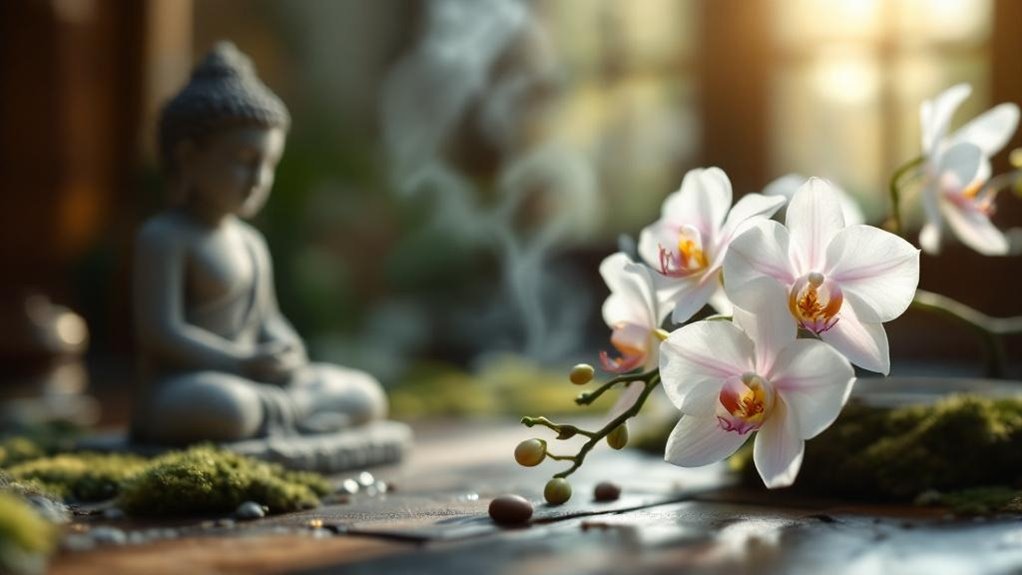
In Buddhism, you can understand orchids as symbols of cultivated beauty, humility, and patient spiritual growth; their refined form and slow unfolding suggest that inner transformation comes through steady attention, not sudden awakening. They also reflect impermanence, because their beauty matures gradually and passes, teaching you to value each stage without becoming stagnant. In temples and meditation, orchids support tranquility and observational awareness, and their meaning becomes clearer when compared with other sacred flowers.
- Key Takeaways
- What Do Orchids Mean in Buddhism?
- Why Orchids Symbolize Beauty and Tranquility
- How Orchids Reflect Impermanence
- How Orchids Represent Spiritual Growth
- How Orchids Are Used in Buddhist Practice
- How Orchids Compare With Lotus and Jasmine
- What Orchids Teach in Buddhist Practice
- Frequently Asked Questions
- Conclusion
Key Takeaways
- Orchids in Buddhism symbolize refinement, humility, and spiritual growth achieved through disciplined, steady cultivation.
- They teach patience and perseverance, since meaningful inner development unfolds gradually rather than appearing all at once.
- Orchids reflect impermanence by reminding practitioners that beauty changes, fades, and should be appreciated mindfully.
- Their delicate elegance represents inner beauty, balance, and serenity rooted in simplicity instead of excess or superficiality.
- In temples and meditation, orchids are offered as symbols of devotion, purity, and mindful attention to one’s spiritual path.
What Do Orchids Mean in Buddhism?

In Buddhism, orchids carry meanings of refinement, humility, and spiritual growth, and their symbolism rests not only in their delicate form but also in what that form suggests about cultivated practice. They remind you that spiritual development is rarely blunt or immediate, because enlightenment depends on sustained attention, patience, and an observational awareness that resists both vanity and stagnant habit.
In temple offerings and on altars, especially in Southeast Asian traditions, orchids symbolize the disciplined elegance of a simple, mindful life. When you encounter their many species and colors, you see how spiritual growth unfolds through variation, perseverance, and careful adjustment rather than force.
Their presence in practice doesn’t promise ease, yet it teaches that devotion, repeated attentiveness, and humility shape the path toward awakening with steadiness, restraint, and discernment.
Why Orchids Symbolize Beauty and Tranquility
When you consider why orchids symbolize beauty and tranquility in Buddhism, you see inner beauty reflected in their cultivated grace and intricate form, which mirror the quiet discipline required for spiritual refinement.
You also see tranquility in practice, as orchids offered in temples support an observational state of mind, deepen meditation, and discourage the stagnant pull of distraction and desire.
Through their elegance and simplicity, they remind you that serenity doesn’t arise from excess, but from humility, balance, and a clearer commitment to inner peace.
Inner Beauty Reflected
Because orchids join delicate form with disciplined growth, they symbolize in Buddhism a beauty that arises from within rather than from display. Their quiet elegance reflects the cultivated qualities of humility, grace, and mental stillness that spiritual practice seeks to refine.
When you observe orchids, you’re reminded that inner beauty doesn’t depend on excess; it appears through restraint, patience, and attentive growth. Their vibrant colors don’t suggest vanity, but balanced refinement, while their translucent petals and intricate structures invite an observational appreciation of what isn’t loud, stagnant, or superficial.
In temples, their presence quietly directs your attention toward subtler virtues, showing how spiritual maturity can appear gentle yet exacting. Because some orchids bloom only after years, they also mirror the steady dedication required to cultivate character, so beauty becomes evidence of disciplined becoming, not mere appearance.
Tranquility In Practice
Although orchids appear fragile, they carry a disciplined stillness that makes them fitting symbols of tranquility in Buddhist practice, since their balanced forms, measured growth, and quiet presence direct your attention away from restless display and toward cultivated awareness.
In temples, their offerings support mindfulness and contemplation; their varied colors and forms enrich meditation spaces without becoming stagnant or intrusive. As you observe them, beauty becomes observational rather than possessive, and that shift quietly orchestrates attention, steadies breathing, and affirms that refinement requires patience.
Orchids also embody humility, because their grace never argues for itself; instead, it reveals how spiritual growth unfolds through dedication, restraint, and repeated practice. In this way, you don’t merely admire orchids, you use them as living reminders that tranquility is trained, sustained, and expressed through careful perception.
Serenity Through Simplicity
While orchids are often admired for their delicacy, Buddhism values them more deeply as signs of refinement and humility, since their beauty doesn’t depend on excess, display, or permanence, but on balance, restraint, and the cultivated order that quiets the mind.
When you see Orchids offered in temples or placed carefully on altars across Southeast Asia, you encounter more than decoration; you meet an observational lesson in serenity, where subtle color, measured form, and patient growth direct your attention away from stagnant desire and toward mindful appreciation.
Their petals don’t argue for grandeur; instead, they suggest that spiritual cultivation requires quiet effort, disciplined perception, and respect for what remains elegant without possession.
In this way, Orchids teach you that tranquility emerges not from abundance, but from simplicity held with care and awareness.
How Orchids Reflect Impermanence
As orchids unfold through slow, cultivated cycles of growth, bloom, and decline, they offer an observational image of impermanence that accords closely with Buddhist thought; many species require years before flowering, and that long interval makes their beauty feel less like a fixed possession than a temporary condition shaped by time, change, and patient attention.
When you observe orchids closely, you see delicate petals that don’t remain at their peak, and that passing refinement reflects anicca, reminding you that beauty, circumstances, and even your present understanding won’t stay stagnant.
Because orchids survive across varied environments, they also show you how acceptance meets change without denial. When they’re offered in Buddhist practice, you’re invited to receive them with gratitude while recognizing that every offering, however graceful, belongs to time and eventually passes away.
How Orchids Represent Spiritual Growth

Discipline finds a clear emblem in the orchid, because its refinement and humility mirror the cultivated effort spiritual growth requires in Buddhist practice; you don’t arrive at insight through display or force, but through steady attention, restraint, and a willingness to let understanding deepen without becoming stagnant.
When you observe orchids, you confront a lesson in simplicity, since their delicate form suggests that genuine elegance develops through modesty, not excess; that observational clarity supports spiritual growth by directing you inward.
Observing orchids teaches that true elegance arises through modesty, guiding the spirit inward through simplicity rather than excess.
Their slow maturation, sometimes lasting eighteen years from seed to bloom, teaches patience, dedication, and trust in gradual transformation, all of which Buddhism values.
Even the range of colors among orchids reflects your path, because spiritual growth doesn’t unfold in one fixed pattern; it broadens through varied experiences, cultivated responses, and increasingly disciplined self-understanding.
How Orchids Are Used in Buddhist Practice
That same lesson of cultivated growth appears in Buddhist practice through the ways orchids are placed, observed, and offered; at temples, devotees commonly present them as offerings that express respect and devotion. The flower’s refinement, humility, and quiet beauty make it a fitting emblem of spiritual cultivation rather than worldly display.
You encounter orchids in meditative and ritual settings because they guide observational attention and discourage a stagnant mind. In many flowers in Buddhist spaces, orchids serve distinct purposes:
- You place them on altars as reminders of patience and dedication.
- You observe their delicate form during meditation, cultivating mindfulness.
- You offer them in rituals to affirm purity, moral discipline, and devotion.
Their varied colors and shapes also show you that spiritual experience can remain disciplined while still unfolding with richness, nuance, and continued growth.
How Orchids Compare With Lotus and Jasmine
Three flowers clarify different dimensions of Buddhist symbolism: the orchid points you toward refinement, humility, and spiritual growth sustained through cultivated effort. The lotus directs attention to enlightenment and purity rising from ignorance, and jasmine emphasizes compassion and purity of intention, with its fragrance suggesting gratitude and a quietly benevolent heart.
When you compare orchids with the lotus, you notice a useful distinction; the lotus rises from stagnant water and marks awakening itself, while orchids suggest patience, perseverance, and an observational respect for gradual cultivation over time.
In Buddhist art, the lotus often appears with deities and carries direct sacred emphasis, whereas orchids contribute subtler beauty through intricate form and varied color.
Jasmine differs again; rather than highlighting disciplined growth, it directs you toward pure love, gratitude, and compassion expressed without display.
What Orchids Teach in Buddhist Practice

When you observe an orchid in Buddhist practice, you recognize that patience isn’t stagnant but cultivated over time, because its slow bloom reflects the steady discipline required for spiritual growth.
When you offer or contemplate orchids in a temple, you learn tranquility through simplicity, since their refined form quiets excess and returns your attention to mindfulness, humility, and the plain conditions that sustain practice.
Their intricate structure and varied colors also guide your observational understanding of interconnectedness, reminding you that personal transformation asks for time, perseverance, and a respectful regard for diversity within a shared spiritual path.
Patience In Bloom
Patience comes into focus through the orchid, whose long, exacting development mirrors Buddhist practice; some species may take as long as eighteen years to bloom from seed, and that slow unfolding offers an observational lesson in perseverance, because inner cultivation rarely proceeds in visible leaps and never deepens through restless demand.
You learn that orchids reward patience, not force, and their delicate forms reveal how steady attention shapes cultivated change over time.
- You invest time without demanding immediate proof.
- You accept gradual progress without calling it stagnant.
- You recognize many paths, as orchids vary across thousands of species and hybrids.
Their colors and intricate structures show that transformation often appears subtly, after long dedication, and Buddhist practice asks the same of you: return, nurture, persist, and trust that meaningful growth matures before it can be seen.
Tranquility Through Simplicity
As the lesson of steady growth settles, the orchid also shows you how tranquility arises through simplicity, because its refinement never depends on excess and its quiet form directs attention toward what’s cultivated rather than what’s displayed; in Buddhist practice, this makes the flower a fitting emblem of humility, one that asks you to notice subtle beauty without grasping at spectacle, and to understand that spiritual deepening usually comes through gentle, consistent effort rather than dramatic change.
When you place Orchids on an altar or observe them in meditation, you meet an observational reminder that mindfulness doesn’t require ornament; it requires steadiness. Their more than 30,000 forms suggest your path needn’t imitate another, nor become stagnant, because tranquility grows when simplicity is honored, attention is disciplined, and inner refinement remains quietly cultivated.
Frequently Asked Questions
What Does the Orchid Symbolize in Buddhism?
In Buddhism, you see the orchid symbolize humility, refinement, patience, and spiritual growth. Its delicate beauty reminds you that enlightenment takes steady cultivation, mindful practice, and simplicity, while its diversity reflects your rich potential for awakening.
What US City Has the Most Buddhists?
Los Angeles, California, has the most Buddhists in the United States. You’ll find about 200,000 Buddhist residents there, plus many temples, traditions, and festivals. You can also look to San Francisco, New York City, and Seattle.
What Do Buddhists Do Before Bed?
Before bed, you might meditate briefly, recite prayers or mantras, and light incense or a candle. In stillness yet reflection, you review the day, contemplate impermanence, and practice calming breaths so you can rest peacefully.
What Is the Sacred Flower of Buddhists?
You’ll often find the lotus regarded as Buddhism’s sacred flower. It shows purity, awakening, and resilience because it rises clean from muddy water. You can also see orchids honored in some traditions for humility and spiritual growth.
Conclusion
In Buddhism, you can read orchids as cultivated signs of quiet beauty, impermanence, and inward development; their brief bloom resists any stagnant idea of permanence, while their patient growth mirrors disciplined practice and observational awareness. One useful detail sharpens this lesson: the orchid family contains more than 25,000 species, a reminder that spiritual growth doesn’t follow one fixed form. When you place orchids beside lotus or jasmine, you see a broader teaching, measured, refined, and calmly transformative.