
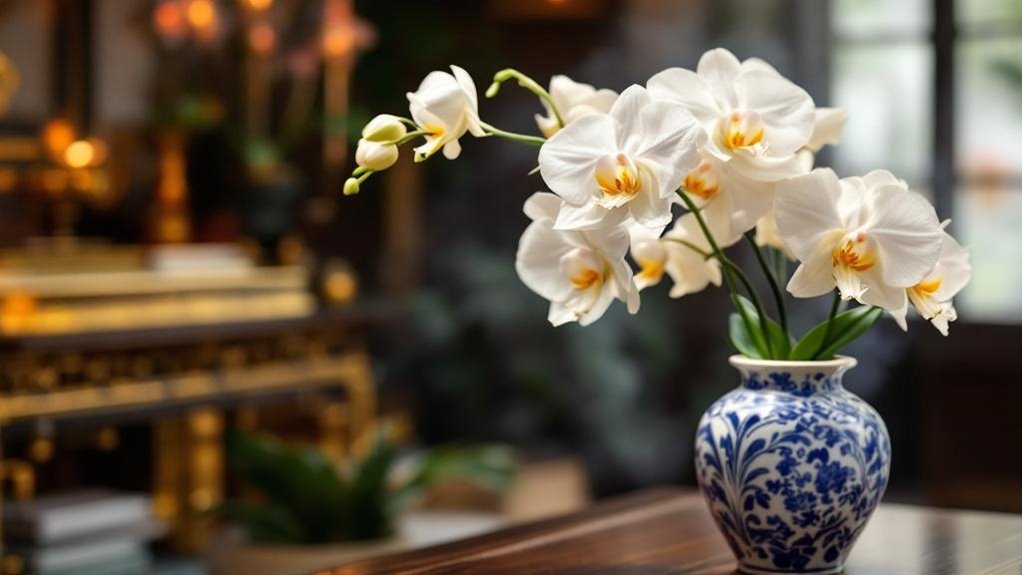
In Vietnamese culture, you see orchids as cultivated signs of respect, prosperity, and lasting regard; families use them at Tết, birthdays, and formal visits to express health, success, and stable ties. You’ll find Phalaenopsis linked to gratitude and devotion, Dendrobium to strength and professional integrity, while white, purple, and yellow blooms sharpen meaning through purity, dignity, and joy. Vietnam’s rich orchid diversity also gives these flowers observational and conservation value, and there’s more context ahead.
- Key Takeaways
- Why Orchids Matter in Vietnamese Life
- Orchid Meanings in Vietnam
- Orchids at Tet and Family Events
- Orchid Colors and What They Mean
- Why Vietnam Is an Orchid Paradise
- Popular Orchid Varieties in Vietnam
- Wild and Rare Vietnamese Orchids
- Orchids in Vietnamese Art and Literature
- When Vietnamese People Give Orchids
- How the Orchid Trade Works Today
- Frequently Asked Questions
- Conclusion
Key Takeaways
- Orchids symbolize beauty, elegance, prosperity, health, and longevity in Vietnamese culture, expressing refined taste and sincere good wishes.
- They are popular gifts for mothers, elders, and superiors, especially on birthdays, Tết, and formal family celebrations.
- Phalaenopsis orchids convey love, gratitude, and respect, while Dendrobium orchids represent strength, professionalism, and integrity.
- Orchid colors carry meaning: white suggests purity, purple shows admiration and dignity, and yellow represents joy, friendship, and prosperity.
- Vietnam’s rich orchid diversity also gives orchids cultural and conservation value, linking national pride with responsible cultivation and protection.
Why Orchids Matter in Vietnamese Life

Because flowers often carry social meaning as much as decorative value, orchids hold a distinctive place in Vietnamese life, where they signal beauty, elegance, and cultivated sophistication while also expressing deeper wishes for health, prosperity, and longevity.
In Vietnamese life, orchids convey elegance and sophistication while also expressing hopes for health, prosperity, and long life.
When you give orchids in Vietnam, you participate in an observational tradition that values refinement, respect, and social awareness; the gesture suits birthdays and formal exchanges alike, especially when honoring mothers, superiors, or clients.
Among orchid varieties, Phalaenopsis and Dendrobium remain especially visible, not only because they present well, but because they align with expectations of taste and discernment.
You also see their importance in Vietnam’s orchid industry, where collectors and growers preserve rare species, resisting a stagnant view of flowers as mere commodities and sustaining a living cultural practice.
Orchid Meanings in Vietnam
Although orchid meanings in Vietnam shift with context, the flower consistently signals beauty, elegance, and cultivated sophistication, and it often carries associations with nobility and grace that make it suitable for both personal and ceremonial exchange. When you consider orchid meanings in Vietnam, you see an observational language of values; Phalaenopsis expresses gratitude and respect, especially for mothers and birthdays, while Dendrobium suggests strength, professionalism, and integrity in work settings. You also find orchids marking milestones, since they imply longevity, relational stability, and good fortune rather than stagnant feeling.
| Orchid use | Meaning |
|---|---|
| Phalaenopsis | Gratitude, respect |
| Dendrobium | Strength, integrity |
| Milestone gifts | Longevity, stability |
| Celebration arrangements | Health, success, happiness |
Placed in arrangements, they let you convey health, success, and happiness with quiet precision.
Orchids at Tet and Family Events
Those meanings become most visible during Tết and other family gatherings, when orchids move from observational symbols into the center of domestic display and exchange; Vietnamese families value them for their elegant form and their longstanding association with prosperity, success, renewal, and social regard.
So the flowers appear in homes not as stagnant decoration but as cultivated statements of hope for the year ahead.
When you place an orchid in a Tết arrangement, you strengthen the room’s visual order while affirming your family’s wishes for advancement, steadiness, and good fortune in the coming year.
You also give orchids to relatives and close friends because the gesture conveys respect, measured generosity, and durable goodwill; through that exchange, you help renew kinship ties, mark shared beginnings, and keep family events centered on luck, continuity, and mutual regard.
Orchid Colors and What They Mean

As you consider orchid colors in Vietnamese culture, you can see that white orchids carry a cultivated sense of purity and innocence, which is why they often suit expressions of love, elegance, and ceremonial grace.
You’ll also notice that purple orchids suggest dignity, respect, and admiration, giving them an observational weight that makes them especially appropriate for formal gifts and gestures of nobility.
Yellow orchids, by contrast, move away from anything stagnant, as they signify friendship, joy, and prosperity, and you can offer them to mark new beginnings with quiet confidence and positive intent.
White Orchids’ Purity
Purity defines the meaning of white orchids in Vietnamese culture, where their cultivated elegance conveys innocence, sincerity, and deep admiration without becoming stagnant or overly ornamental. People choose them for weddings, formal celebrations, and other significant moments because the flowers’ restrained beauty suggests grace and respect. Offering them signals that your feelings are heartfelt rather than merely observational.
When you give white orchids, you communicate more than admiration; you present a respectful gesture that affirms trust, steadiness, and sincere regard in both personal and professional relationships. Their lasting blooms reinforce ideas of stability and enduring affection, while many also believe they invite harmony and good fortune into shared spaces.
In this way, white orchids help you express serious emotion with precision, preserving dignity while still conveying beauty, admiration, and quiet emotional clarity.
Purple Orchids’ Nobility
Nobility shapes the meaning of purple orchids in Vietnamese culture, where their cultivated color and poised form suggest dignity, prestige, and a near-royal perfection, making them especially fitting when you want a gift to register as respectful rather than merely decorative.
When you choose purple orchids, you signal admiration without excess; you acknowledge a mother, a boss, or an esteemed client through elegance rather than stagnant display, and that observational restraint often deepens the gift’s value.
In Vietnamese art and literature, refined flowers carry beauty through form as much as color, so purple hues feel especially sophisticated.
Phalaenopsis and Dendrobium varieties are often preferred because their long-lasting blooms preserve that impression, and their striking appearance supports the message you intend: respect, dignity, and polished appreciation, offered with cultural precision.
Yellow Orchids’ Prosperity
Because yellow carries an immediate association with light, luck, and cultivated abundance in Vietnamese culture, yellow orchids are widely understood as emblems of prosperity and wealth, and you don’t choose them casually when the occasion calls for more than a stagnant gesture.
- During Tet, you present them as signs of good fortune and happiness, much like the yellow apricot flower.
- In homes, you place them in living spaces because tradition reads their color as auspicious, steady, and quietly energizing.
- In business settings, you use them decoratively to signal success, observational confidence, and enterprises positioned to thrive.
- In gifts, you select them to convey well-being and abundance, whether you address family, friends, clients, or professional partners.
Their meaning remains direct, favorable, and socially legible across occasions.
Why Vietnam Is an Orchid Paradise
Although many countries in Southeast Asia support rich orchid life, Vietnam stands apart as an orchid paradise, with more than 1,180 documented species across 170 genera, nearly 200 endemic wild species, and a range of climates and ecosystems that lets these plants adapt, diversify, and persist without becoming stagnant.
As you consider orchids through the lens of Vietnamese culture, you see why this richness matters; mountains, forests, coastal zones, and cultivated gardens create overlapping habitats, while ongoing observational research continues to reveal species not yet fully cataloged.
You also encounter a conservation ethic shaped by rarity, evident in places such as Van Sy Orchid Garden, where endemic orchids receive careful protection and study.
Together, biodiversity, ecological range, and disciplined cultivation give Vietnam an authority among orchid landscapes that few countries can equal today.
Popular Orchid Varieties in Vietnam
Variety defines how orchids are recognized and exchanged in Vietnam, where more than 500 species give growers and gift-givers a cultivated range of choices.
In this context, certain forms have taken on clear cultural roles through repeated use rather than stagnant convention.
- You see Phalaenopsis as a popular orchid for mothers, because its graceful, long-lasting blooms express love and respect with calm clarity.
- You choose Dendrobium in professional settings, since its strength reflects stable partnerships, successful dealings, and an observational regard for business decorum.
- You notice mixed orchid arrangements at major celebrations, where several varieties create elegant, luxurious displays suited to weddings, openings, and formal anniversaries.
- You select purple or red orchids when you want gifts to signal wealth, advancement, and success in career life through shared cultural meaning.
Wild and Rare Vietnamese Orchids
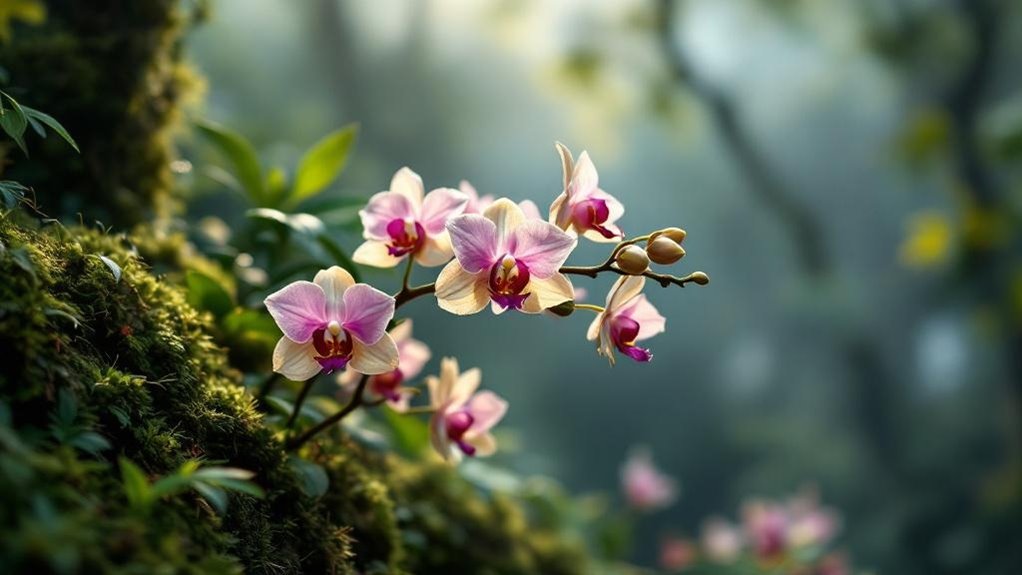
As you turn to Vietnam’s wild and rare orchids, you encounter endemic forest treasures shaped by exceptional biodiversity, with nearly 200 species found nowhere else and more than 1,180 documented species suggesting that the record still isn’t stagnant.
You can also observe how conservation and cultivation now work together, as researchers and collectors such as Trinh Van Sy support observational study, careful breeding, and the preservation of species that might otherwise decline under human pressure.
At the same time, you can see that the rare orchid trade carries cultural and economic weight, and when it’s responsibly cultivated rather than carelessly extracted, it strengthens long-term protection for Vietnam’s most distinctive orchids.
Endemic Forest Treasures
Deep in Vietnam’s forests, endemic orchids stand as cultivated emblems of both biological richness and cultural refinement. Their presence helps explain why the country holds such lasting authority in the world of orchid study and collecting.
With at least 1,180 documented orchid species across 170 genera, and nearly 200 wild species found nowhere else, Vietnam offers an observational record of diversity that remains far from stagnant, since ongoing research continues to identify additional native varieties.
- You encounter endemic forest treasures that embody elegance, sophistication, and positive energy in Vietnamese thought.
- You see rarity deepen their prestige within botanical circles and private collecting.
- You note Van Sy Orchid Garden, associated with Trinh Van Sy, as a national reference for exceptional orchids.
- You understand commercialization has elevated unique specimens into profitable cultural assets for discerning collectors nationwide.
Conservation And Cultivation
Because wild orchids in Vietnam occupy both fragile habitats and a cultivated place in national life, conservation and cultivation now move together rather than apart; growers, researchers, and collectors don’t simply admire rarity in observational terms, they intervene to keep it from becoming stagnant or lost.
You see this clearly in a country with at least 1,180 documented orchid species, where ongoing study still points to undiscovered varieties, and where gardens such as Trinh Van Sy’s preserve nearly 200 endemic wild species through breeding and multiplication before any distribution occurs.
As cultivation matured from modest investment into a disciplined business, you also find more selective placement, with plants entrusted to connoisseurs who can maintain them properly; this measured approach supports conservation, ecological balance, and cultural continuity across Vietnam today.
Rare Orchid Trade
While Vietnam’s rare orchid trade often appears to center on scarcity and price, its more durable structure rests on cultivated knowledge, selective distribution, and the steady conversion of wild botanical value into managed collections.
With nearly 200 endemic wild orchid species and continuing research that still identifies new varieties, the country sustains a market in which rarity carries scientific, cultural, and commercial weight at the same time.
- You encounter rare orchids as biodiversity assets, not stagnant curiosities.
- At Van Sy Orchid Garden, across 1,800 square meters, preservation guides trade.
- Trinh Van Sy shows commercialization can reward cultivated rarity, with annual earnings above VND1 billion.
- Before purchase, breeders multiply rare orchids carefully, so connoisseurs receive stable, observationally managed plants.
You see trade relying on propagation, documentation, and controlled release.
Orchids in Vietnamese Art and Literature
In Vietnamese art and literature, orchids, or *phong lan*, stand as cultivated emblems of beauty, elegance, and sophistication, and their presence reveals an observational tradition that values nature not as stagnant ornament but as a refined source of moral and spiritual meaning.
In paintings, you see artists render each curve and petal with patient precision; flowers are often charged with meditations on life, dignity, and inward balance.
In poetry, you encounter orchids as metaphors for grace and purity, especially when writers align their rare form with admired feminine virtues.
Across folk tales and modern fiction, they also suggest nobility and refinement, linking cultivated taste to elevated character and social esteem.
During festivals and ceremonies, you notice orchids arranged as quiet signs of respect, admiration, and ceremonial beauty in communal settings.
When Vietnamese People Give Orchids
That cultivated regard for orchids carries directly into gift-giving, where Vietnamese people choose them for moments that call for elegance, respect, and good fortune, especially birthdays, when a flower’s beauty must also convey social judgment and relational care.
- You give Orchids, often given to mothers, bosses, and clients, when you want courtesy and cultivated regard.
- You choose Phalaenopsis for beauty; you choose Dendrobium for strength, an observational pairing.
- You send them for milestone birthdays because they suggest health, success, grace, longevity, and stable ties, never stagnant affection.
- You signal thoughtfulness, because the arrangement shows you understand the recipient’s values, status, and the relationship’s proper tone.
In personal and professional settings alike, this choice carries quiet authority, and your gift speaks before you do.
How the Orchid Trade Works Today

You can see today’s orchid trade in Vietnam shaped by rare orchid commercialization, where cultivated scarcity and observational judgment raise value. Top collectors can earn from VND800 million to more than VND1 billion a year by focusing on uncommon species.
If you consider entering the market at scale, you’d need substantial capital, about VND500 million for facilities and another VND200 million for seedlings. This explains why selective sales, careful breeding, and conservation-minded stock control keep the trade from turning stagnant.
You also find that growers support this system through precise handling, protected packaging, and fast delivery across major cities. Gardens such as Van Sy’s link commerce with the measured preservation of endemic orchids.
Rare Orchid Commercialization
Driving today’s rare orchid market in Vietnam is a cultivated mix of scarcity, expertise, and capital; collectors and growers don’t simply display unusual plants, they breed endemic species, document local diversity, and release select specimens to a narrow circle of connoisseurs whose demand rests on rarity, symbolism, and observational distinction.
- You enter orchids commerce with capital; facilities often require VND500 million, seedlings another VND200 million.
- You profit through propagation; Trinh Van Sy’s 1,800-square-meter garden shows how breeding endemic stock scales rarity without making the market stagnant.
- You rely on documentation; Vietnam’s 1,180 recorded species, plus possible undocumented varieties, keep exploration commercially relevant.
- You serve informed buyers; annual returns can reach VND800 million to over VND1 billion when cultivated distinction, provenance, and symbolic value align in selective circulation.
Investment And Selective Sales
In practice, the modern orchid trade in Vietnam works through high entry costs and deliberately selective sales, because rarity retains value only when cultivation, timing, and buyer stewardship remain tightly managed.
Trinh Van Sy’s model makes this plain, requiring at least VND500 million for facilities and roughly VND200 million more for seedlings, then withholding rare plants from sale until they’ve been successfully bred or multiplied, so the market doesn’t become stagnant and the stock isn’t wasted on unprepared hands.
As you observe this system, you see how selective selling protects both value and conservation, directing exceptional orchids to connoisseurs who can cultivate them responsibly, while research and development steadily broaden what growers can offer, from rare specimens to flowers during Tet.
After fifteen years, that disciplined method has produced annual returns from VND800 million to above VND1 billion.
Frequently Asked Questions
What Does the Orchid Symbolize in Vietnam?
In Vietnam, you’d see orchids symbolize beauty, elegance, nobility, health, success, and good fortune. You can give them to express respect, refinement, and lasting relationships, especially during birthdays and other meaningful celebrations or family occasions.
What Does the Orchid Symbolize in Buddhism?
In Buddhism, you see orchids symbolizing purity, beauty, and spiritual awakening. They remind you that life’s fleeting, encourage mindfulness and patience, honor reverence in rituals, and can represent good fortune during spiritual ceremonies too.
What Are the Significant Flowers in Vietnamese Culture?
You’ll find lotus, yellow apricot, peach blossom, and chrysanthemums especially significant in Vietnamese culture. They represent purity, prosperity, renewal, and longevity. You also see flowers honor family bonds, spiritual values, resilience, and seasonal celebrations.
What Does It Mean When Someone Gives You an Orchid Flower as a Gift?
It means they’re honoring you—though there’s more behind it. You’re receiving a wish for elegance, respect, good fortune, health, and lasting success. They’re showing admiration while hoping your life stays graceful, stable, and prosperous.
Conclusion
When you look at orchids in Vietnamese culture, you see more than cultivated beauty; you see a living thread, stretched between mountain forests, ancestral homes, poems, markets, and altars, carrying meanings of dignity, prosperity, restraint, and care. Their colors speak with quiet precision, their presence steadies Tet and family rites, and their trade reflects both pride and pressure, reminding you that what appears delicate can still root deeply, and keep a culture from growing stagnant.