
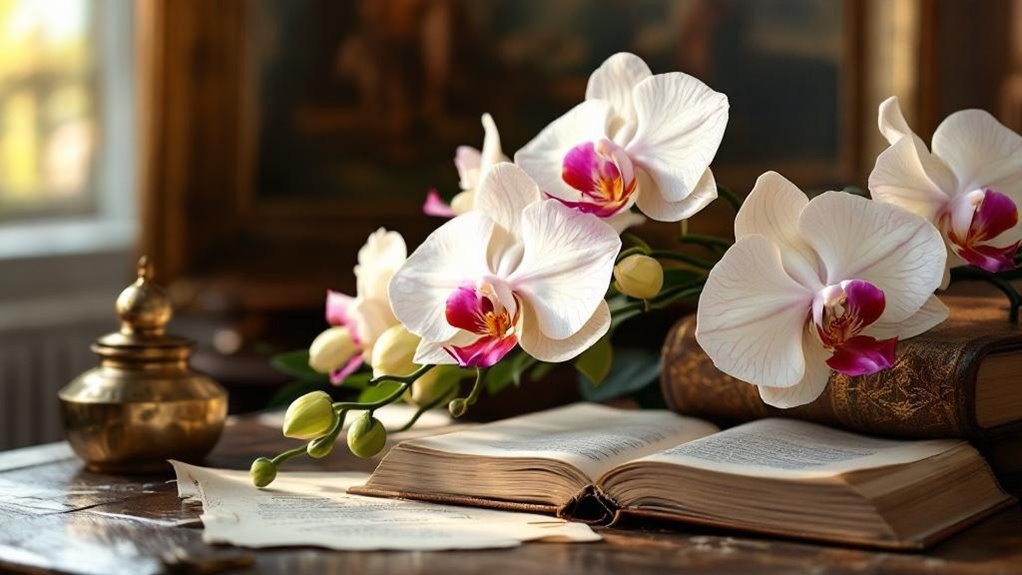
In art and literature, you see orchids as cultivated symbols of beauty, luxury, desire, and rare knowledge; Victorian orchidelirium fixed them as costly, exclusive, and slightly dangerous, while Darwin’s orchid studies tied their allure to observational science and adaptation. Writers used them to mark wealth and moral distance, and artists, especially women botanical painters, treated them as structured, living subjects rather than stagnant decoration. Museums now extend that tradition, and the fuller history opens outward from there.
- Key Takeaways
- What Orchids Symbolize in Art and Literature
- How Victorian Orchid Mania Shaped Their Image
- How Darwin Made Orchids Scientifically Famous
- How Literature Turned Orchids Into Luxury Symbols
- How Botanical Artists Painted Orchids
- How Museums Display Orchids as Art
- How Women Artists Changed Orchid History
- Why Orchids Still Inspire Artists Today
- Frequently Asked Questions
- Conclusion
Key Takeaways
- Orchids symbolize beauty, luxury, desire, and exclusivity, making them powerful motifs in literature and visual art.
- Victorian orchidelirium made orchids status symbols, linking them with wealth, decadence, rarity, and danger in cultural imagination.
- Writers such as Raymond Chandler used orchids to signal affluence, moral distance, and cultivated excess within modern society.
- Darwin’s orchid studies connected scientific discovery with artistic fascination, inspiring botanical illustration and deeper cultural interest.
- Women artists, from Nellie Roberts to Deborah Lambkin, used orchids to unite precise observation with beauty and expressive interpretation.
What Orchids Symbolize in Art and Literature
Symbolically, orchids carry a cultivated set of meanings in art and literature, and those meanings often gather around beauty, wealth, desire, and rarefied knowledge; writers have long used them to signal luxury and decadence, as in Raymond Chandler’s *The Big Sleep*, where the flower reflects a social world still fixated on privilege during the stagnant pressures of the Depression.
Meanwhile, Rex Stout’s Nero Wolfe deepens that association by treating orchid cultivation as a demanding pursuit reserved for those with time, money, and disciplined leisure.
In botanical art, you also see orchids aligned with femininity and observational beauty, while the orchid family carries older suggestions of seduction through the word orchis; across species of orchids, art and science meet, since their allure invites aesthetic attention and disciplined study alike.
How Victorian Orchid Mania Shaped Their Image
When you look at Victorian orchidelirium, you see how rare orchids became cultivated markers of status, prized by elites who paid staggering sums for unfamiliar tropical specimens and then displayed them as proof of wealth, taste, and access.
You can also trace how poems and other literary portrayals cast orchids as seductive and faintly dangerous, and that observational pattern fixed their image as luxurious, high-maintenance plants rather than stagnant household flowers.
As you follow that legacy into later art and culture, you find that these Victorian habits didn’t fade; they established lasting stereotypes of orchids as decadent, alluring, and socially elevated.
Orchidelirium And Status
Although orchids had long been admired for their unusual forms, the Victorian period turned that admiration into orchidelirium, a cultivated obsession in which rare specimens served not simply as plants but as visible proofs of wealth, taste, and access to distant worlds.
You can trace that status partly to language itself, since the orchid’s name reaches back to ancient Greek. Yet Victorian collectors transformed scholarship into display, importing specimens from around the world and assigning them observational, social value.
In New York’s gilded trade, exceptional orchids brought prices as high as $35,000, which made ownership a public declaration rather than a private pleasure. When figures such as Erasmus Darwin and Empress Cixi collected them, you see how orchidelirium aligned beauty with rank, investment, and cultivated distinction, never with stagnant domestic simplicity or ordinary comfort.
Lasting Cultural Stereotypes
Because Victorian orchidelirium tied orchids so firmly to rarity, price, and cultivated display, it left behind more than a historical craze; it fixed the flower in the public imagination as an emblem of luxury, exacting care, and social distinction.
When you encounter orchids now, you still inherit that observational frame: rare plants once sold for more than $35,000, collectors treated them as trophies, and admiration hardened into stereotype.
If an exhibition opened around them, there’s something already implied, namely prestige, difficulty, and expense. Figures such as Erasmus Darwin and Empress Cixi reinforced that cultivated image, because influence made obsession look refined rather than irrational.
As orchidelirium entered language, it also entered memory, and you began to read orchids as demanding, elevated, and faintly distant, never ordinary, never stagnant, always socially coded in art and literature.
How Darwin Made Orchids Scientifically Famous
While Victorian botanists and collectors had already cultivated a strong interest in exotic flowers, Darwin made orchids scientifically famous by treating them as observational proof that evolution worked through fine, accumulated adaptations rather than through any stagnant design. In his 1862 book, *On the Various Contrivances by Which Orchids are Fertilised by Insects*, he showed that their precisely shaped blossoms, deceptive signals, and species-specific relationships with insect pollinators revealed natural selection in action.
When you follow his reasoning, you see orchids as evidence, not ornament; their reproductive structures, pheromone mimicry, and exact floral forms demonstrate interdependence with insects and support evolutionary change.
Darwin’s work also intensified Victorian attention, helping feed orchidelirium, collection, and hybridization, while linking botany, language, and culture through the very name “orchid,” derived from Greek *orchis*.
How Literature Turned Orchids Into Luxury Symbols
When you encounter orchids in literary settings, you often see them coding noir wealth, from Chandler’s stagnant rooms of affluence and cynicism to Nero Wolfe’s cultivated routine of care, where time itself becomes a luxury marker.
You can also trace that symbolism beyond fiction, because gilded-age prices and orchidelirium gave writers an observational shorthand for exclusivity, excess, and the costly appeal of rare beauty.
As you move from page to practice, you begin to see the gap between fiction and horticulture; literature turned orchids into emblems of indulgence, even when the plants themselves belonged to a wider and more varied world.
Noir Wealth Coding
A great deal of noir literature treats orchids not as neutral flowers but as cultivated markers of wealth, taste, and moral distance, and that coding shaped how readers came to see them.
- In *The Big Sleep*, you encounter orchids amid Depression-era cynicism, where their lush presence signals decadence, stagnant privilege, and the observational distrust attached to elite interiors.
- Nero Wolfe’s devotion teaches you that orchid keeping appears to require money, space, and leisure; fiction makes patient care look like an affluent ritual rather than an ordinary practice.
- Behind both images stands orchidelirium, the nineteenth-century chase for rare specimens, which fixed orchids within a cultivated language of exclusivity.
Then film and fiction repeated that language until you could read the flower itself as status, reserve, and indulgence.
Fiction Versus Horticulture
Seen from that literary angle, orchids stop appearing as ordinary plants and start functioning as cultivated emblems of luxury, because fiction repeatedly places them in stagnant drawing rooms, private greenhouses, and observational scenes of wealth where their rarity matters more than their biology.
You see that pattern in Chandler’s The Big Sleep, where orchids help code affluence, and in Nero Wolfe, whose painstaking routines imply that only privilege can sustain such beauty; literature then enlarges the old aura of orchidelirium, recalling gilded-age collectors who paid $35,000 for exceptional specimens.
Yet fiction distorts horticulture as much as it reflects class, because many orchids don’t require obsessive labor, vast estates, or endless leisure, and when you compare the plant itself with its cultivated literary image, you recognize how status often overwhelms botany in cultural memory.
How Botanical Artists Painted Orchids
Because orchids demanded both precision and restraint, botanical artists painted them through an observational method that joined scientific accuracy to cultivated elegance; for centuries they studied the structure of each bloom, traced the curve of petals, lips, and stems with disciplined care, and used color not to exaggerate but to record the plant’s shifting tones before they turned stagnant in memory.
- You see this discipline in the RHS tradition, which has appointed an official orchid artist since 1897, confirming orchid painting as sustained botanical work.
- You find continuity in Deborah Lambkin and earlier painters like Nellie Roberts, whose images balance motion, beauty, and exact description.
- You recognize the method in Isobel Adams, and in wider orchid art, where artists link close study to themes of femininity and natural exploration.
How Museums Display Orchids as Art

When museums display orchids as art, they don’t simply arrange plants for inspection; they construct an observational encounter in which architecture, scent, scale, and cultivated restraint guide your attention toward the blooms as living forms rather than stagnant specimens.
At the Hirshhorn, you encounter orchids in modern space, where “Orchids: A MOMENT” set nearly 100 plants along a 14-foot shelf, replaced 40% weekly, preserving visual intensity through May.
| Feature | Effect |
|---|---|
| Modern architecture | Frames blooms |
| Removed labels | Deepens presence |
| Open access | Invites contact |
You read the display physically, not taxonomically; barriers recede, labels vanish, and horticulturists sustain temperature, humidity, and daily misting. Behind that restraint, the Smithsonian Orchid Collection, expanded from five plants in 1974 to nearly 8,000, reinforces diversity while presenting orchids as botanical forms and artistic objects.
How Women Artists Changed Orchid History
Although orchid history is often told through collectors, explorers, and scientific institutions, women artists altered that record by making the flower legible through observation, design, and cultivated attention, showing you orchids not as stagnant ornaments but as complex forms that move between art and botany.
- Georgia O’Keeffe and Marianne North taught you to see orchids as structured, living subjects, where beauty and complexity coexist through observational discipline.
- Smithsonian Garden’s “Orchids: Hidden Stories of Groundbreaking Women” showed how courage, travel, and study shaped women’s botanical art and widened orchid history.
- Isobel Adams and Angela Mirro expanded visibility differently; Adams clarified native orchids through illustration, while Mirro’s contemporary forms suggest movement, reinforcing how women’s narratives joined artistic expression with scientific exploration and deepened orchids’ cultural meaning.
Why Orchids Still Inspire Artists Today
Even now, orchids continue to attract artists because they resist stagnant interpretation; their forms are precise yet strange, ornamental yet deeply structural, and that tension gives painters, illustrators, and installation artists a subject that rewards observational discipline while still allowing symbolic range.
You can trace that appeal from O’Keeffe and Marianne North to the Royal Horticultural Society’s official orchid artists, whose cultivated record now extends beyond 120 years and includes Deborah Lambkin’s recent work.
You also see it in Angela Mirro‘s attention to movement, where orchids seem less fixed specimens than living gestures. In literature, you encounter the same flexibility; in *The Big Sleep*, orchids suggest decadence, proving that a single flower can carry moral atmosphere as easily as visual beauty.
Contemporary exhibitions, including installations at the Hirshhorn, confirm how effectively orchids still connect nature, culture, and sustained looking.
Frequently Asked Questions
What Do Orchids Symbolize in Art?
In art, you see orchids symbolize beauty, desire, luxury, and mystery. Their exotic forms can suggest femininity, seduction, and rarity, while their vivid complexity often invites you to connect nature with emotion, power, and imagination.
What Do Orchids Symbolize in Literature?
In literature, you’ll see orchids symbolize dizzying luxury, dangerous desire, rare beauty, and exotic mystery; they can practically drip excess from every petal. You also encounter them as signs of wealth, indulgence, fragility, and cultivated obsession.
Who Is the Famous Orchid Painter?
You’d likely name Deborah Lambkin, the Royal Horticultural Society’s ninth official orchid artist. You can also recognize Nellie Roberts, whose detailed orchid illustrations helped shape the RHS tradition and made her a notable orchid painter too.
What Do Orchids Symbolize or Represent?
Like whispers of luxury, orchids symbolize wealth, beauty, rarity, and desire; you also see them represent refinement, fertility, empowerment, and adaptation. Depending on context, they can suggest decadence, obsession, or nature’s intricate resilience and mystery.
Conclusion
When you trace orchids through canvas, glass cases, and pages, you see more than a cultivated flower; you see an observational record of desire, empire, science, and taste, each era pressing its seal upon the bloom. Like Persephone’s return, the orchid keeps suggesting renewal without innocence, and that is why it endures: it resists stagnant meaning, invites disciplined looking, and lets art and literature preserve what history changes, but never fully leaves behind.