
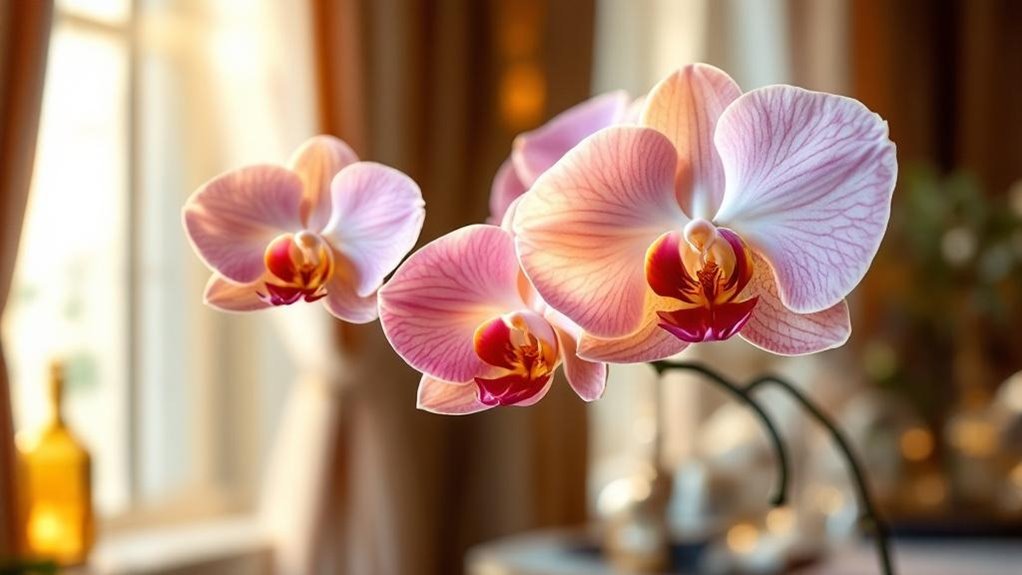
You link orchids to beauty and luxury because they’re rare, visually exacting, and difficult to cultivate well; their observational elegance, unusual forms, and long-lasting blooms suggest refinement rather than excess. Across cultures, they’ve carried associations with fertility, nobility, purity, and wealth, and Victorian collectors turned rare specimens into clear status symbols. Even now, their color symbolism, slow growth, and stagnant accessibility make them feel exclusive, cultivated, and quietly prestigious, as the fuller context shows.
- Key Takeaways
- Why Are Orchids Seen as Luxurious?
- How Did Orchids Become Symbols of Beauty?
- What Did Orchids Mean in Ancient Greece?
- What Did Orchids Mean in Ancient China?
- How Did Victorian Orchids Signal Wealth?
- What Do Orchid Colors Mean?
- Why Are Rare Orchids So Exclusive?
- How Do Orchids Add Elegance to Decor?
- Why Do Orchids Still Symbolize Luxury Today?
- Frequently Asked Questions
- Conclusion
Key Takeaways
- Orchids are linked to luxury because their rare species, exotic shapes, and striking colors make them appear uniquely beautiful and hard to obtain.
- Their historical association with Victorian collectors made orchids symbols of wealth, status, and refined taste.
- Orchids require precise growing conditions and skilled care, which increases their perceived value and exclusivity.
- Many cultures connected orchids with nobility, purity, fertility, and elegance, deepening their symbolic prestige.
- Their long-lasting blooms and sculptural beauty make orchids popular in upscale decor, weddings, and formal settings.
Why Are Orchids Seen as Luxurious?
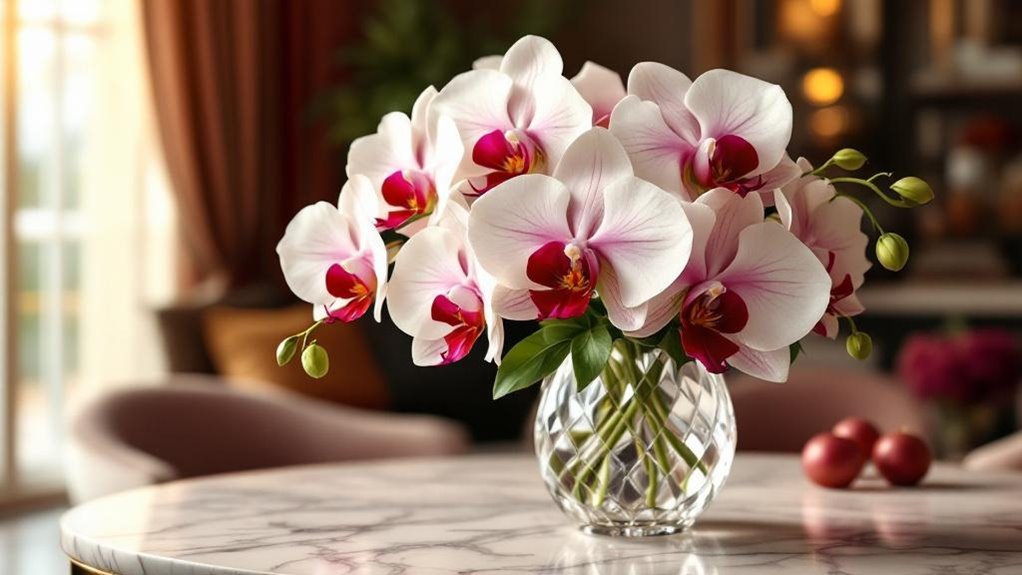
Because luxury often depends on rarity as much as beauty, orchids have long been seen as exceptional flowers; with more than 35,000 species, they present an unusual range of forms, colors, and markings that feels cultivated rather than commonplace. That diversity gives them an unmistakably exclusive presence.
You see luxury and exclusivity reinforced by history; Victorian collectors treated rare orchids as status objects, and that observational record still shapes modern taste. Their intricate veining, sculptural petals, and royal purple tones keep orchid arrangements from looking stagnant, while their demanding care, precise humidity, and specialized cultivation increase their perceived value.
When you choose orchids for interiors, ceremonies, or high-end gifting, you signal refinement without excess, which is why they remain a perfect gift for occasions that call for distinction, polish, and quiet prestige in contemporary design and decor.
How Did Orchids Become Symbols of Beauty?
As people across different eras tried to explain why orchids seemed more compelling than ordinary blooms, they attached the flowers to ideas of beauty that combined rarity, symmetry, and energy; ancient Greeks and Aztecs linked orchids with strength and fertility, and those associations gave them a cultivated stature that went beyond decoration into the domain of life, power, and desirability.
When you look at orchids, you can see why that symbolism endured: their exotic beauty rests in precise symmetry, unusual forms, and colors that resist anything stagnant or ordinary.
Orchids hold the eye through exact symmetry, strange forms, and colors that feel vibrantly beyond the ordinary.
Later admirers, especially in Europe, reinforced this observational logic by treating orchids as refined objects whose scarcity sharpened desire.
Even the flower’s unusual name and morphology sustained attention, making orchids appear more artful than commonplace blooms. That persistent distinctiveness still shapes how you read their beauty today.
What Did Orchids Mean in Ancient Greece?
That older link between orchids and beauty took on a more bodily, lineage-centered meaning in Ancient Greece, where the flower’s significance rested not only in its cultivated appearance but also in what people believed it could shape in marriage, fertility, and inheritance.
In ancient Greece, you see orchids and fertility joined through the Greek word orchis, meaning testicle, an observational reference to the plant’s tuberous roots. People believed those roots could influence childbirth; larger tubers were thought to help produce sons, smaller ones daughters, so orchids entered folklore about virility, reproductive health, and family continuity.
At the same time, you encounter them as refined, beautiful emblems in art, linked to noble character rather than stagnant ornament alone.
Even today, pink orchids given to expecting mothers preserve a quiet trace of those Greek beliefs.
What Did Orchids Mean in Ancient China?

In ancient China, you see orchids as cultivated signs of nobility and purity, honored in art and custom because their quiet form suggested moral integrity rather than stagnant display.
You also find them tied to medicine and healing, especially in the valued Dendrobium, whose therapeutic use linked the flower to health, prosperity, and the steady order of household life.
In poetry, you encounter orchids as emblems of grace, their observational presence shaping ideals of elegance, restraint, and enduring beauty.
Nobility And Purity
While many flowers carried seasonal or decorative value in ancient China, orchids came to signify nobility and purity. Their restrained beauty, fine fragrance, and cultivated presence aligning them with ideals of moral integrity and elevated social character.
In that setting, you can see how orchids represent not mere ornament, but cultivated virtue; their elegant form, subtle scent, and observational presence in poetry and painting marked them as a status symbol among refined circles.
As one of the four noble plants, they expressed harmony without stagnant excess, linking beauty to discipline and inner balance. When offered as gifts, orchids affirmed sincere intentions and steady friendship, which further strengthened their association with nobility and purity.
Through these meanings, you understand why orchids stood for grace, refinement, and elevated character in traditional Chinese society.
Medicine And Healing
A further dimension of orchid symbolism in ancient China appears in medicine and healing, where the flower’s meaning moved beyond cultivated beauty into the sphere of bodily restoration. Physicians and herbal traditions especially valued certain orchids, including Dendrobium, for treating lung ailments and persistent coughs, and this practical use gave the plant a reputation for sustaining health rather than merely representing it.
You can see, through observational records of Chinese medicine, that orchids also entered remedies for eye disease, stomach deficiency, and kidney imbalance, which broadened their significance considerably.
Green orchids, associated with vigor, suggested that health should remain cultivated rather than stagnant, and this symbolism aligned physical healing with spiritual harmony. In this way, you understand orchids in ancient China not only as refined emblems but as active instruments of balance.
Poetry And Grace
Elegance defined the orchid’s place in ancient Chinese poetry, where scholars treated it as more than a flower and made it a cultivated sign of nobility, purity, and inward discipline; when you read classical praise of orchids, you see that poets valued their restrained beauty because it mirrored the moral character they sought to defend, refined without ostentation, fragrant without excess, and constant without becoming stagnant.
In that observational tradition, you encounter the orchid among the four noble plants, honored beside bamboo, plum blossoms, and chrysanthemums; you also see how artists used it to express grace, refinement, and social virtue.
Its meaning extended beyond verse, since feng shui linked orchids to family harmony and fertility, while Dendrobium added medicinal value, reinforcing the flower’s esteemed place in health, home, and cultivated identity.
How Did Victorian Orchids Signal Wealth?
Status in Victorian society often took botanical form, and orchids served that role with unusual force; rare specimens commanded extravagant prices, circulated through elite networks, and told any observer that a household possessed both money and the cultivated taste to acquire what remained inaccessible to most people.
In Victorian times, if you displayed orchids, you signaled wealth through rarity, scientific fashion, and disciplined care; orchidelirium pushed collectors to fund explorers, Darwin’s observational study made cultivation intellectually refined, and drawing rooms avoided any stagnant impression when rare blooms occupied porcelain stands and conservatories.
To display orchids in Victorian rooms was to advertise wealth, scientific taste, and the discipline required for rare beauty.
- A glasshouse beaded with mist
- Velvet petals beside dark mahogany
- Porcelain pots lined beneath tall windows
- Visitors pausing before labeled exotic specimens
You showed means, reach, and cultivated judgment, all at once.
What Do Orchid Colors Mean?
Across orchid varieties, color carries a cultivated language of meaning, and if you choose blooms with even modest observational care, you can shape what they suggest before a word is spoken; white orchids convey purity, elegance, and new beginnings, which is why they appear so often at weddings and formal rites, while pink orchids speak more personally of love, femininity, and grace, making them suited to affectionate gifts that don’t feel stagnant or overstated.
When you select orchid flowers in purple, you signal admiration, respect, and a certain regal esteem; yellow turns the meaning and symbolism toward joy, friendship, and success, so it fits milestones and congratulations.
Blue orchids suggest distinctiveness through their unusual presence, while orange varieties express enthusiasm, pride, and creativity, proving that vibrant colors can refine your message with quiet precision.
Why Are Rare Orchids So Exclusive?

You can see why rare orchids carry such prestige: many grow only in limited regions, their unusual forms and colors set them apart, and strict collection controls keep the market from becoming stagnant.
You also notice that exclusivity depends on difficulty, because these plants often require carefully cultivated conditions, precise care, and an observational patience that more common orchids don’t demand.
As demand rises among collectors, and as history reminds you through periods like Victorian orchidelirium, prices climb accordingly, which reinforces their place as quiet luxury items.
Scarcity Drives Prestige
Because truly rare orchids appear in narrow habitats and in limited numbers, they carry a cultivated exclusivity that common flowers simply can’t match; collectors value them not only for their observational beauty, but also for the difficulty of finding, transporting, and sustaining them without letting conditions turn stagnant or hostile.
You see scarcity become status, as rare orchids from isolated regions enter markets shaped by regulation, history, and desire; during Victorian orchidelirium, wealth pursued them as living proof of refinement and luxury.
- A Ghost Orchid suspended in dim swamp light
- A Blue Orchid displayed behind polished glass
- Auction figures rising into the thousands
- Protected forests, maps, and guarded borders
When you encounter such flowers, you’re seeing more than petals; you’re seeing rarity converted into prestige, then preserved through limited access.
Difficult Cultivation Needs
Prestige doesn’t rest on scarcity alone; it also grows from the exacting conditions these orchids demand, conditions that make ownership less a matter of purchase than of sustained, disciplined care.
When you cultivate rare orchids, you must meet difficult cultivation needs with observational precision, balancing humidity, filtered light, airflow, and temperature so roots never sit stagnant or dry too quickly.
Species such as the Ghost Orchid won’t tolerate generic treatment; they depend on cultivated conditions that closely echo narrow native habitats, which limits accessibility.
You also need proper care through specialized potting media, restrained feeding, and tailored watering schedules, because standard houseplant routines often cause decline.
Propagation remains slow and uncertain, and conservation rules further narrow lawful availability, so these plants retain an unmistakably elevated, carefully protected status in horticulture today.
Collector Demand Surges
For generations, collector demand has intensified the exclusivity of rare orchids, as wealthy buyers and dedicated enthusiasts have treated exceptional specimens not merely as plants but as cultivated proofs of discernment, patience, and access.
You can trace this to Victorian orchidelirium, when a rare bloom became a status gift, and you still see how rarity, slow flowering cycles, and limited habitats elevate certain species of orchids beyond ordinary commerce.
Because some remain stagnant in growth for years before blooming, successful cultivation signals observational skill; because the Ghost Orchid and Rothschild’s Slipper Orchid appear so rarely in the wild, their beauty acquires measured authority.
- A glasshouse glowing at dusk
- Roots clinging to wet bark
- A single bloom after years
- Collectors studying veined petals quietly
How Do Orchids Add Elegance to Decor?
How do orchids bring elegance into a room so effortlessly, without ever allowing the space to feel staged or stagnant? You notice it in their cultivated symmetry, in the observational balance between delicate structure and exotic presence; orchids introduce elegance without clutter, and they suggest luxury through restraint rather than excess.
Because they appear in thousands of colors, shapes, and sizes, you can place them within minimalist interiors or layered, ornate settings, and they still refine the composition.
Their blooms last for weeks, often months, so you maintain visual interest without constant replacement, which keeps a room composed and intentional.
When you use orchids in decor, you add a focal point that feels precise, artistic, and quietly elevated, giving everyday spaces a more polished atmosphere and a distinctly refined visual rhythm overall.
Why Do Orchids Still Symbolize Luxury Today?
Few flowers still carry luxury so convincingly because orchids unite rarity, cultivated beauty, and endurance in a single form; their association with exclusivity was reinforced during the Victorian era, when uncommon varieties circulated as status symbols among wealthy collectors, and that historical memory hasn’t faded from the modern imagination.
- Velvet hotel lobbies framed by white blooms
- Pink anniversary stems on polished tables
- Sculptural petals in quiet corporate interiors
- Long-lasting color above stagnant corners
When you choose them today, you inherit that observational legacy; orchids make upscale gifts and refined decor feel deliberate, never excessive. Their exquisite shapes and cultivated colors distinguish arrangements from ordinary flowers, while lasting blooms sustain elegance longer, preserving atmosphere and value.
Choosing orchids today carries that legacy forward: refined gifts and decor that feel intentional, elevated, and enduring.
In homes, offices, and milestone celebrations, they still signal luxury through restraint, permanence, and visible care.
Frequently Asked Questions
Are Orchids Luxury?
Yes, you can consider orchids luxury flowers because they’re exotic, often rare, and visually striking. You’ll see them used in upscale gifts, elegant decor, and collector markets, where unusual varieties can command especially high prices.
What Do Orchids Symbolize?
For example, you might give purple orchids to show admiration. Orchids symbolize love, beauty, luxury, nobility, and purity. You can also use them to express deep affection, refined taste, and respect in meaningful moments.
What Is the Top 1 Most Expensive Flower in the World?
You’d name the Kadupul flower the world’s most expensive, because it’s fundamentally priceless. You can’t easily buy it; it blooms only at night in Sri Lanka, then fades by dawn, making its rarity unmatched.
What Does the Bible Say About Orchids?
The Bible doesn’t mention orchids specifically, but you can connect them to verses praising flowers’ beauty, like Matthew 6:28-29. You see orchids reflecting God’s creative splendor, provision, and life’s brief, beautiful nature in Christian symbolism.
Conclusion
When you consider orchids through history, art, and design, you see why they remain linked to beauty and luxury; their cultivated rarity, sculptural form, and layered symbolism have never been stagnant, and each quality reinforces the next. You don’t simply look at an orchid, you read it as an observational record of taste, status, and restraint; that’s the long and short of it, and it’s why orchids still define refined elegance today.