
In Victorian literature and imagination, you see orchids as more than flowers; they concentrate empire, observational science, and domestic display, because steamships, imperial collectors, and heated glasshouses made rare tropical specimens visible in Britain. Their cost and cultivated difficulty let owners perform class authority, while Darwinian botany made their forms scientifically charged. Fiction then turned them uncanny, erotic, and stagnant, linking beauty to secrecy, danger, and desire; the larger pattern comes into clearer view ahead.
- Key Takeaways
- Why Were Orchids So Victorian?
- Why Did Orchid Mania Start Then?
- How Were Orchids First Cultivated in Europe?
- Why Did Orchids Become Status Symbols?
- How Did the Middle Class Adopt Orchids?
- How Were Orchids Tied to Empire?
- Who Were the Orchid Hunters?
- How Did Orchid Myths Conceal Violence?
- How Did Darwin Make Orchids Scientifically Important?
- Why Did Orchid Sex Fascinate Victorians?
- How Did Orchids Symbolize Romance and Seduction?
- How Did Gothic Fiction Make Orchids Uncanny?
- How Did Victorian Fiction Use Orchids?
- What Are the Best-Known Orchid Scenes in Literature?
- How Did Orchid Symbolism Shape Crime and Decadence?
- Why Do Orchids Still Shape Cultural Imagination?
- Frequently Asked Questions
- Conclusion
Key Takeaways
- In Victorian imagination, orchids symbolized exotic rarity, imperial reach, and the owner’s wealth, taste, and cultivated self-discipline.
- Literature and print culture turned orchids into emblems of aspiration, teaching readers to associate them with refinement and elite domestic display.
- Orchid stories often drew on plant-hunting narratives, blending danger, adventure, and colonial extraction into romanticized visions of distant tropics.
- Their strange forms and difficult cultivation made orchids powerful literary symbols of mystery, artifice, sensuality, and scientific curiosity.
- Darwinian studies of orchid fertilization gave them added intellectual prestige, linking literary fascination with contemporary botany, observation, and experiment.
Why Were Orchids So Victorian?
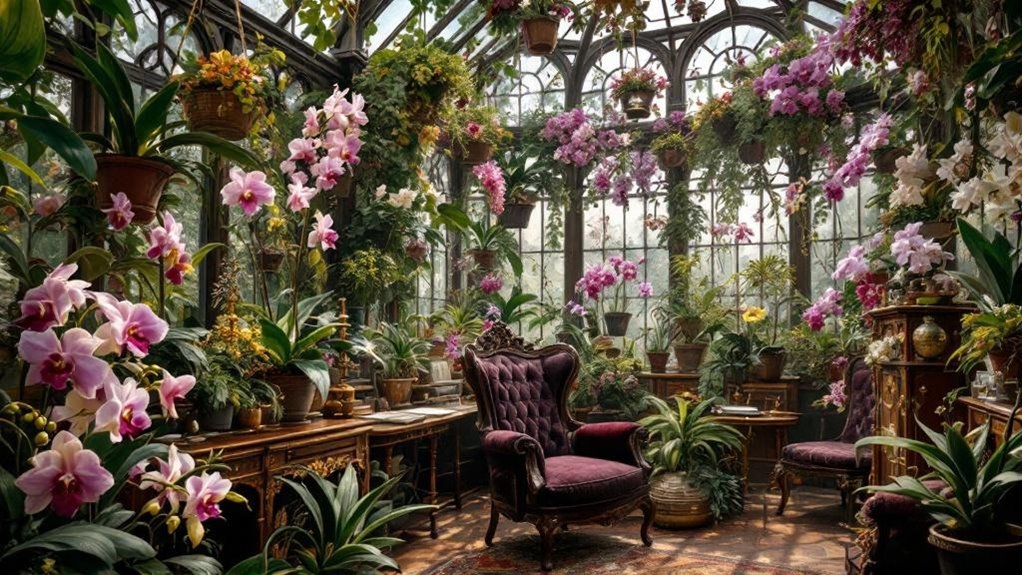
Fascination helps explain why orchids became so distinctly Victorian, because they gathered into a single cultivated object several forces that shaped the period’s imagination at once; by the mid-to-late nineteenth century, faster steamship travel, imperial plant-hunting expeditions, and the spread of glass-and-iron greenhouse technology meant that tropical orchids could be collected abroad, transported with fewer losses, and displayed in Britain without leaving them stagnant curiosities of travel writing.
You can see how orchidelirium suited a culture that prized display, classification, and costly rarity, since elite buyers and ambitious households treated orchids as visible proofs of taste and means. You also find them carrying the observational weight of science and the symbolic weight of empire, because Darwinian inquiry, auction values, and exotic provenance made the orchid unmistakably Victorian in meaning and prestige.
Why Did Orchid Mania Start Then?
Because orchid mania depended on conditions that earlier decades couldn’t yet supply, it began in earnest only when several nineteenth-century changes converged: horticultural methods improved enough to keep tropical orchids alive after import, steamship travel cut the transit that had once left fragile specimens stagnant or dead before arrival, and industrial iron-and-glass production made heated conservatories cheaper to build and maintain, so cultivated orchids moved from the most restricted elite collections into a wider upper- and middle-class market.
In the Victorian era, you also see literacy and print expanding; manuals, advertisements, and observational accounts of plant hunters taught you what to desire and how to display it. As rarity met high prices and elite taste, orchid mania became collectible prestige, encouraging speculation, cultivated domestic display, and orchidelirium as an engine of status, secrecy, and imperial acquisition.
How Were Orchids First Cultivated in Europe?
Once orchids became objects of status and cultivated display, European growers had to learn how to keep them alive, multiply them, and adapt them to conditions far removed from the tropical forests from which many had been taken; that work only became practicable in the mid-to-late nineteenth century, when improved greenhouse management, faster steamship transport, and more systematic botanical observation began to work together.
You see orchids survive when heated iron-and-glass houses replace stagnant rooms, when steamships shorten voyages, and when Kew, Joseph Hooker, and London nurseries circulate cuttings, herbarium specimens, and cultivation notes.
As growers refine observational methods, they move from wild collection toward propagation, aided by Darwinian studies of pollination and seed biology, then by flasking and asymbiotic propagation, so the Victorian orchid becomes a cultivated plant in conservatories and suburban glasshouses across Europe. Their rise also fed Victorian orchidelirium, which turned rare specimens into symbols of wealth, status, and refined taste.
Why Did Orchids Become Status Symbols?
Prestige made orchids into status symbols in Victorian culture, not simply because they were beautiful, but because rarity, cost, and cultivated difficulty combined to mark their owners as people of means, discernment, and modern knowledge; during the height of orchidelirium, a single exceptional specimen could command a price so high that ownership itself functioned as a public display of exclusive wealth, while improved steamship routes, glass-and-iron houses, and more reliable horticultural methods transformed orchids from nearly impossible curiosities into collectible trophies for aristocratic conservatories and aspirational middle-class drawing rooms.
You read these flowers as observational evidence of wealth, because branded specimens, Darwinian science, and plant-hunting narratives gave them cultivated authority; even stagnant display suggested connoisseurship, refinement, and modern intellectual taste. Orchidelirium made possession itself a form of competition, turning rare blooms into trophies that signaled access to distant landscapes and elite networks.
How Did the Middle Class Adopt Orchids?
You can see how orchids moved into middle-class homes when cheaper iron-and-glass greenhouses and faster steamship routes made these once-fragile imports more available, less stagnant in supply, and easier to cultivate as signs of status through flowers.
You can also trace their adoption through print culture and care, because garden manuals, advertisements, and nursery branding gave you practical instruction as well as an observational script for displaying orchids as cultivated proofs of refinement, scientific awareness, and social ambition.
As prices fell and supply widened, orchids passed from elite obsession to popular possession; in that shift, you can recognize how middle-class buyers used them to align themselves with aristocratic taste while presenting their households as modern, disciplined, and genteel.
Victorian orchidelirium helped turn orchids into widely recognized symbols of wealth, rarity, and cultivated taste.
Status Through Flowers
Aspiration shaped the middle-class embrace of orchids in mid- to late-Victorian Britain, because new steamship routes and cheaper iron-and-glass conservatories brought tropical specimens out of a stagnant world of aristocratic exclusivity and into a commercial market that cultivated desire as carefully as it sold plants.
You saw that orchids became a conspicuous status symbol; as the middle class adopted orchids, you could display refinement, cultivated taste, and cultural capital in suburban conservatories and competitive flower shows.
Named hybrids and prize-winning specimens functioned as a visible status symbol, linking your household to observational science, imperial commerce, and moral self-improvement.
Commercial growers strengthened that meaning by branding rare plants, emphasizing dramatic origins, and rewarding exhibition success, so ownership signaled not mere wealth but disciplined aspiration and entry into values once guarded by elite collectors.
Print Culture And Care
Through a dense network of manuals, illustrated journals, and nursery catalogues, the middle class learned to treat orchids not as capricious trophies from a distant tropics but as manageable domestic plants, because print culture translated specialized botanical knowledge into repeatable household practice and paired that knowledge with the material conditions that made success more likely.
- You relied on greenhouse technology, which made suburban conservatories less stagnant, more controlled, and observationally useful.
- You found in print culture clear routines for potting mixes, shading, and watering schedules.
- You encountered gardeners and plant collectors through testimonials, advertisements, and catalogue descriptions that cultivated confidence.
- You ordered hybrids and potted specimens by mail, then displayed them in parlours and civic shows, where careful success signaled refinement and disciplined domestic competence.
From Elite To Popular
By the mid to late nineteenth century, orchids moved from the guarded domain of aristocratic collectors into middle-class homes because the conditions of ownership had changed at once: cheaper iron-and-glass greenhouse construction reduced the stagnant unpredictability of older conservatories, steamship transport brought tropical species to Britain more regularly and at lower cost, and print culture translated specialist cultivation into observational routines that ordinary households could follow with some confidence.
You could now buy orchids as cultivated household plants, not remote trophies; commercially produced hybrids and branded nursery stock widened choice, advertisements and flower shows taught taste, and orchids became deeply associated with refinement, scientific awareness, and disciplined display. In that setting, middle-class ownership let you perform cultural distinction, emulate elite habits, and claim modern prestige without aristocratic inheritance or lineage.
How Were Orchids Tied to Empire?
You can see that Victorian orchids were rarely just cultivated flowers; they arrived in Britain as imperial spoils, taken through colonial routes by plant hunters who relied on ships, outposts, and local labor to move tropical specimens into metropolitan hands.
You can also trace how Kew organized this traffic with observational authority, naming and circulating orchids through networks of collectors, traders, and officials, so that botanical order became a visible form of imperial power rather than a stagnant record of nature.
When you follow orchids into trade, you see how commercial firms and elite buyers turned them into luxury goods and status symbols, while published accounts often erased indigenous knowledge and recast colonial extraction as British mastery.
Orchids As Imperial Spoils
Possession shaped the Victorian orchid trade, because these flowers didn’t arrive in Britain as neutral curiosities; they were gathered through imperial botanical networks, carried out of colonized landscapes by plant hunters working for nurseries and institutions such as Kew, and then displayed as cultivated evidence that the empire could reach into distant climates and make their riches serve metropolitan desire.
- You see orchids at Kew Gardens, where imperial display turns living specimens into observational proof of possession.
- You notice firms using steamships, glasshouses, and colonial supply chains to convert extraction into cultivated markets.
- You read journalism that praises plant hunters, while indigenous knowledge appears stagnant, distrusted, or erased.
- You recognize that rarity, hybrid naming, and expedition narratives let orchids confer class prestige and national authority.
Plant Hunters And Colonies
Across the empire, orchid hunting linked botanical desire to colonial power, because the flowers that entered Victorian literature and collecting culture rarely came through innocent exchange; they were taken from forests in India, Southeast Asia, and the Caribbean through expeditions financed by wealthy Europeans, carried through dangerous terrain at considerable human cost, and then redirected into imperial systems that turned living plants into cultivated evidence of reach, knowledge, and control.
When you trace orchidelirium, you see plant-hunting expeditions shaped by colonial rule, improved steamship routes, and refrigerated transport; collectors died from disease, animal attacks, and violence, yet investors still pursued profit and prestige.
Victorian stories often cast hunters as observational heroes and local people as stagnant impediments, obscuring exploitation, while the imperial orchid trade rewarded branding, secrecy, deceit, and sabotage in competition.
Kew, Trade, And Power
Authority shaped the Victorian orchid trade at every level, because orchids didn’t simply arrive in Britain as beautiful curiosities; they moved through an imperial system in which Kew served as a central clearinghouse for specimens, knowledge, and prestige, receiving plants from colonial botanical networks, cultivating them in glasshouses, and redistributing living collections and herbarium samples for research, commerce, and display.
- You see Royal Botanic Gardens, Kew convert empire into observational science and cultivated authority.
- You watch plant hunters, nurseries, and firms use routes, agents, and colonial labor.
- You notice steamships, print, and iron glasshouses prevent stagnant supply and widen markets.
- You understand orchids become trophies; rarity signals class, while commerce and science justify extraction.
Thus, power organized desire, and desire, in turn, sustained imperial orchid culture across Britain.
Who Were the Orchid Hunters?
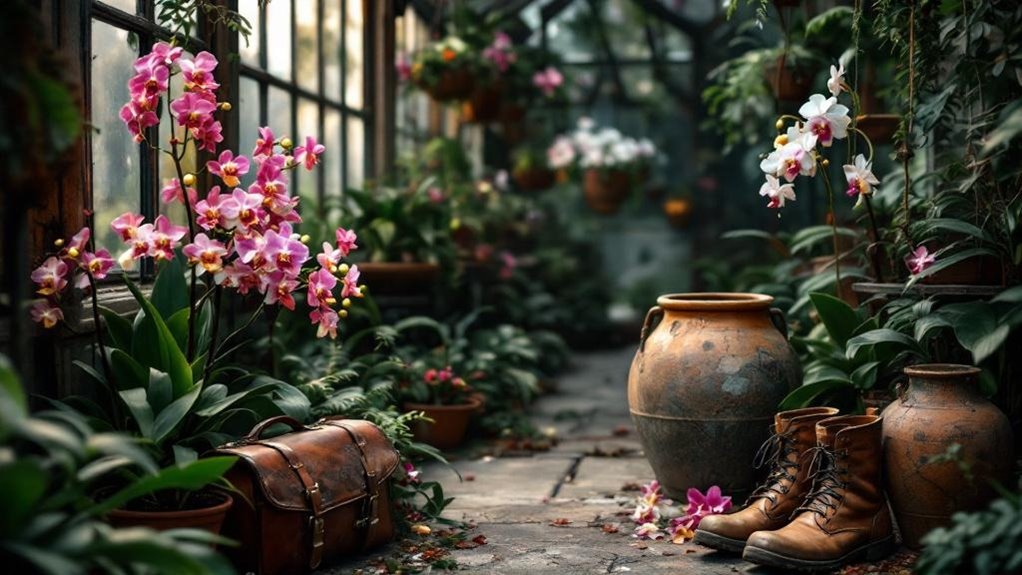
Orchid hunters weren’t a single, romantic type but a cultivated network of Victorian plant collectors, naturalists, nurserymen, and commissioned agents, financed by commercial firms, botanical institutions such as Kew, and wealthy private patrons, who traveled into tropical colonies and other remote regions to secure new orchid species for science and for an increasingly competitive market.
If you look closely at these orchid hunters, you see Victorian-era plant collectors ranging from gentleman botanists to salaried local agents; some, like Walter Davis and Henry Oakeley, mounted expensive expeditions whose results entered science, trade, and auction rooms where rare plants rivaled luxury goods. You also find an observational world shaped by rivalry, secrecy, and risk, since firms sought advantage, journeys often ended in disease or accident, and indispensable Indigenous intermediaries rarely received full credit.
How Did Orchid Myths Conceal Violence?
Strip away the romance that Victorian culture attached to rare blooms, and you can see how orchid myths concealed violence by converting commercial extraction into cultivated adventure; deaths from disease, animal attack, or conflict on collecting expeditions were retold as proofs of masculine daring, while the market pressures that sent men into dangerous colonial landscapes, and the firms that profited from those risks, receded into the background.
- You see orchid-hunting framed as observational heroism, not trade.
- You find commercial growers polishing narratives that hid sabotage and stagnant rivalries.
- You watch indigenous people cast as treacherous obstacles, which shifted blame from collectors and firms.
- You notice seductive murderous orchids turning exploitation, theft, fraud, and environmental damage into decadent metaphor, while recovery tales omitted dispossession and loss.
How Did Darwin Make Orchids Scientifically Important?
You can see Darwin make orchids scientifically important through his cross-pollination studies, because his 1862 book linked cultivated observational detail to precise insect behavior and showed how pollinia, floral columns, and labellum structures worked together to secure reproduction.
You can also trace how orchids became central to evolution, since Darwin used their intricate forms to show that features once treated as fixed or designed could emerge through gradual natural selection, and his prediction of a long-tongued moth for Angraecum sesquipedale gave that argument unusual force.
As you turn to floral adaptation evidence, you can recognize that Darwin made orchids a disciplined case study rather than a stagnant curiosity, and his methods shaped later reproductive biology, pollination ecology, and comparative botanical research across Europe.
Orchid Cross-Pollination Studies
- You see Charles Darwins theory grounded in reproducible observation, not stagnant ornament.
- You follow methods of cross-pollination through greenhouse trials and field notes.
- You note Angraecum’s spur, which let Darwin predict a matching hawk moth.
- You recognize pollinator coevolution as morphology directs pollen precisely between flowers.
Its 1877 edition broadened botany’s authority and public attention.
Orchids And Evolution
Precision made orchids central to evolution, because Darwin’s 1862 book on their fertilisation showed, through cultivated experiments and observational comparison, that structures once treated as decorative curiosities were in fact functional adaptations shaped by natural selection; modified labella guided insect movement, pollinia attached with exact placement, and long nectar spurs matched particular pollinators so closely that floral form could be read as historical evidence rather than stagnant ornament.
You can see why this mattered to Darwin’s theory of evolution: orchids let him test descent with modification experimentally, connect greenhouse trials to global correspondence, and even predict unseen pollinators, as with the Madagascan hawk moth. By explaining complex reproductive mechanisms without special creation, he made orchids exemplary scientific evidence, and orchid mania carried that evidence into Victorian culture and literary imagination widely.
Floral Adaptation Evidence
What made orchids scientifically important for Darwin wasn’t simply their strangeness, but the way their floral structures let him show, through cultivated experiment and observational comparison, that intricate form had a practical history; in orchids, the labellum, the fused column, the pollinia, and the nectar spur could each be read as adaptive specializations shaped by natural selection to secure precise pollen transfer and limit waste.
- You see Darwins theory of evolution tested through floral mechanics, not stagnant speculation.
- You observe co-adaptation when nectar spurs fit pollinator anatomy with measurable precision.
- You follow pollinia attaching to insect bodies, showing function through cultivated evidence.
- You recognize incremental change across species and hybrids, including Angraecum’s spur, which led Darwin to predict a Madagascan hawk moth, later found, and confirmed evolutionary explanation.
Why Did Orchid Sex Fascinate Victorians?
Because orchids seemed to unite observational science with cultivated fantasy, Victorian readers found their sexual lives unusually compelling; Darwin’s studies in 1862 and 1877, especially *Various Contrivances by which Orchids are Fertilised by Insects*, gave the subject intellectual weight by showing how spur lengths, the rostellum, and the transfer of pollinia revealed exquisitely specialized systems of fertilization and, in turn, supported natural selection.
You can see why this mattered beyond botany: popular writing translated complex mechanisms into scenes of seduction and mimicry, while exotic orchids from colonial trade carried an aura of distance, rarity, and controlled transgression. As you follow Victorian fiction and gardening manuals, you find reproductive knowledge tied to hybridization, profit, and status; even stagnant technical details acquired moral suggestiveness when pollinia, labella, and insect partners seemed to stage secretive courtship.
How Did Orchids Symbolize Romance and Seduction?
When you read Victorian orchids through the language of flowers, you see how their exotic allure, rarity, and cost turned them into cultivated signs of desire, signaling romance that appeared refined in public while hinting at stronger private feeling.
You can also observe how courtship absorbed that symbolism, because giving, displaying, or even describing orchids let admirers declare luxury, taste, and serious intent; the flower’s sensual form and elite status made affection visible without becoming stagnant or crude.
At the same time, orchids carried secrecy, since writers used them to suggest seduction, possession, and hidden appetite, allowing you to recognize how romance in Victorian literature often moved through observational codes rather than open confession.
Language Of Flowers
Elegance governed the orchid’s place in Victorian floriography, where the flower signaled not simple courtship but refined love, cultivated desire, and a form of romance marked by rarity, expense, and observational restraint; during the height of orchidelirium, its high price and foreign origins made it an unmistakable token of exceptional devotion, so a gifted orchid suggested both deep affection and the social distinction to sustain such a gesture.
- You read luxury in its cost and scarcity.
- You read exotic sensuality in its elaborate form.
- You read seduction in manuals linking labellum shapes and deceptive pollination to erotic suggestion.
- You read danger in fiction that paired orchids with femme fatales, making desire seem cultivated, hidden, and never stagnant.
Thus, the orchid let you communicate romance with precision, reserve, and unmistakable intensity.
Exotic Allure And Desire
Victorian writers leaned into the orchid’s exotic allure as a way to make desire legible yet controlled, turning its unfamiliar contours, foreign provenance, and prohibitive cost into signs of romance that felt cultivated rather than sentimental; in the language of flowers, an orchid didn’t merely suggest affection, it implied passion refined by restraint, a form of attraction heightened by rarity and observational distance.
When you encounter orchids in Victorian literature, you’re meant to register more than beauty; you’re asked to read erotic morphology, especially the labellum and column, as evidence of appetites disciplined by taste, while Darwinian ideas about pollination quietly intensify the analogy to human coupling. At the same time, fiction makes the exotic bloom seductive and faintly dangerous, its mimicry and deceptive fertility attaching desire to moral ambiguity rather than stagnant innocence alone.
Courtship, Luxury, Secrecy
Secrecy gives the orchid much of its power in literary courtship, because the flower lets writers join romance to luxury and seduction without abandoning cultivated restraint; in Victorian floral symbolism, an orchid didn’t simply mark affection, it suggested refined sexuality, desirability, and a form of intimacy made more persuasive by rarity, cost, and observational distance.
- You read orchidelirium as proof that gifting orchids displayed wealth, elite taste, and intimate devotion.
- You see eroticized labellum, spur, and nectary details turning botanical observation toward clandestine desire.
- You notice secretive pollination, mimicry, and Darwinian cross-pollination shaping courtship as trickery or mutual seduction.
- You sense danger in stagnant hothouses and killer-orchid fantasies, where secrecy makes desire transgressive, luxurious, and quietly threatening to cultivated order.
How Did Gothic Fiction Make Orchids Uncanny?
Because Gothic fiction favored objects that seemed poised between beauty and threat, it made orchids uncanny by treating their exotic rarity, cultivated surfaces, and disturbingly lifelike labella as signs that plants might possess a covert agency of their own; in H. G. Wells, you watch orchids seem almost sentient, and vegetal agency acquires observational force through botanical detail.
| Motif | Gothic effect | Cultural source |
|---|---|---|
| Lifelike labellum | Erotic danger | Mimicry |
| Explorer losses | Menace | Imperial contact |
You also see orchidelirium darken value into obsession; secrecy, rivalry, and illicit collecting turn stagnant rooms into theaters of ruin. Darwinian pollination tropes lend plausibility, yet they also sharpen the boundary crisis, since orchids appear to deceive, desire, and drain, unsettling any secure distinction between scientific curiosity and fearful projection.
How Did Victorian Fiction Use Orchids?
From that Gothic uncanniness, fiction more broadly put orchids to work as narrative instruments of desire, rank, and risk, treating their cultivated beauty and foreign rarity as signs that a character’s tastes had become morally revealing; in H.
- You see orchids mark status, since collectors display rarity as cultivated distinction, yet orchidelirium turns observational refinement into vanity and stagnant obsession.
- You see sexually charged seduction shape motive, because orchid reproduction and mimicry let novelists stage fertility, gender anxiety, and compromised self-command.
- You see empire enter quietly, as tropical orchids carry colonial danger, linking plant hunting to violence, death, and exotic encounter.
- You see Darwinian botany steady the effect; specialist pollination and evolutionary discourse make orchids seem plausible agents, so fiction can warn that beauty, once fetishized, courts ruin.
What Are the Best-Known Orchid Scenes in Literature?
Certain orchid scenes became canonical not simply because they were vivid, but because they gathered Victorian fears about beauty, appetite, and cultivated knowledge into single episodes that readers could readily remember; the best known remains H. G. Wells’s “The Flowering of the Strange Orchid,” where you watch Mr. Wedderburn nearly consumed, and see the killer-orchid trope fixed in popular form.
Around that scene, you can trace quieter but equally influential moments: reviewers turned Darwin and pollination into observational drama, making orchid structure seem sexually charged and evolutionarily unsettling; sensation fiction, especially Wilkie Collins, placed rare blooms in cultivated rooms where stagnant air, auction prices, and hunters’ deaths suggested obsession; across poems, plays, and short stories, orchids as erotic/decadent symbols marked seduction, secrecy, and colonial otherness for many readers.
How Did Orchid Symbolism Shape Crime and Decadence?
Decadence gave orchid symbolism its sharpest criminal edge, for Victorian and early modern crime fiction repeatedly used the flower to concentrate ideas of exotic luxury, cultivated appetite, and moral trespass into a single observational image; in H.
- You see Wells’s orchid drain vigor, turning collecting into crime.
- You find decadence in thrillers, where rare blooms signal seduction, deviance, and impending violence.
- You trace greed through orchidelirium, with ruinous prices, lethal expeditions, and rivalry breeding illicit acts.
- You notice imperial narratives racialize danger, binding orchid desire to colonial violence and secrecy.
Through these patterns, the orchid became a stagnant emblem of cultivated excess; noir and film later preserved that code, placing flowers in luxurious rooms where morality stayed ambiguous, and where crime seemed inseparable from beauty itself.
Why Do Orchids Still Shape Cultural Imagination?
Orchids still shape cultural imagination because Victorian culture fixed them at the meeting point of luxury, science, and danger, and that compound image has proved unusually durable; orchidelirium made the flower a cultivated object of status, with single specimens commanding extraordinary prices, while Darwin’s studies of orchid fertilization gave it an observational aura of biological ingenuity, erotic deception, and specialized agency that literature and film still find useful.
You still inherit that framework when you see orchids in fashion, design, or noir settings, because they carry luxury, sexual deception, and colonial risk at once; greenhouse culture and illustrated print kept them visible beyond elite collections, so the image never became stagnant, and stories of exotic riches sought by hunters still shadow modern readings of desire, hybridity, transgression, and national identity today.
Frequently Asked Questions
How Did Orchids Influence Victorian Interior Design and Domestic Taste?
You saw orchids shape Victorian interiors by inspiring conservatories, elaborate wallpapers, exotic motifs, and glass cases. You’d display them as status symbols, signaling refinement, wealth, and imperial taste while encouraging lush, carefully curated domestic spaces.
What Role Did Orchid Illustration Play in Victorian Print Culture?
You see orchid illustration shape Victorian print culture by fueling demand for botanical books, magazines, and catalogs. It lets you admire exotic beauty, spread scientific knowledge, market rare plants, and reinforce status through collectible imagery.
How Were Orchids Discussed in Victorian Children’s Literature?
You’d find orchids in Victorian children’s literature as wonders, moral lessons, and exotic curiosities. At the tip of the iceberg, they sparked imagination, taught obedience, reflected empire, and softened botany into engaging stories.
Did Victorian Religious Writers Attach Spiritual Meanings to Orchids?
Yes, you’d find some Victorian religious writers giving orchids spiritual meanings, though less often than roses or lilies. They used orchids’ rarity and intricate beauty to suggest divine artistry, moral reflection, and the wonder of creation.
How Did Artificial Orchids Appear in Victorian Fashion and Craft?
Like a hat trimmed with silk orchids at an 1880s milliner’s window, you’d see artificial orchids bloom in bonnets, corsages, hairpieces, and embroidery; you could craft them from wax, silk, velvet, feathers, and beadwork.
Conclusion
When you look back at Victorian orchids, you see more than cultivated rarity; you see an age arranging empire, class, science, and desire beneath glass, as if in a quieter Eden. In fiction, they don’t merely decorate stagnant rooms; they sharpen mood, imply secrecy, and recall hothouse plots where beauty leans toward danger. Their hold remains because they join observational detail to myth, and because, like a faint perfume in a closed conservatory, they linger beyond their moment.