
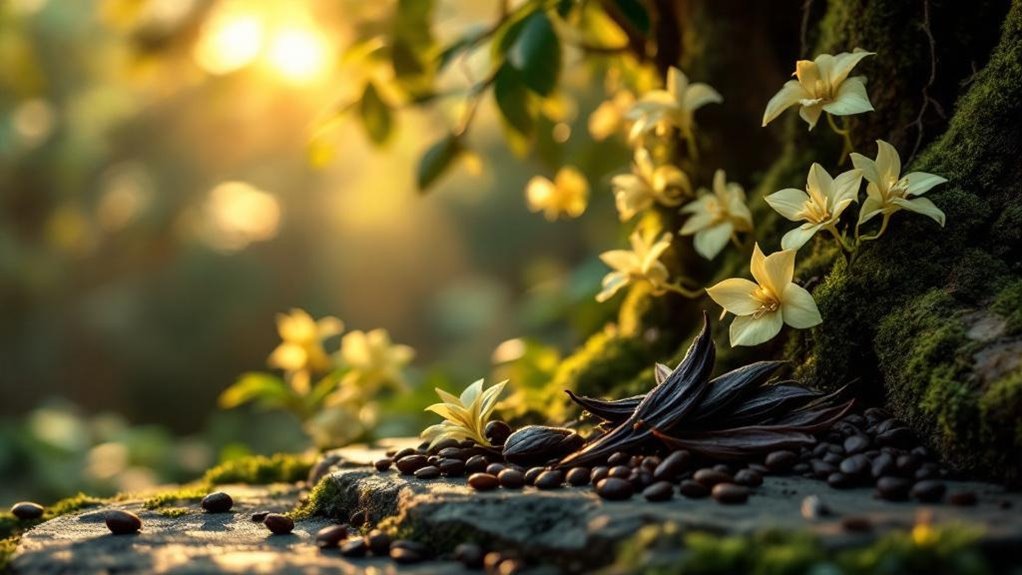
You can trace the Aztec vanilla legend to Totonac Veracruz, where tales of Xanath and Tzarahuin, or Morning Star and Young Deer, explain how sacrificed lovers became the first vanilla orchid; that origin gave cultivated Vanilla planifolia a sacred role in offerings, tribute, and xocoatl. You can also see the orchid’s ecological logic in its bond with the melipona bee, a relationship that kept yields stagnant elsewhere until hand-pollination changed vanilla farming, and the fuller story follows.
- Key Takeaways
- What Is the Aztec Vanilla Legend?
- Who Were Xanath and Tzarahuin?
- How Does the Aztec Vanilla Legend Unfold?
- Why Does the Vanilla Orchid Symbolize Love?
- How Does the Melipona Bee Fit the Legend?
- What Are the Legend’s Totonac Roots?
- Why Was Vanilla Sacred in Mesoamerica?
- How Did the Aztecs Adopt Vanilla?
- Why Did Vanilla Flavor Xocoatl?
- What Plant Is Behind the Vanilla Myth?
- Where Did Vanilla First Grow in Mexico?
- Why Did Vanilla Need a Native Pollinator?
- How Did Vanilla Spread Beyond Mexico?
- How Did Hand-Pollination Change Vanilla Farming?
- How Is Vanilla Grown and Cured Today?
- Why Does the Aztec Vanilla Legend Still Matter?
- How Does the Vanilla Legend Live On in Mexico?
- Frequently Asked Questions
- Conclusion
Key Takeaways
- The Aztec vanilla legend tells of sacred lovers whose spilled blood gave rise to the first fragrant vanilla orchid.
- In Totonac and Aztec tradition, vanilla symbolized love, sacrifice, memory, and a divine gift offered to gods.
- The orchid behind the legend is Vanilla planifolia, a flat-leaf orchid native to the humid rainforests of Veracruz, Mexico.
- Totonacs first cultivated vanilla around 1000 AD, and the Aztecs later adopted it as tribute, perfume, and flavoring.
- Vanilla originally depended on native melipona bees for pollination, limiting cultivation until hand-pollination spread it worldwide.
What Is the Aztec Vanilla Legend?

Legend, in the Aztec vanilla tradition, centers on Princess Morning Star and Prince Young Deer, lovers who tried to flee together, were captured, and were beheaded by temple priests. From the place where their blood touched the earth, a green vine bearing fragrant orchid blossoms emerged, and that cultivated plant came to be understood as vanilla’s sacred origin.
When you examine the aztec vanilla legend, you see more than a tragic romance; you see an observational account of how sacred meaning enters cultivation, ritual, and memory.
The Totonacs treated vanilla as a divine gift linked to love, loss, and offerings to their gods, so the story explains why the flower never stood as a stagnant crop alone.
In some tellings, Young Deer becomes the melipona bee, whose pollination binds myth and environment together through cultivation.
Who Were Xanath and Tzarahuin?
Another strand of the Aztec vanilla legend names the lovers as Xanath and Tzarahuin, and in this version you can see more clearly how sacred identity, social order, and cultivated nature become inseparable;
Xanath appears as a noble daughter of the Totonac people who visits the temple of Chac-Mool and meets Tzarahuin, a handsome young man whose love of music and art mirrors her own, yet their bond remains forbidden because status keeps them apart.
As you follow Xanath and Tzarahuin, you encounter more than lovers; you observe a social pattern in which beauty, devotion, and hierarchy won’t remain stagnant.
Xanath’s refusal of the God of Happiness marks her integrity, while Tzarahuin’s self-sacrifice, becoming the first melipona bee, explains why the vanilla orchid survives through faithful pollination in this observational, sacred account of origin.
How Does the Aztec Vanilla Legend Unfold?
As you follow the sacred lovers’ flight, you see Xanath and Tzarahuin move beyond social boundaries, and their escape becomes more than an act of passion; it reveals how cultivated devotion in the legend resists divine control without turning stagnant or self-indulgent.
You then witness punishment reshape the story, because Xanath’s blood and body become the first vanilla orchid, and this transformation gives the narrative its observational force by tying love, suffering, and nature into a single sacred origin.
When Tzarahuin chooses sacrifice so he can remain near her, you understand why the legend endures across variations; it explains vanilla not merely as a plant, but as the lasting form of love marked by loss and divine intervention.
Sacred Lovers’ Flight
Although the tale moves with the clarity of ritual, it begins in secrecy: Morning Star, a princess consecrated to the goddess Tonoacayohua, and Young Deer, a prince drawn to her despite the sacred limits around her life, cultivated a hidden love and planned to flee together, seeking a future outside the temple’s authority.
You observe their bond as a quiet refusal of stagnant duty; she was treated as a sacred gift, yet both chose motion over submission, privacy over display, and devotion over fear.
As the legend unfolds, you see how their escape attempt carries more than romance; it challenges priestly control, exposes the cost of consecration, and frames vanilla’s origin within an observational account of love crossing ordained boundaries, before violence interrupts the lovers’ brief, deliberate flight.
Blood Becomes Vanilla
When the priests seized Morning Star and Young Deer and beheaded them for defying the temple’s claims over her consecrated life, the legend turns from covert motion to sacred metamorphosis; from the ground marked by their spilled blood, a vine rose, bearing pale green-white orchids and, in time, fragrant brown pods.
You can see why this transformation became the tale’s central observational claim, because it converts forbidden devotion into a living plant that outlasts punishment.
You then understand how the vanilla orchid carried their bond into cultivated memory; the Totonac treated the pods as the lovers’ essence made durable, not stagnant, and that belief gave vanilla sacred force, aphrodisiac meaning, and ritual value.
Why Does the Vanilla Orchid Symbolize Love?
Because Totonac tradition ties the vanilla orchid to the fate of Princess Morning Star and Young Deer, the flower came to symbolize love not as a passing sentiment but as a cultivated bond marked by devotion, sacrifice, and loss; in that observational framework, the lovers’ blood transforming into vanilla pods suggests that true affection endures beyond death, refusing anything stagnant or easily forgotten.
When you consider vanilla within Totonac and Aztec thought, you see why the orchid carries romantic meaning: it joins beauty, fragrance, desire, and memory within a single sacred image.
Its delicate bloom evokes tenderness, its origin story insists that love asks something costly, and its later reputation as an aphrodisiac strengthens its link to attraction, longing, and enduring attachment in ritual and cultural practice.
How Does the Melipona Bee Fit the Legend?
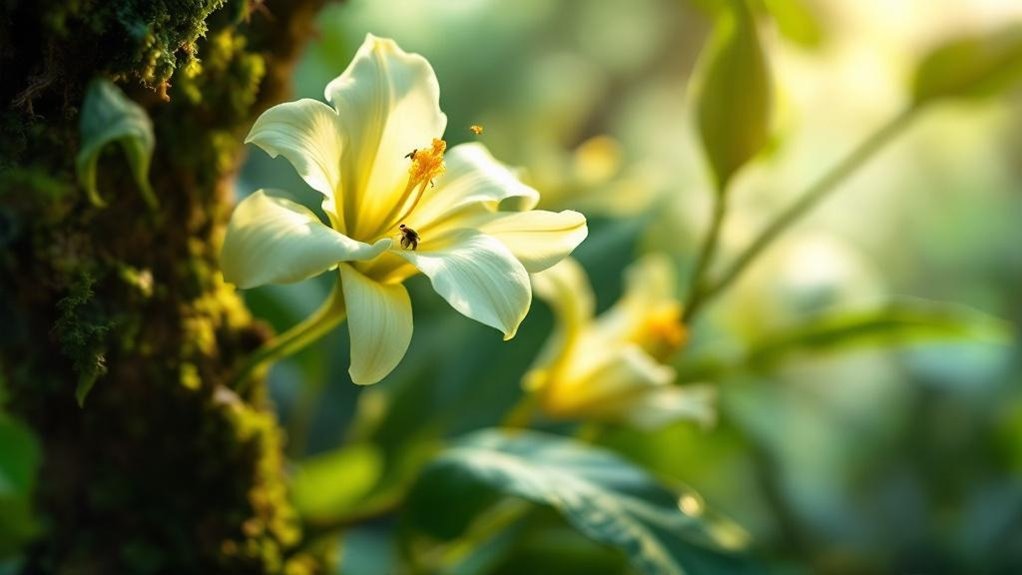
You can see the Melipona bee as the sacred pollinator at the center of the legend, because it alone pollinates the vanilla flower and makes the cultivated plant’s continuation possible.
In the mythology, Young Deer becomes this bee after death, and that transformation gives you an observational link between eternal love and the natural process that keeps vanilla from turning stagnant in the world of the Totonac.
As a result, the bee fits the legend not as a decorative symbol but as a necessary presence, joining myth, nature, and preservation in one quiet, coherent meaning.
Sacred Pollinator Role
Although the vanilla orchid may seem to stand at the center of the legend, the melipona bee gives the story its living structure, since it serves as the orchid’s only natural pollinator in Mexico and thereby binds myth, cultivation, and ecology into a single observational pattern.
You can see why this matters: when the melipona bee visits cultivated vanilla, the plant sets fruit naturally, but outside Mexico growers must pollinate each flower by hand, a careful practice that reveals how dependent vanilla remains on a single species.
In this relationship, you encounter an ancient, non-stagnant understanding of biodiversity; Totonac and Aztec communities recognized that reverence for nature wasn’t abstract, because the orchid’s survival, the region’s agriculture, and the legend’s continuing meaning all rested on environmental stewardship and interdependence.
Bee In Mythology
When the Totonac legend turns from the death of the lovers to the continued life of vanilla, the melipona bee enters as more than a practical pollinator; it carries Young Deer’s presence into the natural world, since tradition holds that he was transformed into this bee after death and consequently remained beside the orchid born from love and sacrifice.
You can see that meaning through:
- A dark bee moving between pale blossoms
- A cultivated vine climbing humid trees
- Pollen transferred before flowers fall stagnant
- Love preserved through agricultural continuity
In this observational frame, the melipona bee binds myth to ecology; as the only bee able to pollinate vanilla orchids, it sustains the plant, confirms the lovers’ lasting connection, and shows you how Totonac belief joins sacrifice, agriculture, and the natural world.
What Are the Legend’s Totonac Roots?
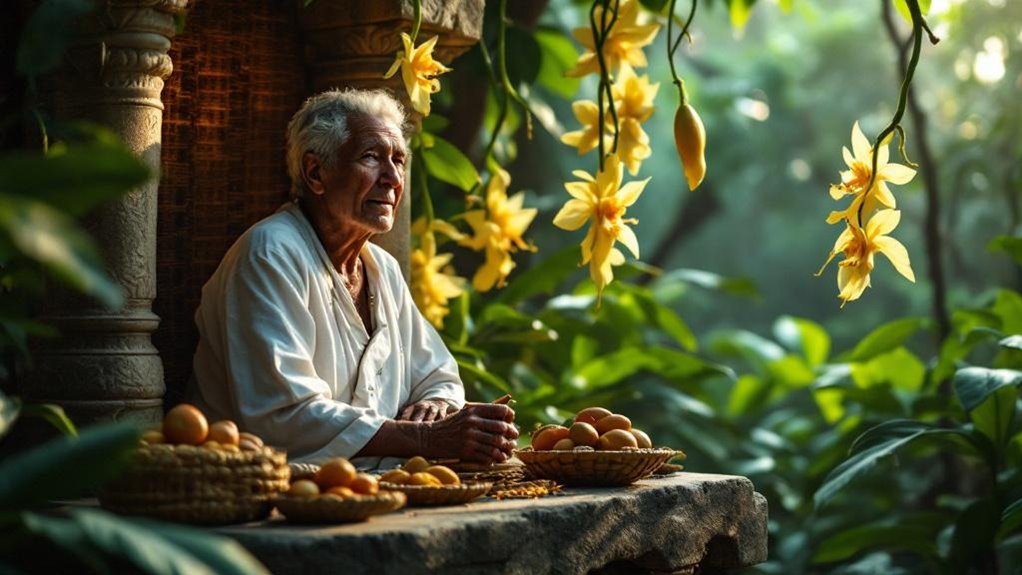
At the legend’s foundation stands the Totonac people of Veracruz, the earliest known cultivators of vanilla, who treated the orchid not as a stagnant commodity but as a sacred presence woven into ritual life, offerings, and cultivated memory; within that observational framework, the story of Princess Xanat and her lover Tzarahuin gives the plant its deepest cultural logic, linking vanilla to love, sacrifice, and divine intervention in a way that clarifies why the flower carried such weight in Totonac belief.
| Root | Meaning | Role |
|---|---|---|
| Xanat | transformed maiden | origin |
| Tzarahuin | devoted lover | bond |
| tlīlxochitl | sacred vanilla | ritual |
You can trace the legend’s roots through Totonac memory, where vanilla shaped identity, entered cuisine, and preserved devotion across generations there.
Why Was Vanilla Sacred in Mesoamerica?
You can see vanilla’s sacred status begin with Totonac sacred origins, where it wasn’t merely cultivated but understood as a divine gift shaped by creation mythology.
That belief gave the flower an observational weight beyond ordinary trade or use. You can also trace its role in rituals, where offerings of vanilla expressed love, loss, and devotion to the gods, while its legendary bond to transformation and the melipona bee kept its meaning from becoming stagnant or merely decorative.
When the Aztecs adopted it through tribute, they joined sacred value to power, nobility, and cacao, so you can recognize why vanilla carried both spiritual and political force across Mesoamerica.
Totonac Sacred Origins
Reverence shaped the Totonac view of vanilla, because they didn’t treat it as a mere cultivated flavoring but as a sacred herb whose fragrance carried observational meaning, linking human devotion to divine will, love, and loss.
In their origin legend, the blood of Princess Morning Star and Prince Young Deer gave rise to the first vanilla orchids, and that transformation made the plant more than useful or beautiful, since it embodied sacrifice, memory, and the continuing presence of the gods in the natural world.
In Totonac sacred origins, you can picture:
- vines climbing humid trees
- pale blossoms opening at dawn
- dark pods ripening slowly
- grief refusing stagnant silence
You see why vanilla signified love and divine favor; its scent, medicine, and offerings joined earthly life to sacred memory across generations.
Rituals, Tribute, And Power
Because vanilla moved through Mesoamerican life as both offering and currency, its sacred status rested not only on myth but also on ritual practice, political control, and cultivated rarity; the Totonacs treated the pods as a divine inheritance linked to love and loss, then delivered them as tribute to the Aztec empire, where that same fragrant herb acquired another layer of meaning, becoming a visible sign of wealth, submission, and imperial power.
If you follow vanilla into ceremonies, you see how rituals joined economy to devotion: priests blended it into xocoatl, rulers received it as tribute, and nobles displayed its scent as observational proof of rank.
Its orchid was delicate, never stagnant in meaning, because scarcity deepened reverence, and controlled access turned fragrance into cultivated authority.
Love, Loss, And Divinity
Imperial tribute and ritual display explain how vanilla signaled power, yet its sacred force in Mesoamerica rested just as firmly in a myth of love, loss, and divine return, one that gave the orchid an origin no merely cultivated luxury could claim.
You can trace that sacredness through observational details:
- Princess Morning Star and Young Deer embody love and loss.
- Their spilled blood feeds the land, and vanilla rises.
- The Melipona bee returns Young Deer to the flower.
- Aztec rites use vanilla as offering and aphrodisiac.
Through this legend, you see divinity rooted in sacrifice, fertility, and renewal; vanilla doesn’t emerge from stagnant earth alone, but from remembered bodies, transformed desire, and a cultivated bond between nature and ritual, honored by Totonac and Aztec communities alike.
How Did the Aztecs Adopt Vanilla?
When the Aztecs conquered the Totonac people in the 15th century, they didn’t simply seize territory; they absorbed a cultivated vanilla tradition that the Totonacs had already treated as sacred. That transfer gave the Aztec elite direct access to one of Mesoamerica’s most valued aromatics.
From that point, you can trace how the vanilla plant entered imperial life: the Aztecs called it tlīlxochitl, or “flower that produces perfume,” an observational name that emphasized fragrance, prestige, and ritual use.
You also see adoption through Montezuma, who received vanilla and folded it into courtly consumption, making it a marker of nobility at feasts and ceremonies; yet cultivation remained geographically constrained, almost stagnant beyond Mexico, because successful pollination depended on specific native bee species for centuries thereafter.
Why Did Vanilla Flavor Xocoatl?
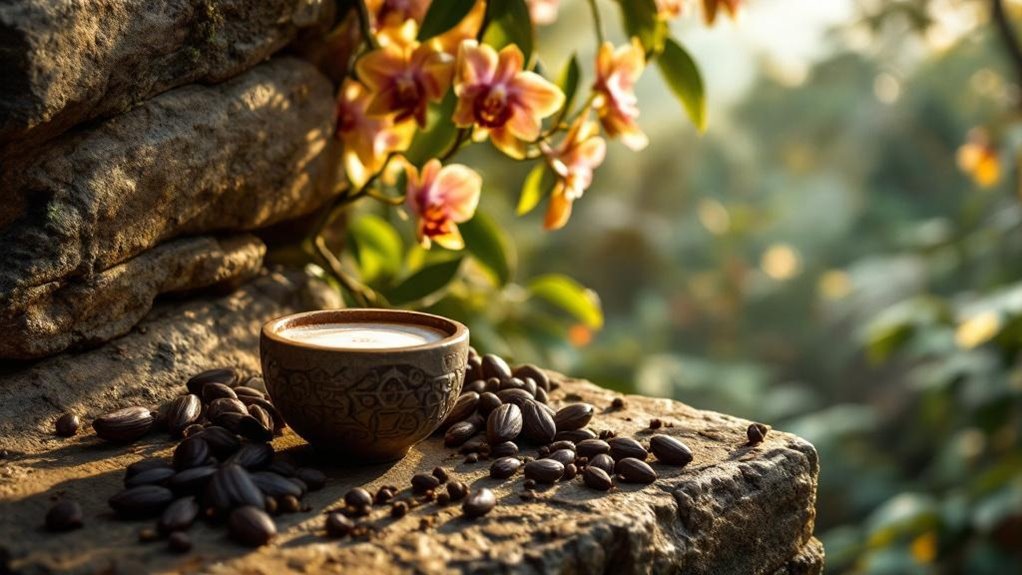
Why, then, did vanilla become so closely tied to xocoatl: the Aztecs recognized that tlīlxochitl could soften cocoa’s stern bitterness with a cultivated aroma and a faint sweetness, and in doing so it turned a potent drink into a more balanced, observational expression of rank, ceremony, and refined taste.
You can picture its appeal through four sensations:
- dark cocoa, less stagnant, more rounded
- vanilla beans releasing a warm, floral scent
- a drink reserved for nobles and sacred occasions
- Montezuma drinking it for stimulation and prestige
When you place vanilla in xocoatl, you understand why elites valued it; flavor mattered, but so did symbolism. Tlīlxochitl suggested luxury, indulgence, and even aphrodisiac force, so the beverage carried social meaning alongside pleasure, reinforcing nobility, ritual order, and cultivated identity.
What Plant Is Behind the Vanilla Myth?
Although legend often enlarges vanilla into something almost abstract, the plant behind that myth is precise and botanical: the flat-leaf vanilla orchid, Vanilla planifolia, a climbing species native to Mesoamerica and cultivated most closely in places like Veracruz, where its historical identity remained rooted in the landscape that first sustained it.
You can trace the myth through its living form: yellow-green flowers, brief and delicate, depend on pollination rather than stagnant symbolism, and traditional belief linked that process to the melipona bee and to Tzarahuin’s sacrifice.
Among the Totonac, who first cultivated Vanilla planifolia, the orchid carried an observational meaning as well as a sacred one, because Xanath’s transformation expressed love, beauty, and divine continuity; later, hand-pollination made wider cultivation possible without changing the plant itself.
Where Did Vanilla First Grow in Mexico?
If you trace vanilla’s earliest roots in Mexico, you arrive in the Totonac homeland of Veracruz, where the tropical rainforests supported Vanilla planifolia and where people first recognized the orchid’s cultivated and sacred value around 1000 AD.
You can see, in an observational way, that this region offered the humid, living conditions the plant required, rather than any stagnant landscape, which helps explain why vanilla first flourished there.
You also find Papantla at the center of that legacy, a place long associated with abundant vanilla orchids and remembered, with good reason, as the city that perfumed the world.
Totonac Homeland
Long before vanilla entered imperial trade and distant kitchens, it was cultivated by the Totonac people in the tropical rainforests of Veracruz, Mexico, where the region’s humid air, frequent rainfall, and dense ecological diversity gave Vanilla planifolia the conditions it needed to root, climb, and flower without becoming stagnant or ecologically isolated.
In the totonac homeland, you can trace vanilla’s earliest cultivated presence through Papantla, called “The City That Perfumed the World,” and through an observational record of ritual, tribute, and myth. You see:
- orchid vines trained with care
- offerings placed with measured intent
- vanilla gathered for Aztec tax
- sacred stories binding plant and people
Here, vanilla wasn’t merely grown; it organized memory, duty, and identity, linking cultivation to belief and local authority across generations.
Veracruz Rainforests
Origin matters here, because vanilla first grew in Mexico within the tropical rainforests of Veracruz, where Vanilla planifolia developed as a native orchid under a stable pattern of heat, humidity, rainfall, and filtered shade that let the vine climb, flower, and mature without becoming ecologically stagnant.
| Feature | Veracruz rainforests | Vanilla link |
|---|---|---|
| Orchid | Native habitat | Vanilla planifolia |
| Climate | Warm, humid | Steady growth |
| People | Totonac cultivation | Sacred herb |
You can trace cultivation to about 1000 AD, when Totonac communities observed the vine closely, cultivated it deliberately, and embedded it within myth, ritual, and regional identity. In the veracruz rainforests, ecology and culture aligned; those conditions sustained vanilla naturally, while human attention preserved and interpreted its value across generations.
Papantla’s Vanilla Legacy
Because vanilla’s story in Mexico becomes most concrete in Papantla, this Veracruz city stands as the place where the Totonac first cultivated Vanilla planifolia around 1000 AD, shaping a native rainforest orchid into a cultural and agricultural inheritance under observational systems that matched the vine’s exacting needs for humidity, shade, and steady warmth.
In Papantla, you can picture:
- humid canopy light
- vines climbing living supports
- ritual offerings scented with vanilla
- xocoatl carrying its fragrance
You see why Papantla became “The City That Perfumed the World”; tropical forests prevented stagnant heat, Totonac reverence tied vanilla to Princess Xanath’s legend and ceremony, and Aztec tribute later carried it into elite chocolate.
Today, Papantla still cultivates vanilla through traditional methods, while festivals preserve memory, labor, and identity.
Why Did Vanilla Need a Native Pollinator?

Few crops illustrate biological dependence as clearly as vanilla; its orchid flower has a precise internal structure that blocks wind and most insects from transferring pollen effectively, so in its native Mexican range it relied on the melipona bee, whose size, behavior, and affinity for the blossom allowed fertilization to occur where other attempts remained stagnant.
If you observe vanilla in cultivation, you see how narrowly its success was shaped by place; outside tropical Mexican regions where the melipona bee lived, flowers often opened beautifully, then failed to set fruit, leaving yields uncertain and cultivated efforts stagnant.
You can also trace this dependence through Totonac tradition, which links Young Deer to the bee itself, joining agricultural observation with legend, and showing that for vanilla, pollination wasn’t incidental, but foundational, local, and historically defining.
How Did Vanilla Spread Beyond Mexico?
When Hernán Cortés encountered vanilla in the Aztec world during the early sixteenth century, he recognized its place in chocolate drinks and carried that observational knowledge back to Europe, where Spanish courts soon cultivated a taste for it and, by the late 1500s, treated it as a luxury flavor in desserts and beverages.
You can picture its spread through:
- silver trays of aristocratic sweets,
- dark chocolate perfumed with vanilla extract,
- convent kitchens refining custards,
- merchants carrying cured pods across Atlantic routes.
Yet cultivation stayed stagnant outside Mexico for centuries, because the orchid’s natural pollinator didn’t travel with it, so Europe imported flavor rather than farmed abundance.
As demand widened, vanilla shaped confectionery, creams, and drinks; you can trace its expansion not through plantations at first, but through appetite, trade, and the prestige attached to rarity.
How Did Hand-Pollination Change Vanilla Farming?
Although vanilla had already traveled widely as a prized flavor, farming remained stagnant outside Mexico until 1841, when Edmond Albius developed a practical method of hand-pollination that replaced dependence on the native Melipona bee and changed cultivation from a regional limitation into a portable agricultural system.
Through hand-pollination, you can see why vanilla production expanded so decisively; farmers in Madagascar and Tahiti were no longer blocked by ecological constraints, and those regions now supply much of the world’s vanilla, sometimes approaching 80 percent.
Yet this observational breakthrough carried a demanding cost, because each cultivated flower required manual pollination, which made labor central to every harvest and helped keep prices high.
Even so, hand-pollination transformed vanilla from a stagnant luxury into a commercially viable global flavor, broadening its market and culinary reach.
How Is Vanilla Grown and Cured Today?
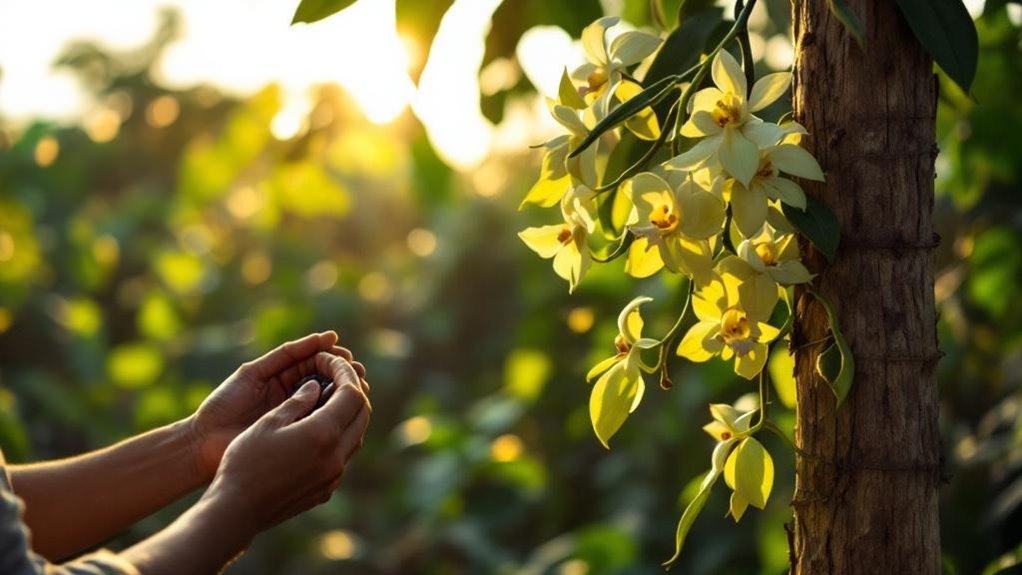
Today’s vanilla farming rests on two exacting stages, cultivation and curing, and both explain why this cultivated orchid remains costly despite its global reach; growers concentrate production in tropical regions such as Madagascar and Indonesia, where heat, humidity, and seasonal rainfall suit Vanilla planifolia, yet they still can’t rely on natural pollination outside Mexico, so workers must hand-pollinate each flower, then wait roughly eight to nine months for the pods to mature on the vine.
Vanilla stays expensive because every flower is hand-pollinated, then the pods need eight to nine months to mature.
- You cultivate vines under dense, damp canopies.
- You watch pale flowers open briefly.
- You harvest green pods before flavor forms.
- You cure them through drying and fermenting.
Only after months of careful handling do aroma and depth emerge; without that measured, observational process, pods remain stagnant, leathery, and commercially worthless.
Why Does the Aztec Vanilla Legend Still Matter?
Why, then, does the Aztec vanilla legend still matter, if vanilla now circulates globally as a cultivated commodity and a familiar flavor; it matters because the story of Princess Morning Star and Young Deer preserves a Mesoamerican way of understanding vanilla not as a stagnant product, but as a sacred gift shaped by love, sacrifice, and transformation.
| Element | Meaning |
|---|---|
| Lovers | devotion |
| Vanilla | divine gift |
| Bee | ecological bond |
You see vanilla differently when you recognize its cultural significance; the legend links ritual, cultivation, and observational respect for nature, reminding you that flavor once carried offerings, blessings, and ecological knowledge. It also explains why vanilla exceeds commerce alone, because its meaning rests in relationship, memory, and transformation. Through that lens, you inherit history rather than consume mere taste.
How Does the Vanilla Legend Live On in Mexico?
That enduring meaning remains visible across Mexico, where the vanilla legend lives on not as a stagnant tale from the past, but as a cultivated part of cultural memory, public ritual, and everyday practice; in places such as Papantla, festivals honor the history of vanilla cultivation and acknowledge the Totonac and Aztec traditions that treated the orchid as sacred, while artisan works fashioned from vanilla orchid leaves preserve its symbolic presence in material form.
You encounter that continuity through:
- Papantla festivals recalling Xanat and Tzarahuin.
- Leaf sculptures carrying the orchid’s sacred image.
- Vanilla dishes linking kitchens to older ritual memory.
- School programs teaching its observational cultural history.
Through these forms, you see vanilla remain a living emblem of love, sacrifice, and heritage across communities today still.
Frequently Asked Questions
How Old Is the Earliest Recorded Version of the Vanilla Legend?
You can date the earliest recorded version of the vanilla legend to the 16th century, so it’s roughly 500 years old. You’ll find later retellings expanded it, but that’s the earliest written record historians cite.
Are There Regional Variations of Xanath’s Story in Mexico?
Yes—you’ll find regional variations of Xanath’s story in Mexico. Like rivers shaping one mountain differently, each community retells her fate with local gods, landscapes, and morals, especially in Veracruz, Puebla, and Totonac traditions.
Which Vanilla Species Is Most Used in Modern Perfumery?
You’ll find Vanilla planifolia used most in modern perfumery because it delivers the classic rich, creamy, sweet profile perfumers want. You also encounter tahitensis and pompona, but they’re less common in mainstream fragrance formulas.
How Long Does a Vanilla Orchid Take to Produce Beans?
You’ll usually wait about three to four years for a vanilla orchid to flower and produce beans. After pollination, the pods need another eight to nine months to mature before you can harvest and cure them.
Can Vanilla Orchids Be Grown Successfully Outside Tropical Climates?
Yes, you can grow vanilla orchids outside tropical climates if you recreate warm, humid conditions indoors or in a greenhouse. You’ll need bright filtered light, consistent warmth, high humidity, and careful hand-pollination for beans.
Conclusion
When you trace the Aztec vanilla legend, you see more than an origin story; you encounter an observational record of love, labor, and loss, cultivated through ritual and preserved through farming. The orchid stands like a quiet thread between myth and practice, reminding you that beauty rarely survives in stagnant forms. In Mexico, the legend endures because people still grow, cure, and protect vanilla with methods that honor both the flower’s fragility and its history.