
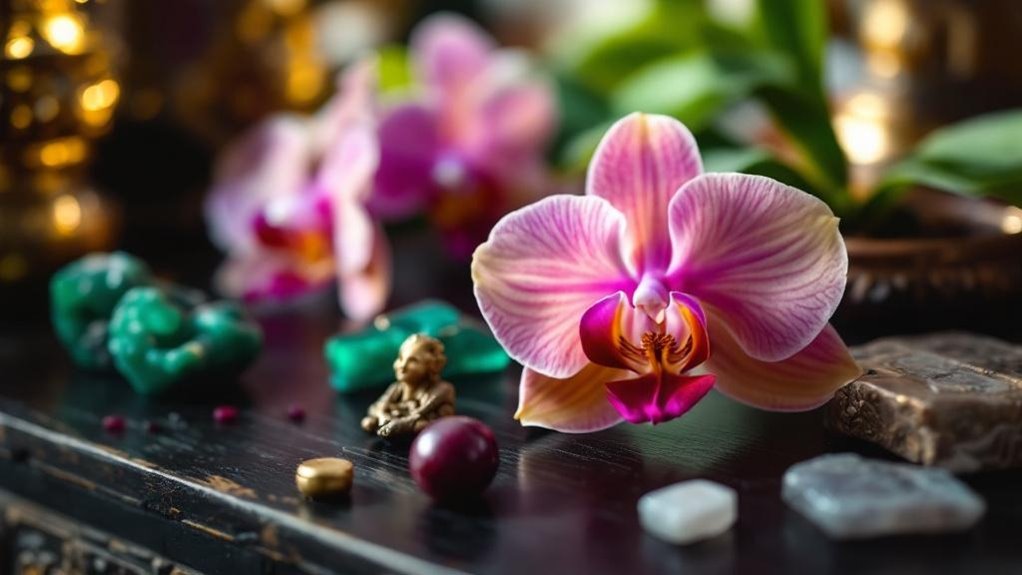
You can trace orchids through world mythology as cultivated signs of fertility, beauty, status, and sacred power; in Greece and Rome, their roots and medicinal lore tied them to virility, desire, and renewal, while Chinese and Japanese traditions linked them to virtue, admiration, and peace. In Aztec ritual, vanilla orchids carried divine and restorative force, and in Victorian culture, rare blooms resisted stagnant taste and signaled rank. The broader pattern becomes clearer just ahead.
- Key Takeaways
- Why Orchids Symbolize Love and Fertility
- Orchids in Ancient Greek Culture
- Was the Myth of Orchis Ancient?
- Orchids in Ancient Roman Art and Meaning
- Orchid Symbolism in Chinese Tradition
- Orchids in Japanese Culture
- Orchids in Aztec Belief and Ritual
- How Orchids Became Victorian Status Symbols
- How Orchid Symbolism Evolved Over Time
- Frequently Asked Questions
- Conclusion
Key Takeaways
- Orchids symbolize fertility, beauty, purity, love, and status across cultures, making them powerful mythic and social emblems.
- In ancient Greece, órkhis linked orchids to virility, reproduction, and herbal beliefs about influencing offspring’s sex.
- Chinese and Japanese traditions associate orchids with virtue, cultivated love, bravery, peace, and refined admiration.
- Aztec culture revered vanilla orchids as divine gifts tied to healing, sacred drinks, wealth, and prestige.
- Victorian Europe transformed orchids into symbols of romance, longing, rarity, and elite social competition.
Why Orchids Symbolize Love and Fertility

Desire, in many traditions, sits at the center of the orchid’s meaning, because the flower’s symbolism developed from both its physical form and the stories cultures cultivated around it; even its name points in that direction, since the Greek word *orchis*, meaning “testicle,” linked the plant to fertility through its bulbous roots, which ancient observers read as direct signs of reproductive power rather than as stagnant ornament.
You can see that association deepen across cultures: the vanilla orchid signified essentiality in sacred Aztec drinks. Chinese tradition treated the orchid as an emblem of beauty, virtue, and cultivated love, and later Victorian collectors turned rare blooms into markers of romance, wealth, and longing.
Together, these observational patterns explain why you still encounter orchids as flowers of love and fertility today.
Orchids in Ancient Greek Culture
When you look at orchids in ancient Greek culture, you find that even their name, from orchis, ties them to virility and fertility, while the myth of Orchis frames the flower through punishment, death, and renewal rather than any stagnant ideal of beauty.
You also see how cultivated aphrodisiac beliefs shaped everyday meaning, since Greek herbalists claimed that different tubers could influence the sex of offspring, linking the plant to desire, lineage, and an observational reading of nature.
As you move toward Greek botanical thought, Theophrastus gives orchids formal attention, recording their medicinal and erotic associations and confirming that their beauty carried a divine resonance within Greek understanding.
Orchis And Myth
Origins of the orchid’s Greek meaning lie in the myth of Orchis, a demi-god whose death and transformation into the flower followed his violation of sacred boundaries during a festival of Dionysus, a pattern that places the plant within a cultivated mythic tradition where beauty, fertility, and divine punishment remain tightly joined.
When you read this myth, you see how ancient Greeks used orchis to frame moral and natural meaning; the flower’s name comes from the Greek word for testes, an observational reference to its paired tubers, which linked it to virility and generative force.
You can place Orchis beside Hyacinthus and Pentheus, since each story warns against impiety before divine power. Theophrastus later recorded orchids as healing plants, confirming that their symbolic value never became stagnant within Greek thought.
Aphrodisiac Beliefs
Although Greek writers treated orchids as part of a broader medicinal tradition, they also regarded them as potent aphrodisiacs. That belief rested on an observational logic that tied the plant’s paired tubers to male anatomy, virility, and fertility; the very name órkhis, meaning “testicle,” shows how directly form shaped meaning in ancient Greek culture.
In ancient Greece, you encounter aphrodisiac beliefs that joined medicine, myth, and reproduction, never stagnant, always cultivated through practice and story:
- You read that certain orchids heightened virility and fertility.
- You find that eating large tubers supposedly encouraged male children, while smaller ones favored girls.
- You see Orchis’s blood transformed into flowers, reinforcing sexuality through myth.
Together, these ideas made orchids seem physically efficacious, symbolically charged, and socially persuasive in intimate life and household expectation.
Theophrastus And Naming
Classification gave the orchid a durable place in Greek thought, because Theophrastus, writing with the observational discipline that later earned him the title “Father of Botany,” named the plant órkhis, “testes,” after the paired, bulbous tubers that seemed to mirror male anatomy.
| Figure | Name | Meaning |
|---|---|---|
| Theophrastus | orchis | tubers |
| Herbalists | satyrion | fertility |
You can see how classification prevented meaning from becoming stagnant; once Theophrastus fixed orchis in language, cultivated herbal traditions connected the flower to virility, fertility, and satyrs. You also encounter the myth of Orchis, whose punishment and transformation show how Greek botany and myth developed together, while recognized species and durable naming carried the orchid into later symbolism and systematic study.
Was the Myth of Orchis Ancient?
If you look for Orchis in authentic Greek and Roman literature, you won’t find an ancient myth of a youth transformed into the orchid; that familiar story appears to be a later cultivated invention, not a preserved classical tradition.
- You can trace the named figure Orchis to Louis Liger’s 1704 gardening book, where shifting parentage and death accounts first appear, which makes the tale observational rather than Ancient Greek.
- You should separate the flower’s real antiquity from the story’s stagnant pedigree; Greek *orchis*, meaning testicle, described the bulbous form noted by Theophrastus.
- You may notice borrowed motifs, since punished transgression recalls Pentheus, while floral transformation echoes Hyacinthus; meanwhile, Greeks linked orchids with satyrs, virility, and fertility, without preserving this specific legend in surviving classical texts at all.
Orchids in Ancient Roman Art and Meaning

Across Roman visual culture, orchids appear less as isolated botanical studies than as cultivated signs of abundance, renewal, and auspicious order; in architectural carving, painted walls, and mosaic fields, they joined the broader floral repertory that framed civic peace and private prosperity. Their presence in ornamental programs such as those associated with the Ara Pacis shows how Roman artists used plant imagery to make political and domestic ideals visible at once.
When you read ancient Roman frescoes, mosaics, and garden remains observationally, you see the orchid flower valued for exotic beauty, elite display, and cultivated prosperity. Poetry and medical lore also connect orchids with fertility, love, and aphrodisiac force, so their meaning never remained stagnant. Their later Renaissance return confirms how strongly Roman associations shaped Western artistic memory.
Orchid Symbolism in Chinese Tradition
Where Roman art often presented orchids within broader ornamental systems of abundance and cultivated order, Chinese tradition gave the flower a more explicitly ethical and literary force, treating it as an image of beauty, refinement, and virtuousness that could express both personal character and social ideals.
You can see this symbolism in several cultivated forms:
- Confucius compared good company to a room of orchids, so orchid plants suggest noble character and observational moral influence.
- As spring harbingers, they mark renewal, life returning after stagnant winter, and a disciplined joy.
- In poetry and gift exchange, they signify integrity, good fortune, and relational harmony.
Whether you consider a vanilla orchid or wild orchid plants, Chinese tradition asks you to read them ethically, as signs of beauty joined to conduct and prosperity.
Orchids in Japanese Culture
In Japan, orchids carry a cultivated prestige that joins aesthetic refinement to social meaning, and several varieties came to signify respect, admiration, nobility, and the quiet order of disciplined taste. By the 17th century, you see orchid plant cultivation treated as a noble art, prized by educated elites; unlike the Victorian era, this regard remained observational, not stagnant.
| Variety | Meaning | Context |
|---|---|---|
| Dendrobium | Respect | Art |
| Dendrobium | Admiration | Society |
| Dendrobium | Nobility | Elite taste |
| Neofinetia falcata | Bravery | Samurai |
| Wind orchid | Peace | Gifts |
You encounter orchids in poetry, where they suggest purity and nature’s beauty, and in business custom, where gifts convey good fortune and peace, reinforcing cultivated relationships with quiet authority.
Orchids in Aztec Belief and Ritual

Aztec attitudes toward orchids framed them less as cultivated emblems of taste, as in Japan, than as divine gifts woven into ritual, medicine, and exchange; you see this most clearly in the esteem granted to the vanilla orchid, *Vanilla planifolia*, whose pods entered a sacred drink mixed with chili and chocolate, a preparation associated with strength and vigor and consequently with the sustaining powers the gods were thought to confer.
- You find orchids in offerings, where Aztecs revered them as links to gods.
- You note medicinal uses; healers applied orchid parts to restore wellness, avoiding stagnant imbalance.
- You see commerce too, because these blooms signaled wealth, prestige, and observational knowledge of valued resources.
Through these roles, vanilla and other orchids shaped daily life, joining beauty, utility, and sacred order.
How Orchids Became Victorian Status Symbols
By the nineteenth century, orchids had become cultivated markers of rank in Victorian society, because their exotic beauty, scarcity, and difficulty of transport turned them into living proofs of wealth, observational reach, and refined taste. As new species entered Europe through collecting expeditions and commercial networks, elite households competed to possess what few others could secure.
Figures such as Frederick Sander, the so-called “Orchid King,” helped formalize that desire by building vast collections that made rarity itself a social language.
If you displayed orchids, you signaled means, access, and discipline; some specimens arrived torn apart by wild journeys, yet survival increased prestige. You inherited even stagnant legends, including claims that orchids favored noble blood alone, and you recognized their value as gifts of admiration.
Even the oldest known collections affirmed exclusivity.
How Orchid Symbolism Evolved Over Time
Although orchid meanings changed with each culture that cultivated and observed them, the pattern remains consistent: people read into the flower what they most valued in human life, from fertility and liveliness to virtue, status, and disciplined admiration.
Across cultures, orchids mirror human ideals, carrying meanings shaped by fertility, virtue, status, and admired restraint.
- In Greece, you see the Greek word órkhis, linked to bulbous tubers, shaping an observational symbolism of fertility and virility.
- Among the Aztecs, orchid vanilla became a divine gift, blended with cacao in sacred drinks, so you connect orchids with strength, energy, and cultivated power.
- In China, Japan, and later Victorian Europe, you watch meanings shift toward virtue, respect, bravery, peace, luxury, and exclusivity; the flower never becomes stagnant, because each society recasts it through its own ideals, seasons, and social order.
Frequently Asked Questions
What Does the Bible Say About Orchids?
The Bible doesn’t mention orchids specifically. You can connect them to biblical flower imagery, like lilies in Matthew 6:28–30, where God highlights creation’s beauty and care. Orchids, then, can remind you of God’s artistry.
Who Is the God of Orchids?
Over 25,000 orchid species exist, yet you won’t find one universal god of orchids. Instead, you’ll see cultures tie orchids to fertility, beauty, and luxury; Greeks linked them to Orchis, while Aztecs revered vanilla orchids.
What Do Orchids Symbolize in Culture?
You see orchids symbolize fertility, beauty, virtue, strength, respect, bravery, peace, luxury, and status across cultures. They can also suggest refinement, integrity, good fortune, energy, and admiration, depending on the tradition you’re considering worldwide.
What Does Baking Soda Do for Orchids?
With a gentle assist, baking soda helps your orchids balance potting-medium pH, absorb nutrients, resist fungal issues, and discourage pests. You may even see brighter blooms, but don’t overdo it, or you’ll upset soil health.
Conclusion
Across these traditions, you can see orchids carrying a consistent charge of desire, fertility, rank, and cultivated refinement, even as each culture gave the flower a distinct observational meaning shaped by ritual, art, and social order. If you imagine a mourner placing a single orchid on a grave, the gesture still works because the symbol never became stagnant; it adapted, and in that adaptation you recognize how myth preserves human longing while changing its language.