
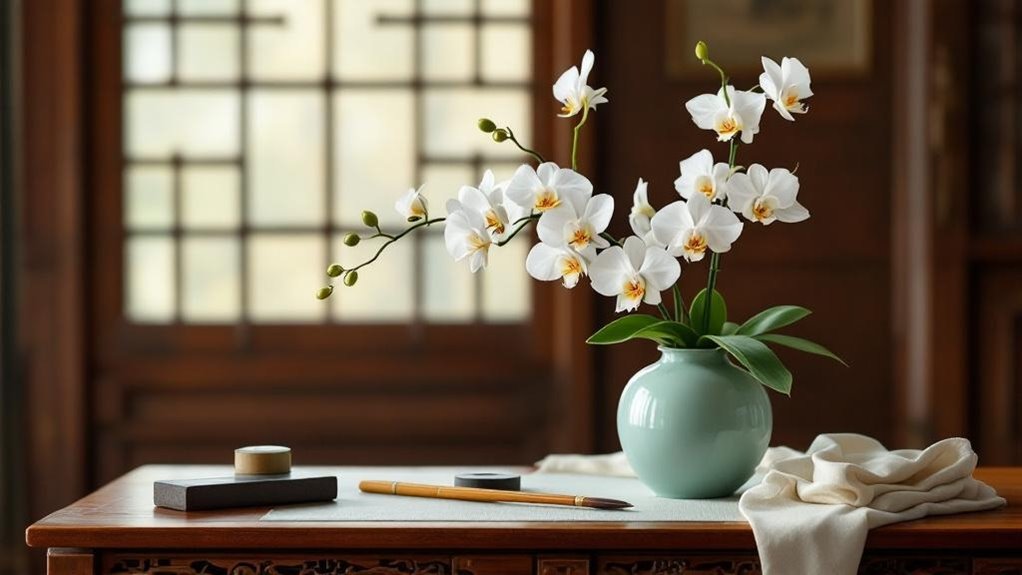
To Chinese scholars, orchids meant the cultivated ideal you were meant to emulate: integrity without display, humility without weakness, and influence that moved outward like fragrance in solitude, subtle yet lasting. You can see why Confucian writers linked the orchid to the junzi, since its restrained growth, spare form, and secluded habitat answered stagnant ambition with inward steadiness and refined judgment. In paintings, poems, and homes, it became a quiet test of character, with more to notice.
- Key Takeaways
- Why Orchids Mattered to Chinese Scholars
- How Orchids Symbolized the Gentleman
- What Confucius Saw in Orchids
- Why Orchid Fragrance Signaled Virtue
- Why Orchids Belong to the Four Gentlemen
- How Scholars Used Orchids in Poetry
- How Scholars Painted Orchids
- Why Scholars Grew Orchids at Home
- How Orchids Expressed Scholarly Taste
- How Orchid Meaning Lives on Today
- Frequently Asked Questions
- Conclusion
Key Takeaways
- Orchids symbolized the junzi, expressing integrity, humility, refinement, and self-restraint through quiet beauty rather than display.
- Their hidden fragrance represented virtue influencing others without seeking recognition, a key Confucian ideal admired by scholars.
- Scholars used orchid paintings, poems, and calligraphy to declare ethical commitments, cultivated taste, and political steadfastness.
- Solitary orchids in secluded valleys signified moral endurance, especially in exile, neglect, or corrupt political conditions.
- Caring for orchids in study rooms became a daily practice of disciplined attention, self-cultivation, and refined scholarly identity.
Why Orchids Mattered to Chinese Scholars
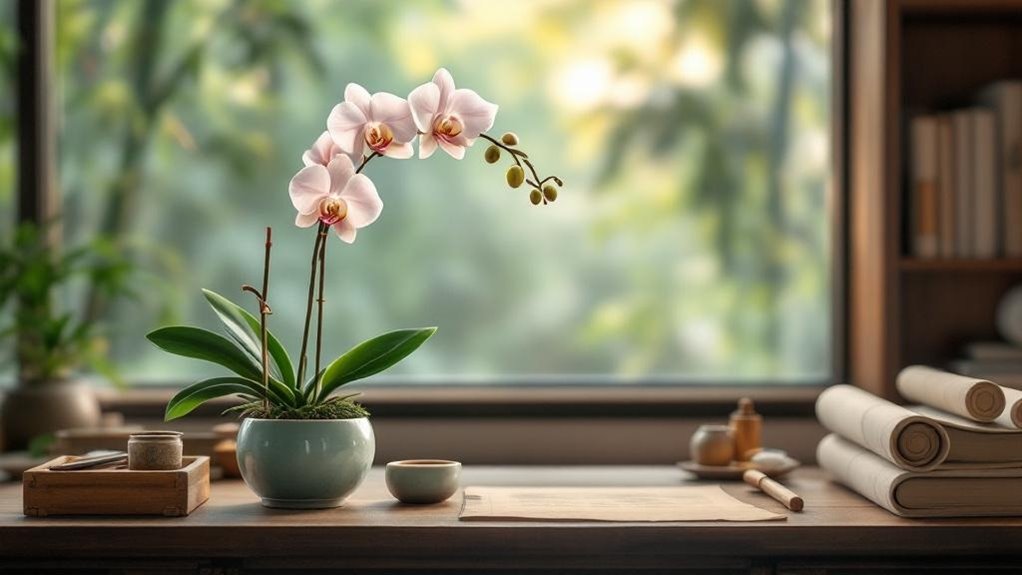
Because Chinese scholars treated moral self-cultivation as inseparable from aesthetic judgment, orchids came to matter not merely as attractive plants but as cultivated signs of integrity, humility, and refined character; for the literati, the orchid embodied the ideal junzi long praised in the Confucian tradition, and its quiet presence in paintings, poems, and study rooms allowed scholars to declare ethical commitments without resorting to display.
When you place orchids among the Four Gentlemen, you see why they mattered so deeply: they joined spring’s renewal to scholarly discipline, and their subtle fragrance, which spreads without forcing itself, offered an observational model of virtue that avoids stagnant self-assertion.
You also find orchids shaping cultivated practice, since studying their leaves, scent, and growth habits trained perception while linking poetry, painting, tea, and social identity for literati communities.
Orchids also became a cherished scholarly flower because Confucius and later writers associated their fragrance with the noble person, reinforcing the idea that beauty should express moral steadiness rather than ornament alone.
How Orchids Symbolized the Gentleman
Restraint gives the orchid its force as a symbol of the gentleman, for Chinese scholars saw in lánhuā an image of virtue that doesn’t advertise itself: it grows without ostentation, releases a fragrance that remains delicate rather than dominant, and thus models the junzi, whose integrity holds steady whether the world notices him or not.
You recognize that symbolism in four cultivated traits:
- Humility within the Four Noble tradition.
- Integrity without pursuit of fame.
- Refinement expressed through observational discipline.
- Self-restraint that keeps character from turning stagnant.
When you study an Orchid in a quiet room, noting posture, leaf gloss, and scent, you rehearse the scholar’s ideal; painters and poets did likewise, using orchid imagery to declare taste, grief, or political steadfastness, and to show how a gentleman remains inwardly ordered under pressure. Confucius linked the orchid’s quiet fragrance to virtue that influences others without seeking attention.
What Confucius Saw in Orchids
When you consider what Confucius saw in orchids, you notice first their fragrance in solitude, a quiet presence that fills the air without asking for witness or praise.
You can then understand why he treated the orchid as a figure for virtue without recognition; like a cultivated person of integrity, it keeps its character intact in secluded places and never turns stagnant through neglect or obscurity.
In that observational frame, you see the humble gentleman ideal take shape, because the orchid’s restrained growth and inward excellence reflect the moral standard Confucius asked you to admire.
Later writers would develop this into the tradition of the Four Gentlemen, where the orchid stood beside plum blossom, bamboo, and chrysanthemum as a sign of integrity, humility, nobility, and self-restraint.
Fragrance In Solitude
Although the orchid often grows beyond notice in a secluded valley, Confucius saw in its unflaunted fragrance a precise image of the junzi, whose moral worth doesn’t depend on recognition yet remains perceptible to any cultivated mind.
For you, that scent clarifies why scholars esteemed orchids:
- fragrance suggests inner refinement, never stagnant display.
- solitude proves noble character can endure apart from approval.
- dawn and dusk rituals train observational attention, letting you meet scent with mindfulness.
- poets such as Qu Yuan and Su Shi turn aroma into fidelity, linking place, principle, and memory.
Repeated visual return to balanced design can also train attention and reinforce steadiness, which is why the orchid’s quiet symmetry suits contemplative study.
You see, then, why Chinese scholars preferred the orchid’s lingering presence to brighter blooms; its aroma remains delicate yet steadfast, and in cultivated solitude it models humility, constancy, and an inward discipline that quietly shapes the mind.
Virtue Without Recognition
Because Confucius praised the orchid for giving its fragrance even where no admirer stands, he made it a durable image of virtue without recognition, and Chinese scholars took that lesson seriously, seeing in the flower a model of the junzi whose worth doesn’t depend on applause, office, or public reward.
You see why literati painted orchids in secluded valleys or with exposed roots; they used observational detail to show how cultivated character endures exile, avoids stagnant ambition, and keeps quiet integrity when politics turns hostile. In this emblem, humility isn’t self-erasure but steadiness, a refusal to trade inner refinement for display.
Song scholars and their successors repeated the orchid across poetry, painting, and Confucian writing because it taught you that influence should move outward through character, subtly, lastingly, even when recognition never comes.
In later East Asian gift and display traditions, orchids also carried good fortune and disciplined refinement, reinforcing the idea that cultivated worth should bless others quietly rather than seek applause.
Humble Gentleman Ideal
That ideal of unrecognized virtue leads directly to what Confucius saw in the orchid: not merely a good person under neglect, but the humble gentleman, or junzi, whose cultivated character remains measured, modest, and complete without any need for display.
- You see the orchid thrive in shade, and its humility becomes observational proof of restraint.
- You notice its fragrance continues without witnesses; virtue doesn’t become stagnant when praise is absent.
- You understand why scholars ranked it among the Four Gentlemen: the gentleman values inner refinement above wealth or fame.
- You read solitary orchids, sometimes with exposed roots, as images of integrity; they preserve principle, even amid loss.
For Confucius, the orchid shaped others ethically, through quiet presence, and that influence remained complete, disciplined, and modest.
Why Orchid Fragrance Signaled Virtue
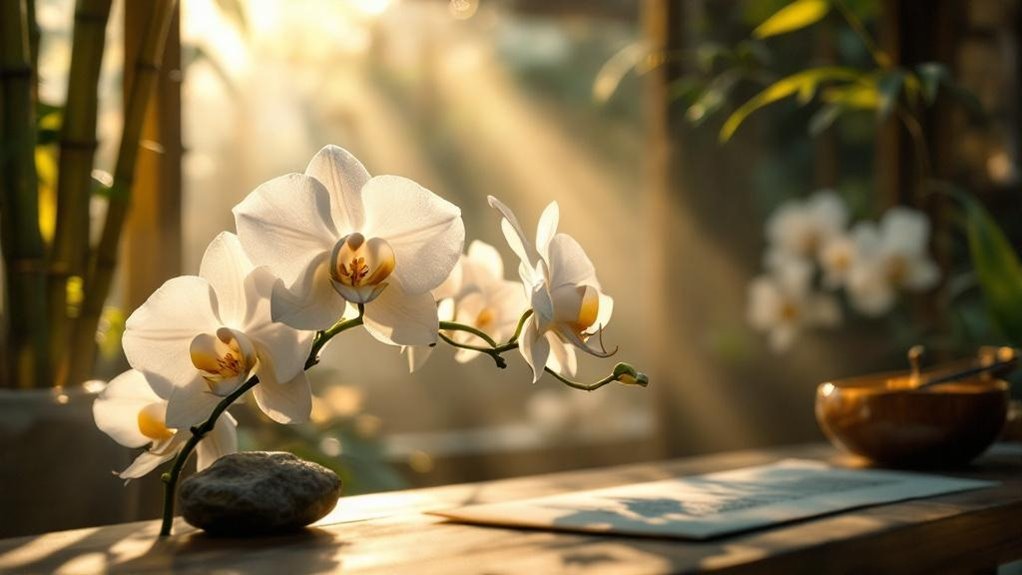
Consider how Chinese scholars treated orchid fragrance not as a decorative trait but as an ethical sign, one that made virtue legible through restraint rather than display; Confucius gave the classic formulation when he praised the orchid that grows in the forest and still releases its scent even when no one is present to admire it, and in doing so he fixed the flower as a model of moral character that doesn’t depend on recognition.
You see true virtue in that unseen perfume, because it persists without audience, and you learn quiet integrity from its subtle endurance. Its cultivated, observational scent suited a scholarly temperament, never stagnant or loud, and painters who showed exposed roots or lonely ground made the same claim: in hardship or exile, moral refinement remains. To notice orchid fragrance, you must attend closely, patiently, and with self-discipline.
Why Orchids Belong to the Four Gentlemen
You can see why the orchid belongs among the Four Gentlemen when you consider how its restrained beauty, unobtrusive fragrance, and solitary habit align with cultivated virtue rather than stagnant display.
In Chinese art and literati thought, it embodies integrity, humility, and refined taste; for that reason, scholars treated it as a visible analogue for the junzi, whose moral worth remains intact whether others notice it or not.
When you place the orchid beside plum, bamboo, and chrysanthemum, you recognize not just a seasonal motif but an observational code of scholar ideals, one that joins natural form to self-cultivation and moral steadfastness.
Virtues Of The Orchid
Integrity, more than display, explains why the orchid belongs among the Four Gentlemen: Chinese scholars saw in its quiet bloom and restrained fragrance an image of cultivated virtue, a moral presence that doesn’t need applause to prove itself.
You can see its virtues clearly:
- Integrity appears in fragrance that persists without witnesses, echoing Confucius.
- Humility lives in secluded valleys, where beauty avoids stagnant display.
- Self-restraint shows in spare leaves and exposed roots, an observational emblem of purity.
- Refinement marks the orchid as one of the Four Gentlemen, signaling cultivated taste.
When you read literati poetry or view ink paintings, the orchid doesn’t announce status; it presents moral steadiness, resilience under hardship, and inner nobility, qualities scholars admired because they remained visible even when public recognition disappeared completely.
Scholar Ideals Embodied
That moral steadiness explains why the orchid entered the company of the Four Gentlemen: scholars recognized in its modest habit, secluded growth, and refined scent a precise image of the junzi, the cultivated person whose worth doesn’t depend on notice or reward.
When you place the orchid beside plum, bamboo, and chrysanthemum, you see why scholars treated it as more than a flower; its quiet endurance, delicate form, and lasting fragrance make integrity visible. Confucius’s observational praise established the pattern: the orchid releases perfume even unseen, so you understand virtue as something practiced without audience.
In painting and calligraphy, exposed roots and spare brushwork convey humility, noble spirit, and sorrow at stagnant politics, while the plant’s valley habitat confirms a cultivated refusal of corrupt ambition and empty display.
How Scholars Used Orchids in Poetry
Restraint shaped how Chinese scholars used orchids in poetry, because the flower offered a cultivated image of the junzi, whose virtue remained steady, observational, and unadvertised; drawing on sayings associated with Confucius and later classical lines about the orchid that perfumes an empty forest, poets praised a character that doesn’t depend on recognition, and they used its quiet fragrance to suggest moral conduct that persists even in neglected or stagnant times.
- You see Orchids mark scholars’ virtue.
- Qu Yuan used them to lament exile.
- Later poetry linked seclusion with integrity.
- Literati used them for modest resilience.
When you read these poems, you find a disciplined emblem: secluded growth, delicate scent, and endurance under decline; each image lets you measure character without display, and judge society by what it neglects.
How Scholars Painted Orchids
Turning from verse to image, Chinese scholars painted orchids as one of the “Four Gentlemen,” and they did so with deliberately spare brushwork, because the plant’s narrow leaves, restrained posture, and quiet presence let them present humility, integrity, and cultivated taste without spectacle; in these paintings, botanical precision mattered less than the disciplined movement of the brush, the balance of empty space, and the observational force of a few ink lines, which together suggested inner character rather than outward display.
You can see this clearly in Zhao Mengjian’s Southern Song Spring Orchid Scroll, where exposed roots imply loyalty and melancholy; rendered in monochrome ink, such works often joined calligraphy and poetry, so you encountered not a stagnant specimen but a moral image, composed for contemplation, ethical self-cultivation, and literati judgment.
Why Scholars Grew Orchids at Home
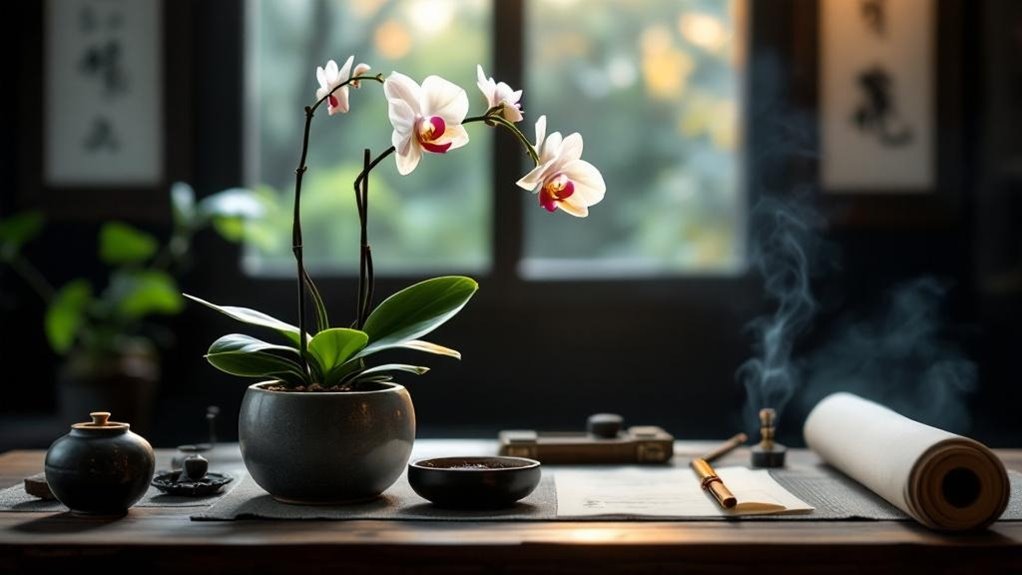
Because the orchid condensed so many literati values into a living form, Chinese scholars kept it in their homes for more than two millennia as a daily companion to the junzi ideal, finding in its modest bearing, evergreen leaves, and cultivated fragrance an observational model of integrity, humility, and refined taste that could inhabit the study without becoming stagnant ornament.
- You encountered integrity in daily care and restraint.
- Its humble fragrance suggested influence without display.
- Its shade-loving endurance suited secluded scholarly routines.
- Its presence joined poetry, painting, and literati cultivation.
Chinese scholars set orchids in plain ceramic or wooden pots, often with rocks and moss, so you could contemplate naturalness in miniature; by tending long-flowering, evergreen varieties, you practiced disciplined attention, moral self-alignment, and quiet endurance in solitude.
How Orchids Expressed Scholarly Taste
Keeping orchids at home did more than support moral self-cultivation; it also let scholars display a cultivated standard of taste, one grounded not in luxury or spectacle but in disciplined perception, learned allusion, and the ability to value what remained quiet, secluded, and easily missed.
When you judged leaf gloss, petal arrangement, posture, and scent at dawn or dusk, you practiced observational restraint, and that practice marked refined taste. By placing orchids among the Four Gentlemen, you aligned them with literati symbolism, not stagnant decoration; their modest fragrance and hidden growth signaled humility and integrity.
In paintings and calligraphy, simple strokes, bare roots, and sparse soil showed that you could register loss, exile, and moral steadfastness through understatement. In study rooms, tea gatherings, letters, and poems, orchids announced cultivated membership in a discerning scholarly world.
How Orchid Meaning Lives on Today
Today, orchid meaning still lives within Chinese cultural life, not as a stagnant survival of the past but as an active sign of integrity, humility, and cultivated taste, visible in study rooms and tea spaces where the plant continues to anchor habits of observational attention and restrained display.
In Chinese life today, orchids still embody integrity, humility, and cultivated taste through quiet, attentive presence.
You can see that continuity in four ways:
- In homes, orchids still signal refined taste and moral steadiness.
- In orchid art, painters, calligraphers, and stamp designers renew literati ideals.
- In museums and digital galleries, displays teach how scholars since ancient times observed blooms.
- In societies and journals, you record fragrance and flowering, repeating classical practice.
You also encounter orchids at weddings and cultural events, while medicine and horticulture preserve their associations with elegance, longevity, and living heritage.
Frequently Asked Questions
What Does an Orchid Symbolize in Chinese Culture?
In Chinese culture, you’d see an orchid symbolize integrity, nobility, humility, and self-restraint. It also represents refined character, modesty, resilience, and quiet inner virtue—showing that you can remain excellent and principled without seeking attention.
What Did Confucius Say About Orchids?
Confucius gently praised orchids, saying they bloom in the forest and still share their fragrance unseen. You can read this as his lesson: true virtue doesn’t chase applause; it stays humble, refined, and steady regardless.
Is It True That in China 520 Roses Mean I Love You?
Yes—you can say 520 roses mean “I love you” in China, especially online and in gift culture. You’ll see florists market 520 bouquets for May 20, though older people might not recognize the numeric pun.
Why Do Asians Love Orchids?
You love orchids because they symbolize virtue, refinement, and inner beauty across Asia. You admire their delicate form, subtle fragrance, and resilience, and you value how they express taste, purity, patience, and emotional depth.
Conclusion
When you consider what orchids meant to Chinese scholars, you see more than a flower; you see a cultivated ideal of character, restraint, and discernment, tested in solitude and preserved in art. Their quiet fragrance suggested virtue that didn’t advertise itself, and their spare form resisted anything stagnant or excessive. What better emblem could a scholar choose, if he wished to make his inner life observational, disciplined, and legible through the natural world?