
Yes, you can understand orchids in much of Asia as symbols of wisdom, because they signify cultivated character, quiet discernment, and moral refinement rather than raw intellect; in Chinese and broader East Asian traditions, especially around cymbidium and Phalaenopsis, they mark scholarly virtue, inward balance, and observational clarity. In Japan, they also carry aristocratic and contemplative meanings tied to disciplined taste and transience. Their use in gifts, temples, and studios shows how that symbolism extends much further.
- Key Takeaways
- Are Orchids Symbols of Wisdom in Asia?
- Why Orchids Symbolize Wisdom in Asia
- Orchid Meaning in Chinese Tradition
- Orchids and the Four Gentlemen
- What Do Orchids Symbolize in Japan?
- Orchid Symbolism in Buddhism
- Orchids in Feng Shui
- Do Orchid Colors Change Their Meaning?
- White Orchid Meaning in Asia
- Pink Orchid Meaning in Asia
- Purple Orchid Meaning in Asia
- Orchids as Symbols of Refinement
- Orchids, Scholars, and Noble Character
- Are Orchids Good Gifts in Asia?
- When to Give Orchids in Asian Traditions
- Symbolic Orchid Varieties in Asia
- How Caring for Orchids Adds Meaning
- Frequently Asked Questions
- Conclusion
Key Takeaways
- Yes—across Asia, orchids often symbolize wisdom as cultivated character, ethical refinement, and inward balance rather than raw intellectual ability.
- In Chinese Confucian and literati traditions, orchids represent noble character, moral clarity, humility, and the quiet presence of a true scholar.
- Cymbidium especially became a scholarly emblem in paintings, studios, and gardens, where its subtle fragrance suggested inner worth and disciplined judgment.
- Buddhist and Taoist readings link orchids to mindfulness, purity, discernment, transience, and spiritual clarity, expanding their association with wisdom.
- In Japan, Korea, and Southeast Asia, orchids also signify refined taste, self-mastery, respect, and harmonious relationships, reinforcing wise and cultivated living.
Are Orchids Symbols of Wisdom in Asia?
Yes; across much of Asia, orchids have long functioned as symbols of wisdom, though the meaning tends to center on cultivated character, ethical refinement, and inward balance rather than mere intellect.
You see this clearly in Chinese tradition, where the Orchid, especially Cymbidium, stands among the Four Gentlemen, representing scholarly virtue, humility, and moral integrity within an observational, cultivated ideal. Confucian scholars praised its restrained fragrance and composed form as signs of wholesome character rather than stagnant display.
In Japan, you find orchids linked to aristocratic and samurai taste, where contemplative refinement mattered more than cleverness.
Across parts of Southeast Asia, temple and meditation settings use Phalaenopsis and Dendrobium to suggest mindfulness, spiritual insight, and balance. In art and literature, you repeatedly encounter orchids as emblems of ethical purity.
Confucian thought also helped make the orchid a model of quiet moral presence, where fragrance and restraint signaled virtue without self-advertisement.
Why Orchids Symbolize Wisdom in Asia
You can see why orchids came to signify wisdom in Asia when you consider how Chinese scholars, guided by Confucian ideals, treated them as emblems of cultivated virtue and refinement, and how Japanese court culture linked them with disciplined taste and observational sensitivity.
You also find in the orchid an image of inner peace and insight, because it suggests hidden integrity, modest beauty, and a mind that remains clear rather than stagnant, even in seclusion.
When you view orchids through art, poetry, and calligraphic training, you recognize how they also point to harmony in relationships; they teach moral discernment, balanced conduct, and the quiet elegance expected of a learned person.
In China, orchids are also counted among the Four Gentlemen, a classical group of plants that express refined character, resilience, and scholarly virtue.
Scholarly Virtue And Refinement
Because East Asian scholarly culture tied learning to character as much as to knowledge, orchids came to represent wisdom not merely as intellect, but as a cultivated moral state; in China, especially since Confucian times, the cymbidium’s restrained fragrance and elegant, unforced form made it an observational model of scholarly virtue, praised by literati and later absorbed into the visual language of the “Four Gentlemen,” where it signaled integrity, humility, and refined taste.
When you trace how orchids symbolize learning, you see scholar-officials placing them in studios and on seals, fans, and stationery, marking educated identity without stagnant display; in Japan and Joseon Korea, cultivated elites likewise treated orchid imagery as evidence of disciplined judgment, righteous conduct, and refinement that scholarship should visibly sustain in public life.
Zhao Mengjian’s Spring Orchid Scroll helped establish the orchid as a lasting literati model, uniting spare brushwork, quiet space, and moral intention into a visual language of disciplined inward life.
Inner Peace And Insight
Although orchids often appear modest beside brighter flowers, in much of Asia that very restraint explains their link to inner peace and insight; the cymbidium’s balanced form, muted palette, and quiet fragrance invite observational attention rather than sensory excess, so painters, poets, and monks treated it as a natural image of the mind at rest, cultivated yet unforced.
You see this inward lesson in:
- shaded, persistent blooms resisting stagnant display
- Taoist praise for solitary growth and discernment
- Buddhist readings of transience, mindfulness, non-attachment
- Japanese poetry linking elegance with contemplative insight
- Chinese literati painting orchids as disciplined calm
Across these traditions, orchids symbolize wisdom because they direct you inward, away from excess and toward balance; their symmetry steadies attention, their fragrance rewards patience, and their quiet endurance suggests insight that deepens without spectacle or noise. In Japan, the tatefuda presentation tradition also reinforces this reverent, thoughtful way of gifting orchids.
Harmony In Relationships
Where inner peace turns outward into conduct, the orchid becomes a sign of relational wisdom, not merely private insight; in Chinese thought, especially around cymbidium and phalaenopsis, it came to represent refined virtue and harmonious bonds, and Confucian praise for the flower as an emblem of noble friendship and moral integrity gave that meaning unusual durability.
In Thailand, orchids also carry respect and esteem, making them fitting gifts for teachers, elders, and ceremonial occasions where thoughtful regard matters most. In Japan, you see similar logic: orchids symbolize elegance, respectful bearing, and wa, so offering them once helped secure alliances among nobles and samurai. In Feng Shui, when you place orchids in shared rooms, you invite clearer communication and prevent stagnant feeling between partners. Chinese and Korean art links orchids with bamboo and plum, suggesting cultivated empathy; in Buddhist settings, their presence supports mindfulness and restrained affection, which sustain balanced, lasting relationships over time.
Orchid Meaning in Chinese Tradition
In Chinese tradition, orchids carry a meaning that reaches well beyond ornament, for they’ve long signaled refinement, moral integrity, and the cultivated wisdom associated with scholarly life; classical varieties such as Cymbidium and Phalaenopsis appear in this symbolic field as emblems of inner worth, not display, and that distinction matters in a culture that has often valued observational restraint over stagnant vanity.
You see this orchid meaning in:
- Confucian gentlemanly character
- Qu Yuan’s poetry
- literati painting
- scholarly gifts
- seals and studios
When you encounter orchid imagery, you’re meant to read modesty, purity, and disciplined learning; scholars praised the flower because it suggested inner beauty governed by ethics.
If you give orchids, you convey respect for achievement and moral wisdom, not ornamental taste alone.
Orchids and the Four Gentlemen
Seen through the tradition of the Four Gentlemen, the orchid takes on a precise moral role, standing beside plum blossom, bamboo, and chrysanthemum as the flower that marks refined character, scholarly integrity, and the cultivated restraint of the Confucian gentleman; Song and Ming poets and painters used it this way because its elegant form and subtle fragrance suggested worth that doesn’t depend on display, but instead reveals an inner clarity that remains steady even when outward conditions turn stagnant.
When you read literati painting this way, you see how orchids Teach Us to value observational discipline, modest conduct, and moral steadiness; painters used spare brushwork and minimal composition to make refinement visible without ornament, and later Korean and Japanese scholars adopted the same emblem, preserving the orchid as a sign of cultivated taste, ethical self-command, and inward purity.
What Do Orchids Symbolize in Japan?
In Japan, you can read the orchid as a cultivated sign of samurai courage and noble character, because floral motifs and literary references tie its poised form to discipline, bravery, and an observational respect for restraint. You also see in it an elegant transience, since its refined beauty suited elite taste and echoed mono no aware, where beauty matters precisely because it doesn’t remain fixed or stagnant. As orchids moved through ikebana, decorative arts, and aristocratic collecting, you can recognize how they came to signify luxury, social prestige, and a quiet awareness of season and form.
Samurai Courage
Discipline helps explain why orchids carried meaning in Japan beyond simple ornament, because the flower’s poised symmetry, cultivated rarity, and restrained beauty matched ideals the samurai admired in themselves; although orchids were historically prized by nobles as markers of luxury, elegance, and refined taste, warriors also valued them as a quiet emblem of courage, moral refinement, and inner steadiness.
You can see that prestige in several linked qualities:
- rarity suggested distinction
- balance reflected discipline
- refinement signaled honor
- cultivation implied self-mastery
- beauty resisted stagnant excess
In this observational symbolism, samurai valued orchids for their association with bravery and moral refinement, and you can read the flower as a disciplined mirror of warrior character, respected, cultivated, and quietly authoritative within Japanese cultural memory.
Elegant Transience
Because Japanese aesthetics often value what doesn’t last, orchids came to signify elegant transience as much as luxury, their graceful form and brief seasonal flowering inviting an observational awareness of beauty at the moment it appears and before it fades.
When you consider Japan’s orchid symbolism, you see aristocrats and samurai valuing the flower for noble taste, yet also for mono no aware, which keeps beauty from becoming stagnant by tying it to impermanence.
In painting, poetry, ikebana, and restrained interiors, a White Orchid conveys cultivated elegance, subtlety, and respect, while its limited bloom reminds you that life’s finest moments don’t remain available for possession.
Even samurai associations with bravery and dignity deepen this meaning, because courage, like beauty, proves most refined when you hold it lightly, observe it carefully, and let it pass without resistance.
Orchid Symbolism in Buddhism
While orchids appear delicate, Buddhist symbolism reads them as disciplined emblems of mindfulness and non-attachment, reminding practitioners to notice beauty without trying to possess it, and to remain observational rather than stagnant in the present moment.
- orchids represent inner beauty
- impermanence in monastic gardens
- white blooms suggest purity
- resilience models perseverance
- paired plants mark virtue
When you encounter orchids in Buddhist settings, you see cultivated reminders of awakening; temple offerings of white orchids direct your attention toward purity and spiritual clarity, while their presence in monastic gardens asks you to contemplate life’s passing forms without clinging.
Their ability to thrive in elevated or difficult places strengthens the lesson, because perseverance, not ease, shapes the path. In East Asian art, orchids beside bamboo or plum signal moral refinement and disciplined character.
Orchids in Feng Shui
In feng shui, you’ll often place orchids where they can steady a room’s energy, because their cultivated beauty is associated with harmony, mental clarity, and an observational sense of order that supports study and creative work.
You’ll also find that placement matters; when you position healthy, blooming orchids in the east or southeast areas of your home, you align them with growth, family balance, and prosperity.
White and pink orchids strengthen this effect with a calmer emphasis on purity, gratitude, and relationship harmony, while careful upkeep prevents the stagnant energy that wilted plants are thought to invite.
Harmony And Energy
Few plants carry Feng Shui associations as gracefully as orchids, which are valued for cultivating harmony and steady energy in a room; when you place them in home offices or other creative areas, they’re believed to encourage inspiration, emotional balance, and a more observational state of mind, partly through their refined symmetry and partly through the sense of order a healthy plant brings to a space.
Their quiet elegance supports calm flow when you avoid stagnant clutter and keep conditions carefully cultivated:
- white blooms suggest serenity
- pink blooms foster loving harmony
- bright, indirect light sustains life force
- moderate humidity supports lasting flowers
- clean leaves strengthen balanced chi
When your orchid remains healthy for weeks or months, you reinforce stable energy; its symmetry, beauty, and attentive care shape a room’s atmosphere with measured, restorative influence.
Placement For Prosperity
Placement shapes how that balanced energy settles and circulates, and in Feng Shui, an orchid’s position can direct its cultivated beauty toward prosperity, relational ease, and steady growth; when you place a healthy, blooming orchid in the living room or family area, you’re thought to strengthen positive chi across shared spaces, which supports both material abundance and family harmony.
You can deepen that effect by setting orchids in the southeast, the traditional wealth sector, where they symbolize prosperity and encourage financial luck, observational focus, and career growth; in the bedroom, positioned away from direct view of the doorway, they’re believed to support fertility and relational steadiness. Keep only vigorous plants with multiple spikes, give them bright, indirect light and moderate humidity, and replace wilted blooms promptly, since stagnant chi weakens their intended influence.
Do Orchid Colors Change Their Meaning?
How, then, do orchid colors change their meaning; they do so through cultivated cultural associations, historical use, and spiritual interpretation, so the same flower can communicate purity in one setting, affection in another, or wisdom and status in a more ceremonial context. Across Asia, you read color as an observational signal shaped by local custom, never stagnant, because context directs interpretation.
- Pink suggests affection and gratitude.
- Purple orchids imply royalty and introspection.
- Yellow conveys joy, friendship, and modest luxury.
- Japan may stress elegance and transience.
- Ceremonial use can elevate status and wisdom.
When you give orchids, you consequently communicate more than beauty; you participate in regional symbolism, where social rank, spiritual depth, and relational intent become visible through color, timing, and cultivated tradition, with subtle local variation.
White Orchid Meaning in Asia
Among orchid colors in Asia, white carries one of the most disciplined and contemplative meanings, because many East Asian traditions read it as a sign of purity, serenity, and spiritual enlightenment, especially in ceremonies and temple offerings where the flower’s restrained appearance mirrors inner peace rather than outward display.
You see white orchids signal cultivated virtue in China, where scholars linked them to refinement, integrity, and the Four Gentlemen; in Japan, they convey respect and sympathy, often accompanying farewells; in Buddhist settings, they support mindfulness, non-attachment, and clear observational attention, never stagnant feeling.
| Place | Feeling |
|---|---|
| China | Noble restraint |
| Japan | Reverent sympathy |
| Temples | Inner clarity |
| Weddings | Enduring blessing |
White Phalaenopsis deepen this meaning, since their long blooms suggest purity that quietly lasts.
Pink Orchid Meaning in Asia
As you turn to pink orchids in Asia, you find that they most often signify affection, gratitude, and a cultivated form of admiration, which is why people give them when they want their regard to feel sincere rather than stagnant or performative.
In Chinese culture, you can read pink orchids as signs of refinement, respect, and lasting friendship, while in Japan their pale tones carry an observational sense of elegance and transience, linking beauty to harmony rather than display.
You also see this meaning in practice, because pink Phalaenopsis orchids appear in weddings, celebrations, feng shui, and floral offerings, where their long blooms support associations with gentle love, emotional balance, and affectionate bonds within families or between partners.
Pink Orchid Affection
While orchid colors carry varied meanings across Asia, pink orchids hold a distinctly cultivated place in the region’s symbolic language, where they convey affection, gratitude, and gentle love, so they’re often chosen when you want to express appreciation, mark a budding romance, or acknowledge a bond that feels sincere without becoming sentimental.
- In China, you signal refinement and lasting friendship.
- In Japan, you honor elegance and fleeting beauty.
- In Thailand, you express welcome and admiration.
- In lei traditions, you affirm warm social bonds.
- With pink Phalaenopsis, you sustain affectionate intent.
Because these blooms last for weeks or months, you can place them in homes or businesses without the message becoming stagnant; their observational presence suggests respect, tenderness, and cultivated regard, especially during ceremonies, visits, and quiet celebrations.
Harmony And Gratitude
Pink orchids also stand for harmony and gratitude across much of Asia, and that meaning holds because their softened color tempers the orchid’s cultivated form with a sense of peace, making them a fitting way to thank someone, acknowledge steady support, or mark a relationship that depends on mutual regard rather than display; in Chinese symbolism, they suggest refinement, lasting friendship, and social balance, so they appear naturally in poetry, painting, and formal gift exchanges, whereas in Japan, especially in paler shades, they carry an observational awareness of beauty’s brevity, linking gratitude to the fleeting moments people try not to let become stagnant or unseen.
When you give pink orchids at weddings, anniversaries, or housewarmings, you affirm peaceful partnership and gentle appreciation; across Asia, florists recommend them when you want gratitude to feel sincere, balanced, and enduring.
Purple Orchid Meaning in Asia
Wisdom gives the purple orchid its distinctive meaning across much of Asia, where the color’s long association with aristocratic dye, cultivated taste, and ceremonial rank has made the flower a quiet emblem of royalty, introspection, and refined judgment.
When you encounter purple orchids, you often read them through scholarly and ceremonial contexts, not stagnant decoration.
- In China, they suggest learned virtue.
- In Japan, they imply noble luxury.
- In ceremonies, they convey respect and dignity.
- For elders, they indicate seasoned judgment.
- Spiritually, they invite inward observation.
You can see this observational symbolism in literati painting, formal arrangements, and contemplative practice, where purple’s prestige supports associations with wisdom; the flower doesn’t merely decorate a space, it directs attention toward inner discovery and disciplined understanding.
Orchids as Symbols of Refinement
Across much of Asia, orchids symbolize refinement because their form, fragrance, and cultural history align with ideals of cultivated character; in Chinese tradition, Confucian scholars treated the orchid as a sign of moral virtue and scholarly elegance, placing it among the Four Gentlemen, where its restrained beauty suggested discipline rather than stagnant display.
When you look across Asia, you can trace this refinement through observational details: Qu Yuan and later poets valued orchids for subtle fragrance, balanced symmetry, and quiet associations with honest friendship; in Japan, aristocrats and samurai used them to signal cultivated taste, while in Southeast Asia, formal displays of Phalaenopsis and Cymbidium communicate sophistication and measured hospitality.
You see the pattern clearly, orchids endure, they don’t overwhelm, and their long-lasting blooms mirror refined beauty shaped by patience.
Orchids, Scholars, and Noble Character
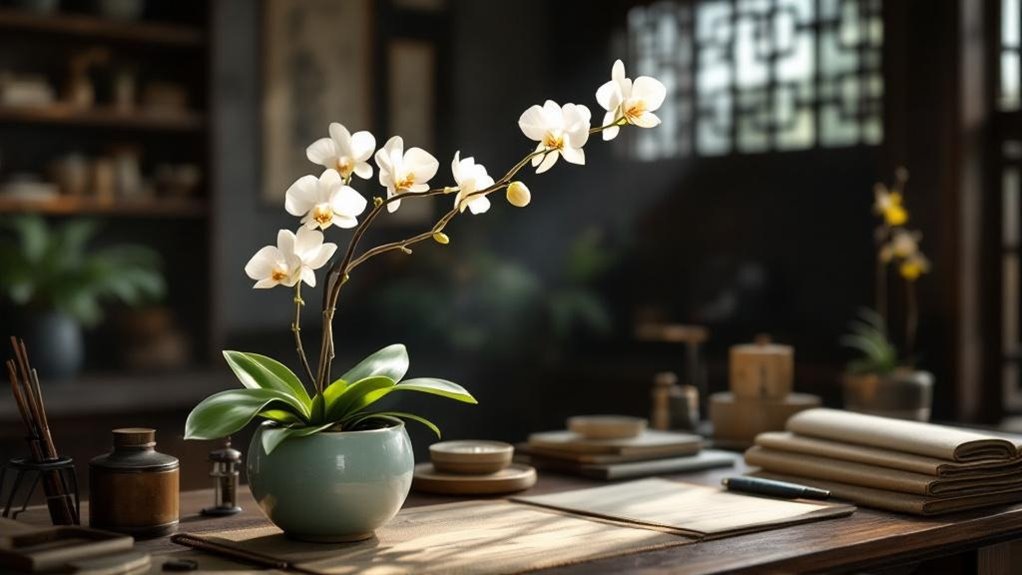
Because East Asian scholars treated moral cultivation as something you could observe in bearing, taste, and restraint, they made the orchid a durable emblem of noble character, one that joined refinement to integrity, modesty, and moral rectitude as early as the Spring and Autumn period in Chinese classical culture.
You see this observational code across East Asia:
- Confucius praised quiet virtue through orchids.
- Literati compared inner worth to subtle fragrance.
- Song and Ming scholars cultivated orchids.
- Edo elites valued orchids as cultivated taste.
- Manuals used orchids to mark virtue.
When you read paintings and poems, orchids don’t merely decorate; they identify the cultivated scholar, whose restraint avoids stagnant display, whose learned status appears through disciplined taste, and whose character remains inwardly ordered, visibly refined, and morally serious.
Are Orchids Good Gifts in Asia?
In much of Asia, orchids make especially good gifts, not simply for their elegance but for the cultivated meanings they carry; in China and Japan especially, they signify refinement, moral virtue, and scholarly wisdom, so they suit occasions where you mean to express respect for learning, character, or disciplined achievement.
| Meaning | Best choice | Impression |
|---|---|---|
| Respect | White orchid | Purity |
| Gratitude | Pink orchid | Esteem |
| Longevity | Phalaenopsis | Lasting care |
| Honor | Cattleya | Prestige |
You’ll find they symbolize refinement, prosperity, fertility, and good fortune; that observational range makes them suitable for academics, new couples, and formal hosts. In Thailand, a high-quality potted orchid suggests national pride and accessible luxury, while elegant packaging preserves esteem and avoids any stagnant impression. Avoid wilted sprays.
When to Give Orchids in Asian Traditions
Often, the right moment to give orchids in Asian traditions matters as much as the flower itself, since timing signals what quality you mean to honor, whether scholarly discipline, public esteem, spiritual purity, or the steady promise of prosperity.
You give orchids when occasions call for cultivated judgment, not stagnant display; they symbolize wisdom through timing as clearly as through beauty:
- in China, during examinations, graduations, and teacher appreciations
- in Japan, for promotions, milestone birthdays, and retirements
- in Thailand, at formal events, appointments, and business openings
- in Buddhist settings, at temples and memorials for purity and insight
- during Lunar New Year and festivals, for longevity and steady growth
Your choice becomes observational and precise, expressing respect, encouragement, honor, or peace according to the moment.
Symbolic Orchid Varieties in Asia
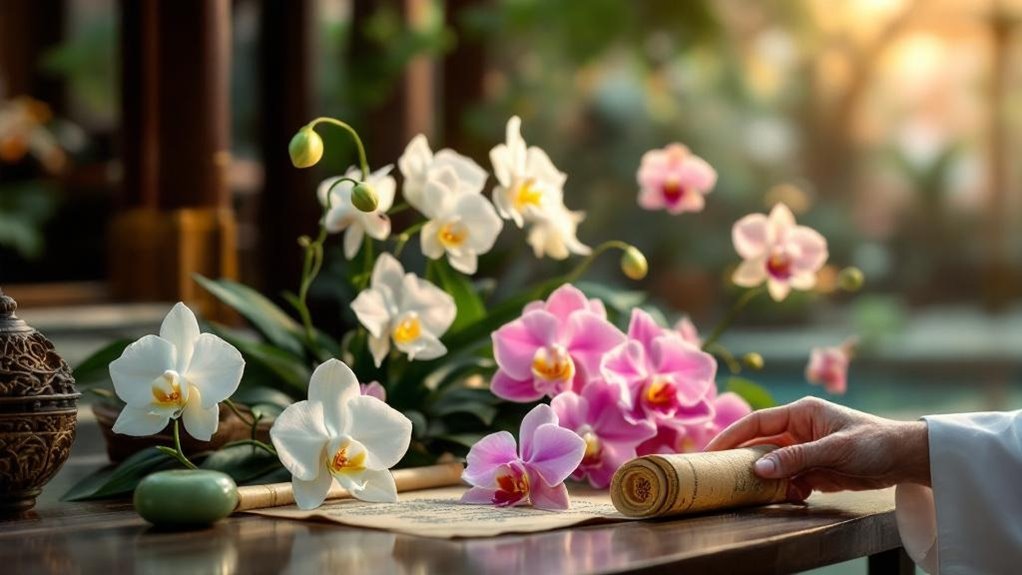
The moment of giving shapes meaning, yet the variety itself sharpens that meaning further, since different orchids carry distinct associations across Asia and let you honor wisdom with greater observational precision rather than stagnant admiration.
In China, if you choose Cymbidium or Phalaenopsis orchids, you invoke refinement, moral integrity, scholarly wisdom, and friendship, because these flowers belong to the Four Gentlemen and represent cultivated character rather than display alone.
In Japan, certain orchids historically marked noble luxury and cultivated taste, so you gesture toward learned elegance and the reflective sensitivity of mono no aware.
Across East and Southeast Asia, Dendrobium and Cymbidium appear in literati paintings and imperial gardens as emblems of scholarly virtue; Phalaenopsis also suggests health, prosperity, resilience, and measured judgment in tradition.
How Caring for Orchids Adds Meaning
Tending an orchid adds meaning because the symbolism no longer rests in a stagnant gesture alone; it becomes something you practice through time, attention, and cultivated restraint.
As you cultivate Phalaenopsis or Cymbidium, you enter an observational discipline long linked in Asia with wisdom, scholarly refinement, and moral clarity; Confucius praised the orchid’s purity, and samurai valued its union of bravery and refinement.
- You monitor bright, indirect light.
- You keep humidity near 50–70%.
- You water about weekly, with care.
- You use bark media and mild fertilizer.
- You place orchids intentionally for balance.
Through these steady acts, you train patience, because reblooming takes months; you sharpen judgment by adjusting temperature and moisture; and you practice mindfulness, as Buddhist, Taoist, feng shui, and Hindu traditions all connect deliberate care with emotional balance.
Frequently Asked Questions
What Do Orchids Symbolize in Asia?
In Asia, you’ll find orchids symbolize refinement, purity, dignity, spiritual beauty, and sometimes wisdom. You can also read them as signs of affection, gratitude, royalty, courage, abundance, and cultured elegance across traditions.
Do Orchids Represent Wisdom?
Yes, you can see orchids represent wisdom, especially in many Asian traditions. They embody refined character, moral strength, patience, and cultivated insight, so you’d often interpret them as symbols of thoughtful, mature, enlightened understanding.
What Do Orchids Symbolize in Different Cultures?
With over 25,000 species, you’ll find orchids symbolize refinement and friendship in China, luxury and bravery in Japan, fertility in Greece, and prosperity, dignity, mindfulness, and spiritual growth across Southeast Asia and Buddhist traditions.
What Is the Significance of Orchids in Thailand?
In Thailand, you see orchids signify beauty, respect, dignity, prosperity, and national pride. You’ll find them in garlands, temple offerings, gifts, hotels, and festivals, while their cultivation and export industry strengthens Thailand’s economy and tourism.
Conclusion
Across Asia, you can read orchids as cultivated signs of wisdom because they reward patience, restraint, and observational care; Confucius compared their fragrance in solitude to the virtue of a noble person, and that story still clarifies why they endure in art and ritual. When you give or tend an orchid, you aren’t offering stagnant decoration but a quiet ethic, one that asks you to value character that deepens slowly, holds form, and influences without display.