
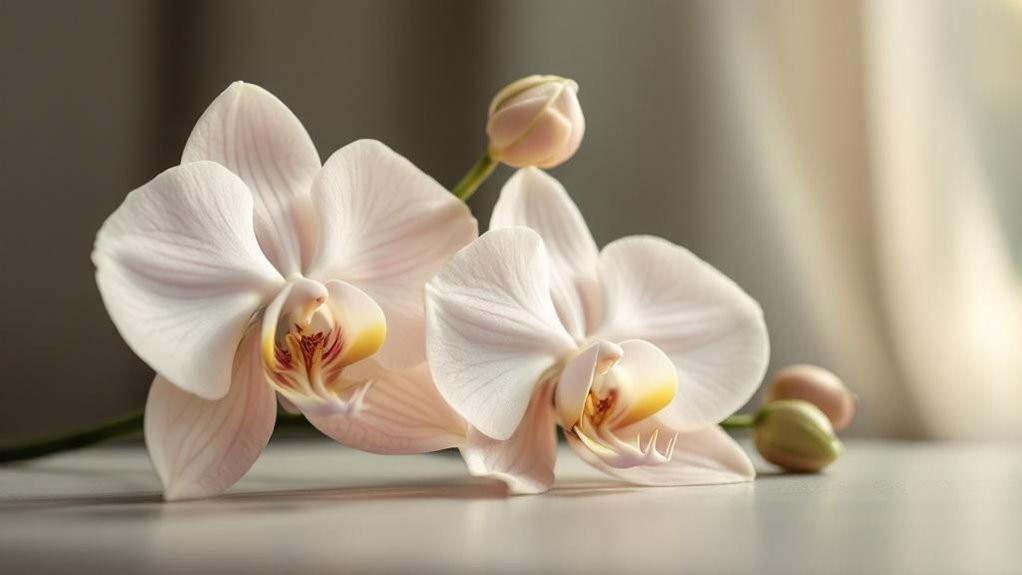
You understand orchids’ quiet beauty when you notice how they communicate without display: scents timed to dusk or dawn, restrained color shifts that mark age and receptivity, leaves that lean, pale, or droop as light and water change, and roots that signal comfort through steady growth below the surface. These are observational, cultivated signs, not dramatic ones, so stagnant habits often miss them; with closer attention, their meaning becomes clearer and more layered over time.
- Key Takeaways
- How Do Orchids Communicate Without Words?
- Why Do Orchids Seem Quiet but Aren’t?
- How Do Orchid Scents Attract Pollinators?
- Why Do Some Orchids Smell Strongest at Night?
- What Can Orchid Colors Tell You?
- Why Do Orchid Leaves Change Color?
- How Does Orchid Movement Signal Stress?
- Why Do Orchids Lean Toward the Light?
- How Do Orchid Roots and Fungi Communicate?
- How Can You Notice Orchid Signals Daily?
- Why Do We Miss Orchid Warning Signs?
- What Do Drooping, Pale, or Blooming Orchids Mean?
- Frequently Asked Questions
- Conclusion
Key Takeaways
- Orchids express quiet beauty through subtle signals: timed fragrance, shifting color, and restrained forms that reward close attention rather than loud display.
- Many orchids release scent only at precise hours, so their beauty is experienced through presence, timing, and pollinator relationships.
- Pale blooms, delicate markings, and nectar guides create elegance that feels understated while still serving clear ecological purposes.
- Quiet beauty also appears in gradual changes, as flower color and scent shift with age to signal receptivity and conserve energy.
- Healthy orchids embody calm beauty in balanced leaves, steady roots, and gentle movement toward light rather than dramatic visible change.
How Do Orchids Communicate Without Words?

Although orchids never speak in any literal sense, they communicate with remarkable precision through scent, color, posture, and timing; many release highly specific fragrances, sometimes only at night and sometimes in forms that mimic rotting fruit or female insects, so the proper pollinators arrive under the proper conditions.
You can also read an orchid through its surfaces and habits: leaves that spot, pale, or darken often reflect excess light, imbalance, or age; stems that lean and flowers that turn show cultivated adjustment, not stagnant stillness. Below the potting medium, roots and fungal partners exchange chemical information about water, nutrients, and microbial pressure, shaping responses you later see aboveground.
If you practice observational care, tracking bloom timing, leaf droop or lightening, and steady root growth, you can recognize comfort or stress before decline becomes obvious. In some healing traditions, Dendrobium stems have long been brewed into teas and restorative formulas for dryness and depletion.
Why Do Orchids Seem Quiet but Aren’t?
Because orchids time most of their signals to moments you may not be present to witness, they seem quiet at first; in practice, they’re conducting a steady exchange through fragrance released only at certain hours, slight shifts in color and posture, and underground adjustments in roots and fungal partners that never register as obvious motion.
If you watch with cultivated, observational patience, you see that nothing about them is stagnant: leaves lighten or droop when light or nutrients fall out of balance, stems and roots redirect growth over days, and a bloom can arrive as a measured declaration of readiness.
Even below the potting medium, mycorrhizal partnerships carry stress and nutrient information, so the plant answers conditions without spectacle. What seems silent is simply paced beyond casual attention, and your own timing determines what you notice.
In many traditions, orchids also carry meanings of beauty and virtue, so their restraint can feel less like absence than like a deliberately refined presence.
How Do Orchid Scents Attract Pollinators?
How, then, does an orchid make itself legible to the right visitor when so much of its life appears observational and still; it does so by releasing precise blends of volatile compounds—terpenes, benzenoids, and esters—at the hours when its target pollinator is most active, so a night-flying moth encounters strongest fragrance after dusk while a day-active bee meets a different schedule and signal.
- You encounter cultivated specificity, not stagnant perfume.
- Some scents mimic food, even rotting fruit, drawing flies.
- Others mimic mating cues; Ophrys copies female bee hydrocarbons, and males transfer pollen.
- As flowers age, scent shifts in strength and composition, marking receptivity, conserving resources, and reducing wasted pollen transfer.
You can see the logic: by narrowing attraction to reliable bees or flies, orchids improve reproductive success where those partners remain available.
The Ghost Orchid is legendary for its elusive bloom and swamp folklore of wish-granting mystery.
Why Do Some Orchids Smell Strongest at Night?
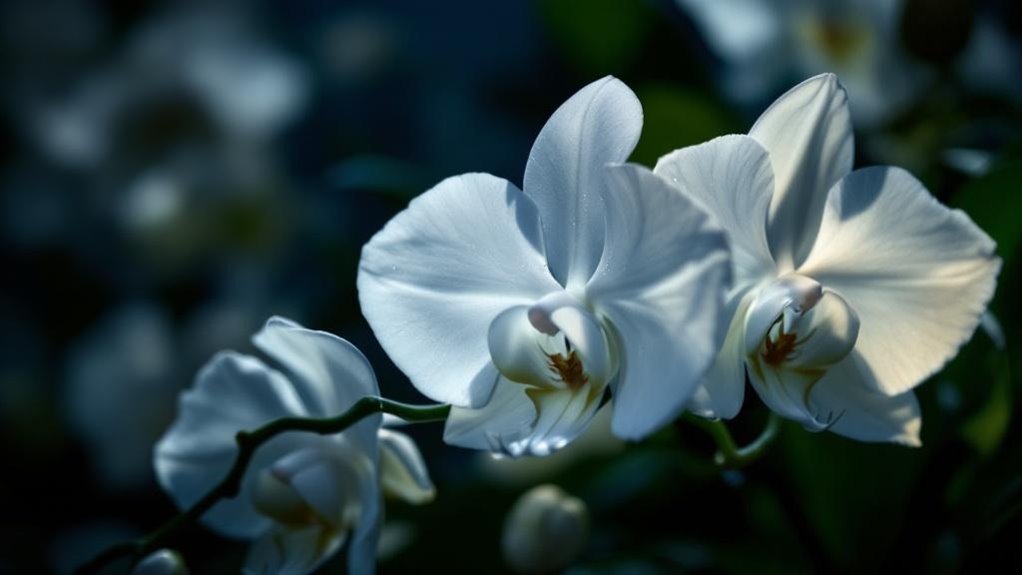
When dusk settles and visual signals lose force, some orchids intensify their fragrance to meet the senses their pollinators actually use; moths and other night-active visitors navigate chiefly by smell, so species such as certain Cattleya and Brassavola release their strongest scent after dark, when a cultivated chemical message can travel farther and remain more legible than color in low light.
If you observe them closely, you find that this timing isn’t accidental; orchids often increase volatile compounds such as linalool and benzyl acetate in the evening, aligning scent with sphingid moth foraging cycles. You also see economy in the pattern, because fragrance is metabolically costly, and a plant conserves resources by avoiding stagnant daytime release. Decreasing light, cooler air, and circadian control regulate scent glands, while chemically specific odors narrow attraction precisely. In Feng Shui, orchids are also associated with positive chi, harmony, and emotional balance, which adds another layer to their quiet beauty.
What Can Orchid Colors Tell You?
You can read a great deal in orchid color if you treat it as an observational signal rather than decoration; pale or white flowers often belong to species adapted to low light, where reflected moonlight helps nocturnal moths locate blooms, while saturated reds, oranges, and other vivid tones more often align with daytime birds and bees that rely on strong visual contrast.
- You can watch for nectar guides, spots, and stripes; they direct pollinators efficiently.
- You can notice mimicry in *Ophrys*; cultivated patterns imitate female insects with precision.
- You can compare hybrids with wild orchids; anthocyanin-heavy breeding favors intense purples and reds.
- You can read fading blooms as age after pollination, not stagnant beauty; color often marks timing, strategy, and reproductive intent in place.
Because orchid colors also carry cultural meaning, they can communicate romance, gratitude, royalty, friendship, or purity depending on the shade and setting.
Why Do Orchid Leaves Change Color?
When your orchid’s leaves change color, you can often read the shift as an observational record of light exposure, nutrient stress, and the plant’s own aging and recovery cycle; leaves that lighten or yellow may be receiving too much direct sun, while darker, mottled, or translucent areas can point to stagnant moisture and failing roots.
You should also consider cultivated feeding patterns, because shortages of nitrogen or iron often produce pale growth, while brown tips or margins usually reflect salt buildup or fertilizer burn rather than simple dryness.
At the same time, you shouldn’t treat every yellow leaf as decline, since older lower leaves commonly fade and drop as part of normal aging, and subtle seasonal changes alongside steady growth and blooming often indicate adjustment rather than acute stress.
In many traditions, a thriving orchid is also seen as a sign of good fortune and balanced energy, so healthy color changes can sometimes reflect the plant’s natural cycle rather than a loss of vitality.
Light Exposure Signals
Leaf color often gives away an orchid’s light history before any other sign appears, and a cultivated eye can read those shifts with some precision: Phalaenopsis, for example, generally holds its best balance in bright, indirect light around 12,000–20,000 lux, while direct midday sun pushes leaves toward yellow or reddish tones, and prolonged excess can leave bleached, translucent, papery patches that mark sunburned tissue rather than a stagnant nutrient problem. In Thai culture, orchids also carry meanings of quiet beauty and respect, making their careful light balance feel as symbolic as it is botanical.
- If leaves darken, you’re usually seeing low light; more chlorophyll forms, and flowering often declines.
- If yellowing appears quickly, recent exposure likely intensified.
- If pale bands emerge after relocation, your orchid is recording that shift.
- If red or purple pigments develop, anthocyanins are shielding tissue, and gentler light often reverses them over time, without lasting harm.
Nutrient Stress Signs
Watch the pattern of discoloration closely, because orchid leaves don’t change color at random; they register how well roots are moving water and dissolved nutrients, and a cultivated, observational reading of that pattern usually separates nutrient stress from simple aging or stagnant care conditions.
| Leaf sign | Likely stress |
|---|---|
| Yellowing or uniform chlorosis | Nitrogen shortage; iron or other mobile nutrient limits |
| Dark patches, limp tissue | Cold below 10°C; root rot blocking uptake |
Pale, washed leaves usually mean excess light, especially for Phalaenopsis, which stays steadier near 1,000–1,500 foot-candles of bright, indirect light. Red or purple tints often reflect phosphorus strain or strong ultraviolet exposure, and cool nights can deepen that response. When color shifts fast and tissue softens, inspect roots. Firm green or white roots sustain flow; brown, mushy roots don’t.
Aging And Recovery
Patterns of discoloration tell you whether an orchid is under strain, but time itself also leaves a readable mark; an older leaf may yellow evenly, thin slightly, and detach as part of normal senescence, while new growth continues and the plant’s overall habit remains steady.
Use this observational guide:
- Even yellowing on one old leaf usually reflects aging, not decline.
- Sudden patchy yellow, brown, or black areas often indicate stagnant roots, overwatering, rot, or infection.
- Deficiencies follow cultivated patterns; nitrogen or magnesium fades older leaves first, while iron leaves new foliage pale between veins.
- Recovery begins when you correct cause and conditions; improve drainage, reset light, refine feeding, and isolate diseased plants.
Then you can expect healthier new leaves within weeks or months, even if marked foliage remains altered.
How Does Orchid Movement Signal Stress?
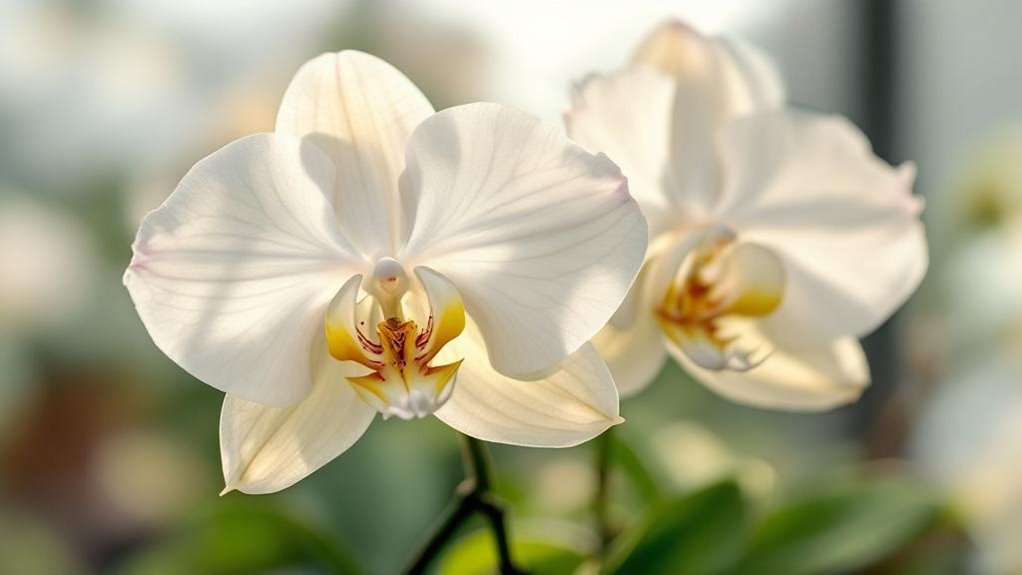
Although orchids seem still at a glance, their small shifts in posture often provide the earliest observational record of stress, because a cultivated plant will lean or twist its leaves and flower spikes as it tries to correct for light that’s either too weak or too harsh, and when that movement becomes persistent rather than gradual, it usually points to an imbalance rather than normal growth.
| Sign | Meaning | Feeling |
|---|---|---|
| Drooping spike | Water stress | Concern |
| Brown bud | Temperature swing | Quiet loss |
You also read stress in speed; when new leaves stay stagnant and root tips don’t appear for weeks, conditions often remain unsuitable, while yellowed edges, translucent patches, and aborted buds confirm strain from salts, heat, nutrient imbalance, or exhausted medium.
Why Do Orchids Lean Toward the Light?
When you notice an orchid leaning toward a window, you’re seeing phototropism at work; auxin shifts to the shaded side, those cells elongate more, and the spike or stem gradually curves toward brighter light.
You can track this with simple observational notes or weekly photos, because the change is slow rather than stagnant, and different orchids respond according to their cultivated preferences, with Phalaenopsis often bending less than brighter-light Cattleya or Vanda.
If you correct uneven light by rotating the plant every few days, you encourage straighter, more balanced growth; if you don’t, the orchid may set a lasting direction that also helps position its flowers for better visibility and scent dispersal.
Phototropism In Orchid Growth
Because orchids depend on light that’s often filtered rather than constant, they exhibit a cultivated form of phototropism, bending stems and orienting leaves toward the brightest available source as auxin shifts to the shaded side and drives greater cell elongation there; in many epiphytic species, that lean remains moderate, often around 10 to 30 degrees toward a canopy gap or a window, which improves photosynthesis without pushing delicate foliage into stagnant heat, bleaching, or desiccation.
- You can observe Phalaenopsis responding within hours.
- Cattleya shifts spikes toward bright, indirect light.
- Auxin redistribution makes the shaded side lengthen faster.
- Over days, asymmetry becomes plainly observational.
You see a measured adjustment, not erratic reaching; the plant balances light capture with water stress, and it favors dappled brightness over direct midday exposure.
Correcting Uneven Light
In a pot lit mainly from one side, your orchid leans toward the brighter source for a simple physiological reason: cells along the shaded side elongate more than those exposed to stronger light, so the stem or flower spike bends in a slow, cultivated arc rather than remaining symmetrical.
You can moderate that bias by rotating the pot each week about 45 to 90 degrees, which redistributes exposure and encourages more balanced growth.
If the lean persists, you should soften the directional force itself; place the plant one to two feet back from an east- or west-facing window, or hang a sheer curtain so light becomes more diffuse, less stagnant, and more even.
For a crooked spike, stake it and tie it gently while you reposition the pot.
Watch leaf color and new growth closely for quiet, observational confirmation.
How Do Orchid Roots and Fungi Communicate?
Although orchid roots appear self-contained, they conduct a cultivated exchange with mycorrhizal fungi through root exudates, chemical gradients, and hormonal signals; the roots release sugars and other compounds that shape which fungi gather around them, and the fungi, often Rhizoctonia-like partners, enter the cortical cells and return water, nutrients, and carbon in measurable flows.
Orchid roots seem solitary, yet they stage a measured barter with fungi through exudates, gradients, and hormonal signals.
- You can trace this observational dialogue through isotopic labels, which reveal two-way carbon and nitrogen movement.
- You see seeds depend on fungi first; until leaves form, fungal carbon sustains germination.
- You find roots alter exudates as moisture, light, and nutrients shift, preventing stagnant partnerships.
- You notice mycelium extends communication outward, linking roots with microbes and nearby plants, conveying drought, nutrient patches, and pathogen warnings through gradients and hormonal cues.
How Can You Notice Orchid Signals Daily?
You can pick up an orchid’s daily signals by settling into a brief observational routine, one that treats scent, color, firmness, and direction of growth as cultivated indicators rather than isolated quirks. Smell it in morning, midday, and night, because some orchids release fragrance only at precise hours, and that timing reveals normal rhythm rather than stagnant air.
Each week, compare leaf color to a healthy baseline; most Phalaenopsis should remain uniformly dark green, while older leaves may yellow gradually. Every few days, press leaves lightly and inspect roots; plump leaves and green or silvery-green roots suggest balanced hydration. Watch flowers and stems orient toward light, rotate the pot a quarter-turn weekly if growth leans, and monthly lift the pot, noting weight, new roots, or an emerging spike.
Why Do We Miss Orchid Warning Signs?
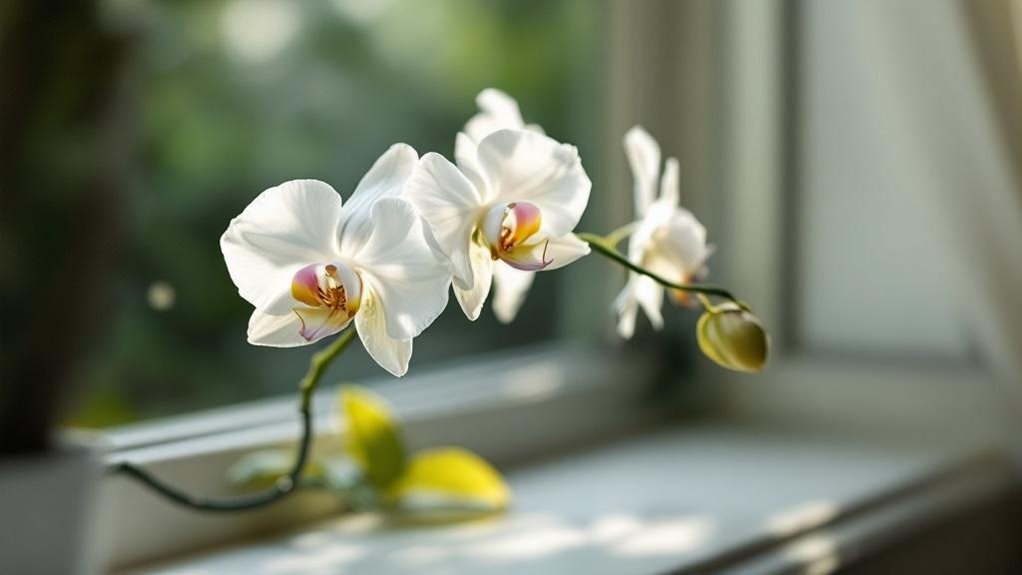
You often miss orchid warning signs because their signals are quiet and observational, with yellowing leaves, altered fragrance, and slight stem lean emerging so gradually that they seem ordinary rather than cultivated indicators of stress.
Your fast routines blur these changes, and when attention settles on blooms alone, stagnant growth, dull leaf color, and fewer spikes pass without notice because they don’t announce decline in obvious ways.
Subtle Signals Go Unnoticed
Because orchid distress rarely announces itself in obvious ways, many of its warning signs pass beneath ordinary notice; scent may appear only at certain hours, with some orchids releasing fragrance at night rather than during a casual daytime check, while shifts in leaf color toward yellowing or bleaching develop so gradually that they register only through regular comparison over weeks.
- You expect immediate reactions, so quiet decline escapes cultivated observational habits.
- Distress often stays below the surface; roots rot, and drought signals move through fungal networks unseen.
- New growth may lean slightly, leaves may droop occasionally, and bloom frequency may diminish without drama.
- If you inspect only the obvious, you mistake a stagnant pattern for stability, though the orchid has been speaking in restrained, cumulative changes for months, and you simply haven’t learned its timing yet.
Fast Routines Blur Changes
When care collapses into a fast routine, watering, misting, and a brief glance at blooms get compressed into minutes, and that speed trains your attention toward whatever looks immediately wrong while gradual shifts—slight stem softening, a faint week-by-week yellowing of leaves, slower new growth, or a reduced release of scent at certain hours—remain outside cultivated notice.
| Rushed check | Missed change |
|---|---|
| Brief glance | Root browning below bark |
| Bloom focus | Edge burn, stagnant growth |
You respond to brown leaves or wilted flowers, because busy schedules reward visible crises; meanwhile, orchids signal across hours and weeks, through root darkening, loss of turgor, and tiny percentages of discoloration. If you expect direct reactions, you discount quiet positives and small declines, and your observational rhythm narrows before damage appears above the pot.
Stress Signs Seem Normal
That narrowed observational rhythm also makes orchid stress look ordinary, and the plant’s earliest warnings often resemble the variations you’ve already learned to excuse: a leaf that yellows or turns slightly translucent may reflect excess light or root damage, yet it’s easily filed under normal aging; a missed evening fragrance seems incidental if you don’t know scent follows a timed cycle; a spike that leans away from light, or new growth that turns stagnant rather than stopping outright, rarely announces itself as decline.
- You expect obvious collapse.
- Roots fail out of sight.
- Wilting appears late.
- Small shifts accumulate quietly.
Because your cultivated expectations favor dramatic symptoms, you may read reduced blooming, slight leaf lightening, or one spent flower as ordinary variation, while hidden rot or fungal imbalance advances below the pot.
What Do Drooping, Pale, or Blooming Orchids Mean?
At first glance, a drooping, pale, or suddenly blooming orchid can seem to have changed all at once, yet each shift usually reflects a cultivated response to conditions you can observe; drooping leaves often point to water stress or root trouble, with overwatered plants turning limp and yellow as roots sit stagnant and fail, while underwatered ones develop wrinkled, leathery leaves that no longer hold moisture well.
Pale leaves may mean bleaching from excess light, a nitrogen shortage, or simple aging in lower leaves. Sudden blooms usually follow enough light, steady watering, and cooler nights; Phalaenopsis often spike after six to twelve weeks with nights dropping five to ten degrees. You read the plant best through observational comparison: inspect roots for firm green or white growth, note quiet new roots or shoots, and track recent shifts carefully.
Frequently Asked Questions
What Does the Orchid Symbolize for a Woman?
For a woman, the orchid symbolizes your beauty, femininity, and unique strength. It also reflects fertility, grace, patience, and resilience. When you receive one, it shows admiration, respect, prosperity, and the quiet power you carry.
What Is the Philosophy of Orchids?
You see the orchid as a lantern of patience: it teaches you to value slow attention, read subtle signals, trust hidden connections, and understand that growth, stress, and beauty often reveal themselves only in time.
What Type of Person Likes Orchids?
You like orchids if you notice small changes, enjoy patient care, and appreciate elegant complexity. You’re often observant, curious, and disciplined, valuing subtle rewards, specialized knowledge, and plants that respond meaningfully without demanding constant attention.
Why Are Lady Slipper Orchids Illegal in the US?
Lady slipper orchids are illegal to collect or trade in many U.S. cases because you’d harm protected wild populations. Habitat loss and overcollection endangered them, so laws restrict removal, possession, sale, and import unless permits apply.
Conclusion
If you watch orchids with observational patience, you’ll see that their quiet beauty isn’t stagnant but cultivated through scent, color, timing, and root-level exchange; they signal by opening, by paling, by drooping, by blooming, and each change carries meaning. You notice more when you look steadily, when you compare light to shadow, health to strain, day to night, because orchids don’t lack a voice; they simply speak through forms that reward restraint, attention, and continued care.