
You see orchids in ghost stories because their pale blooms, leafless forms, and stagnant habitats make them seem detached from ordinary life; ghost orchids intensify that effect by appearing to hover in shadow, blooming rarely, and depending on elusive pollinators. Across folklore and gothic symbolism, orchids also carry desire, loss, mortality, and transformation, so they become natural emblems of haunting beauty and hidden forces. Their deeper meanings, and the stories attached to them, soon become clearer.
- Key Takeaways
- Why Orchids Feel Ghostly at First Glance
- What Makes the Ghost Orchid So Mysterious
- How Ghost Orchids Shaped Folklore
- Why Rare Orchids Inspire Supernatural Tales
- How Orchids Came to Symbolize Life and Death
- Why Orchids Represent Transformation in Myth
- How Greek Myths Linked Orchids to Desire
- How Aztec Lore Made Vanilla Orchids Sacred
- How Chinese Tradition Framed Orchids as Virtue
- How Hawaiian Culture Honors Orchids
- Why Victorians Saw Orchids as Unsettling
- Why Orchids Thrive in Gothic Literature
- How Orchid Hunters Fueled Wild Legends
- Why Ghost Orchid Blooms Look Unworldly
- How Orchid Scents Blend Seduction and Unease
- Why Orchids Carry Love, Loss, and Longing
- Why Orchids Haunt Modern Culture
- Frequently Asked Questions
- Conclusion
Key Takeaways
- Orchids, especially ghost orchids, look spectral because their pale, leafless blooms seem to float in dark, misty habitats.
- Their rarity and unpredictable blooming make orchids feel elusive, secretive, and tied to hidden forces beyond ordinary human control.
- Folklore links orchids to spirits, transformation, desire, and fate, giving them strong symbolic power in supernatural storytelling.
- Gothic literature uses orchids to express beauty mixed with decay, danger, and secrecy, which suits haunting and eerie narratives.
- Orchid hunters’ tales of obsession, disappearance, and peril helped turn rare orchids into symbols of mystery, loss, and sacred power.
Why Orchids Feel Ghostly at First Glance
When you first encounter an orchid, especially a ghost orchid, its effect can seem almost spectral, because the flower’s pale bloom appears to hover in space, detached from ordinary structure, and its cultivated elegance carries an otherworldly stillness that invites observational comparison to an apparition.
The ghost orchid seems to hover without structure, its pale stillness suggesting an apparition suspended in air.
You notice how an Orchid can seem suspended against stagnant air, how Ghost associations arise from whiteness, remoteness, and silence rather than movement.
With ghost orchids, that impression deepens because their leafless forms conceal familiar plant structure, while their dependence on host trees places them in dim swamps where mist softens edges and distance.
Other orchids also suggest the supernatural; unusual shapes echo faces or figures, and their rarity, fragility, and transience align with the visual language you already connect to haunting presences and absence.
What Makes the Ghost Orchid So Mysterious
Something about the ghost orchid resists ordinary explanation, because nearly every feature you can observe in it seems to withhold as much as it reveals; its leafless form removes the familiar signs by which you’d usually recognize a plant, its white flower appears to hover apart from supporting structure, and its habitat in the dim, stagnant wetlands of the Everglades places it in cultivated imagination as much as in botany.
When you encounter the Ghost Orchid, you also confront rarity, because only about 2,000 remain in the wild, and that scarcity gives every sighting an almost prohibited quality.
Its dependence on specialized pollinators, especially the giant sphinx moth, deepens the mystery through observational complexity, while myths and legends persist because people notice how easily it seems to vanish from attention and into shadow.
How Ghost Orchids Shaped Folklore
You can see how the Ghost Orchid shaped folklore through phantom bloom symbolism, because its leafless form and pale flowers seem to hover in stagnant air, turning an observational detail into a cultivated sign of spirits, enchantment, and uneasy beauty.
You can also trace Everglades mystery legends to the orchid’s shadowed habitat, where low light, swamp silence, and rare appearances encouraged stories that linked the flower to hidden forces and the unknown.
As you consider vanishing flower folklore, youll notice that its elusive growth, dependence on a specific moth, and endangered status made it easy for storytellers to cast it as a rare presence pursued by collectors and ghosts alike.
Phantom Bloom Symbolism
Few flowers have cultivated a more spectral symbolism than the Ghost Orchid, whose pale, suspended bloom seems to hover in stagnant air, and whose leafless stems give it an observational strangeness that folklore readily turns into an omen, an apparition, or a sign that the boundary between the living and the dead has thinned.
When you encounter the Ghost Orchid in supernatural symbolism, you see why it persists: its ethereal form appears detached from soil and season, its rare blooming suggests secrecy, and its dependence on fragile conditions mirrors life’s brevity.
Folklore turns that delicacy into meaning; you read beauty and loss together, and you understand how ghost stories use the flower to suggest transcendence, haunting memory, and a threshold that neither fully opens nor fully closes. In that suspended image, absence itself acquires form.
Everglades Mystery Legends
Across the Everglades, the ghost orchid, *Dendrophylax lindenii*, has shaped mystery legends by seeming to emerge from the swamps rather than merely grow in them. Its pale, leafless bloom, suspended against stagnant water and dark cypress, has given local folklore a cultivated image of spirits made briefly visible.
When you trace Everglades stories, you find local myths linking each ghost orchid to lost souls and watchful guardians. Its white form resembles a floating crown, and because rarity sharpens belief; with only about 2,000 remaining, the flower carries beauty, grief, and observational weight.
You also encounter accounts shaped by poaching and habitat destruction, which turned botanical loss into moral folklore. People came to read damaged swamps as haunted ground, where spirits seemed to endure beside the threatened bloom still.
Vanishing Flower Folklore
From those Everglades legends, vanishing flower folklore follows naturally, because the ghost orchid doesn’t only appear to hover above stagnant water and dark bark; it also seems, in story after story, to withdraw from ordinary sight the moment strangers arrive, and that cultivated pattern of appearing and receding has made it a durable emblem of hidden territories, watchful presences, and meanings that remain just beyond observational reach.
| Trait | Folkloric meaning |
|---|---|
| Rarity | Hidden territories |
| Sudden bloom | Fate’s signal |
| Leafless form | spectral presences |
| Camouflaged roots | Floating spirit |
When you follow Ghost Orchid lore, you find loss, obsession, and messages from the dead; vanishing flower folklore persists because each encounter feels conditional, as if nature itself admits you briefly, then closes.
Why Rare Orchids Inspire Supernatural Tales

You can see why rare orchids invite supernatural tales: their elusive blooms seem to hover outside ordinary time, their leafless forms and cultivated strangeness encourage legends, and their scarcity gives them the air of sacred power.
As you trace these flowers through stagnant swamps and other haunted places, you find that their vanishing habits, dark beauty, and fragile dependence on hidden fungi and host trees make them fitting emblems of loss, seduction, and haunting.
You also inherit the observational record of explorers marked by danger and misfortune, and that history steadies the sense that such orchids don’t merely grow in remote places, they gather an otherworldly meaning around them.
Elusive Blooms, Strange Legends
Because rare orchids appear where most people rarely look—deep in swamp light, on stagnant forest margins, or in cultivated collections guarded by secrecy—they invite an observational habit of mind that easily turns into legend; the Ghost Orchid, in particular, seems to hover between presence and absence, and that elusiveness has long encouraged folklore to treat it as something more than botanical.
When you encounter such elusive blooms across the orchid family, you see why supernatural narratives gather around them: beauty appears briefly, then withdraws, and that rhythm suggests hidden agency rather than ordinary growth.
Leaves like Macodes petola’s can seem designed, almost coded, which lets legends assign transformative origins or dangerous allure.
You also inherit older floral symbolism, where orchids carried secret meanings, romance, and risk, making them natural emblems of fragility, impermanence, and spectral memory in folklore.
Rarity Breeds Sacred Power
Rarity gives an orchid more than botanical interest; it gives the flower a kind of perceived authority, and folklore often turns that authority into sacred power. When you encounter a bloom so scarce that few people ever see it, you don’t treat it as ordinary; you read significance into its survival, and rarity breeds sacred power.
That logic shapes supernatural tales around orchids, especially the Ghost Orchid, whose hidden growth and difficult cultivation make it seem chosen rather than merely biological.
In European superstition, you find orchids carried as talismans, cultivated as signs of luck, or regarded as aphrodisiacs, and each belief strengthens their otherworldly reputation.
Luxury and exoticism also matter; as Orchid Thief narratives suggest, what resists possession gains symbolic force, and even stagnant habitats can feel charged under close observational attention.
Vanishing Flowers, Haunted Places
When a flower appears only in stagnant swamps, on remote trunks, or in cultivated collections few people ever enter, it doesn’t remain merely botanical; it gathers atmosphere, and that atmosphere readily settles into haunted places.
You sense that in Florida’s Fakahatchee Strand, where the Ghost Orchid, a leafless epiphytic rarity, seems to float, complete without visible support, and where absence becomes part of the sight itself.
Because you seldom encounter it, you grant it secrecy; because poachers reduce it and conservation struggles persist, you read lament into its decline.
Maori-linked tales of transformation and loss, along with literary associations of love and mystery, make the bloom feel observational rather than ornamental, a presence half-withdrawn from the world.
Even in archives, comments must be approved before certainty fully settles around it.
How Orchids Came to Symbolize Life and Death
An orchid carries a double meaning that ghost stories use with quiet precision, since its cultivated beauty appears vivid yet fleeting. That tension has long made it a fitting emblem for both life’s allure and death’s certainty.
You see orchids embody life and death because their bloom feels intensely alive, yet never permanent; that observational contrast invites supernatural meaning. In East Asian ritual culture, orchids appear beside chrysanthemums, and together they mark celebration and mourning without forcing a stagnant division between them.
Victorian taste deepened this symbolism, because orchids signaled luxury, desire, and rarity, yet funeral arrangements placed that cultivated splendor beside mortality.
Even older associations matter: Greek fertility symbolism gave orchids life-giving force, while funerary use tied them to endings, loss, longing, and the afterlife itself.
Why Orchids Represent Transformation in Myth
That same double meaning also explains why myth so often casts orchids as signs of transformation, because cultures rarely treat them as stagnant ornaments; instead, they use the flower to mark a change in body, status, spirit, or character that can’t be reversed.
You can trace that observational pattern through several traditions:
- Gods reshape human fate, as with Orchis, whose punishment becomes floral form.
- Aztec vanilla orchid lore links transformation to cultivated significance, sacred strength, and renewal.
- Chinese, Hawaiian, and Victorian meanings tie orchids to character, ritual honor, and altered rank.
Even the Slipper orchid suggests passage, as if beauty guides you across thresholds.
Charles Darwin’s close study reinforced the sense that orchids embody adaptation, precision, and metamorphosis rather than static perfection in nature.
How Greek Myths Linked Orchids to Desire

Because Greek myth rarely separates beauty from consequence, it links orchids to desire through both language and story; the flower’s very name comes from *orchis*, the Greek word for “testicle,” so from the outset it carried associations with fertility, virility, and erotic force rather than serving as a stagnant ornament.
When you follow the legend of Orchis, you see a young man punished by the gods and transformed into an orchid, a cultivated warning that desire can generate renewal yet invite retribution when it turns reckless.
Ancient observers also treated orchids as aphrodisiacs, which strengthened the flower’s role in love lore and in spring rituals tied to fertility, seasonal return, and life’s observational cycles. Its exotic beauty then preserved that meaning, so you inherit a symbol shaped equally by longing, consequence, and sacred continuity.
How Aztec Lore Made Vanilla Orchids Sacred
When you turn to Aztec lore, you find vanilla orchids treated as a divine gift, cultivated with observational care because they linked human life, ritual practice, and the presence of gods.
You can see that bond most clearly in the sacred drink of cacao and vanilla, which wasn’t a stagnant luxury but a ceremonial source of strength and energy, trusted to support both body and spirit.
As this subtopic begins, you should note that vanilla’s sacred status grew from more than flavor alone; it expressed reverence for nature’s gifts and affirmed a lasting connection between the Aztecs and their gods.
Divine Gift Of Vanilla
Although vanilla is often treated now as a familiar flavor, the Aztecs regarded the vanilla orchid, *Vanilla planifolia*, as a divine gift, cultivated not merely for taste but for its sacred force; in their lore, vanilla joined cacao in a revered drink that signified strength and energy, and this association gave the orchid a status far beyond ornament or trade.
You can trace that status through Aztec lore, where vanilla orchids carried ritual weight, social esteem, and an observational link to divine favor, never a stagnant luxury.
- Priests used them in ceremonies to invoke blessings.
- Nobles valued them in formal customs and offerings.
- Myths tied them to Xanat, whose sorrow transformed into bloom.
When you place vanilla within this sacred framework, you see why its fragrance suggested presence, significance, and contact with powers above mortal life.
Cacao And Sacred Drink
If you look at the place vanilla held in Aztec life, you find its sacred status most clearly in the cacao drink that joined fragrance, nourishment, and ritual force; by blending vanilla orchid with cacao, Aztec nobles and priests didn’t treat the plant as a stagnant luxury or a cultivated garnish, but as part of a ceremonial substance believed to confer strength, energy, and an observational sign of divine favor.
When you trace this sacred drink through Aztec custom, you see why vanilla orchid carried unusual esteem; it entered rites reserved for nobility, marked formal offerings, and linked sensory pleasure with disciplined reverence.
Even preparation mattered, with cacao sometimes raised with pop ash, so the drink became not merely flavored sustenance but a carefully ordered ritual medium, one that placed vanilla within society’s highest sacred expressions.
Strength, Vitality, And Gods
Because Aztec belief treated vanilla orchid not as a stagnant ornament of cultivated taste but as a direct gift from the gods, the plant came to signify strength and energy in ways that joined bodily vigor to sacred order; by blending Vanilla planifolia into cacao, priests and nobles affirmed the view that divine power could be received through disciplined ritual consumption, and that the fragrance and force of the orchid marked an observational sign of favor rather than mere pleasure.
You can trace that sacred status through:
- ceremonial offerings to deities,
- elite cacao rites promising vigor,
- a wider reverence for nature’s gifts.
Even when orchids in Big Cypress National or Angraecum sesquipedale seem to float in mid-air, you should remember this older pattern: beauty suggested power, and power, in Aztec thought, carried divine legitimacy into daily life.
How Chinese Tradition Framed Orchids as Virtue
Virtue sits at the center of the orchid’s meaning in Chinese tradition, where the flower came to signify beauty disciplined by refinement, moral integrity sustained without display, and a cultivated inner character that doesn’t wither in isolation or grow stagnant in obscurity.
| Aspect | Meaning |
|---|---|
| Confucius | Virtuous men |
| Spring | Renewal |
When you read Chinese poetry or study brush painting, you see orchids cast as observational emblems of integrity, admired by Confucius, who likened upright people to flowers that keep their fragrance even when standing alone. You also encounter them as signs of spring; they announce renewal, the return of life, and good fortune, so their beauty never appears merely decorative. Instead, it becomes ethical beauty, cultivated, restrained, and enduring in solitude.
How Hawaiian Culture Honors Orchids

Across Hawaiian culture, orchids carry honor rather than mere ornament, and you see that status most clearly in leis, ritual adornment, and ceremonial exchange, where the flowers mark royalty, divine beauty, and respect in forms that are public yet never stagnant.
You can trace that cultivated regard through three enduring uses:
- In leis, orchids honor love, rank, and appreciation during important gatherings.
- In rituals, they help preserve heritage, acknowledge ancestors, and connect observance to the land.
- In beliefs around Pele and spiritual protection, they act as quiet conduits to sacred presence.
When you view orchids through this Hawaiian lens, you don’t encounter decoration alone; you witness an observational system of meaning, where beauty carries authority, ancestry remains near, and reverence is made visible through careful, ceremonial practice.
Why Victorians Saw Orchids as Unsettling
The Victorian imagination didn’t regard orchids as innocent luxuries alone; it placed them in a cultivated borderland between refinement and threat, where rarity, foreign origin, and difficult cultivation made the flower feel observationally significant yet never entirely safe.
If you’d lived then, you’d have seen orchids framed by luxury and uncertainty; people believed only noble blood could truly keep them alive, so the plants seemed selective, enigmatic, almost judgmental.
Their unusual forms and colors unsettled you further, because petals could suggest faces, insects, or otherworldly bodies rather than stagnant domestic beauty.
Elite collecting deepened the unease, since each specimen implied distant jungles, hidden labor, perilous travel, and secretive plant hunters moving through imperial networks.
Even before any supernatural meaning appeared, orchids had already trained you to expect beauty carrying risk, status carrying menace.
Why Orchids Thrive in Gothic Literature
You can see why orchids settle so naturally into Gothic literature: they join exotic decay to cultivated beauty, and their lush forms, toxic associations, and stagnant floral stillness make menace appear elegant rather than obvious.
As you move through these dark narratives, you notice that orchids often signal seductive danger; they mirror desire, death, and inward corruption at once, which gives authors a precise, observational symbol for beauty that unsettles as much as it attracts.
You can trace this pattern from decadent writers to the ghost orchid itself, whose rare, vanishing presence turns the flower into a quiet emblem of the supernatural, and into a fitting companion for characters drawn toward secrecy, longing, and ruin.
Exotic Decay
Within gothic literature, orchids embody a cultivated form of exotic decay, because their beauty never appears innocent; it arrives with strangeness, with stagnant air, with shapes that seem almost too deliberate for the natural world, and that tension makes them ideal symbols for stories concerned with hidden desire, mortality, and the quiet persistence of fear.
You see this effect clearly:
- Their bizarre forms, from monkey orchid to ghost orchid, make nature seem observational, uncanny, and faintly theatrical.
- Their shadowed habitats suggest beauty sustained by concealment, which mirrors gothic fiction’s dark romanticism and private dread.
- Their literary history, reaching from Shakespeare to Wilde, lets you read them as emblems of desire complicated by peril, and of life already leaning toward ruin. In ghost stories, that cultivated duality deepens every haunted room.
Seductive Menace
From that sense of exotic decay, orchids move easily into a more dangerous role, because Gothic literature rarely treats beauty as passive, and these flowers carry an allure that seems designed to attract, unsettle, and entangle at once; their historical ties to fertility and aphrodisiac power give them a seductive force, while their strange structures and elusive habits keep that force from ever appearing innocent.
When you meet orchids in Gothic fiction, you encounter cultivated temptation shadowed by menace: ghost orchids seem nearly bodiless, dependent on precise pollinators, and consequently uncanny; rarer species suggest obsession, secrecy, and destructive longing born from Victorian collecting.
Their roots in dark, humid, almost stagnant spaces deepen that effect, while old beliefs linking some blooms to death, decay, and ill fate let you read desire itself as a beautiful warning.
How Orchid Hunters Fueled Wild Legends
Because rare orchids promised prestige as much as profit, orchid hunters pushed into remote forests, stagnant swamps, and steep mountain passes where ordinary travel already invited risk. Their cultivated secrecy about routes and specimens made every return story sound larger, darker, and less verifiable than the last.
You can see how legends formed:
- Hunters entered isolated terrain, so every delay suggested supernatural interference.
- Men like Benedikt Roezl survived bandits, storms, and accidents, and observational retellings blurred peril into hauntings.
- When others vanished in jungles or swamps, local folklore attached ghosts to their unfinished searches.
The ghost orchid gathered special mystique because few people saw it, fewer admitted where it grew, and that secrecy let desire and danger merge. In your reading of these tales, orchids become emblems of pursuit shadowed by loss.
Why Ghost Orchid Blooms Look Unworldly
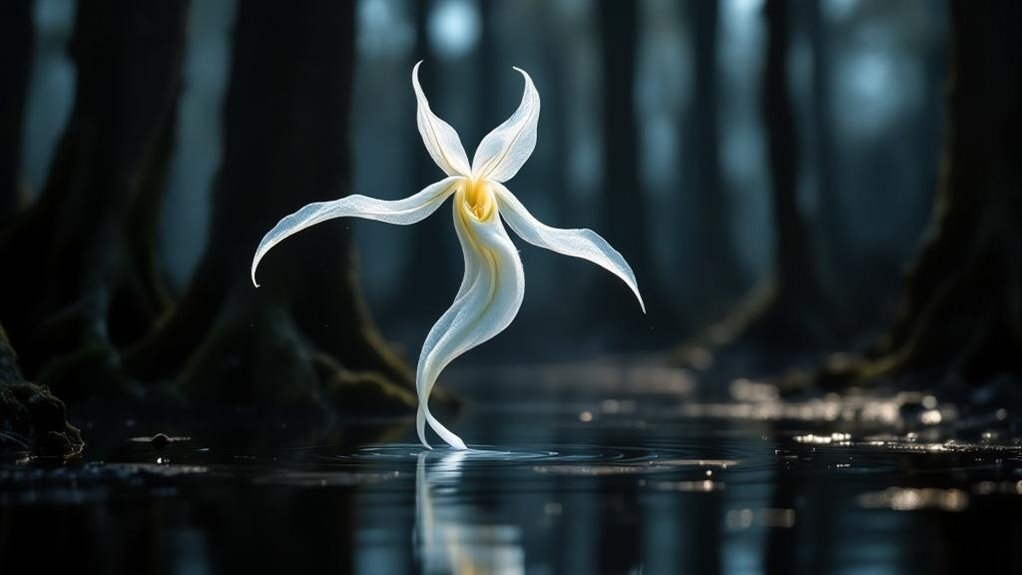
Legends gathered around the ghost orchid not only through cultivated secrecy and dangerous searches, but also through the bloom itself, which appears detached from ordinary plant life; leafless against bark and shadow, the plant seems to suspend its bright white flower in midair, and that stark contrast gives it the observational force of an apparition rather than a rooted organism.
When you study the flower closely, you see long, curling tendrils extending from the white form, and they soften its outline until it seems less botanical than spectral. You encounter it only in summer, from June through October, under narrow conditions that keep it rare, distant from stagnant familiarity.
Its bloom offers no nectar, yet it persists through precise mimicry and dependence on hawk moth pollinators, and that hidden strategy deepens the sense that it belongs to another order.
How Orchid Scents Blend Seduction and Unease
Scent completes the orchid’s unsettling power, since fragrance reaches you before form does and shapes perception with a cultivated intimacy; many orchids have long been treated as emblems of seduction, their rich, exotic perfumes tied to aphrodisiac traditions and to the idea that desire can arise through atmosphere as much as through appearance.
Orchid scent unsettles before beauty appears, cultivating seduction through atmosphere and making desire feel intimate, immediate, and faintly dangerous.
You encounter that duality in three ways:
- Sweet orchid scents invite fascination, surrounding you with luxury, allure, and observational calm.
- Other orchids emit stagnant, carrion-like odors, revealing a colder strategy that attracts pollinators through decay.
- Literature amplifies both effects, especially in Victorian writing, where orchids signal attraction while shadowing scenes with danger.
Because scent bypasses distance and reason, you don’t merely observe orchids; you register seduction and threat together, and that union suits supernatural tales with disturbing precision.
Why Orchids Carry Love, Loss, and Longing
That atmospheric unease deepens when orchids begin to signify attachment rather than mere allure, since the flower has long carried ideas of love, loss, and longing. Those meanings rest on more than decorative custom; in Greek tradition, its ties to fertility and passion gave it an intimate symbolic charge. Later aphrodisiac associations strengthened its role as a token of romantic feeling, and its exotic beauty kept desire slightly out of reach. Thus, admiration often shaded into yearning.
In Victorian circles, you see that charge cultivated through luxury and exclusivity, where orchids marked deep affection yet also implied distance, restraint, and aspirations that remained stagnant. The Ghost Orchid sharpens this pattern; its rarity and fragility make you read it as remembrance, grief, and beauty already vanishing.
This is why literature so often places orchids beside sorrow and desire.
Why Orchids Haunt Modern Culture
Because modern culture favors symbols that can hold beauty and unease at once, orchids continue to haunt its stories, images, and obsessions; their exotic forms, unusual life cycles, and cultivated air of secrecy make them feel less like ordinary flowers than like signs of hidden meanings that haven’t fully disclosed themselves.
You encounter that tension repeatedly, and it persists because orchids gather several haunting associations at once:
- The ghost orchid suggests disappearance, absence, and the spectral.
- Literature and art cast orchids as beauty edged with danger.
- Older links to death, the underworld, and Victorian opulence deepen their gothic charge.
When you read modern supernatural narratives, orchids rarely function as stagnant decoration; they act as observational signals, pointing toward secrecy, lost wealth, and afterlives that remain near, cultivated, and unsettled in cultural memory still.
Frequently Asked Questions
What Do Orchids Symbolize in Witchcraft?
In witchcraft, you’ll find orchids symbolize sensuality, fertility, love, prosperity, luck, protection, and mystical desire. Practitioners use them in spells, charms, and amulets because their rare beauty suggests enchantment, attraction, and powerful spiritual energy.
What Does the Ghost Orchid Symbolize?
The ghost orchid symbolizes beauty that won’t stay, rarity, mystery, and nature’s fragility. You see its “living ghost” bloom and can’t miss the irony: something so delicate carries powerful meanings of loss, wonder, and spirit.
What Is the Spiritual Significance of Orchids?
You can see orchids as spiritual symbols of beauty, integrity, fertility, and divine connection. They remind you to value inner refinement, welcome good fortune, honor sacred love, and recognize strength, grace, and transformation.
Why Are Ghost Orchids Illegal?
Protected, prized plants become illegal for you to pick or sell because poaching and habitat loss have pushed ghost orchids toward peril. You can’t legally collect them; laws safeguard their scarce survival and fragile ecosystems.
Conclusion
When you trace orchids through ghost stories, you see why they persist: their cultivated beauty resists easy interpretation, their pale blooms seem to hover above stagnant water or dark bark, and rarity invites observational habits that turn absence into omen. The ghost orchid alone can take seven to ten years to flower, a statistic that helps explain its hold on the imagination; what appears suddenly, after years unseen, naturally gathers meanings tied to life, death, and return.