
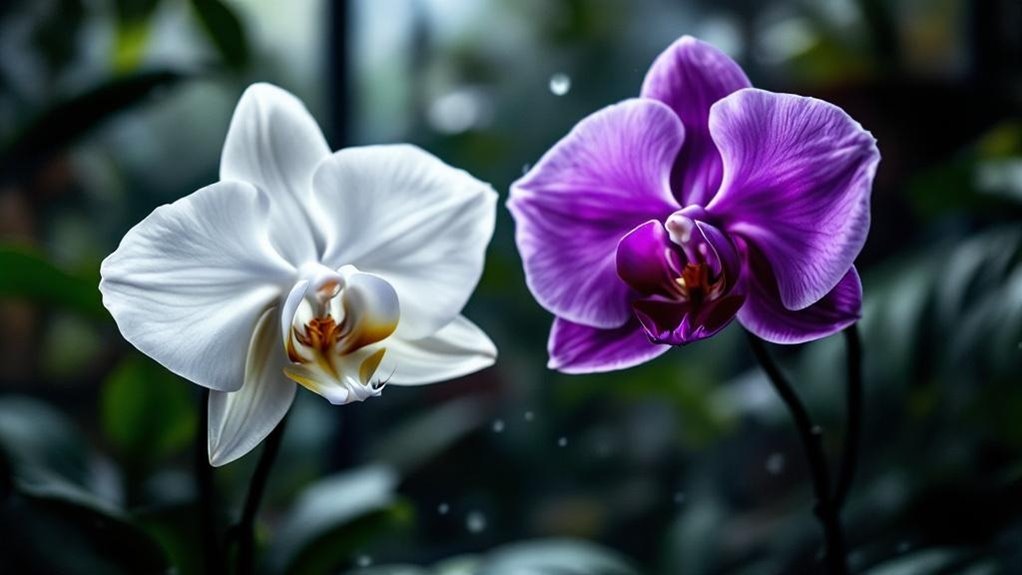
You find contradictory orchid meanings because orchids never carried one stagnant symbolism; thousands of species, distinct colors, regional customs, and changing historical uses all shaped different interpretations. Ancient observational links produced fertility meanings, medicinal and culinary orchids suggested health or comfort, and cultivated greenhouse orchids came to signal refinement, rarity, and status. Trade, breeding, and gift culture added more layers, so meaning now depends on species, shade, occasion, and place; the fuller pattern becomes clearer just ahead.
- Key Takeaways
- What Orchids Mean Overall
- Why Orchid Meanings Vary
- Orchid Meaning by Color
- White Orchid Meanings
- Pink Orchid Meanings
- Purple Orchid Meanings
- Yellow, Red, and Green Orchid Meanings
- How Orchid Species Affect Meaning
- Orchid Meaning Across Cultures
- Ancient Greek Orchid Symbolism
- Aztec Orchid Meanings
- Victorian Orchid Meanings
- Chinese Orchid Meanings
- Japanese Orchid Meanings
- Orchid Meanings in Modern Gifting
- How to Choose the Right Orchid Meaning
- Frequently Asked Questions
- Conclusion
Key Takeaways
- Orchid meanings conflict because thousands of species differ in appearance, use, rarity, and cultivation history, preventing one fixed universal symbolism.
- Ancient medicinal, ritual, and fertility associations survived alongside later ideas of virtue, elegance, prestige, and luxury.
- Cultural context changes orchid symbolism: East Asia praises moral refinement, Greek tradition stressed fertility, and Victorian Europe emphasized status and passion.
- Color meanings add contradictions, since white orchids may signify purity in weddings but mourning or reverence in some Asian funerary traditions.
- Trade, colonial collecting, and commercial breeding layered new luxury meanings onto older local traditions, creating overlapping and inconsistent interpretations.
What Orchids Mean Overall

Although orchid meanings often seem contradictory at first, the flower’s overall symbolism is fairly consistent: across many cultures, orchids have come to represent beauty, refinement, and rarity, qualities that feel cultivated rather than accidental and that still shape how people use them in gifts, interiors, and collections.
When you look across history, you find that orchids symbolize distinction more than any single emotion; even ancient traditions that linked them to fertility, status, healing, or noble character still point toward something exceptional rather than ordinary or stagnant.
Orchid Colors add modern nuance, yet the broader observational pattern remains stable: whether displayed in a home, given formally, or collected horticulturally, orchids suggest taste, care, and selective value. Their immense botanical breadth and long history reinforce that impression, because rarity, complexity, and refinement remain their most durable meanings.
Their Victorian-era popularity during orchidelirium helped cement orchids as expensive symbols of exclusivity and elite taste.
Why Orchid Meanings Vary
When you ask why orchid meanings vary, you have to take into account cultural context shifts, because a flower cultivated across thousands of species and regions never stays tied to one stagnant interpretation.
You also have to take into account how history shapes meaning; ancient rituals, medicinal uses, and later European luxury culture each attached different values to orchids, and those observational layers persisted even when they contradicted one another.
Then color symbolism differences complicate your reading further, since white, purple, yellow, and pink orchids don’t signify the same thing across cultures or occasions, and global trade only intensified those conflicts.
In China, orchids also belong to the Four Gentlemen, which ties them to virtue, refinement, and scholarly character rather than just decoration.
Cultural Context Shifts
Because orchid symbolism grows out of local habits, materials, and ideals rather than any stagnant universal code, its meanings shift from culture to culture and from one historical moment to the next; Ancient Greeks fixated on the plant’s tuber shape and linked it to fertility, which is reflected in the word *orkhis*, while Victorian collectors, shaped by scarcity, imperial trade, and cultivated taste, treated rare orchids as emblems of luxury and status during the period often called orchidelirium.
| Culture | Orchid use | Meaning |
|---|---|---|
| ancient Greeks | tubers | fertility |
| Victorian times | collecting | status |
| China | Dendrobium medicine | healing |
You can see how cultural context directs interpretation; with thousands of species, regions used different orchids for medicine, food, or ornament, and those practical roles steadily shaped symbolic meaning over time. In East Asia, orchids were also prized for cultivated refinement, which helped them stand for virtue, admiration, and graceful conduct rather than only desire.
Color Symbolism Differences
Since orchid colors never carry a stagnant meaning across place and time, their symbolism varies with the cultivated habits, beliefs, and uses that surround them; in China, green and yellow orchids often suggest health and good fortune, shaped by medical traditions and broader associations with liveliness, while in Victorian Europe, purple orchids signaled royalty and luxury, reflecting elite taste, rarity, and the social theater of collecting.
As you compare traditions, you see why purple orchids can imply prestige in one setting yet feel merely decorative in another; white orchids symbolize restraint, virtue, or mourning depending on philosophical and ritual frameworks, and Yellow Orchids often lean toward being essential where medicinal or culinary uses matter. In Thailand, orchid colors also carry distinct meanings, with white suggesting serenity, pink expressing affection, and purple signaling royalty and wisdom.
Modern breeding complicates your reading further, because commercial labels add aspirational meanings to cultivated hues.
History Shapes Meaning
A fuller explanation for these shifting color codes lies in history itself, which records what people observed in orchids, how they cultivated and used them, and which texts or institutions gave those observations lasting authority. In ancient Greece, you see fertility attached to orchids because observational readings of tuberous roots guided belief; in China, Confucius made orchids emblems of virtue and cultivated nobility.
You also see practical use shaping symbolism, since vanilla orchids and Aztec ritual drinks linked orchids with strength, value, and potency, while Dendrobium in medicine connected them to health. Later, Victorian “orchidelirium” recast orchids in the West as rare luxuries, and trade, colonial collecting, and botany layered new meanings over older ones, so symbolism never stayed stagnant, singular, or entirely local, across generations and regions. Queen Victoria’s approval helped turn orchids into unmistakable status symbols in Victorian Britain.
Orchid Meaning by Color
When you look at orchid meaning by color, you can’t assume a single message, because white may suggest purity or funerary reverence in one setting while pink reflects cultivated ideas of femininity, fertility, and modern care.
You also see how purple shifts between royalty, admiration, luxury, and mystery, while yellow often follows commercial floristry toward friendship and joy rather than older, more regional readings.
Green, by contrast, offers an observational reminder that symbolism doesn’t stay stagnant, because its rarity can mark renewal and good fortune in some cultures yet produce different interpretations where the hue is uncommon.
Across these examples, cultural context shapes whether an orchid feels romantic, respectful, celebratory, or even solemn.
White And Pink Meanings
You’ll notice that white and pink orchids seem straightforward at first, yet their meanings diverge once cultural context enters the frame; white orchids are widely cultivated as emblems of purity, innocence, and new beginnings in Western weddings and sympathy arrangements, but that same color can carry associations with mourning in parts of Asia, which gives white a distinctly contradictory symbolism rather than a stagnant one.
When you turn to pink orchids, the symbolism and meaning become more stable; you’ll usually encounter femininity, grace, joy, and admiration, which explains their popularity for baby showers and affectionate gifts. Victorian flower language strengthened this divide, casting white as refined elegance and pink as gentle affection, while modern floristry keeps repeating those cues, even as local history, ritual use, and regional prestige still modify your reading. In some traditions, white orchids also stand for peace, remembrance, and quiet dignity, which helps explain why the same flower can feel celebratory in one setting and memorial in another.
Purple Yellow And Green
Across purple, yellow, and green orchids, the symbolism becomes more layered rather than more stagnant, because each color carries a cultivated set of meanings shaped by rarity, prestige, and local custom; purple orchids usually signal royalty, dignity, and admiration, a pattern reinforced by Victorian collectors who treated rare purple blooms as status objects and by modern floral practice, which still reads them as marks of respect and quiet luxury.
- You read purple orchids as prestige, admiration, mystery.
- You see yellow orchids suggest friendship and renewal.
- You notice Chinese custom ties yellow to fortune.
- You interpret green orchids through health and harmony.
- You remember meanings shift across eras and regions.
You can read yellow orchids as friendship, joy, and new beginnings, while green orchids suggest renewal, health, harmony, and sometimes luck, especially where prized varieties shaped cultural esteem.
White Orchid Meanings
Ambiguity defines white orchid meanings, because the same cultivated bloom can signal purity, innocence, and new beginnings in Western floral etiquette, yet it can also express mourning and reverence in funeral traditions shaped by different regional expectations.
| Context | Meaning |
|---|---|
| Weddings | purity |
| Christenings | innocence |
| Bridal bouquets | new beginnings |
| Funerals | mourning |
| Regional rituals | reverence |
When you give white orchids, you aren’t sending a stagnant, universal message; you’re participating in an observational system shaped by ritual, market history, and recipient expectation. The white Phalaenopsis strengthened purity associations because florists promoted its long-lasting blooms for weddings, yet historical symbolism attached white flowers to both sacred celebration and death, so your meaning depends less on the orchid itself than on where, why, and to whom you present it.
Pink Orchid Meanings

Pink orchid meanings feel less divided than white orchid meanings, yet they still depend on hue, setting, and cultural expectation; in many traditions, cultivated pink orchids symbolize femininity, grace, and joy, which is why florists and gift-givers often choose them for baby showers, milestone celebrations, and breast-cancer awareness events.
Pink orchids often convey femininity, grace, and joy, though their meaning still shifts with shade, setting, and cultural expectation.
- Victorian codes favored admiration
- Pale tones suggest innocence
- Deeper hues show affection
- Some Asian readings express gratitude
- Phalaenopsis Orchid gifts feel enduring
When you assess pink meaning, you should watch the shade and occasion; Victorian observers read pink orchids as gentle romantic interest, not stagnant passion, while many Asian recipients may read thanks or friendship instead.
Because pink orchids often appear as Phalaenopsis Orchid or Cattleya gifts, you also associate them with accessibility, durability, and cultivated elegance.
Purple Orchid Meanings
Regality shapes most readings of purple orchids, and that association isn’t accidental; in Victorian Europe, collectors treated rare purple varieties as cultivated displays of wealth, refinement, and high social rank, so the flower acquired a durable link to prestige that still informs modern interpretation.
When you give purple orchids today, you usually signal admiration, respect, and dignity, which is why they suit graduations, awards, and formal congratulations; yet shade alters the observational reading, since deep purple suggests opulence and power, while lavender leans toward grace, mystery, or spiritual enrichment.
Cultural context rarely leaves meaning stagnant, and some Asian traditions reinforce these themes by tying purple to nobility and prosperity. Commercial floristry broadens the message further, so weddings, sympathy arrangements, and romantic gestures can overlap, producing interpretations that differ by hue, setting, and intent.
Yellow, Red, and Green Orchid Meanings
Once you move beyond purple’s cultivated link to prestige, yellow, red, and green orchids show even more clearly why orchid symbolism doesn’t stay stagnant, because each color carries an observational meaning shaped by region, ceremony, and use.
- yellow orchids suggest friendship, joy
- they can also imply mourning, jealousy
- red orchids signal love, strength, respect
- in Japan, red may mean prosperity
- green orchids suggest renewal, fortune, novelty
When you read yellow orchids as cheerful, you follow sunlight associations; when another source treats them as funeral flowers, you see ceremony redirect meaning.
With red orchids, Western gifting favors romance, while other traditions emphasize status, power, or respect.
Green orchids often suggest harmony and good fortune, yet horticultural writing may stress rarity or medicinal utility instead, creating contradiction.
How Orchid Species Affect Meaning

When you consider orchid meaning, you can’t treat the family as stagnant or uniform, because species shape symbolism through their uses, forms, and scarcity; a medicinal Dendrobium, a cultivated Phalaenopsis, and a rare Cattleya have never carried the same cultural weight.
You also have to distinguish wild from cultivated orchids, since regional habitats, local myths, and ease of growing changed how people read each variety, turning some into signs of healing, sensuality, prestige, or simple domestic grace.
If you take an observational view, you’ll see that cultural meaning by variety isn’t accidental but built from geography, practical value, and visible traits, which is why one orchid can suggest refinement while another suggests fertility or status.
Species Shape Symbolism
Although orchids are often discussed as a single symbol, their meanings shift noticeably from species to species, because people read form, use, rarity, and place through an observational lens that turns botanical difference into cultural meaning.
- Phalaenopsis suggests calm elegance.
- Cattleya implies passion, display, luxury.
- Vanilla signals comfort through use.
- Dendrobium supports health, longevity traditions.
- Neofinetia reflects regional virtue histories.
When you compare different species of orchids, you see why no single reading stays stable; one orchid species acquires meaning from petals, another from species used in food or medicine, and another from cultivated scarcity.
Vanilla became comforting because daily flavor resists stagnant abstraction, while Vanda remained exotically distant.
Dendrobium entered Chinese healing texts, so health attached to it specifically.
Cattleya’s rarity, and difficult cultivation, reinforced status.
Wild Vs. Cultivated
Because orchid meaning begins with actual plants rather than a stagnant emblem, the contrast between wild and cultivated species matters immediately; wild orchids belong to a family of more than 25,000 forms, and people historically attached meaning to the particular species around them, reading local shape, scent, habitat, and use through an observational lens that produced very different symbols in different places.
| Type | Basis | Meaning |
|---|---|---|
| wild orchids | medicinal use | health |
| wild orchids | culinary value | provision |
| cultivated orchids | greenhouse display | elegance |
| cultivated orchids | selective breeding | status |
You can see how orchidelirium intensified this divide; breeders favored Phalaenopsis, Cattleya, and Vanda for enlarged blooms and curated color, so luxury meanings accumulated, while practical species such as Dendrobium and Vanilla planifolia kept older associations grounded in potency and use.
Cultural Meaning By Variety
Variety governs orchid meaning more than any stagnant, universal emblem ever could, since people don’t respond to an abstract “orchid” so much as to observable species traits, historical uses, and cultivated reputations that have accumulated over time.
- Phalaenopsis suggests elegance, enduring affection; orchids symbolize purity.
- Dendrobium carries health, longevity through Chinese medicine.
- Cattleya implies luxury; Victorian rarity shaped orchid symbolism.
- Oncidium reads as cheerful friendship through accessibility.
- Vanilla and Neofinetia show function, geography create different meanings.
When you compare species observationally, meanings separate with surprising consistency; white Phalaenopsis suits sympathy and purity, large Cattleya or Vanda projects admiration and royalty, Neofinetia recalls Japanese nobility and bravery, and vanilla orchids, tied to Aztec ritual and culinary richness, suggest power, sensuality, and cultivated value beyond appearance alone.
Orchid Meaning Across Cultures
Across cultures, orchid meaning doesn’t stay fixed; it shifts with history, local practice, and the cultivated values a society chooses to attach to the flower. When you examine orchids globally, you see the meaning of orchids diverge because each culture absorbed different species into medicine, ritual, literature, and status display, so symbolism never remains stagnant.
You can trace those differences through use and context: medicinal orchids suggest health and longevity, rare orchids suggest wealth and sophistication, and color meanings change with social custom rather than botany alone. White may mark purity in weddings yet mourning elsewhere; pink may signal femininity for expecting mothers in parts of Asia.
Literary voices also matter, because writers and philosophers gave orchids observational, moral, and linguistic weight that later generations preserved, revised, or contradicted across eras.
Ancient Greek Orchid Symbolism
Ancient Greece offers one of the clearest early examples of orchid symbolism taking a sharply specific form, since the very word orchid derives from the Greek orkhis, meaning “testicle,” a name shaped by the observational resemblance of certain tubers and quickly cultivated into ideas of fertility, virility, and reproductive power.
- You see the Greek word anchor meaning.
- You find orchid tubers guiding folk belief.
- You notice fertility and virility dominate symbolism.
- You trace Theophrastus preserving associations.
- You recognize medicinal and magical use.
If you look beyond stagnant decoration, you find orchids embedded in remedies and rites tied to reproduction; Greek belief even held that eating larger orchid tubers encouraged sons, while smaller ones favored daughters.
Through Theophrastus, these associations entered early botanical memory and continued shaping later traditions, including gifts for expecting mothers.
Aztec Orchid Meanings
As you turn to Aztec orchid meanings, you find a cultivated association with power and strength, because orchids—especially vanilla—weren’t treated as stagnant ornaments but as active symbols of virility, courage, and elite authority.
You can see this most clearly in vanilla-based ritual elixirs, where orchid pods were mixed with cacao and consumed by warriors and nobles before battle or ceremony, an observational pattern that tied the plant to physical prowess and political success.
If you follow the Aztec view closely, you notice that botanical precision mattered less than aromatic force and symbolic potency, so orchids functioned as luxurious, magical agents reserved for ritual use rather than ordinary healing.
Power And Strength
- You see orchid motifs beside warfare and rulership signs.
- You notice nobles using orchids to reinforce status.
- You find ritual caches tying orchids to sacred legitimacy.
- You recognize rarity and scent as markers of power.
- You understand why Aztecs read orchids as strength.
When you read codices and chroniclers together, you can trace an observational pattern: orchids didn’t sit as stagnant ornaments, they signaled sanctioned authority, martial prowess, and political reach, and their presence helped rulers frame conquest as divinely supported, materially grounded, and publicly visible.
Vanilla And Ritual Elixirs
In ritual drinking practices, the Aztecs treated the vanilla orchid not as a stagnant flavoring but as a cultivated source of potency, mixing its fragrant pods with cacao, and at times with honey or chili, to produce an elixir that marked rank, reinforced masculine vigor, and signaled readiness for war.
When you trace these elixirs through Spanish observational accounts, you see how ritual use tied vanilla to mystical authority and visible status, because nobles and warriors consumed them in ceremonies that joined appetite, governance, and conquest. You can also see why orchid meanings later diverged; once European readers encountered reports of Aztecs using vanilla as medicine, stimulant, and aphrodisiac, they carried forward an exoticized image in which orchids signified refinement, virility, sacred power, and imperial ambition all at once.
Victorian Orchid Meanings

Although Victorians often treated flowers as coded messages, orchids carried a particularly cultivated set of meanings, joining refinement, exotic beauty, and deep passion in a single bloom, so their significance could shift from quiet admiration to unmistakable desire depending on the giver, the setting, and the social distance between those involved.
- In the Victorian era, floriography made your orchid highly observational.
- Orchidelirium turned collecting into status display and cultivated prestige.
- Rare imports signaled wealth, empire, and access to global trade.
- Conservatories, hybrids, and greenhouse methods raised orchid authority.
- Demand also encouraged damaging harvests from stagnant wild habitats.
You can see why meanings contradicted each other: one orchid suggested disciplined taste, another implied desire, and both reflected rarity, colonial networks, and social performance, not simply the flower itself or botanical beauty alone.
Chinese Orchid Meanings
Where Victorian orchid meanings often turned on social performance, Chinese orchid meanings rest more firmly in cultivated virtue, learned tradition, and the steady observation of character, since classical writers, painters, and scholars treated the orchid, especially Cymbidium, as a sign of refinement and nobility rather than mere rarity.
When you read Confucius, you see why the Orchid became moral rather than merely decorative; its restrained fragrance and upright growth model cultivated conduct. In Chinese art, it stands among the Four Gentlemen, so you interpret it through seasonal endurance and self-discipline, not stagnant display.
Dendrobium adds another layer, because medicinal use in treating dryness, weakness, and yin depletion links orchids with health and longevity. Color also guides meaning: green suggests renewal, pink grace, and purple respect, though regional species traditions still complicate any single reading.
Japanese Orchid Meanings
Japanese orchid meanings keep that East Asian emphasis on cultivated character, yet they turn it toward rank, discipline, and auspicious domestic life; from the Edo period onward, orchids, especially Neofinetia falcata, carried associations with bravery, refinement, and status because samurai and nobles collected them, displayed them, and treated their careful growth as an observational practice rather than stagnant ornament.
- In Japan, the samurai orchid signaled status.
- You also read it as prosperity and good fortune.
- Rarity linked orchids with wealth and luxury.
- White, purple, pink, and green carried distinct values.
- You still see them in ikebana and nurseries.
If you trace these meanings, you find fertility, reverence, grace, and renewal layered onto prestige, so orchids in Japan present disciplined beauty, cultivated wealth, and quietly auspicious order.
Orchid Meanings in Modern Gifting

In modern gifting, orchid meanings become especially legible because people usually choose them with a clear social purpose in mind, matching color and variety to the tone of the occasion rather than treating the plant as stagnant decoration.
Orchid symbolism reads most clearly in gifting, where color and variety are chosen to suit the occasion’s social meaning.
When you send pink orchids, you usually signal grace, feminine appreciation, or baby-shower joy; when you choose purple orchids, you communicate admiration, respect, and cultivated success, which explains their fit for promotions and formal congratulations.
White orchids remain observationally consistent, since you give them at weddings and in sympathy arrangements, where purity and elegance can mark both beginnings and remembrance.
You may also see yellow and green orchids at housewarmings or beside recovery beds, reflecting friendship, renewal, and good fortune.
Variety matters too; Phalaenopsis suggests endurance, while Vandas and Cattleyas project status and visual drama.
How to Choose the Right Orchid Meaning
Selection begins with context, because you can’t choose the right orchid meaning by relying on stagnant ideas about floral beauty alone; you need to take into account the recipient’s culture first, then match color and species to the message you actually intend to send.
- Start with cultural context; white may honor purity, or mourning.
- Use color symbolism precisely: pink gratitude, purple admiration, yellow friendship, green renewal.
- Let species choice support meaning; Phalaenopsis suggests enduring affection through cultivated, lasting blooms.
- Add observational clarity with history; Dendrobium can signify resilience and medicinal associations.
- Include a brief card explaining color, species, and cultural reference, preventing misreading.
You should choose deliberately, because meanings shift across traditions, and explicit explanation keeps your intent clear, respectful, and aligned.
Frequently Asked Questions
What Does the Bible Say About Orchids?
The Bible doesn’t mention orchids at all. You won’t find orchid names or symbolism in Scripture; instead, you’ll see common Near Eastern plants. Any “biblical meaning” attached to orchids comes from later Christian interpretation, not the text.
Why Can’t You Touch Orchids?
You can’t touch orchids much because your skin’s oils, salts, and germs can damage blooms, spread disease, and crush delicate parts. Picture a fingerprint bruising velvet: even light handling can shorten flowering, trigger bud drop.
What Do Different Orchids Symbolize?
You’ll find different orchids symbolize distinct ideas: Phalaenopsis suggest lasting love, Cattleya signal luxury, white conveys purity, purple admiration, pink gratitude, yellow friendship, red passion, while Dendrobium and Cymbidium can represent refinement, health, endurance, and prosperity.
Why Are Lady Slipper Orchids Illegal in the US?
They’re illegal because you can’t collect, sell, or transport many lady slipper orchids from the wild in the U.S. Laws protect them after overcollection and habitat loss devastated populations, and violators can face fines or charges.
Conclusion
You can read orchid meanings as you would follow a cultivated garden path through shifting light; each turn alters the color of the same bloom, yet the flower itself remains unchanged. Contradictions persist because symbols grow from place, ritual, and intention, and no single reading can govern them without becoming stagnant. If you choose an orchid with observational care, you won’t need one fixed meaning; you’ll offer a message shaped by context, and thus more truthful.