
Across cultures, you find rare orchids turned into legends because their strange mimicry, brief flowering, and exacting ties to fungi, trees, wetlands, and pollinators made them seem governed by hidden rules; Greek traditions linked orchis to desire and fertility, Aztec vanilla to sacred vigor, Chinese orchids to cultivated virtue, Hawaiian leis to honor and mana, and rarities like the Dove, Green Squid, and underground orchids to souls, thresholds, and guarded domains. More patterns follow.
- Key Takeaways
- Why Rare Orchids Inspire Legends
- Greek Orchid Myths of Desire
- Aztec Vanilla Orchid Myths
- Chinese Rare Orchid Symbols of Virtue
- Hawaiian Orchid Legends of Honor
- Victorian Orchid Myths About Wealth
- Why Orchid Biology Feels Mythical
- Ghost Orchid Legends and Spirit Worlds
- Fly Orchid Myths of Trickery
- Flying Duck Orchid Dreamtime Stories
- Donkey Orchid Shape-Shifting Myths
- White Egret Orchid Legends of Purity
- Dove Orchid Legends as Soul Messengers
- Green Squid Orchid Legends of Hidden Realms
- Western Underground Orchid Legends and Biology
- Why Rare Orchid Myths Matter Today
- Frequently Asked Questions
- Conclusion
Key Takeaways
- The ghost orchid of Florida swamps is often seen as a lost soul, its pale, leafless bloom inspiring legends of spirits and vanished lovers.
- In Greek tradition, Orchis was transformed into an orchid, linking the flower to fertility, desire, and divine punishment.
- The Aztec vanilla orchid was treated as a sacred gift, especially in ceremonial cacao drinks associated with strength, status, and ritual devotion.
- In Chinese culture, orchids symbolize virtue, solitude, renewal, and moral refinement, especially in poetry and literati painting.
- Regional legends give rare orchids animal-spirit identities, including Australia’s flying duck orchid and Japan’s white egret orchid as signs of transformation.
Why Rare Orchids Inspire Legends
Because rare orchids appear at the edge of ordinary observation, cultures have long treated them as more than plants, reading their unusual forms, elusive habits, and exacting ecological needs as signs of hidden power.
Rare orchids linger at the limits of notice, inviting cultures to read hidden power in their uncanny forms and exacting lives.
When you encounter rare orchids that resemble bees, flies, monkeys, or doves, you can see why observational traditions imagined plants crossing into animal or spirit domains; mimicry seems too exact to feel stagnant or accidental.
Their secrecy deepens that impression, since some bloom underground, some open only at night, and some remain dormant for years, as though they answer cultivated rules beyond human reach.
You also find legend in dependence: fungi, host trees, wetlands, and precise pollinators must align before an orchid survives, so people inferred guardianship, status, mystery, and forces working just outside ordinary sight and memory.
The ghost orchid adds another layer, with its pale, leafless bloom in Florida swamps inspiring lost-soul and lost-lover legends.
Greek Orchid Myths of Desire
When Greek ideas about orchids come into view, you can trace their legends first through language itself, since the word orchis, meaning “testicle,” gave the family Orchidaceae its name and fixed the plant within an ancient framework of fertility, virility, and bodily desire; from that linguistic root, classical belief moved easily into myth, including the story of Orchis, a youth transformed by the gods into the flower after provoking divine punishment, a narrative that joined erotic impulse to retribution and made the orchid a cultivated emblem of desire that could never remain morally stagnant.
You also find an observational tradition around the orchid’s tubers, whose sizes were read as signs of an unborn child’s sex, while healers and ritual practitioners used the plant in medicinal and fertility rites, reinforcing its authority as an erotic symbol. In later print culture, Louis Liger’s 1704 gardening manual helped spread the Orchis story beyond botany into broader horticultural lore.
Aztec Vanilla Orchid Myths
Although the Aztecs valued many fragrant and medicinal plants, they set the vanilla orchid, Vanilla planifolia, within a more elevated order of meaning, treating its aromatic pods as a divine gift and combining them with cacao in a cultivated drink reserved for nobles, warriors, and ceremonial life.
If you trace Aztec myth through observational accounts, you see how vanilla orchid lore attached strength, vigor, and restrained aphrodisiac power to that beverage, which kept the plant from seeming merely pleasant or stagnant in ritual imagination. You also notice how its epiphytic growth in tropical forests, and the demanding care tied to producing its prized cured fruit, reinforced value through scarcity; therefore Vanilla planifolia moved from sacred ceremony into trade, while supernatural origin stories preserved its fragrant authority beside cacao in Mesoamerican rites. The legend’s Melipona bee connection also explains why the orchid’s pollination was understood as part of a sacred relationship between nature and devotion.
Chinese Rare Orchid Symbols of Virtue
As you turn to Chinese rare orchids, you see why Confucian thought treated them as cultivated signs of virtue, because their restrained beauty, clean fragrance, and observational stillness suggested moral integrity rather than stagnant display.
You also find that their frequent growth in secluded places gave them special force as symbols of solitude and integrity, much as Confucius compared the orchid’s quiet elegance to the character of a gentleman who remains upright without public praise.
In this tradition, you recognize that rarity deepened meaning, since an orchid that endured in humble ground could represent inner worth, disciplined conduct, and refinement that didn’t depend on status or spectacle.
In Chinese art, ink painting helped закрепить the orchid’s association with restraint, self-cultivation, and quiet moral clarity.
Confucian Virtue Symbolism
Because Chinese thinkers valued moral character that remained steady without display, the orchid became a precise Confucian emblem of refined virtue and integrity; Confucius himself compared its delicate fragrance and modest growth to the cultivated person, whose worth doesn’t depend on applause, whose conduct doesn’t turn stagnant in solitude, and whose influence, like scent in clear air, extends through quiet example rather than force.
You see this symbolism reinforced across Chinese culture:
- Orchids are considered signs of spring, renewal, and good fortune.
- In literati art, they join plum, bamboo, and chrysanthemum as moral exemplars.
- In gardens, calligraphy, and rituals, they mark cultivated refinement.
When you read observational poetry or view classic brushwork, the orchid signals disciplined character, auspicious beginnings, and a scholar’s measured, ethical bearing.
Solitude And Integrity
When an orchid appears alone in Chinese poetry or brushwork, it doesn’t suggest abandonment but tested integrity, the cultivated self remaining upright in a secluded grove, still fragrant, still ordered, still free from the stagnant distortions of applause or neglect.
In that observational image, you meet a Confucian standard: Confucius compared the orchid’s solitary fragrance to a gentleman’s character, which stays upright even when no crowd affirms it.
Orchids also announce spring, so you read them as virtue enduring through difficulty, quiet yet persistent, never theatrical.
Because many Orchids root in remote habitats and demand patient tending, Chinese poets and painters treated them as disciplined emblems of restraint, moral purity, and inward cultivation. In art and ritual alike, they promise good fortune by honoring principle over popularity, and steadiness over display.
Hawaiian Orchid Legends of Honor
As you turn to Hawaiian Orchid Legends of Honor, you see orchids tied to royalty and divine beauty, woven into cultivated lei traditions that mark graduations, weddings, and formal presentations, where their color and longevity keep respect from feeling stagnant.
You also encounter Pele, whose presence gives the orchid an observational weight beyond ornament, linking sacred beauty to the land’s creative and destructive force and to the mana that high-status gifts are meant to convey.
When you consider these customs together, you recognize why offering an orchid lei signals honor with unusual precision, and why protecting culturally significant native orchids remains part of that respect.
Royal Lei Traditions
Step into Hawaiian royal lei traditions, and orchids emerge not as stagnant ornaments but as cultivated signs of honor, respect, and a sacred bond between people and ʻāina; in leis made from native and favored varieties such as Dendrobium and Aerides, their durability and fragrance support an observational truth central to ceremony, that beauty must also endure in order to carry meaning through hula, formal welcomes, and rites of passage.
You see orchid leis mark rank and recognition with quiet authority:
- they honor aliʻi and distinguished guests
- they accompany births, weddings, graduations, and funerals
- they preserve mana through strand, braid, and clip forms
When you place or receive one, you participate in a royal practice where cultivated beauty, endurance, and respect remain inseparable across generations and ceremonies alike.
Pele And Sacred Beauty
Consider how Pele’s presence reshapes the meaning of orchid beauty in Hawaiian legend, because these flowers don’t stand as stagnant ornaments alone but as cultivated signs of honor, divine regard, and the living authority of the islands themselves; in traditions that link certain orchids to the volcano goddess and to the sacred landscapes formed by fire, their use in leis and offerings carries an observational truth central to ritual, that beauty becomes most meaningful when it acknowledges both rank and origin, both human ceremony and the enduring power of the land.
You see why orchids are associated with royalty, why they appear at significant occasions, and why lei-giving marks respect, prestige, and spiritual obligation; when you place them in ceremony, you affirm ties to Pele, to ancestors, and to the island’s sacred order.
Victorian Orchid Myths About Wealth
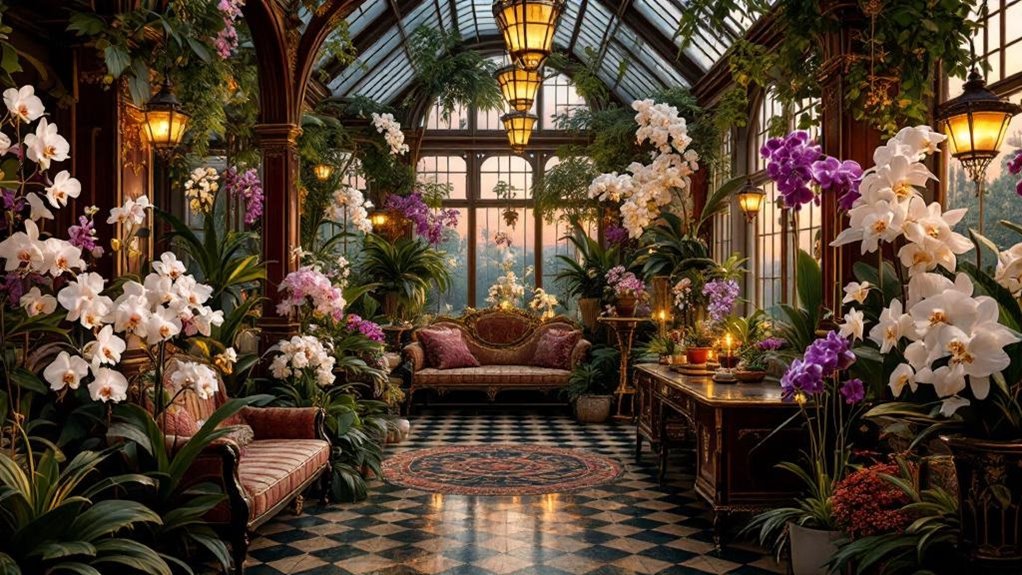
Although orchids had long carried an aura of rarity, Victorian Britain turned them into cultivated proofs of wealth and rank, and one of the most persistent myths claimed that the most delicate specimens would only thrive in the hands of noble blood. In orchid mania, you can see how that legend served collectors, because rarity looked more legitimate when society treated success with certain flowers as inherited refinement rather than money alone.
- Vast prices suggested cultivated distinction and worldliness.
- Glasshouses displayed labor, expense, and observational control.
- Expeditions and smuggling fed prestige while native habitats grew stagnant.
If you followed Victorian fashion, you’d read an orchid house as a social document; each imported bloom implied risk, reach, and leisure, while possession, not conservation, governed taste and encouraged overcollection abroad.
Why Orchid Biology Feels Mythical
What makes orchid biology feel mythical isn’t mere rarity, but the way ordinary botanical processes in this family so often evade ordinary expectations; some orchids, such as *Rhizanthella gardneri*, pass their entire life cycle underground, from germination to flowering to seed set, while many others begin as dust-like seeds so poor in stored nutrients that they can’t develop at all unless specific mycorrhizal fungi supply carbon and initiate growth.
When you add sexual deception, where flowers imitate female insects with cultivated precision, you see why observational minds once imagined intention rather than selection; even a mycorrhizal fungus seems less like a partner than a hidden accomplice. You also encounter orchids tied to narrow habitats, stagnant dependencies, nocturnal scents, brief bloom windows, and uncommon color displays, so their appearances feel less botanical than ceremonial, and their absences equally patterned.
Ghost Orchid Legends and Spirit Worlds
You encounter Ghost Orchid legends where observation meets belief:
- its bloom suggests a lost soul drifting near stagnant water;
- its rarity marks moments when spirit boundaries seem briefly cultivated open;
- its irregular flowering implies unseen presences, not botanical timing alone.
Because you rarely find a Ghost Orchid, communities historically read sightings as omens, while modern conservation often joins science with reverence, protecting fragile habitats as liminal ground.
Fly Orchid Myths of Trickery
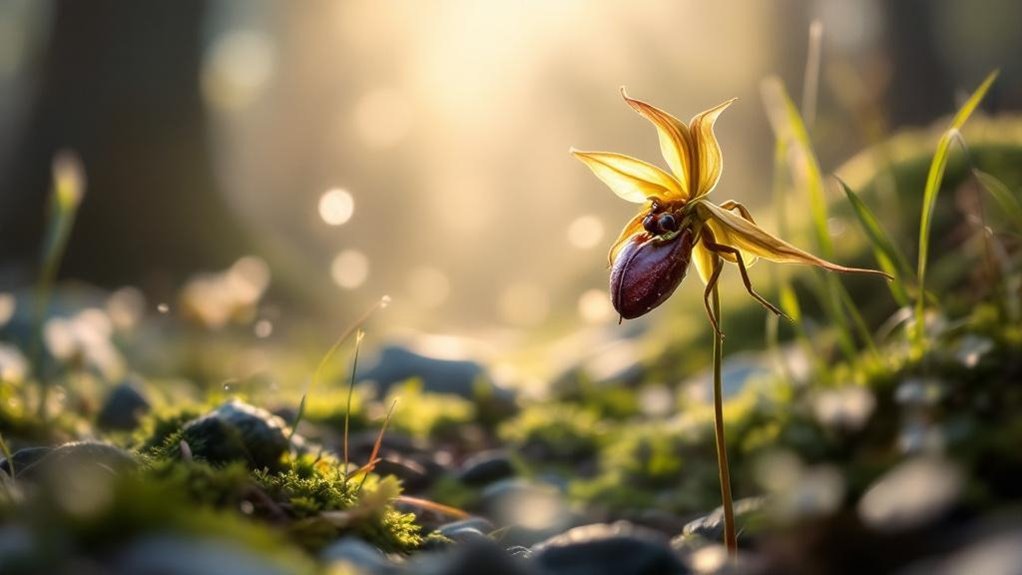
How did the Fly Orchid come to represent botanical deception so completely in European folklore, if not through the unsettling precision of its form; its dark, glossy labellum and yellow-green sepals create the observational impression of a fly at rest, and traditional accounts held that the plant also mimicked the scent of female insects, drawing male flies into futile mating attempts that served the orchid’s pollination.
When you trace the Fly Orchid through cultivated rural memory, you find a plant portrayed as dressing itself in insect likeness, fooling flies, unsettling stagnant superstition, and, when it vanished from familiar woods, seeming to confirm tales of caprice or forest spirits.
You also encounter botanists and collectors who enlarged its reputation with claims that it confused travelers or attracted livestock, although conservation records show a narrower truth: specialized fungal dependence and fragile pollinator ties.
Flying Duck Orchid Dreamtime Stories
Set against the wetlands and open forests of eastern and southern Australia, the Flying Duck Orchid enters Dreamtime storytelling not as a botanical curiosity alone but as an ancestral sign, because its small flower resembles a duck in mid-flight and its hinged labellum moves with such unsettling precision that traditional interpretations read motion, memory, and country together; in some Aboriginal narratives, a duck spirit fell from the sky and became this orchid, leaving behind a cultivated reminder of waterfowl presence, seasonal rains, and the obligations of custodianship that bind people to the sandy soils and fragile habitats where the plant appears.
- You read rain signs.
- You observe wetland returns.
- You inherit custodial duties.
In observational lore, the Flying Duck Orchid marks waterbird cycles, avoids stagnant ground, and teaches interconnectedness among people, pollinators, birds, and country.
Donkey Orchid Shape-Shifting Myths
Across southwestern Western Australia, the Donkey Orchid shifts the mood from wetland bird-sign to inland warning tale, because the genus *Diuris*, with its twin upright petals and cultivated resemblance to long ears, entered both Aboriginal Dreaming and later farming folklore as evidence of unstable form; observational stories describe a mischievous being that could take donkey shape to mislead travellers and then return to human appearance at dusk, while local bush myths recast those same ear-like petals as the remains of a spirit that once warned farmers of approaching fires, so the flower came to mark not only transformation but also the reading of country, seasonal disturbance, and the uneasy sense that strange animal movements or other departures from the stagnant ordinary had already passed nearby.
You read prolific donkey orchid blooms after winter rains as a sign that shape-shifters crossed country. Conservation storytellers now use these legends to protect vulnerable *Diuris* habitats.
White Egret Orchid Legends of Purity
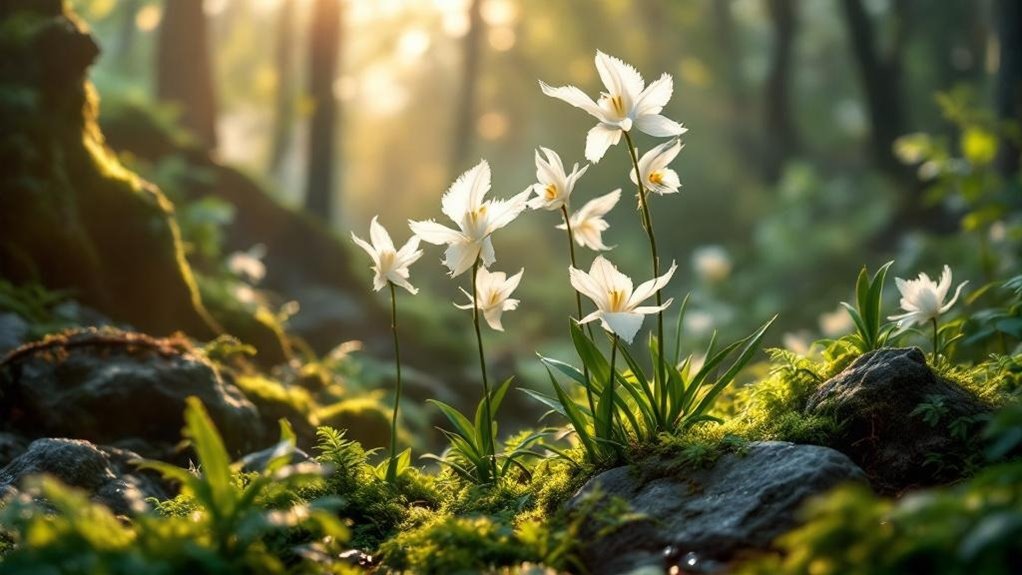
As you turn to the White Egret Orchid, you see why East Asian legends cast its white, winged petals as signs of purity and transformation; in Japan and Korea, its fringed form recalls an egret poised for flight, and that observational likeness connects spring’s return with spiritual renewal.
You can also trace its sacred grace symbolism through cultivated art and poetry, where its pristine color and delicate structure stand for chastity, virtuousness, and a moral beauty kept clear of what’s stagnant or corrupt.
Yet its brief bloom and narrow wetland habitat give these legends a quieter force; they remind you that purity is fleeting, that grace depends on preservation, and that protecting marshes also protects the cultural meanings attached to them.
Purity And Transformation
Although its fringed white petals look almost weightless, the White Egret Orchid, native to China, Korea, and Russia, has carried a cultivated symbolic force in East Asian folklore for centuries, because its egret-like form suggests innocence in motion and its spring bloom marks a season of release from what’s morally stagnant.
When you encounter a White Egret Orchid in legend, you’re meant to read transformation through restraint, not spectacle; its brief flowering suggests purity that must be renewed.
- You see innocence aligned with virtuous character.
- You recognize quiet rites of offering and contemplation.
- You understand atonement as change, not escape.
Some tales say a troubled soul becomes the flower to cleanse itself, and modern retellings extend that observational lesson: if wetlands vanish, you don’t only lose a species, you diminish a moral inheritance.
Sacred Grace Symbolism
Because its white, winged petals seem to hover between blossom and bird, the White Egret Orchid came to signify sacred grace in East Asian legend, not merely as an emblem of beauty but as a cultivated image of purity held above what’s morally stagnant; in Japanese and Chinese poetry, painting, and seasonal display, its egret-like form joins innocence to refinement, and its solitary bloom suggests the disciplined bearing of a virtuous person who remains unsoiled by corruption.
When you observe the White Egret Orchid in legend, you also encounter a measured lesson: purity appears briefly, like a soul rising beyond earthly stain, so you must value honorable conduct while it remains visible; spring exhibitions and garden displays consequently present this flower as good fortune, moral renewal, and quiet spiritual elevation for watchers.
Dove Orchid Legends as Soul Messengers
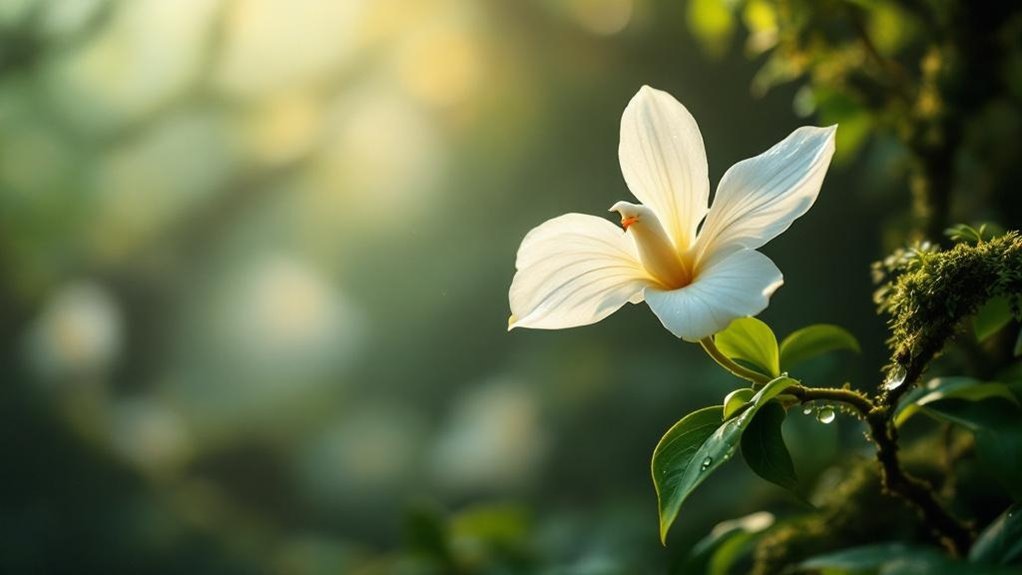
When people in Central America speak of the Dove Orchid, or Peristeria elata, they often treat its white, dove-shaped center not as a simple botanical curiosity but as an observational sign that the dead don’t move into silence alone; local legend holds that the flower carries souls toward the afterlife, and in Costa Rican and Panamanian tradition its blooms may appear near the place where a loved one died, marking peace rather than loss.
You also find three persistent meanings attached to the Dove Orchid:
- saints or guardian spirits guide souls
- rivers and trails promise safe passage
- taboos protect blooms, while collectors endanger them
After Christian contact, Indigenous storytellers cultivated dove imagery into saintly messages, and when you encounter this orchid in humid forests from Nicaragua to Ecuador, you’re meant to read motion, not stagnant endings.
Green Squid Orchid Legends of Hidden Realms
As you consider hidden domain symbolism, you can see why Prosthechea cochleata, native to Central America, the Caribbean Basin, and the Florida Everglades, became a cultivated emblem of thresholds; its green, squid-like lip and purple hood present an observational image of a guarded opening rather than a stagnant ornament.
You can also trace the squid orchid mystique to its upward-facing, inverted bloom, which has long suggested concealed fae or dusk spirits emerging from a protected interior, while its habit of rooting on trees and rocks supports legends of secret canopy paths and shaded grottoes.
Because it flowers repeatedly on long-lasting inflorescences, you can read it as a dependable guideflower in hidden domain narratives, one that appears when light and humidity align and therefore seems to confirm that unseen passages obey natural signs.
Hidden Realm Symbolism
Although the Green Squid Orchid grows in humid shade from Central America and the Caribbean Basin to the Florida Everglades, its purple hood and long green legs have long encouraged an observational symbolism that places it at the threshold of hidden domains, where land, water, and spirit seem to overlap.
You read its form as a quiet marker of places cultivated by secrecy:
- clamshell blooms above springs and submerged caves
- tentacled segments like threads into forest sanctuaries
- an alien messenger guarding mangroves, swamps, and stagnant coves
Because Green Squid Orchid often hangs from trees in shaded wetlands, you can see why legends link it to portals and protected sanctuaries; today, that symbolism still fits threatened coastal habitats, which ask for respect, restraint, and attentive protection.
Squid Orchid Mystique
From that symbolism of thresholds and sanctuaries, the Green Squid Orchid gathers a more specific mystique in coastal legend, because its green body, purple hood, and long lateral segments give observers an observational basis for reading it not simply as strange, but as a guide to cultivated domains concealed among mangroves, tidal inlets, and stagnant coves.
When you encounter the Green Squid Orchid in Caribbean shores, Central America, or the Everglades, folklore asks you to read more than shape; it directs lost seafarers toward submerged medicinal groves, marks high tides and storm-washed humidity through brighter blooms, and places protective force in the purple hood, where guardian mollusks or small spirits preserve wetlands.
You also learn its absence matters, because when healthy orchids vanish near waterways, local knowledge treats that loss as evidence of drainage, development, and ecological imbalance.
Western Underground Orchid Legends and Biology
Beneath the broom brush scrublands of Western Australia, Rhizanthella gardneri has cultivated one of the most unusual life cycles in the plant world, because it flowers, germinates, and sets seed entirely below ground, its inward-facing deep red, pink, or cream blossoms enclosed by pale bracts and hidden in conditions that remain observational rather than easily witnessed.
Beneath Western Australia’s scrublands, Rhizanthella gardneri blooms unseen, completing its entire life cycle in subterranean secrecy.
You can trace its survival through a strict subterranean alliance:
- a thread-like mycorrhizal fungus transfers nutrients;
- Melaleuca uncinata supports that fungus overhead;
- termites, gnats, and small mammals likely complete pollination and seed dispersal.
With fewer than fifty wild plants, you encounter a critically endangered orchid shaped by stagnant specificity, because habitat loss, salinity, drought, wildfire, and repeated captive failures disrupt the fungal networks and shrub hosts it can’t outgrow.
Why Rare Orchid Myths Matter Today
Because rare orchid myths still shape how people notice, value, and intervene in the living world, they matter today not as stagnant curiosities but as active cultural forces; stories of fertility, divine favor, royal prestige, and seasonal return can cultivate local protection, guide observational monitoring, and give conservationists language for explaining why an orchid’s survival often depends on hidden partners such as host trees, fungi, and pollinators.
| Myth effect | Meaning |
|---|---|
| Fertility legends | You value orchids, then protect them |
| Sacred status | You support habitats, or exploit rarity |
| Seasonal signs | You time surveys and management carefully |
| Hidden partners | You grasp fungi, trees, pollinators |
| Public storytelling | You fund seed banks and restoration |
Yet aphrodisiac lore also drives black-market hunting of Rothschild’s Slipper, proving myth can either conserve beauty or commodify extinction.
Frequently Asked Questions
How Do Rare Orchids Influence Local Festivals or Rituals Today?
Rare orchids shape today’s festivals and rituals by inspiring offerings, dances, costumes, and conservation events. You’ll see communities honor seasonal blooms, attract visitors, strengthen identity, and connect spiritual traditions with environmental stewardship and local pride.
Which Rare Orchid Legends Involve Healing or Medicinal Powers?
You’ll find healing orchid legends in Chinese tales of dendrobiums restoring vigor, Himalayan stories of blue orchids curing fevers, and Amazonian myths where rare orchids heal wounds; you can trace medicine, protection, and spiritual renewal.
Are Any Rare Orchid Myths Linked to Specific Seasons or Moon Phases?
Yes, you’ll find rare orchid myths tied to spring bloom festivals, midsummer fertility rites, and full-moon ceremonies. Some legends say orchids open only under moonlight, while others link their appearance to rainy seasons and harvest omens.
How Have Explorers and Collectors Changed Orchid Legends Over Time?
You’ve reshaped orchid legends by turning local sacred stories into global tales of rarity, danger, and obsession. Explorers exaggerated discoveries, while collectors fueled myths through competition, theft, and exotic marketing, changing reverence into desire worldwide.
Do Endangered Orchids Receive Special Protection Because of Their Legends?
Yes, you’ll find some endangered orchids gain attention, inspire funding, and attract legal support because their legends resonate. Still, you can’t rely on folklore alone; governments protect them mainly through science, habitat laws, and conservation priorities.
Conclusion
When you follow these rare orchid legends across cultures, you see how people cultivated meaning from scarcity, beauty, and risk; like the Western underground orchid, which can remain unseen for years before flowering, these stories persist beneath stagnant habits of thought, then surface when you need them. Their observational value endures because they join biology to belief, reminding you that rarity has always invited reverence, and that reverence, carefully held, can still guide attention toward the living world.