

When you encounter the Greek myth of Orchis, you should treat it as a cultivated later origin story for the orchid, not a stagnant ancient tradition; the tale, in which Orchis assaults a Dionysian priestess, is torn apart, and becomes a flower, appears chiefly in Louis Liger’s 1704 gardening literature. Ancient writers discussed orchids observationally as plants tied to virility and medicine, but not this myth; if you continue, the distinctions become clearer.
- Key Takeaways
- What Is the Myth of Orchis: and Is It Ancient?
- How Does the Orchis Myth Go?
- Where Did the Orchis Myth Begin?
- Was Orchis a Real Figure in Greek Myth?
- Which Parts of the Orchis Myth Were Invented?
- How Did Louis Liger Create Orchis?
- How Did Garden Books Spread the Orchis Story?
- Why Is the Orchid Named Orchis?
- What Did Orchis Mean in Greek?
- Why Were Orchids Linked to Satyrs?
- Why Were Orchids Seen as Aphrodisiacs?
- Which Ancient Writers Mentioned Orchids?
- How Is Orchis Similar to Butes?
- Why Does the Orchis Myth Still Matter?
- Frequently Asked Questions
- Conclusion
Key Takeaways
- Orchis was said to be the son of a nymph and a satyr who assaulted a priestess during a Dionysian festival.
- As punishment for violating sacred order, he was torn apart by wild beasts and transformed into the orchid flower.
- The story symbolizes uncontrolled desire, sacrilege, and divine retribution rather than heroic adventure or romance.
- Despite sounding ancient, the myth is not attested in classical Greek sources and likely originated in Louis Liger’s 1704 gardening book.
- The orchid’s name comes from Greek *orchis*, meaning “testicle,” linking the flower to fertility, virility, and sexual symbolism.
What Is the Myth of Orchis: and Is It Ancient?

At first glance, the myth of Orchis looks like a minor Greek metamorphosis tale: Orchis, usually described as the child of a nymph and a satyr, assaults a priestess of Dionysus, suffers a brutal punishment when wild beasts tear him apart, and then, through a cultivated logic of transformation familiar from classical storytelling, his remains become the orchid flower.
Yet when you examine it historically, you don’t find it in ancient Greek literature; instead, you trace it to Louis Liger in the early eighteenth century, which makes its authority uncertain.
You can read it as a learned fabrication, assembled from authentic motifs, including punishment narratives and flower transformations, while the name Orchis also reflects the Greek word for testicle, linking the orchid to longstanding ideas about sexuality, fertility, and observational plant lore.
How Does the Orchis Myth Go?
As you follow the myth of Orchis, you see a young man born of a nymph and a satyr commit a grave offense, and you can trace how his drunken assault on a priestess of Dionysus establishes the tale’s cultivated moral order.
You then watch punishment arrive without delay, as the Bacchanalians set wild beasts upon him, and the story’s observational logic makes clear that contempt for divine rites never remains stagnant or unanswered.
At the end, you find not restoration but transformation, because Orchis becomes the orchid itself, and even the flower’s name, rooted in the Greek word for testicle, carries the myth’s quiet pattern of sexuality, fertility, and consequence.
Orchis And His Crime
Unfolding in the shadow of Dionysus’s rites, the myth of Orchis begins with a violation that defines everything that follows: Orchis, born of a nymph and a satyr, attended a Bacchic festival, became drunk, and raped a priestess, an act that broke both sacred order and social restraint in a setting already charged with cultivated excess.
If you read the story observationally, you see why this crime stands at its center; Orchis was the son of mixed, unstable forces, and his assault turned ritual celebration into moral collapse. The festival honored ecstasy within boundaries, yet he abandoned restraint, making stagnant impulse sovereign over reverence, consent, and communal law.
In that sense, his offense doesn’t merely injure one priestess; it desecrates a god’s space, exposes the danger within intoxicated desire, and frames the myth’s severe logic.
Punishment And Transformation
Because Orchis committed his violence within Dionysus’s sacred rites, the punishment that follows doesn’t read as incidental vengeance but as the myth’s stern restoration of order; the Bacchanalians, acting as agents of divine retribution, tear him apart for allowing drunken appetite to overrule reverence, consent, and ritual boundary.
Some versions shift the instruments of that sentence to wild beasts or enraged priestesses without changing its meaning.
You then see the myth refuse stagnant finality, because Dionysus imposes transformation upon the violated remains, turning Orchis into the orchid, a cultivated emblem of fertility and sexuality whose tubers echo the Greek orchis, “testicle.”
In observational terms, the flower doesn’t erase guilt; it preserves consequence, binding body, desire, and sacred law into one enduring form, and it reminds you that excess invites correction.
Where Did the Orchis Myth Begin?
Where, then, did the myth of Orchis begin if not in the preserved body of Greek legend; it began in 1704 with Louis Liger’s *Le Jardinier Fleuriste et Historiographe*, where he cultivated a story about a youth named Orchis, his assault on a priestess of Dionysus, and his transformation into the orchid as punishment for sexual violence.
You can trace the tale not to ancient Greek myths, but to a modern, observational fabrication that borrowed classical tones while lacking ancient support. The name itself came from Greek for “testicle,” linking orchid tubers to sexuality and fertility, themes that prevented the story from going stagnant in cultural memory.
| Source | Basis | Result |
|---|---|---|
| Liger, 1704 | Invented narrative | Pseudo-myth |
| Greek term *orchis* | Plant shape | Sexual symbolism |
Was Orchis a Real Figure in Greek Myth?
Orchis wasn’t a real figure in Greek myth; the name carries a cultivated aura of antiquity, yet no classical source presents him as the son of a nymph and a satyr, records his assault on a priestess of Dionysus, or describes his punishment and transformation into a flower.
When you examine Greek literature, you find a stagnant silence around Orchis, and that absence matters more than later retellings. The earliest recorded mentions appear in Louis Liger’s early eighteenth-century writings, which places Orchis outside authentic classical tradition.
You can also observe how the tale borrows recognizable patterns from older myths, including punishment narratives and floral transformation motifs, rather than preserving an independent ancient memory.
Even the Greek word orchis points to plant anatomy, not to a documented mythic person whom ancient audiences would’ve recognized as real.
Which Parts of the Orchis Myth Were Invented?

How much of the Orchis story was invented becomes clear once you trace it to its actual point of appearance; nearly every narrative feature that gives the tale its mythic shape comes not from Greek antiquity but from Louis Liger’s 1704 gardening book, where he supplied the assault on a Dionysian priestess, the divine punishment, the tearing apart by wild beasts, and the final transformation of bodily remains into a flower.
If you compare that account with actual Greek and Roman sources, you find no corroboration for Orchis as a mythic figure at all; the story’s cultivated structure reflects borrowed patterns, not stagnant tradition.
You should also treat the orchid’s sexual symbolism, especially the name’s tie to tuber shape, as one of several invented connections that later botanical writing preserved and normalized for readers.
How Did Louis Liger Create Orchis?
- You see fabrication working through selective imitation.
- You see botany turned into cultural narrative.
- You see how Louis Liger linked orchids with aphrodisiac folklore, giving horticultural writing unusual symbolic authority, and shaping later perceptions of the flower’s identity.
How Did Garden Books Spread the Orchis Story?
You can trace the Orchis story’s wider reach to Liger’s garden invention, because he placed a fabricated myth inside practical horticultural writing.
That cultivated pairing gave the tale authority among readers who valued both flowers and observational learning. As florists and educated readers encountered these books, they didnt treat the story as stagnant ornament; they absorbed it as a moral tale tied to beauty, sexuality, and reproduction, which made orchids seem culturally significant as well as botanically distinct.
You can also see how print culture spread the lore, because later garden writers repeated mythological associations.
Each new reference carried Orchis farther beyond a single text, reinforcing the flower’s allure within horticultural discourse.
Liger’s Garden Invention
A useful starting point is Louis Liger’s 1704 gardening manual, *Le Jardinier Fleuriste et Historiographe*, because it gave the Orchis story a durable printed form, presenting the flower’s origin as the gods’ punishment and transformation of a transgressive youth.
It did so in a genre that readers already trusted for cultivated knowledge about plants, beauty, and domestic order. You can see how this stabilized Orchid species within an observational frame, where pseudomyth borrowed authority from Greek precedent, linked fertility lore to anatomy, and kept botanical curiosity from becoming stagnant.
- You witness myth entering practical literature.
- You see elite readers absorb cultural values through plants.
- You understand how horticulture and story fused, giving orchids a lasting place in cultivated memory and later botanical interpretation across Europe.
Florists And Moral Tales
From Liger’s printed invention, the next question is how such a story circulated so effectively, and the answer lies in the character of eighteenth-century garden books themselves, which didn’t present flowers as merely observational objects but as cultivated signs of taste, conduct, and social order; in *Le Jardinier Fleuriste et Historiographe*, Louis Liger attached the Orchis tale to practical horticultural writing, giving readers a moralized account they could absorb alongside instructions on planting and display, and that pairing mattered because educated households already treated florists’ manuals as trustworthy guides to domestic refinement.
| Function | Effect |
|---|---|
| Planting advice | disciplined taste |
| Greek mythology | moral consequence |
Print Culture Spread
In print culture, you can trace three effects:
- You inherit beauty shaped by moral commentary.
- You absorb older herbal claims linking orchids to sexuality and allure.
- You see Victorian societies and botanical journals turn orchids into cultivated status symbols, fixing Orchis within elite collecting habits and inherited taste.
Why Is the Orchid Named Orchis?

Because the flower’s paired tubers resembled male anatomy, the Greeks called it *orchis*, a word that means “testicle”; that physical observation, plain though it was, became entwined with the myth of Orchis, the figure who was torn apart after assaulting a priestess of Dionysus and then transformed into the flower.
When you trace the name, you see how the Greek word joined botanical naming to mythic memory, linking the plant’s form to ideas of sexuality, fertility, and cultivated renewal rather than to anything stagnant.
In ancient Greece, orchids carried aphrodisiac associations, so Orchis’s transformation worked as more than punishment; it became an observational metaphor for rebirth after violence.
From that union of body, story, and symbolism, the later term “orchid” emerged, preserving the myth inside the flower’s very name for centuries afterward.
What Did Orchis Mean in Greek?
For you, that meaning clarifies Orchis as language, myth, and cultivated belief meeting at one point:
- It names the flower through anatomy, showing how Greeks read nature directly and gave Orchis a reproductive identity.
- It frames the myth, because Orchis becomes the plant after wrongdoing, and the name preserves punishment through bodily resemblance.
- It supports ancient fertility beliefs; people treated the tubers as potent, even thinking consumption could influence offspring, while the Greek term passed into Latin *orchis* and then botanical classification itself.
Why Were Orchids Linked to Satyrs?
You can see the link in the old name satyrion, which tied orchids to satyrs through an observational symbolism grounded in the plant’s tuber roots, whose form suggested male anatomy and, by extension, fertility, masculinity, and cultivated ideas of sexual power.
You can also trace the bond through the belief that those roots worked as an aphrodisiac, a view that aligned the flower with satyrs’ hedonistic nature and kept the association from becoming stagnant in Greek thought.
As you move into the myth of Orchis itself, you’ll notice that this symbolic framework helps explain why the flower carried meanings of male desire, excess, and punishment.
Satyrion And Symbolism
Although the name may sound purely botanical, “satyrion” carried a distinctly mythic weight in the ancient world, linking orchids to satyrs because their paired, tuberous roots closely resembled male anatomy and invited an observational reading of the plant as a natural emblem of virility.
You can see how satyrion fused plant form with myth, turning orchids into cultivated signs of masculine potency. Theophrastus reinforced that symbolism by recording their healing uses, and herbalists preserved the association rather than letting it grow stagnant.
- You witness morphology becoming meaning, as roots suggested fertility.
- You see satyrs shaping interpretation, since their unruly sexuality framed the plant’s image.
- You understand Greek thought more clearly, because botany, medicine, and myth didn’t remain separate domains, but informed one another through visible correspondences and cultural memory.
Aphrodisiac Roots Belief
Because the orchid’s paired underground tubers seemed to mirror male anatomy with unusual clarity, Greeks named the plant orchis, “testicle,” and from that observational resemblance they drew a larger medicinal and mythic conclusion, treating the root as a cultivated sign of virility rather than a stagnant botanical curiosity.
| Source | Image | Meaning |
|---|---|---|
| Theophrastus | twin tubers | potency |
| Pliny | swelling root | fertility |
| satyrion | woodland lust | satyrs |
| Petronius | erotic mention | desire |
You can see how doctrine of signatures guided this reading; form suggested function, so orchid roots promised aphrodisiac properties. Early herbalists called them satyrion, binding the plant to satyrs, while Roman literature preserved that erotic reputation. Through repeated textual authority, the orchid became less a flower than a persuasive emblem of male generative force.
Why Were Orchids Seen as Aphrodisiacs?
Since the orchid’s paired tubers closely resembled male anatomy, Greek observers treated the plant as more than an object of beauty, and that likeness shaped both its name—*orchis*, meaning testicle—and its cultivated reputation as an aphrodisiac. You can see how observational logic guided this belief; when a plant mirrored reproductive organs, people assumed it carried reproductive power, not stagnant ornament alone.
- Greek fertility symbolism made orchids signs of generative force, joining beauty to potency.
- Herbal practice reinforced the aphrodisiac claim, because roots were thought to strengthen desire and male vigor.
- Later doctrine of signatures preserved the pattern, teaching you that resemblance revealed function, so orchid forms seemed medicinally instructive.
Taken together, these ideas made orchids emblems of desire, fertility, and bodily potency within enduring cultural imagination.
Which Ancient Writers Mentioned Orchids?
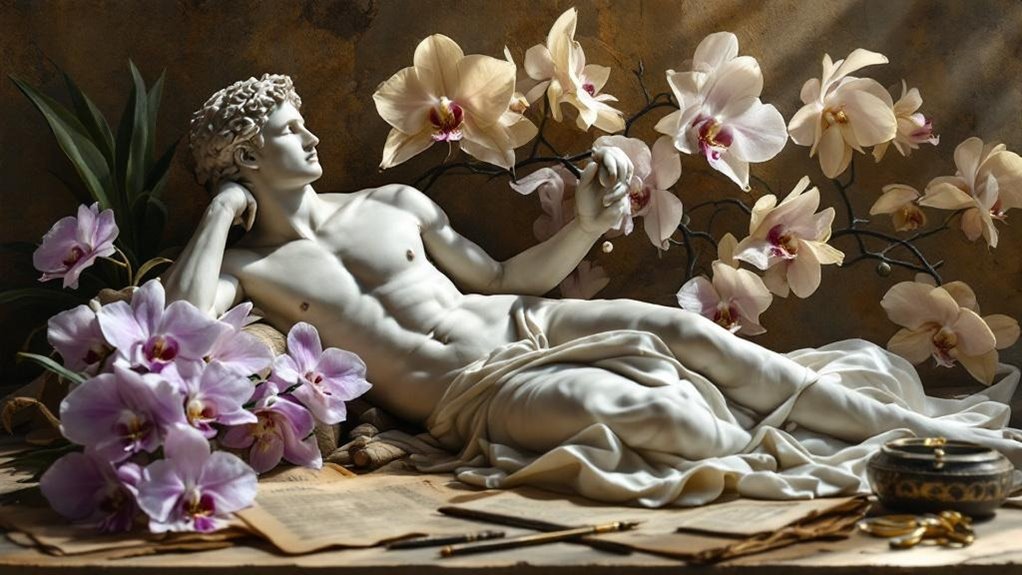
You won’t find the Orchis myth itself in classical Greek or Roman literature, yet you can trace the flower’s older reputation through observational writers who treated orchids as cultivated medicinal and sexual symbols rather than as figures in a stagnant legend.
You see this clearly in Theophrastus, who linked orchids to fertility through their form and supposed aphrodisiac effects, and in Pliny the Elder, who preserved similar herbal accounts for a Roman audience.
You can also note Dioscorides, whose discussion of satyrion continues that medicinal tradition, showing that ancient writers recognized the plant and its symbolic force even if they didn’t record the later myth of Orchis.
Theophrastus On Orchids
Among the ancient writers who mentioned orchids, Theophrastus stands at the center, not only as the observational scholar later called the father of botany, but also as one of the earliest authors to record the plant’s cultivated reputation for stirring male desire and strengthening fertility.
Through Theophrastus, you see why orchis mattered in Greek thought; its very name meant “testicle,” and that physical resemblance supported stagnant beliefs about potency.
- You encounter a plant whose form and function were linked through early herbal reasoning.
- You see fertility framed as both medicinal and symbolic, not merely sensual.
- You recognize how later writers echoed this pattern, preserving orchids as signs of virility.
In this way, Theophrastus gives you a disciplined starting point, where botanical notice and cultural meaning remain closely joined in antiquity.
Pliny’s Herbal Accounts
Although Pliny the Elder wrote from within Rome’s encyclopedic habit of gathering inherited knowledge, his *Natural History* preserves a distinctly revealing account of orchis, one that joins observational description to stagnant assumptions about the body and treats the plant’s twin tubers as evidence of its power over male desire and sexual potency.
In Pliny’s herbal accounts, you can see how Roman readers linked form to function, letting resemblance govern interpretation; the Greek name ὄρχις reinforced that habit, because anatomy seemed to authorize medicinal meaning.
If Theophrastus had already cultivated a botanical and therapeutic framework, Pliny hardened it into a more public claim about virility.
Elsewhere in ancient literature, even Petronius reflects the same sexual association, showing you that orchids carried not only medicinal value, but also a durable cultural symbolism.
Dioscorides And Satyrion
- You see Dioscorides systematize a belief that earlier writers, including Theophrastus, had already treated as medicinal and aphrodisiac.
- You find Pliny reinforcing that tradition, ensuring orchids didn’t remain a stagnant local remedy.
- You recognize ancient herbalists sustaining a continuous literary record, where botanical observation, reproductive symbolism, and human health remained closely joined.
How Is Orchis Similar to Butes?
Because both figures violate sacred boundaries tied to Dionysus, Orchis and Butes stand as closely related examples of divine punishment in Greek myth; each man directs sexual aggression toward a woman under the god’s protection, and each then suffers a fate that answers the offense with harsh, unmistakable retribution.
When you compare Orchis with Butes, you see an observational pattern: both assault, or try to violate, Dionysian women, both challenge divine law through cultivated arrogance, and both receive punishments shaped by the offense itself.
Orchis is torn apart by wild beasts and transformed into a flower, while Butes meets a comparable end after attacking the priestess Coronis. Their stories reject stagnant assumptions that mortal desire can overrule sacred status; instead, they show that priestesses remain protected, and violations invite severe, morally legible consequences.
Why Does the Orchis Myth Still Matter?
The force of Orchis’s punishment explains why the myth still matters, since it preserves an observational record of how Greek culture linked sexuality, morality, and divine order, and since it frames transgression not as a private act but as a public violation that leaves a lasting mark on the body and the landscape.
- You see Orchis turn desire into warning; transformation makes morality visible, cultivated in nature rather than stagnant in memory.
- You notice how orchis, meaning testicle, binds plant life to fertility, eroticism, and ancient theories of consequence.
- You recognize orchids’ aphrodisiac reputation, and you see why Orchis still shapes literature, herbal practice, botany, horticulture, folklore, and conservation, where myth preserves cultural meaning beside scientific attention today.
Frequently Asked Questions
What Is the Myth of Orchis?
You’d describe the myth of Orchis as a cautionary tale: after he assaults a Dionysian priestess, the gods punish him through dismemberment by beasts and transform his remains into the orchid, symbolizing desire and consequences.
Who Is Zeus’ Only Male Lover?
Zeus’ only male lover is Ganymede, and you can recognize him as the beautiful Trojan prince Zeus abducted as an eagle. You’ll see their bond symbolize divine desire, youth, and immortality in Greek myth and art.
What Does Baking Soda Do for Orchids?
Baking soda can work wonders for your orchids: you’ll reduce soil acidity, discourage fungal diseases, and boost treatment effectiveness. Use a diluted mix sparingly, or you’ll upset soil balance instead of helping your plant thrive.
What’s the Biggest Mistake When Repotting Orchids?
The biggest mistake when repotting orchids is using regular potting soil. You’ll trap too much moisture, suffocate roots, and invite rot. Instead, use bark or sphagnum moss, check roots, and choose a snug, draining pot.
Conclusion
When you look closely at Orchis, you find less an ancient Greek myth than a cultivated later explanation, shaped from language, plants, and moral imagination; that observational approach matters, because it keeps tradition from becoming stagnant legend. One useful measure gives the story depth: the orchid family contains more than 28,000 accepted species worldwide, a reminder that one doubtful tale attached itself to a vast botanical reality, and that your understanding is stronger when myth and evidence remain distinct.