
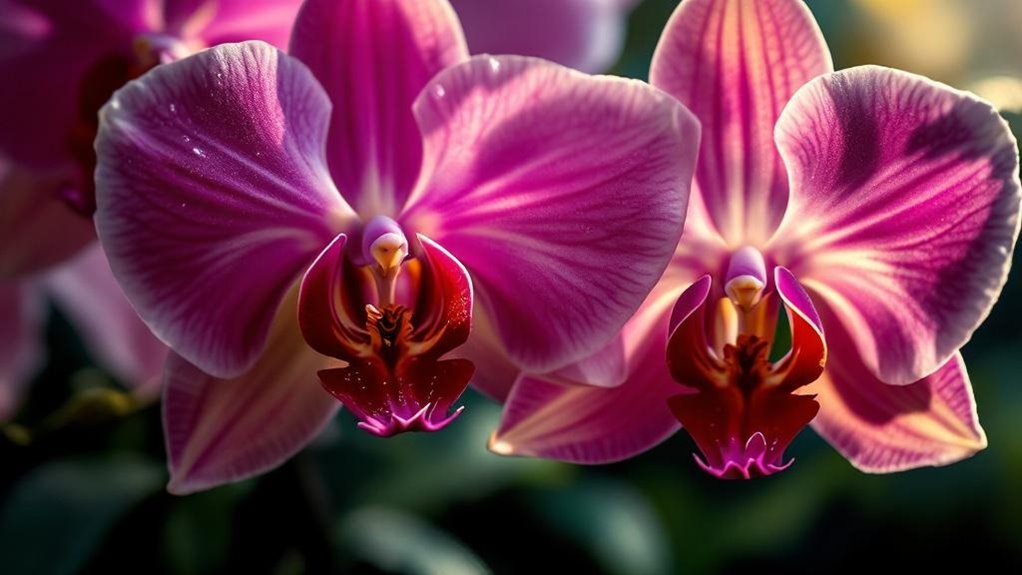
Yes, you can call orchids flowers of temptation, because many species don’t simply invite pollinators; they manipulate them through cultivated deception, matching insect pheromones, visual cues, textures, and precise pollinia mechanics that secure transport without nectar rewards. You can also see temptation in human history, from Victorian orchidelirium to hand-pollination, hybridization, and global trade, which carried orchids far beyond stagnant natural limits. Continue, and you’ll see how both plant and human strategies shaped that reputation.
- Key Takeaways
- Why Are Orchids Called Flowers of Temptation?
- How Do Orchids Trick Pollinators?
- How Does Orchid Sexual Deception Work?
- Which Orchids Mimic Female Bees and Wasps?
- How Do Orchid Pollinia Attach to Insects?
- Why Do Deceptive Orchids Skip Nectar?
- Why Are Some Orchids Pollinator-Specific?
- How Does Orchid Deception Drive Speciation?
- What Other Deceptive Orchid Strategies Exist?
- How Have Humans Helped Orchids Spread?
- Frequently Asked Questions
- Conclusion
Key Takeaways
- Orchids can be called flowers of temptation because many lure pollinators through deception rather than honest rewards.
- Some orchids mimic female insect scents, shapes, and textures, tricking males into attempted mating called pseudocopulation.
- This temptation is highly targeted, often attracting just one pollinator species through precise chemical, visual, and tactile signals.
- Orchids also tempt humans: Victorian orchidelirium turned rare blooms into symbols of desire, status, and obsession.
- Human fascination spread orchids globally through collecting, hybridization, and trade, eventually prompting conservation rules like CITES.
Why Are Orchids Called Flowers of Temptation?
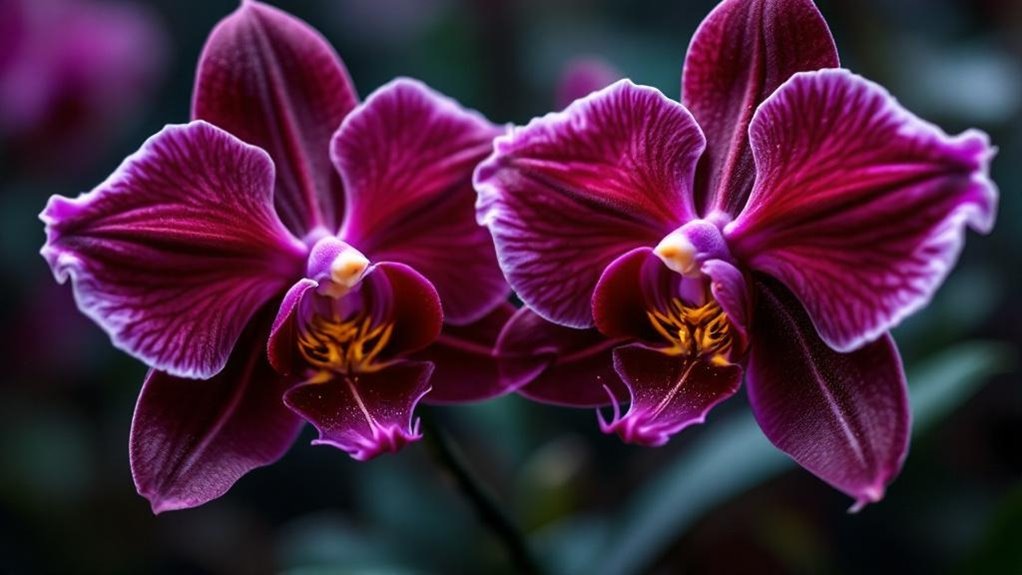
When you consider orchids historically, the association deepens; Victorian collectors treated each orchid as an object of refined longing, and modern cultivation, with more than 100,000 registered hybrids, preserves that observational pattern.
Biology supports the metaphor as well: many orchids rely on sexual deception, including signals resembling insect pheromones, while others use stagnant odors or false promises, so temptation defines both how you perceive orchids and how these plants persist.
That fascination was once called orchidelirium, the Victorian obsession with rare orchids as emblems of wealth and cultivated taste.
How Do Orchids Trick Pollinators?
When you examine how orchids trick pollinators, you see cultivated deception at work; many species offer no nectar, yet they secure pollen transfer by mimicking food, shelter, or mates with remarkable precision.
You can trace the most exacting strategy in sexual mimicry, where orchids such as Ophrys release scents that match female insect pheromones and pair them with visual and tactile cues, including labella that resemble a female seen from behind, so males attempt pseudocopulation and probe deeply enough to collect pollinia.
You also find that scent and structure govern the final step, because stagnant or putrid odors, hinged lips, spring-loaded pollinia, and traplike forms guide the insect’s movement, reduce wasted energy for the plant, and promote more targeted outcrossing as pollinators travel farther between visits.
This strategy is especially vivid in the bee orchid, whose false female-bumblebee display can trigger male bee mating attempts without offering nectar.
Sexual Mimicry Tactics
Although orchids appear passive, many species conduct a cultivated fraud of remarkable precision, combining visual, tactile, and chemical signals so exact that male insects mistake the flower for a receptive female and attempt copulation, a behavior called pseudocopulation, during which the orchid attaches its pollinia to the insect’s body.
You can see sexual mimicry sharpen into sexual deception, because many orchids target one male species with exact pheromones and fitted surfaces; in Ophrys and Cryptostylis, that precision guides grasping, grooming, and pollinia placement.
- You observe species-specific matching that limits wasted visits.
- You find pseudocopulation effective enough that some males ejaculate.
- You note avoidance learning later, which can make success stagnant.
You also see how tiny pheromone shifts isolate populations, altering insect response, and, over generations, separating lineages through observational mate-targeting fidelity patterns. The ghost orchid shows a different kind of allure, where rarity and a fleeting bloom turned it into a symbol of longing and supernatural presence.
Scent And Visual Lures
Sexual deception works because orchids don’t rely on shape alone; they build a layered lure in which scent reaches first, vision confirms, and touch completes the fraud, so the pollinator follows a cultivated sequence rather than a single false signal. You can see this observational design in orchids that release pheromones matching female insects, then reinforce sexual deception through visual mimicry, UV markings, and textured labella, so males commit to pseudocopulation.
In Ophrys and Cryptostylis, scent reservoirs and tactile guides draw the insect inward until the illusion feels specific rather than approximate. Other orchids shift the formula, copying fungi or stagnant decay to attract flies, while some suggest food or shelter with sweet fragrances, false nectar signals, or chambered forms; each lure brings bodies into position for eventual pollinia attachment without offering any reward whatsoever. In feng shui traditions, orchids are lucky symbols that can also shape how people read their beauty and presence.
Pollinia Transfer Mechanics
What follows the lure is a transfer system built for precision, because orchid pollen isn’t scattered as loose dust but packed into cohesive sacs called pollinia, usually two, which the flower fastens to a visitor with a quick-drying, glue-like adhesive and then deposits whole on the stigma of the next suitable orchid.
Through pheromone mimicry, sexually deceptive orchids guide males into mating postures that create specific body placement. Hinged pollination mechanisms press, fling, or align pollinia transfer with cultivated accuracy. Trap routes prevent stagnant wandering and force observational contact with exit points.
When you watch Ophrys, Cryptostylis, Drakaea, or Coryanthes, you see morphology restrict visitors, ensuring pollinia attach to the abdomen tip or thorax, where the next conspecific flower will reliably receive them. The melipona bee shows how a single native pollinator can shape orchid survival, as with vanilla in Veracruz.
How Does Orchid Sexual Deception Work?
You can see orchid sexual deception work through a cultivated blend of pheromones, shape, and touch; the flower releases scents that closely match a female insect’s sex signals, while its labellum presents the color, texture, and form a male expects, preventing his response from turning stagnant.
As you observe the sequence, you find that smell, visual patterning, and tactile cues act together, leading the male to attempt pseudocopulation with striking precision rather than searching for nectar. In that contact, the orchid’s column places pollinia onto his body, and when he repeats the mistake at the next flower, you get efficient pollen transfer and the highly specific pollination that defines this strategy. In folklore, orchids are also linked to Venus and water, symbols of beauty, receptivity, and emotional connection.
Pheromones, Shape, And Touch
- Pheromones guide approach from afar.
- The labellum completes the illusion nearby.
- Touch cues intensify pseudocopulation behavior.
As you watch, tactile textures, false fur, and posture refine contact, directing movement so pollinia attach to predictable body sites. Modern studies also show how orchid mimicry can exploit pollinators with remarkable precision.
Pollinia Transfer Through Pseudocopulation
Entering the decisive phase of deception, the male insect shifts from approach to contact, and the orchid uses that cultivated mistake with remarkable precision; as he attempts copulation with the labellum, his body is guided into the flower’s column, where two compact pollinia fasten to the abdomen or thorax by a quick-drying, glue-like adhesive. Through sexual deception, you can observe how floral form controls behavior: the labellum’s texture, posture, and UV cues position males, including thynnine wasps, in an exact mating stance, so pseudocopulation becomes a transport mechanism rather than a stagnant error.
When that male visits another flower of the same species, the attached pollinia meet the stigma with high accuracy; because many orchids target one pollinator species, cross-pollination improves, and frustrated males often travel farther before trying again.
Which Orchids Mimic Female Bees and Wasps?
Deception reaches its most cultivated form in a small group of orchids that mimic female bees and wasps so precisely that males attempt to mate with the flowers, carrying pollen in the process; among the best known are Ophrys, the bee and fly orchids, along with Drakaea, Chiloglottis, Cryptostylis, and some species of Catasetum.
Orchid deception reaches its peak when flowers mimic female insects so exactly that males become unwitting couriers of pollen.
- In sexually deceptive orchids, pheromone mimicry recruits one male species with observational precision.
- Drakaea and Ophrys exemplify specialization; males rarely confuse these signals with stagnant background odors.
- Chiloglottis targets thynnine wasps, while Cryptostylis imitates female ichneumonid wasps, guiding contact with pollinia.
As you compare them, you see why these orchids remain effective: each combines visual, tactile, and chemical cues, and each usually targets one pollinator species, reducing wasted visits.
Yet deception can’t become too common, because males learn.
How Do Orchid Pollinia Attach to Insects?
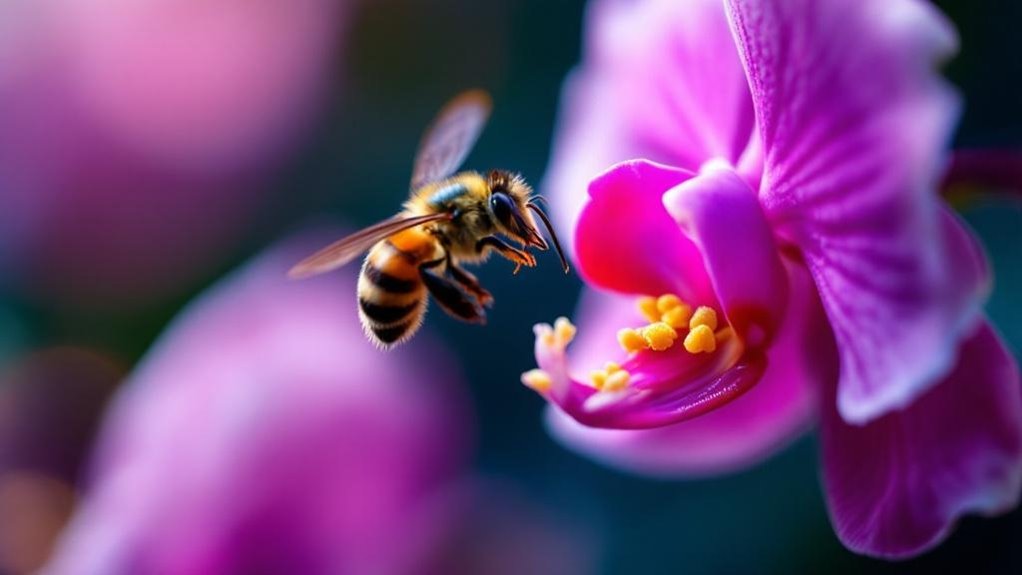
Fasten is almost the right verb, because orchid pollinia don’t drift away as loose grains but travel as coherent masses, usually paired, and the flower secures them with a quick-drying viscidium, a glue-like pad that fixes the package to a precise part of an insect’s body.
When you watch cultivated orchids closely, you see how floral architecture directs pollinators with observational precision; the labellum, column, and narrow passages turn the insect, slow it, or hold it long enough for contact, so the attached pollinia later meet a matching stigma instead of falling into stagnant chance.
Some species mechanize the process, flinging or depositing the adhesive disc when touched, while trap-flowers constrain movement until placement is reliable. In orchids using pseudocopulation, the male insect receives pollinia on the abdomen or genitalia, then carries the intact mass to another bloom.
Why Do Deceptive Orchids Skip Nectar?
You can see why many deceptive orchids skip nectar, because they avoid the substantial energy cost of producing a reward and redirect those resources toward cultivated signals that still bring pollinators in.
You also find that this tradeoff shapes pollinator movement; when an insect leaves unrewarded and won’t remain stagnant among nearby flowers, it often travels farther before visiting another plant. As a result, you get a more observational view of deception, one in which energy savings and increased travel work together to support pollination.
Energy Savings Tradeoff
Because nectar is metabolically expensive to make, many orchids forgo it entirely, and in roughly one-third of orchid species that choice isn’t a deficit but a cultivated strategy that conserves energy while sharpening reproduction. You can see how deception turns energy savings into precision; instead of funding sugary nectar, orchids redirect resources toward scent chemistry and sculpted labella that guide pollinators with observational accuracy, while frustrated visitors often probe harder, removing pollinia efficiently and supporting outcrossing.
- Deception saves resources for targeted floral traits.
- Nectar absence can increase handling intensity per visit.
- Small populations and variable mimicry keep avoidance stagnant.
You should also note that this tradeoff works best when pollinators don’t learn too quickly; small populations and imperfect mimicry preserve uncertainty, so each flower visit remains potentially productive rather than predictably ignored by experienced foragers nearby.
Farther Pollinator Travel
Deceptive orchids redirect the logic of a flower visit, and the missing nectar doesn’t merely save metabolic expense; it changes how pollinators move through space, sending them away from an unrewarding plant and often on to a more distant conspecific, which raises the odds that pollinia will be carried between separate individuals rather than deposited nearby or wasted in selfing.
As you follow this observational pattern, you see why nectarless flowers can improve outcrossing: frustrated visitors leave quickly, search farther, and carry pollinia across scattered plants rather than within stagnant neighborhoods. In small, dispersed populations, deceptive orchids preserve the illusion because repeat visits stay unlikely, and pollinator travel stretches across the landscape.
In sexually specialized genera such as Ophrys and Cryptostylis, cultivated specificity makes longer flights especially effective at moving genes.
Why Are Some Orchids Pollinator-Specific?
Consider how some orchids narrow their appeal to a single pollinator, then refine flower form, texture, and scent so precisely that an insect responds as if it has found a mate rather than a blossom; in genera such as *Ophrys*, *Drakaea*, and *Cryptostylis*, that cultivated specificity reduces wasted pollen transfer to the wrong species, improves the odds that pollinia will land on a conspecific stigma, and supports outcrossing even in sparse, observationally complex habitats.
- Through sexual deception, you see pheromone mimicry intensify pollinator specificity and guide species-specific pollination.
- Bilateral symmetry, hinged labella, and glue-fast pollinia mechanically fit bodies, limiting stagnant error.
- Small populations and imperfect mimicry keep insects uncertain, so avoidance learning stays weak, preserving attraction.
You can read this strategy as efficiency, not excess.
How Does Orchid Deception Drive Speciation?
That same cultivated precision doesn’t only secure pollination in the moment; it also helps split orchid lineages over time, since roughly one-third of orchid species offer no nectar and instead use deception in ways that push pollinators to move farther between plants, reduce selfing and close inbreeding, and strengthen outcrossing across sparse, observational landscapes.
Through orchid deception, you see pollinator specificity tighten quickly, because even slight shifts in floral scent, including pheromone-like compounds linked to sexual mimicry, can redirect visits to a different insect and immediately change pollinia transfer. Small populations, imperfect signals, and bilateral symmetry keep learning from becoming stagnant, preserve rare forms, and let visual, tactile, and mechanical traits track new pollinators, so reproductive isolation accumulates and speciation follows.
What Other Deceptive Orchid Strategies Exist?
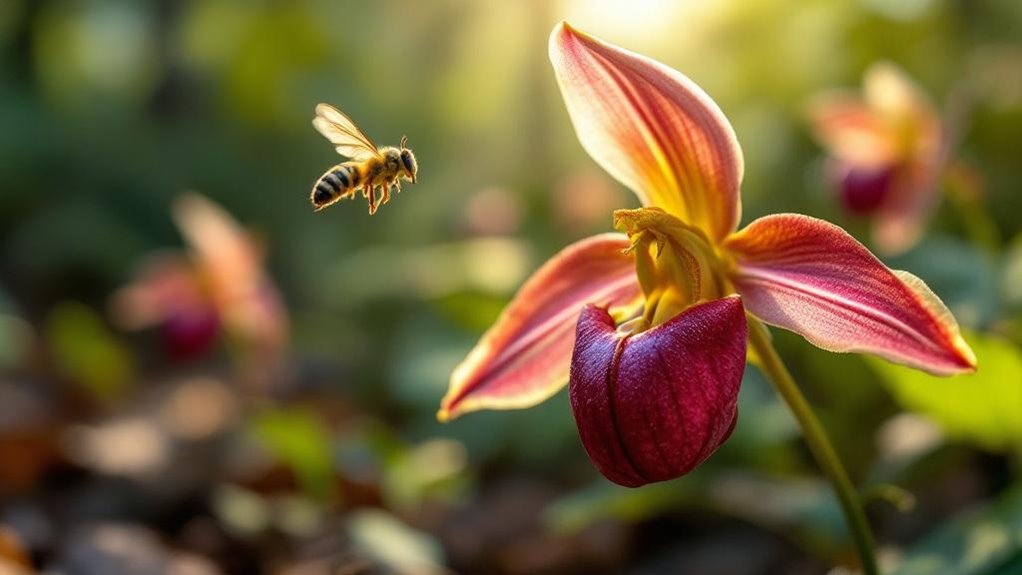
Although sexual mimicry often receives the most attention, orchids use a wider deceptive repertoire that manipulates hunger, shelter seeking, aggression, and simple movement, and about one-third of the family relies on such strategies instead of nectar to secure pollination. Beyond sexual deception, you find nectar mimicry and pheromone mimicry; some species smell like fungi, dung, flesh, or aphid alarm signals, drawing cultivated flies and hoverflies toward stagnant blossoms.
- You encounter shelter mimicry in Serapias, whose tube-like flowers offer apparent refuge.
- You see mechanical traps in Catasetum, Coryanthes, and Drakaea, where launched pollen, bucket exits, or hinged hammers enforce contact.
- You also observe fake pollen, false nectar, and even self-pollination in Holcoglossum, where twisted anthers complete transfer without a visitor through remarkably precise, observational floral engineering alone.
How Have Humans Helped Orchids Spread?
Across centuries of cultivation, humans have become one of the most effective agents of orchid dispersal, not by replacing the family’s evolutionary ingenuity but by moving plants beyond the limits imposed by native pollinators, climate, and geography; from the Victorian era onward, collectors, botanists, and growers carried orchids from tropical forests into private glasshouses and botanical gardens, then multiplied them through deliberate hybridization and hand-pollination, a practice that now accounts for roughly 100,000 registered hybrids and for crops such as Vanilla planifolia, which can be cultivated far from the insects that once serviced it in the wild.
You can trace this spread through orchidelirium, through commercial cultivation, and through hobbyist trade; yet you also see why CITES emerged, because stagnant oversight once encouraged wild removal, transport, and the quiet establishment of nonnative orchids in new regions worldwide.
Frequently Asked Questions
What Does the Bible Say About Orchids?
The Bible doesn’t mention orchids specifically. You can still connect orchids with biblical themes like beauty, God’s provision, and creation’s mystery, but you shouldn’t treat cultural ideas about sensuality as scriptural teaching or direct biblical symbolism.
Why Can’t You Touch Orchids?
You can’t touch orchids because you may damage delicate parts, remove chemical cues, or leave oils that disrupt pollination. You could also disturb roots and fungi, harm rare plants, and increase risks from trampling.
Why Put Cinnamon on Orchids?
You put cinnamon on orchids mainly to discourage fungus and rot, not to feed them. You can also enhance their scent for display, but natural cinnamon-like fragrance already comes from the orchid’s own chemistry.
Why Are Lady Slipper Orchids Illegal in the US?
They’re illegal to collect because you’d devastate rare, slow-growing wild populations. You can’t just “rescue” them; they need specific fungi and habitats. Laws protect them from poaching, trampling, and history’s brilliant idea: stealing orchids.
Conclusion
You can see why orchids are called flowers of temptation: they don’t simply attract pollinators, they manipulate perception through scent, shape, and timing, and that observational precision has helped make Orchidaceae one of the largest cultivated plant families on Earth, with more than 28,000 accepted species. Their deceptive methods prevent stagnant evolutionary patterns; instead, they sharpen specialization, drive divergence, and show you that temptation in orchids is not metaphor alone, but a functional ecological strategy.