
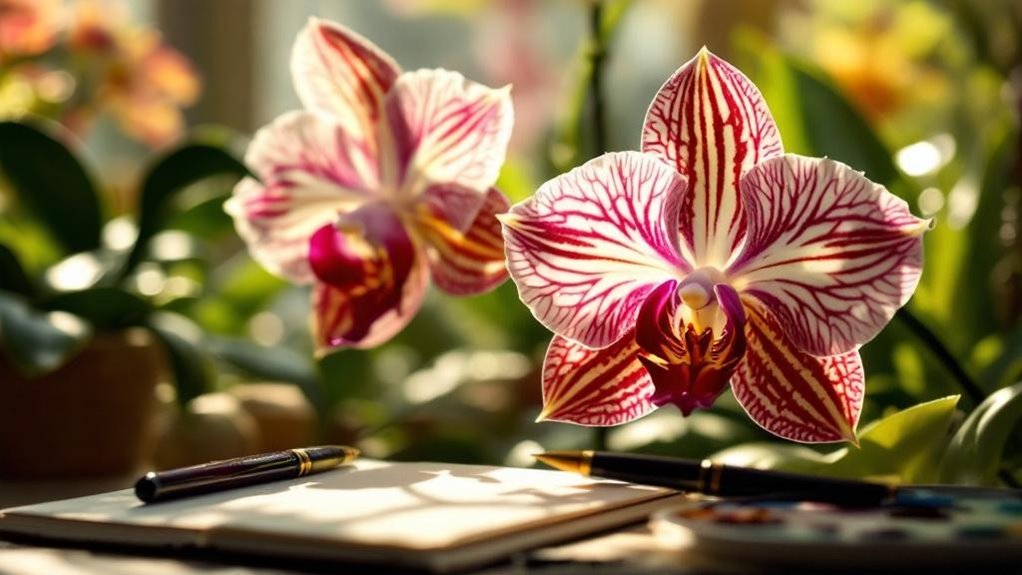
You’re drawn to orchids because they unite biological strangeness, cultivated difficulty, and cultural weight in a single form; with more than 25,000 species, precise pollination strategies, and epiphytic, terrestrial, or lithophytic habits, they resist stagnant meaning. As you collect, write, or make, you encounter patience, observation, prestige, extraction, beauty, and loss at once, and that layered record gives orchids unusual force as subjects, symbols, and living archives. There’s more in their histories and care.
- Key Takeaways
- Why Orchids Inspire Creative People
- What Makes Orchids So Compelling
- How Orchids Teach Patience and Process
- Why Orchid Diversity Fuels Inspiration
- How Collectors Learn Through Orchids
- Why Writers Use Orchids as Metaphor
- How Artists Reimagine Beauty With Orchids
- How Orchid History Deepens Their Meaning
- Why Orchids Hold Beauty and Violence
- How Orchid Exhibitions Bring Stories to Life
- How Orchids Spark Memory, Wonder, and Belonging
- Frequently Asked Questions
- Conclusion
Key Takeaways
- Orchids inspire through extraordinary diversity, with thousands of species and uncanny forms that seem architectural, animal-like, and sculptural.
- Their evolutionary drama—mimicry, deception, and specialized pollination—gives writers and artists rich metaphors for desire, strategy, and transformation.
- Collectors are drawn to the challenge of cultivation, where precise care rewards patience, observation, and long-term stewardship.
- Orchids carry powerful cultural meanings, symbolizing beauty, prestige, intimacy, obsession, and belonging across many traditions.
- Their history links elegance to colonial extraction and status, giving artists and curators material for beauty, memory, critique, and social meaning.
Why Orchids Inspire Creative People
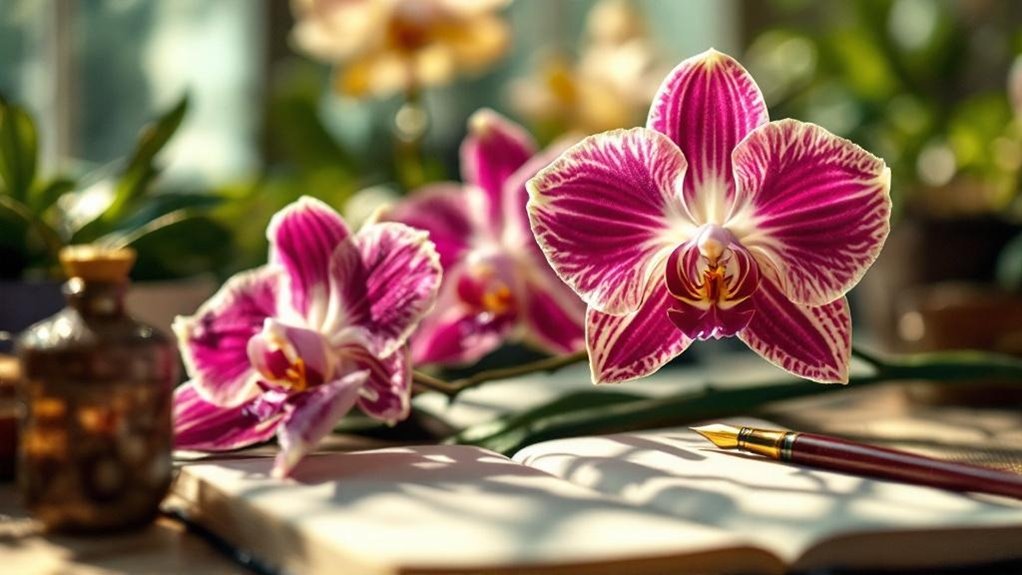
Consider how an orchid holds your attention: its cultivated forms range across more than 25,000 species and innumerable hybrids, its petals and structures seem almost architectural in one case and nearly animal in another, and that sheer variation gives creative people a vast observational field in which shape, color, symmetry, rarity, and adaptation never become stagnant.
You encounter an orchid species not as a fixed emblem but as a record of long evolution, specialized pollination, and environmental adjustment; those layered histories support metaphor, image, and narrative without strain.
You also see how orchid care deepens attention, because light, humidity, media, and mounting methods require disciplined looking and patient revision. That sustained contact lets you study fragility beside resilience, dormancy beside reblooming, and from those contrasts you derive enduring creative material for years.
Orchids have long symbolized nobility and refinement, giving writers and artists a ready language for elegance, devotion, and resilience.
What Makes Orchids So Compelling
You find orchids compelling because their cultivated beauty rarely stands alone; it arrives with rarity and layered meaning, shaped by thousands of species and hybrids that refuse any stagnant idea of what a flower should be.
You also see how science and craft hold them in place, from their observational fascination as masters of specialized pollination to the exacting work of managing light, humidity, air, and media with disciplined care.
And as their history of luxury, plant hunting, and symbolic weight gathers around them, you recognize why story and symbolism keep returning to orchids as a steady way to frame desire, transformation, and more difficult human inheritances.
Their long association with orchid prestige also helps explain why collectors, writers, and artists keep returning to them as symbols of refinement, rarity, and power.
Beauty, Rarity, And Meaning
Because orchids unite visual refinement with biological strangeness, they compel creators on more than a merely decorative level; across more than 25,000 species and innumerable hybrids, the family offers an observational range that few plants can match, from cryptic epiphytes that nearly disappear into bark to cultivated Cattleya and Vanda blooms whose color, texture, and form seem deliberately composed.
In your Orchid Collection, you notice beauty sharpened by rarity; even years ago, growers without a green thumb recognized that exacting care, never stagnant habits, gives orchids their quiet authority.
Victorian collectors turned orchidelirium into a lasting symbol of wealth, taste, and exclusivity.
| Beauty | Rarity | Meaning |
|---|---|---|
| Color, texture | Elusive species | Love, class |
| Sculptural blooms | Costly histories | Transformation |
You read each plant as a cultivated paradox, fragile yet durable, refined yet strange, and that tension keeps your attention steady.
Science, Story, And Symbolism
Although orchids first draw attention through form and color, they remain compelling for stricter reasons as well: Orchidaceae spans more than 25,000 species and innumerable hybrids, and that scale produces an observational field so broad that science, story, and symbolism naturally converge within it.
- You see adaptation: mimicry, deception, precise pollinators.
- You trace more than 100 million years across climates.
- You read power, desire, and belonging in cultivation.
- You learn patience from a miniature orchid reblooming.
Because orchids have inspired scientists, curators, and writers, you rarely encounter them as merely decorative; their forms record coevolution, their habitats resist stagnant categories, and their cultivated lives, often epiphytic, humidity-bound, dormant, then renewed, support symbolism grounded in resilience, transformation, and long attention.
Even now, they remain exacting subjects for observation and interpretation. In many traditions, they also stand for fertility and beauty, giving them a symbolic reach that extends from ritual and medicine to art and elite cultivation.
How Orchids Teach Patience and Process
You learn patience from orchids because they don’t reward constant intervention; after flowering, a Phalaenopsis may appear stagnant, with a shriveled stem and flattened leaves, even as it conserves strength for growth you won’t see for months.
As you care for it through a cultivated rhythm of thorough watering, drying, steady temperatures, and humidity, you begin to trust process over performance, and your observational discipline becomes part of the work itself.
Even the long stewardship of orchid collections, and the slow acclimation or recovery of demanding species, shows you that meaningful results often come through waiting, adjustment, and sustained attention.
Mindful orchid care can turn watering, pruning, and quiet observation into a grounding ritual that strengthens patience and presence.
Slow Growth Lessons
When you grow orchids, patience stops feeling like a virtue and starts functioning as a method, since many familiar varieties, including Phalaenopsis, enter a dormant phase after flowering in which stems brown, growth appears stagnant, and yet the leaves remain green as the plant quietly stores energy for a rebloom that may not come for months or even years.
- You read brown stems carefully.
- You respect seasonal rhythms.
- You adjust conditions gradually.
- You learn by observational trial.
At a museum complex like the Smithsonian Gardens, nearly 5,000 cultivated specimens demonstrate that progress accumulates through years of records, routines, and revision.
You also confront deeper scales: orchid pollination systems evolved across more than 100 million years, so mastery comes through tuned temperatures, restrained watering, coarse media, and steady observation, not haste. In Victorian history, Orchidelirium turned rare orchids into elite status objects and competitive collectibles.
Care Through Waiting
Patience becomes more than a lesson in orchid growing; it becomes a form of care, because the plant often appears stagnant just as it enters the physiological pause that makes future flowering possible. You learn to respect dormancy, especially in Phalaenopsis, when stems shrivel, leaves flatten, and energy shifts inward; with cultivated rest, steady indirect light, 60–80°F warmth, humidity, air movement, and soakings followed by drying, reblooming remains possible for years.
You also learn process, because orchids reward observational discipline rather than intervention. Like the Smithsonian’s long stewardship of thousands of specimens through protocols, maintenance, and risk management, you work within seasonal rhythms, plan for months or years, and accept delayed gratification, knowing apparent stillness is active, and that new spikes often arrive after patient, consistent attention. Their symbolism across cultures—from Chinese tradition to Japanese, Hawaiian, and Victorian settings—shows how orchids have long carried meanings of refinement, respect, and care.
Why Orchid Diversity Fuels Inspiration
Few plant families offer a creative field as expansive as Orchidaceae, whose more than 25,000 species and innumerable hybrids present an observational archive of form, color, scale, and habit that resists anything stagnant and keeps artistic attention moving across cultivated differences.
You see inspiration deepen through:
- mimicry, nectar spurs, and pollination dramas;
- epiphytic, terrestrial, and lithophytic habits;
- Cattleya fragrance, Vanda color, Phalaenopsis accessibility;
- ancient lineage, exploration, and orchidelirium.
Because orchids have evolved with bees, moths, butterflies, and birds, you inherit metaphors of desire, deception, and interdependence; because they range from compact houseplants to rare museum specimens, your subject remains inclusive, materially varied, and narratively open.
Their deep history, extending beyond 100 million years, steadies your imagination with resilience, while human histories of exchange add ethical texture and consequence.
How Collectors Learn Through Orchids
As you cultivate orchids, you build practical horticultural knowledge through observational care, adjusting light, humidity, air movement, and watering so roots don’t stay stagnant and species-specific needs are met.
You also learn that a collection is never just decorative; as it grows, it becomes a cultivated record of plant origins, care histories, and seasonal cycles, which teaches you patience, documentation, and steady judgment.
Over time, your orchids show you that collecting is both a discipline and a form of preservation, shaped by technique, mentorship, and the quiet historical value carried in every well-kept specimen.
Cultivation Builds Knowledge
Tend an orchid collection for any length of time, and you begin to see that cultivation is really a disciplined education, because each genus asks for a different balance of light, moisture, airflow, and temperature, and meeting those needs teaches you to observe rather than assume.
- You match Phalaenopsis, Cattleya, and Vanda to bright indirect light, warm 60–80°F conditions, and humidity.
- You mount epiphytes, choose airy mixes, and prevent stagnant roots by drying media between waterings.
- You track dormancy, rebloom cycles, propagation windows, and spike management through cultivated, observational patience.
- You learn accessioning, record-keeping, conservation standards, mentoring, and institutional communication through collection stewardship.
Over time, you don’t just grow flowers; you acquire method, judgment, and a curator’s steadier eye.
Collections Reflect History
When you study an orchid collection, you aren’t only looking at cultivated plants; you’re reading a living record of botanical fashion, scientific exchange, economic ambition, and environmental extraction, because collections preserve not just species but the human choices that moved them across regions and institutions.
You can see this clearly in the Smithsonian Gardens Orchid Collection, established in 1974, whose nearly 5,000 specimens and more than 1,300 species form an observational archive rather than a stagnant display. As you trace orchids through orchidelirium, from Kew’s 1787 Prosthechea cochleata flowering to Frederick Sander’s £2,000 Cattleya warscewiczii sale, you learn how desire shaped science and status. You also confront colonial extraction, since many cultivated orchids were removed from native habitats, while modern stewardship, through CODIE, turns collecting toward conservation, education, and public memory.
Why Writers Use Orchids as Metaphor
Ambiguity makes the orchid especially useful to writers, because it can hold beauty and desire in the same cultivated image while also suggesting the observational complexity of human longing; Orchidaceae includes more than 25,000 species, and that immense range of forms, colors, and structures gives authors a flexible metaphor for difference, attraction, and the way desire rarely stays simple or stagnant.
The orchid lets writers hold beauty, desire, and human longing in one image that never settles into simplicity.
- You see seduction in deceptive pollination.
- You register obsession in orchidelirium prices.
- You trace renewal through dormancy, then reblooming.
- You confront power in greenhouse removal.
When you write with orchids, you can join intimacy to strategy, since mimicry and nectar rewards suggest relationships shaped by dependence and disguise; you can also expose status hunger, colonial extraction, and the uneasy line between preservation and harm, without losing the flower’s quiet authority.
How Artists Reimagine Beauty With Orchids
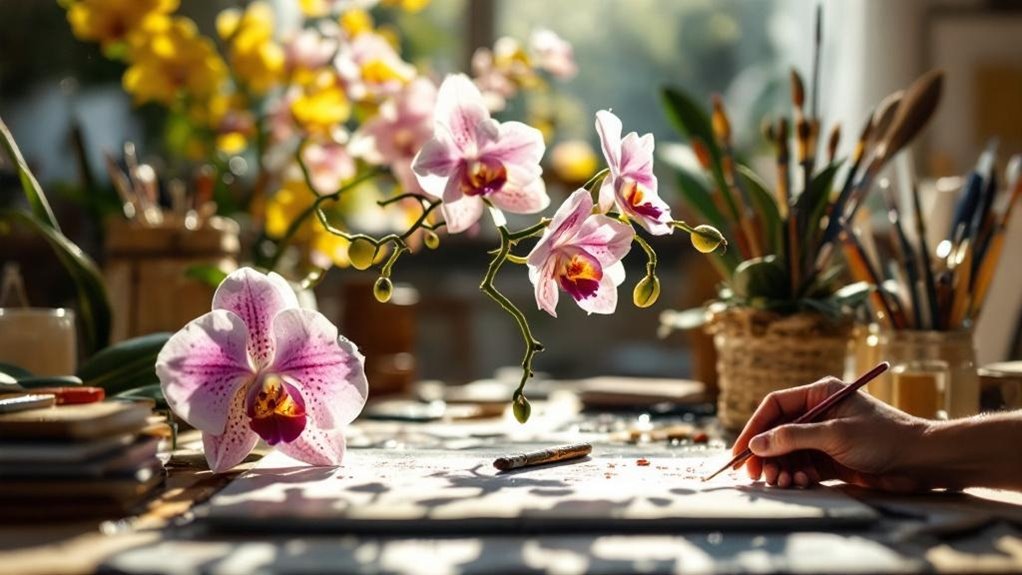
Artists reimagine beauty with orchids by refusing stagnant ideals of perfection and instead turning to a flower family whose more than 25,000 species and countless hybrids make beauty appear observational, unstable, and deliberately cultivated; in photography, fashion, and mixed-media installation, orchid forms let them place fragility beside structure, as in self-portraits with orchid headdresses or the repeated use of Phalaenopsis, whose graceful lines and durable bloom have come to signify femininity, transformation, and ornamental prestige without reducing those qualities to softness alone.
You also see artists reclaim discarded orchids, giving wasted blooms new ethical force, while scented varieties and pollination imagery extend meaning beyond ornament, so beauty becomes sensory, remembered, and quietly resistant to disposal. That shift lets you read orchids as materials for critique as well as admiration.
How Orchid History Deepens Their Meaning
Because orchid meaning has been cultivated through centuries of trade, study, display, and desire, you can’t read the flower only as a sign of delicate beauty; its symbolism also carries the record of obsession, status, and extraction.
Orchid symbolism records more than beauty; it also preserves histories of obsession, prestige, desire, and extraction.
When you encounter orchids in art or literature, you also encounter history:
- Kew’s 1787 clamshell orchid bloom helped ignite Western Europe’s orchid craze.
- By 1890, elite auctions turned rare specimens into visible wealth and prestige.
- Scientific study and display evolved together, from taxonomy to Smithsonian cultivation.
- Writers and artists use that cultivated past to deepen themes of desire and power.
This history keeps orchid symbolism from becoming stagnant or purely ornamental; it makes your observational reading sharper, because each bloom can suggest commerce, classification, longing, and the cultural force of centuries.
Why Orchids Hold Beauty and Violence
Tension gives orchids their unusual force in art and thought, since their cultivated beauty doesn’t stand apart from violence but emerges beside it; the same extravagant diversity that makes them observationally compelling—more than 25,000 species, countless hybrids, elaborate labella, improbable colors, and specialized forms—also helped drive the 19th-century collecting fever that turned them into objects of conquest, speculation, and display.
When you look closely, you see beauty joined to extraction: patrons financed hunters, habitats were stripped, and rarity became a luxury measure, with prized Cattleyas selling for sums that excluded nearly everyone. You also encounter evolutionary strategies that refuse stagnant sentiment, since some orchids mimic female insects or depend on singular pollinators, making reproduction appear precise, wondrous, and severe; that doubleness lets artists and writers connect admiration with trauma, desire, and loss.
How Orchid Exhibitions Bring Stories to Life
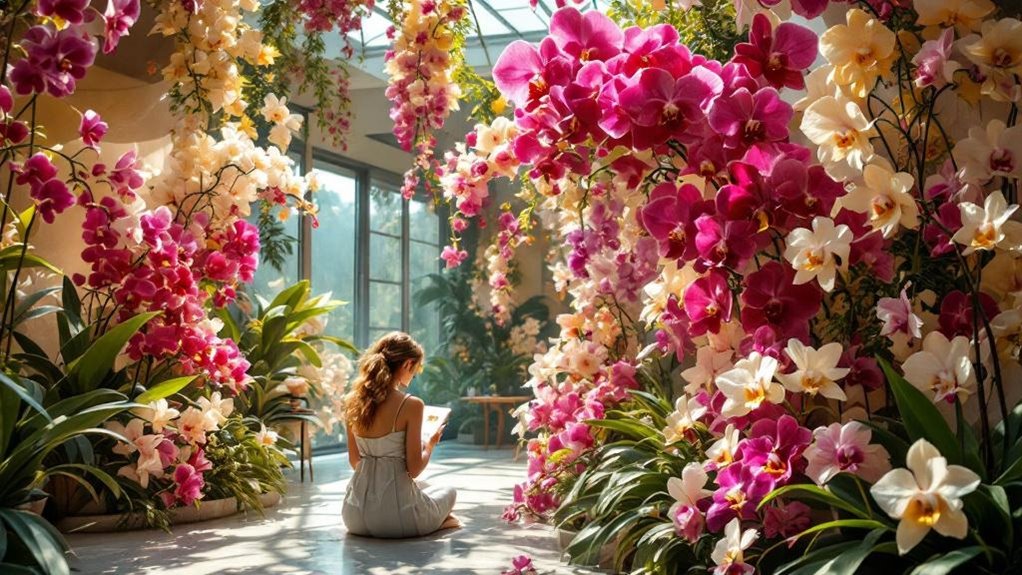
In orchid exhibitions, the plant rarely remains a cultivated specimen on a pedestal; curators use living collections, archival context, and multimedia interpretation to make each bloom carry history, science, and social memory at once.
Curators turn orchid displays into living archives, where each bloom holds science, memory, and history in elegant suspension.
You encounter:
- nearly 150 live orchids at the National Museum of African American History and Culture
- stewardship grounded in Smithsonian Gardens’ 1974 collection, with 5,000 specimens
- screens translating care, scholarship, and growers’ observational knowledge
- programs where visitors draw, ask, and learn, rather than remain stagnant
Through this framing, you don’t merely view orchids; you read colonial history, ecological stewardship, craft, and identity through them.
The exhibition becomes an interpretive structure, and each flower, precisely cultivated, carries evidence, argument, and community knowledge without losing its visual authority.
How Orchids Spark Memory, Wonder, and Belonging
When you stand before a cultivated orchid display, its variety does more than register as visual difference; with more than 25,000 species and countless hybrids in circulation, orchids sustain a durable sense of wonder, and that breadth gives visitors, growers, and artists repeated opportunities to recognize something they haven’t seen before, whether in the saturated geometry of a Vanda or the restrained delicacy of a Phalaenopsis.
In living exhibits at places like the Smithsonian Gardens or U.S. Botanic Garden, sight, scent, and texture can return you to precise memories, and those memories often become observational stories you share.
Orchids also resist stagnant meaning; from orchidelirium to contemporary fashion, they mark identity and class. When you join programs like Expert is In, shared questions create intergenerational connection, and inclusion suggests there’s an orchid for you.
Frequently Asked Questions
What Do Orchids Symbolize in Art?
Orchids symbolize luxury, love, beauty, strength, and transformation in art. You also see them suggest femininity, exoticism, healing, and status, while some works use them to critique colonial exploitation, commercial waste, and possessive desire.
What Do Orchids Symbolize in Literature?
In literature, you’ll see orchids symbolize beauty, love, femininity, status, and desire. They can also represent loss, transformation, memory, and colonial violence, letting you read them as both treasured symbols and troubling signs.
What Do Orchids Symbolize or Represent?
What do orchids symbolize? You see love, beauty, femininity, and grace in them, but they also represent rarity, status, transformation, resilience, and fragile power. Their intricate forms can suggest desire, healing, memory, and nature’s intimate interdependence.
What Is the History of Orchid Collecting?
You can trace orchid collecting to 1787, when a bloom at Kew sparked Europe’s orchid mania. Soon, wealthy patrons funded hunters, prices soared, habitats suffered, and eventually you see collections shift toward conservation, research, and display.
Conclusion
You don’t look at orchids for decoration alone; you study them as cultivated proofs that beauty is rarely simple, that patience resists a stagnant life, and that form can carry history, risk, and desire at once. In their strange symmetry and disciplined variation, you find an observational lesson for making and collecting: attend closely, wait without complaint, and let wonder deepen into knowledge, as roots grip bark in silence and a flower opens like a measured thought.