
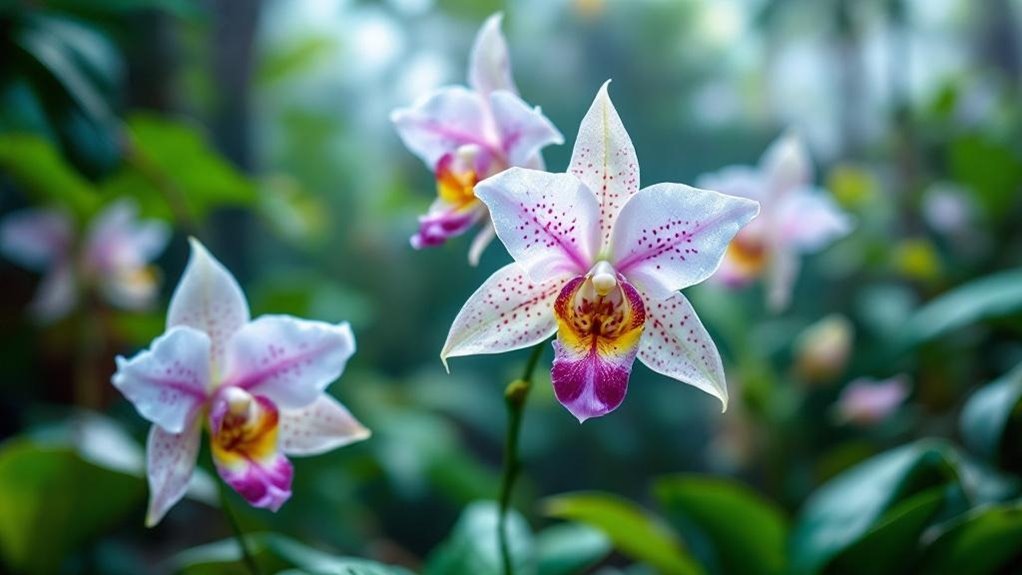
You’ll find that rare orchid legends usually begin with real scarcity, because many species survive in tiny, observationally elusive populations, mature so slowly that a first bloom may take years, and rely on exact fungi, pollinators, and wetland or woodland chemistry that disturbance can render stagnant; from the Ghost Orchid’s phantom flower to the Yellow Lady’s Slipper’s guarded decline, these stories reflect biology, cultivated desire, and loss, and the examples ahead make that pattern clearer.
- Key Takeaways
- What Makes an Orchid Rare?
- Why Rare Orchids Inspire Legends
- Why the Ghost Orchid Feels Supernatural
- Why the Yellow Lady’s Slipper Is Rare
- How Hochstetter’s Orchid Disappeared
- Why the Underground Orchid Defies Belief
- Why Rothschild’s Slipper Is So Valuable
- How the Prairie Fringed Orchid Survives
- Rare Orchids That Mimic Insects
- Why the Fly Orchid Tricks Pollinators
- Why the Bee Orchid Deceives Bees
- Why the Monkey Orchid Fascinates People
- Why the Flying Duck Orchid Looks Unreal
- Why the Bird Head Orchid Looks Alive
- What Makes the Green Squid Orchid Alien
- Why the Dove Orchid Inspired Sacred Stories
- Why the White Egret Orchid Looks Airborne
- Why the Dragon’s Mouth Orchid Earned Its Name
- Why the Three Birds Orchid Blooms Briefly
- How the Sky Blue Sun Orchid Follows Light
- Why the Hawaiian Swamp Orchid Is Vanishing
- Why the Bull Orchid Became a Giant
- How Coleman’s Orchid Lives Without Chlorophyll
- Why the Donkey Orchid Looks Comical
- Why the Goat Orchid Looks Mythical
- How Greek Myth Shaped Orchid Lore
- Why Vanilla Orchid Mattered to the Aztecs
- How China Turned Orchids Into Symbols
- Why Victorian Orchid Mania Created Myths
- How Conservation Protects Rare Orchids
- Frequently Asked Questions
- Conclusion
Key Takeaways
- Many rare orchids are “legends” because tiny wild populations survive in highly specific habitats with exact soil, moisture, and light conditions.
- Orchid rarity often comes from dust-like seeds needing one mycorrhizal fungus, plus dependence on specialized pollinators or hidden underground relationships.
- Some legendary orchids recover extremely slowly, taking 6–15 years to flower, so even one removed plant can set conservation back.
- Several famous rare orchids are hard to detect because they bloom briefly, grow underground, or remain vegetative for years, causing undercounting.
- Their legendary status is intensified by habitat loss, poaching, and black-market demand, making protection of habitat, fungi, and pollinators essential.
What Makes an Orchid Rare?
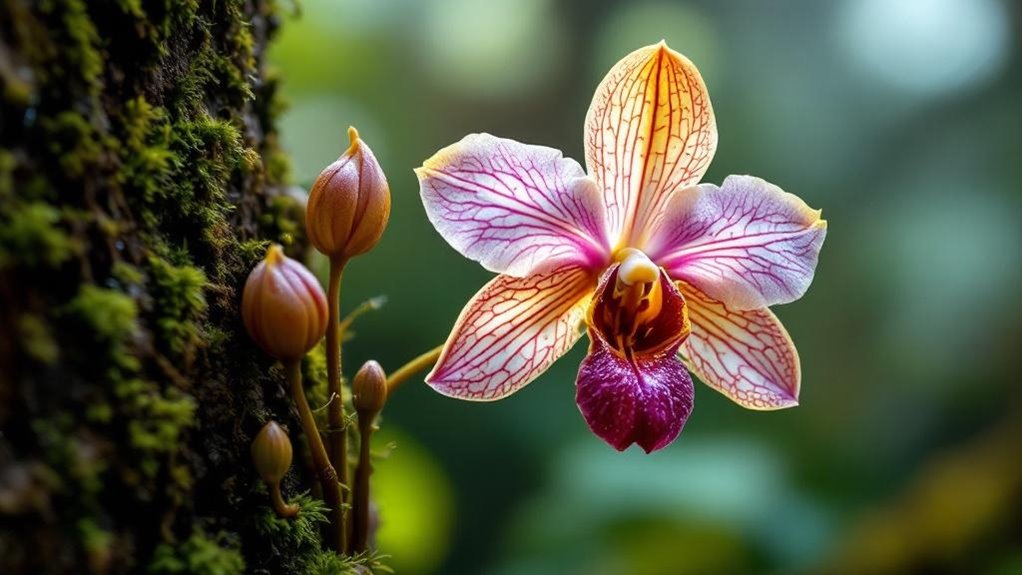
Although rarity can seem like a simple matter of low numbers, an orchid is usually considered rare because several limiting conditions converge: it may occupy an extremely narrow natural range, persist as only a few dozen wild plants, or depend on ecological relationships so specialized that even slight disturbance leaves the population stagnant.
You can see this in Rothschilds Slipper, with fewer than fifty wild plants, and in species tied to one mycorrhizal fungus, one pollinator, or exact wetland chemistry.
Recovery also stays slow when orchids mature over many years and flower infrequently, so losses aren’t quickly replaced. Habitat destruction, cultivated demand, and poaching push some species into Critically Endangered status despite legal protection.
Finally, observational difficulty matters; subterranean or brief-blooming orchids can remain overlooked, undercounted, and thus classified as rare. The Ghost Orchid is a famous example of an elusive, highly protected species that feels rare because it is so difficult to find in the wild.
Why Rare Orchids Inspire Legends
Because rare orchids appear so briefly, so sparsely, and often in places few people can reach, cultures have long treated them as signs rather than merely plants; when a flower such as Rothschild’s Slipper survives as only a handful of wild individuals, or the Ghost Orchid emerges like an apparition from deep swamp shade, scarcity itself begins to look like evidence of divine favor, supernatural power, or hidden knowledge.
When you observe Rare Orchids, you also encounter forms that resist ordinary explanation: the ghost orchid, the White Egret, and the Slipper orchid suggest birds, spirits, and cultivated emblems, while deceptive pollination and stagnant waiting periods of years invite stories of transformation, patience, and concealed wisdom; across societies, from vanilla’s sacred prestige to orchid ideals of nobility, those meanings harden into legend.
The Ghost Orchid’s two-week bloom and leafless, swamp-hidden habit make it feel as fleeting and supernatural as a legend.
Why the Ghost Orchid Feels Supernatural
When you see the Ghost Orchid’s phantom white bloom suspended against a stagnant swamp backdrop, you understand why its nearly leafless form and lack of visible greenery give it an observational, almost supernatural presence.
You notice how its roots cling to bark while the flower seems to float alone in shadow, and that cultivated illusion of a body without substance makes the plant feel less rooted in biology than in legend.
When it opens in the night forest, pale and brief, drawing specialized hawk moths through darkness, you can’t miss how rarity, secrecy, and unstable flowering rhythms deepen its mystery.
Its ghostly bloom and extreme rarity have helped make it a lasting symbol of haunting beauty.
Phantom White Appearance
Specter is the image the Ghost Orchid invites, not through folklore alone but through form: in many populations it has no visible leaves, and its pale, cream-to-white flower emerges against dark bark with so little green tissue in view that the bloom seems detached from ordinary plant life, suspended rather than rooted.
When you encounter this Ghost Orchid in a shaded Florida swamp or cultivated observational record from Cuba and the Bahamas, its white color, reinforced by the apparent absence of chlorophyll in the bloom, reads as unearthly rather than decorative; the long nectar spur, nocturnal fragrance, and rare appearance in stagnant hammocks deepen that impression, especially at dusk, when sphinx moths begin to work and the flower seems briefly present, then gone, protected, scarce, and difficult to witness.
Like many so-called black orchids, it reminds observers that dramatic plant myths often grow from unusual appearance, rarity, and the stories people attach to them.
Leafless Floating Illusion
Although the ghost orchid produces no leaves and no visible green blade to anchor your eye, it doesn’t appear incomplete; instead, its photosynthetic roots spread flat against bark and do the plant’s work in silence, so the white, narrow-limbed flower seems to detach from ordinary structure and hover in place, especially in dim hammock light where contrast rather than outline governs what you see.
In its natural habitat, high on cypress or pond-apple trunks, the flowers look less cultivated than accidental, an observational anomaly among Orchids, brief from June to August and gone within weeks. Because so few remain in accessible places, you register each bloom as a floating illusion shaped by rarity, stagnant shade, and exact ecological dependence, rather than by any visible support, with orchidelirium and fungal and pollinator alliances holding it there.
Night Forest Mystery
That floating illusion deepens after dark, because the ghost orchid’s creamy-white flower, unsupported by any visible leaf or green blade, catches the weak light that filters through stagnant swamp and hammock forests and seems to separate itself from bark, root, and ordinary plant form.
- In the night forest, you notice no leaves, only bloom and root.
- Its natural habitat hides it on trunks in observational silence.
- Wild Ghost orchid populations remain so limited that sightings feel cultivated by chance.
- Brief blooms coincide with giant sphinx moth visits, which strengthens its nocturnal legend.
- Protection laws and habitat loss make it a conservation emblem.
You read the scene as supernatural because aerial roots vanish into shadow, the flower appears suspended, and rarity, fragility, and legal guardedness keep this orchid half seen, half remembered. Orchids in ancestral rituals often signify enduring love, reverence, and continuity beyond a single life, which adds to the ghost orchid’s otherworldly aura.
Why the Yellow Lady’s Slipper Is Rare
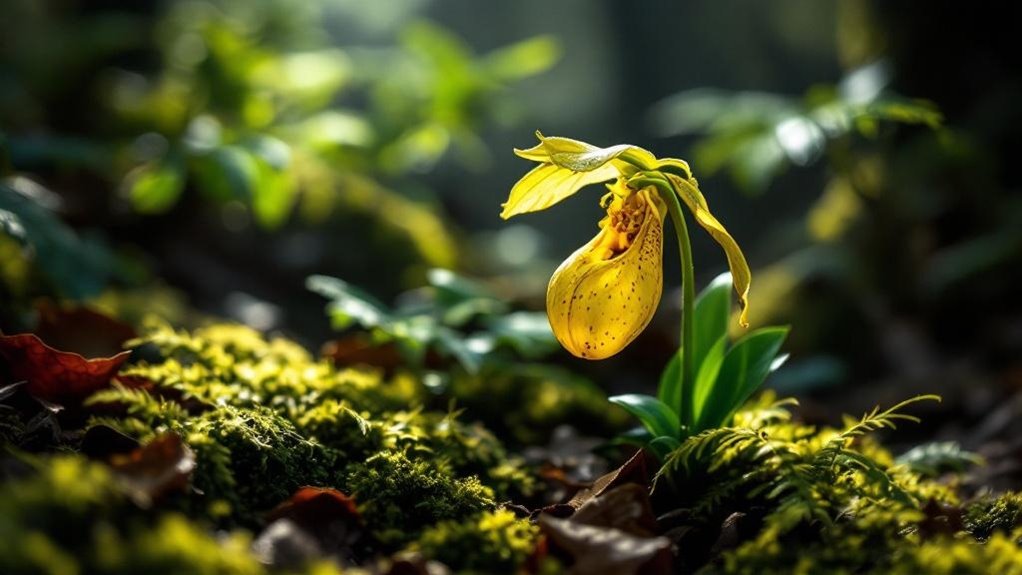
When you consider why the Yellow Lady’s Slipper is rare, you see a species shaped by a slow growth cycle, because it may take 6 to 11 years to produce its first flower, and by then any damaged population recovers only at a stagnant pace.
You also find that its survival depends on unusually narrow conditions, including specific mycorrhizal fungi in undisturbed soils and suitable calcareous or mixed-woodland habitats, so agriculture, development, and poor woodland management have steadily reduced the places where it can establish.
As you follow the observational record, you recognize severe conservation threats in both history and law; over-collection sharply reduced wild plants, and its critically endangered status in Great Britain, along with protection under CITES, the Bern Convention, and the EU Habitats Directive, shows how carefully this cultivated-looking orchid must now be guarded.
Orchids in general have long been linked with good fortune and refinement, which helps explain why rare species often carry both cultural value and conservation concern.
Slow Growth Cycle
Because the Yellow Lady’s Slipper advances through its life cycle at a remarkably slow pace, its rarity isn’t incidental but cultivated by biology itself; from seed to first flower, a plant may need 6 to 11 years to mature, and even that long interval depends on an intact partnership with specific mycorrhizal fungi, since the dust-like seeds carry almost no nutrient reserves of their own.
- You see recruitment remain stagnant after disturbance.
- You notice fungal partners govern early survival.
- You find vegetative growth measured and observational.
- You observe flowering arrive infrequently, sometimes sparsely.
- You understand why each mature Lady’s Slipper matters.
For this orchid species, including the Yellow Lady’s Slipper, slow growth compresses reproduction across decades; if you remove even a few blooming plants, recovery doesn’t simply pause, it recedes.
Severe Conservation Threats
You see habitat steadily reduced by agriculture, woodland clearance, and development, leaving fragmented calcareous grassland and mixed woodland; you also see how Orchid Collection, from Victorian demand to modern illegal digging, strips remaining sites despite legal safeguards.
Because this slipper depends on precise fungal partners, soil disturbance, fungicides, and stagnant ecological change can block germination, while overgrazing, trampling, and altered hydrology erase small populations before the Yellow Lady’s Slipper can recover.
How Hochstetter’s Orchid Disappeared
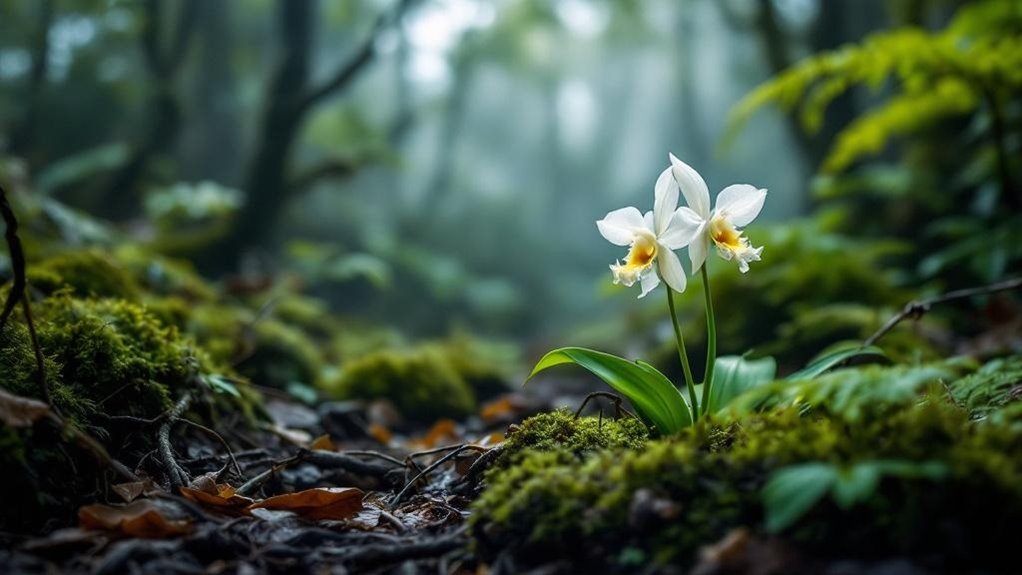
Although Hochstetter’s Butterfly Orchid was first recorded on the Azores in 1838, it then slipped from observational reach for 175 years, and that long silence persuaded many botanists that it had effectively vanished from Europe.
First recorded in 1838, Hochstetter’s Butterfly Orchid then vanished from sight for 175 years, seeming lost to Europe.
You can trace that disappearance through several pressures:
- Hochstetter’s butterfly orchid, Platanthera azorica, was first discovered on isolated Azorean ground.
- It occupied remote volcanic ridges with alpine-like conditions, rarely visited by observers.
- Habitat loss and ecological change likely fragmented populations across the islands.
- Tiny surviving groups became harder to detect, especially in stagnant survey patterns.
- In 2013, botanists finally relocated a remnant population on a ridge.
You see, the species never truly vanished; instead, cultivated landscapes expanded, suitable habitat contracted, and its cryptic distribution kept surviving plants hidden, confirming how vulnerable rarity becomes.
Why the Underground Orchid Defies Belief
Where most orchids announce themselves above the leaf litter, the Western Underground Orchid, *Rhizanthella gardneri*, completes its entire life cycle at or below ground level, producing as many as 100 inward-facing flowers in deep red, pink, or cream, all concealed beneath pale bracts, and that hidden architecture is only the beginning of what makes it seem almost implausible.
If you trace its observational logic, you find a plant from southwestern Australia that survives through a cultivated mycorrhizal relationship, likely receives visits from termites and gnats in stagnant soil, fruits between May and July with berry-like bodies carrying heavy seeds, and depends on small mammals rather than wind for dispersal.
With fewer than 50 wild plants known, the Western Underground Orchid stands among the rarest orchids, while conservation programs now guard its remaining habitat carefully.
Why Rothschild’s Slipper Is So Valuable
When you consider why Rothschild’s Slipper commands such value, you begin with extreme rarity; fewer than about 50 mature plants are known in its native Mount Kinabalu habitat, and that narrow mountain-forest range has grown increasingly stagnant under habitat loss and legal protection.
You also have to account for its slow blooming cycle, because cultivated plants take years to mature, then produce dramatic, observational flowers with long horizontal petals and marked spotting, often bearing several blooms at once and reinforcing collector interest.
As scarcity, cultivation difficulty, and prestige converge, you can see why black-market demand has pushed prices into the thousands, making this orchid valuable not only as a botanical specimen but also as a symbol of constrained access.
Extreme Rarity
Because Rothschild’s Slipper survives in such a narrow band of rainforest near Mount Kinabalu, with fewer than roughly fifty mature plants believed to remain in the wild, its value doesn’t come from myth alone; it comes from measurable scarcity, a slow and easily stagnant recovery rate, and a cultivated demand that has long exceeded any lawful supply.
- You’re looking at an Orchid with extreme rarity.
- Rothschild’s Slipper occupies a specialized elevational niche.
- Illegal collecting magnifies every loss.
- Habitat destruction narrows survival options.
- Conservation now protects remaining genetic stock.
When you assess its price, often several thousand dollars per plant, you’re seeing observational economics at work; beauty matters, but constrained supply, difficult re-establishment, and persistent black-market demand shape value more decisively than legend does.
Slow Blooming Cycle
Although rarity explains part of Rothschild’s Slipper’s price, its slow blooming cycle makes that value more intelligible; a plant may need roughly fifteen years to reach maturity and produce its first flower, and that long juvenile span, shaped by a narrow elevational habitat, exacting rainforest conditions, and specialized mycorrhizal relationships, keeps propagation difficult and recovery stagnant even under careful cultivation.
| Factor | Effect |
|---|---|
| Slow growth | Delays first bloom |
| Tiny wild population | Makes flowers scarce |
When you observe a cultivated Rothschild’s Slipper Orchid, you’re seeing time condensed into one inflorescence, often carrying up to six durable flowers, yet standing against fewer than fifty wild plants; that imbalance deepens conservation concern, because each natural bloom remains ecologically significant and observationally rare.
Black Market Demand
Set against a wild population reduced to fewer than fifty mature plants in Mount Kinabalu’s rainforests, Rothschild’s Slipper attracts black-market demand with a predictability that’s as grim as it’s economic; collectors prize its large, green-and-red-spotted flowers, its cultivated scarcity, and its years-long path to flowering size, and those traits combine with strict legal protections, including CITES controls and local conservation limits, to push trade out of regulated channels and into illicit ones, where individual plants have historically brought several thousand dollars or more.
- Scarcity hardens prices
- Slow growth sustains desire
- Laws constrict legal supply
- Poachers remove whole clumps
- Conservation becomes stagnant
You can see why orchids are considered trophies here; black‑market demand follows rarity, remote habitat, and difficult propagation, while Rothschild’s Slipper loses reproductive capacity and wild stability.
How the Prairie Fringed Orchid Survives
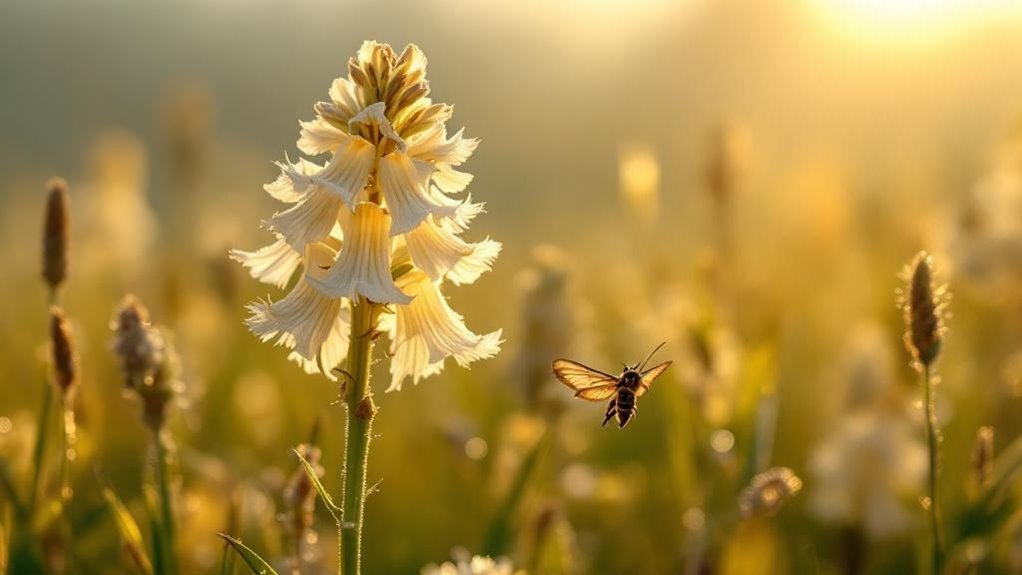
Where the tallgrass prairie still holds its seasonal moisture and avoids stagnant disruption, the Western Prairie Fringed Orchid survives through a cultivated balance of timing, habitat, and partnership: it rises about one to two feet, opens as many as two dozen pale flowers on a stalk during May and June, and releases a strong nighttime fragrance that draws in large sphinx moths, its most effective pollinators.
| Trait | Role | Risk |
|---|---|---|
| Night bloom | Attracts moths | Drainage |
| Fungi | Starts seedlings | Fungicides |
You can read this as an observational lesson in dependence: intact hydrology, compatible soil fungi, and moderated disturbance keep remnant populations alive. Though no sun orchid, and it never resembles an insect, the Western Prairie Fringed Orchid persists with some grazing and prescribed fire, while pigs, trampling, development, and isolation steadily narrow its chances worldwide.
Rare Orchids That Mimic Insects
As you turn to rare orchids that mimic insects, you see deception working with cultivated precision; the Bee Orchid imitates the look and scent of a female bumblebee so closely that male bees attempt mating and carry pollen instead of finding nectar. You also encounter the Fly Orchid, whose dark, glossy form and chemical signals mislead male flies into pollination in European woodlands and chalk grasslands, an observational pattern that appears between May and July rather than in stagnant cycles.
As you follow these examples, you recognize that such mimicry binds each orchid to specific pollinators, which helps explain why many populations remain highly localized and vulnerable when habitat loss or fungicides disturb their fungal partners.
Bee Orchid Deception
Although the Bee Orchid, *Ophrys apifera*, appears at first glance to be merely decorative, its flower has cultivated a highly specific deception: the labellum mimics the shape, texture, and scent of a female bumblebee so convincingly that male bees attempt copulation, and in that brief mistake they pick up or deposit pollen.
- You see why Bee Orchid flowers Look Like Animals.
- This orchid called Ophrys apiferauses scent and pattern precisely.
- Hair-like surfaces strengthen that observational illusion for bees.
- Self-pollination prevents stagnant reproduction when visitors fail.
- Fungi in soil quietly govern germination and growth.
In Europe, you can observe selfing during poor pollinator years, yet insect visits still matter, because genetic exchange preserves diversity, and suitable habitat, intact fungi, and careful land management remain necessary for persistence across changing landscapes.
Fly Orchid Mimicry
The Fly Orchid, *Ophrys insectifera*, carries this cultivated strategy into a narrower register, presenting yellow-green sepals and dark, glossy petals that read, to the right male insect, as the outline and presence of a female fly rather than a flower. You observe how these Orchids extend deception through scent, drawing males into pseudocopulation, where pollinia attach and move between blooms with observational efficiency.
From May to July, you find them in damp alkaline soils, beech woodlands, limestone grasslands, and wet meadows, never stagnant ground, because their pollinators and fungal partners must coincide. Unlike a Fringed Orchid, this species depends on exact visual and chemical cues, so fungicides, disturbance, and pollinator loss reduce local populations. If you love Orchids, you protect habitat first, then the insects they imitate.
Why the Fly Orchid Tricks Pollinators
Why does the Fly Orchid rely on deception rather than reward; because its survival depends on a highly specialized exchange in which male flies are drawn not by nectar, which the flower doesn’t provide, but by a cultivated illusion of a receptive mate.
- You see dark, glossy petals mimic a fly.
- You detect volatile scents that imitate pheromones.
- You find low spikes place pollinia with precision.
- You note May to July bloom timing.
- You understand damp, alkaline habitats support this system.
When you observe Ophrys insectifera, you see a strategy shaped by scarcity and exact timing; males attempt copulation, and the flower secures pollen transfer efficiently.
Because this orchid also depends on mycorrhizal fungi, habitat change, stagnant air pollution, and chemical disturbance can unravel the entire observational balance beneath it.
Why the Bee Orchid Deceives Bees
Consider the Bee Orchid, and you see deception refined into a cultivated reproductive method; Ophrys apifera doesn’t invest in nectar, but instead shapes its labellum to resemble a female bumblebee in size, pattern, texture, and sheen, then reinforces that visual signal with volatile compounds that imitate female sex pheromones, so male bees approach under a false biological expectation and, in attempting to mate with the flower, collect or deposit pollen.
When you examine that strategy, you notice efficiency rather than cruelty; the orchid spends energy on specialized form and scent, not rewards, which can suit low-competition, observational habitats where nectar would be wasteful or stagnant.
If pollinators rarely arrive, you still find another safeguard, because in parts of its range the species can self-pollinate and preserve reproduction.
Why the Monkey Orchid Fascinates People
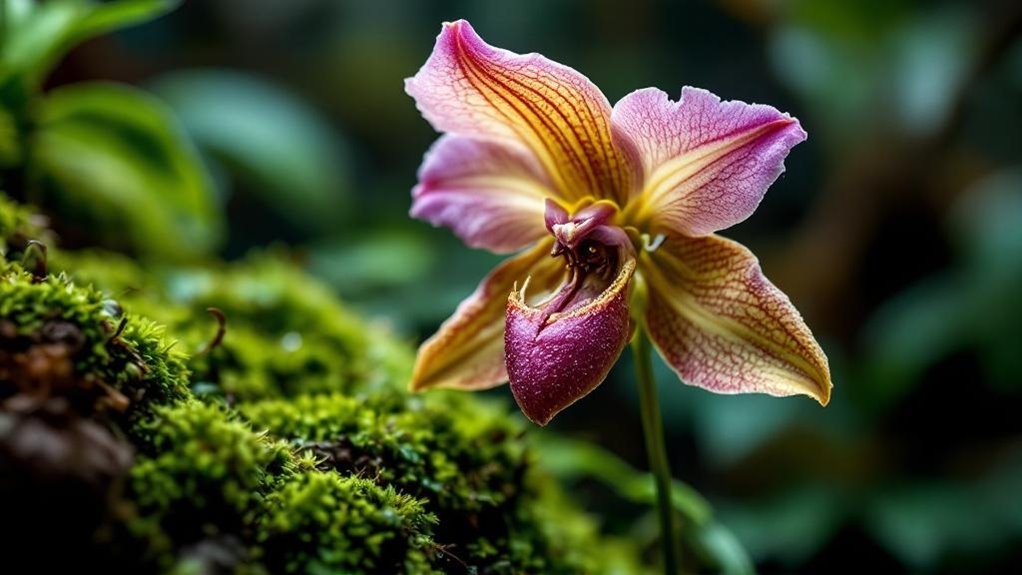
You notice the Monkey Orchid first because its flower presents a persuasive monkey-face illusion, the petals and lip aligning into eyes, nose, and mouth; that observational likeness fixes itself in memory and gives the plant an unusual cultivated fame.
You remember it again because the bloom carries a citrus-like scent, often compared to ripe oranges, and because that fragrance, combined with cool, humid cloud-forest conditions, suggests a precise ecological role rather than a stagnant curiosity.
You also see why myth and internet appeal gather around it, since its rare range in Ecuador and Peru, its exacting cultivation needs, and its uncanny appearance turn each image into both spectacle and quiet evidence of why conservation matters.
Monkey Face Illusion
- You notice facial symmetry.
- You see features best up close.
- You may find several “faces.”
- You connect rarity with value.
- You associate loss with significance.
In Ecuador and Peru, cool cloud-forest conditions shape this orchid’s rarity; multiple blooms intensify the illusion, while deforestation and climate change deepen your attention.
Citrus-Like Bloom Scent
What sets the Monkey Orchid apart even further is that its bloom doesn’t rely on appearance alone; when Dracula simia flowers in the cool, shaded cloud forests of southeastern Ecuador and Peru, it releases a distinct citrus scent, often compared to mandarin or orange peel, and under still, humid conditions that fragrance can carry several feet through stagnant air.
| Feature | Effect | Observational note |
|---|---|---|
| Citrus volatiles | Attract insects | Resemble ripe peel |
| Cool shade | Enhances contrast | Dense growth limits sight |
For you, that cultivated fragrance explains part of the orchid’s hold, because scent broadens the encounter beyond vision; for pollinators, similar volatile molecules likely mimic food cues, helping blooms stand out where low light, dense vegetation, and restricted elevation mute other signals.
Myth And Internet Appeal
Because the Monkey Orchid presents a bloom that seems to form an unmistakable monkey’s face, it moves easily from botanical curiosity into myth, and that shift explains much of its internet appeal; people don’t simply observe the flower, they interpret it through pareidolia, then circulate that interpretation through high-resolution macro photographs, time-lapse videos, and collector accounts that emphasize both its cultivated rarity and its strange sensory presence.
- You register the face first.
- You follow the ripe-orange scent.
- You note its cloud-forest rarity.
- You see stagnant folklore gather.
- You watch posts turn observational.
As you encounter it online, you’re seeing more than novelty; you’re seeing scarcity from Ecuador and Peru, multisensory description, and mythic framing converge, so the bloom appears less like a specimen and more like a spirit-shaped rarity.
Why the Flying Duck Orchid Looks Unreal
How does a flower come to resemble a bird so convincingly that it seems almost cultivated rather than wild; in the Flying Duck Orchid, the illusion comes from a precise arrangement of petals and sepals, a brownish-red palette with lighter markings, and a labellum shaped like a duck in mid-flight, complete with a hooked beak and outstretched wings.
When you see one, the effect feels observational rather than decorative, because every contour serves pollination; the hinged labellum snaps downward when an insect lands, briefly trapping it so pollinia attach with unusual efficiency.
You’re also looking at a very small orchid, only a few centimeters across, borne in October and November on a single stem from a tuber, often above well-drained sandy ground, never stagnant soil, where fungi quietly support its specialized life.
Why the Bird Head Orchid Looks Alive
Although the Bird Head Orchid belongs to the familiar Phalaenopsis group, its bloom appears almost animate, since the central column projects like a small bill, the surrounding petals and sepals set the outline of a head, and the lip curves forward like an open beak poised over nectar.
Though a Phalaenopsis, the Bird Head Orchid seems alive, its bill-like column and beak-curved lip forming an avian face.
- You notice a beak-like column.
- You see eye-like markings.
- You read glossy surfaces as feathers.
- You follow stripes toward nectar.
- You sense fragrance completing the illusion.
As you study it, thick, fleshy segments give depth, cultivated color contrast sharpens facial contours, and reflective texture prevents any stagnant appearance under shifting light.
Its subtle scent and nectar guides don’t merely decorate the flower; they direct pollinators through observational cues, and that adaptive design makes the blossom seem uncannily alive to you, by intent and appearance.
What Makes the Green Squid Orchid Alien

When you look at the Green Squid Orchid, you notice at once its inverted flower, its purple hood, and its long green segments, which curve outward like cultivated arms and give the bloom a distinctly squid-like form.
You also see how the sharp contrast between the recurved purple lip and the green sepals creates an observational effect that feels otherworldly, especially when multiple flowers appear in sequence and hang along the stem like small creatures suspended above stagnant shade.
In swampy hammocks and mangroves, that uncommon architecture makes the plant seem less like a familiar orchid and more like an alien presence shaped for precise pollination.
Squid-Like Floral Form
Because its flower is effectively inverted, Prosthechea cochleata presents a form that doesn’t read as conventionally floral; you see a flattened, hood-like purple or maroon lip poised above the column like a head, while the long, narrow green sepals and petals extend outward and downward as tentacular limbs, giving the cultivated plant its distinctly alien, squid-like outline.
- You observe an epiphyte, usually anchored to trees.
- You notice pendant inflorescences extending the display.
- You get sequential blooms, not a single brief event.
- You find small insects responding to nectar and shape.
- You maintain humidity, airflow, and never stagnant conditions.
Across humid forests, swamps, and Everglades habitats, this observational structure persists; each bloom reinforces the marine silhouette, and when several flowers open in sequence, you see why the plant’s form, more than anything else, defines its singular presence.
Otherworldly Color Contrast
Where the flower’s silhouette already feels unfamiliar, its color contrast completes the effect; you see bright lime-green sepals and leg-like segments set against a dense purple hood, and the cultivated plant reads less like a conventional orchid than a controlled, observational study in cephalopod mimicry.
You aren’t looking at dye or horticultural distortion, because across Central America, the Caribbean Basin, and the Florida Everglades, this green-and-purple division remains stable in wild populations.
You also notice that the green elements do practical work; photosynthetic pseudobulbs and bracts support the plant while intensifying the visual split from the darker hood.
In stagnant, shaded understory habitats, that contrast improves visibility to pollinators, and because the shell-like color division repeats reliably across blooms, you understand why it also carries the names cockleshell and clamshell orchid.
Why the Dove Orchid Inspired Sacred Stories

Although the Dove Orchid, *Peristeria elata*, is simply a plant in botanical terms, its white central bloom presents such a clear likeness to a perched dove that communities across Central America, as well as in Ecuador and Venezuela, didn’t treat it as an ordinary flower; they cultivated sacred meanings around it, linking its symmetrical, observational precision to peace, the Holy Spirit, and the idea of a divine messenger made visible in living form.
- You recognize peace in its form.
- You see ceremonial use in garlands.
- You understand why rites reserved it.
- You note its localized rarity mattered.
- You see reverence risk stagnant loss.
When you encounter this orchid, you can understand why gifts or sightings felt auspicious; its sacred reputation shaped devotion, and later conservation, because overcollection threatened both species and story.
Why the White Egret Orchid Looks Airborne
At first glance, the White Egret Orchid, *Habenaria radiata*, seems to lift off from its stem rather than merely open, since its pure-white bloom arranges itself into an observational likeness of a bird in flight: the deeply fringed lip spreads wide like soft wings, the narrow lateral petals sweep back like trailing feathers, and the split lower portions suggest a tail caught mid-motion.
When you study a summer bloom from China, Korea, or Japan, you see how several-centimeter fringes intensify that illusion, while the elevated stalk holds the flower above the foliage, as if it has already risen; beneath the white segments, the green spur and column read as a compact body and head, and in cultivated plants grown in sunny, boggy, never stagnant conditions, those margins expand fully, sharpening the airborne silhouette called Sagiso.
Why the Dragon’s Mouth Orchid Earned Its Name
Look closely at the Dragon’s Mouth orchid, *Arethusa bulbosa*, and its name resolves itself with little strain, because the single flower’s broad, flared labellum and surrounding fused segments create the clear impression of an open mouth, while the saturated magenta to deep rose tones, set off by yellow and white markings within the throat, suggest heat, flame, and the old observational likeness of a dragon poised to roar.
The Dragon’s Mouth orchid earns its name in a single glance: a flared, flame-colored bloom like a dragon mid-roar.
- You see fiery coloring.
- You notice a gaping form.
- You find one bloom per stem.
- You observe bee-guiding structure.
- You recognize fragile habitat.
Standing only 10–25 cm tall in bogs and wet meadows, it still commands attention; its labellum serves pollinators as a landing platform, while acidic, nutrient-poor, stagnant wetlands keep this cultivated-looking orchid vulnerable to drainage.
Why the Three Birds Orchid Blooms Briefly
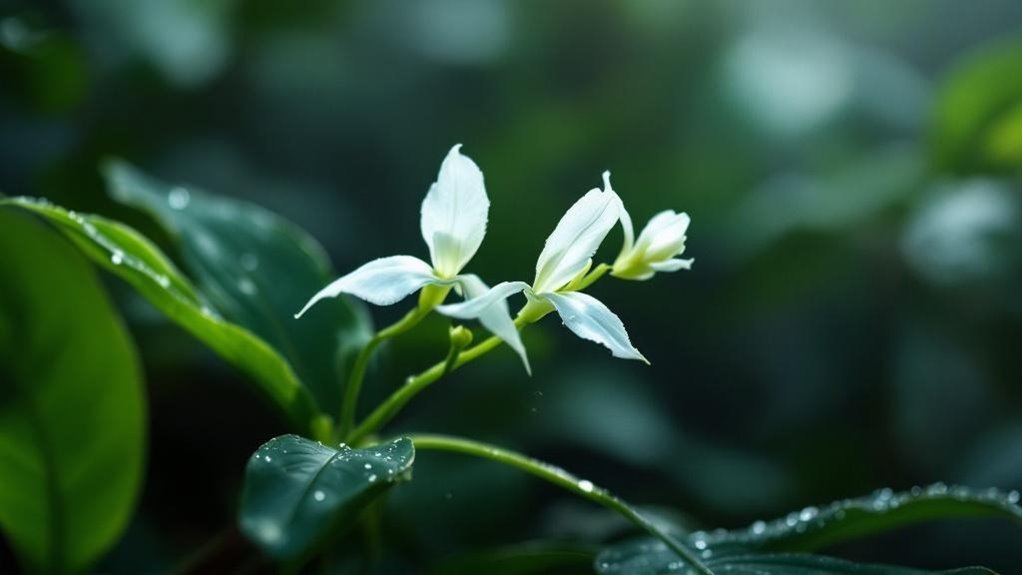
Because the Three Birds orchid depends on a narrow pollination window, its flowers often open for only a few hours, a brief display that concentrates scent release and nectar production into the part of the day when tiny flies or bees are most active, and when temperature, humidity, and light align with unusual precision. You can read this brevity as cultivated efficiency; by avoiding stagnant, risky hours, the plant limits herbivores, fungal attack, desiccation, trampling, and abrupt weather stress.
| Trigger | Benefit | Result |
|---|---|---|
| Warmth | Scent peaks | Pollinators arrive |
| Humidity | Nectar holds | Visits improve |
| Brief opening | Risks drop | Seeds set |
If you watch closely, you’ll notice an observational pattern: one short bloom may suffice, yet sequential flowers extend opportunity while conserving resources across changing seasons.
How the Sky Blue Sun Orchid Follows Light
As you turn to the Sky Blue Sun Orchid, you see that its sky-blue flowers open only under direct, strong sunlight, an observational pattern that supports photosynthesis and places the bloom before daytime pollinators when light is highest.
You can also note its cultivated precision in light-tracking petal behavior, because the petals and floral structures orient toward the sun and reflect it in ways that sharpen color against stagnant surrounding vegetation, making the flower easier for insects to detect.
If you follow that relationship further, you find that abundant light governs not only display but success itself, since plants in open habitats flower and set seed more reliably than those left in shade.
Sunlight-Triggered Blooming
When direct sun reaches the Sky Blue Sun Orchid, a cultivated member of the Australian Thelymitra genus, its blue petals open with striking precision, while the same flower often stays closed under cloud cover or in stagnant, cool air; this sunlight-triggered response isn’t ornamental but observational in its logic, since warm, bright conditions align the bloom with the hours when bees and other diurnal pollinators are most active.
- You see petals open within minutes.
- You notice clouds halt flowering.
- You find warmth strengthens opening angles.
- You observe pollen timed to bees.
- You learn weather shortens bloom windows.
In Tasmania and South Australia, you can read each brief flowering episode as a calculation, because solar irradiance and ambient temperature set thresholds, and the orchid’s reproductive success depends on meeting them exactly.
Light-Tracking Petal Behavior
Watch the Sky Blue Sun Orchid through a clear spring day, and you can see that its flower head doesn’t merely open in direct sun but subtly aligns itself toward the strongest overhead light, a cultivated precision that increases the bloom’s visibility during the same midday interval when bees and other diurnal pollinators move most reliably through open grasslands and woodland edges.
If you observe closely, you’ll notice this isn’t stagnant growth but daily motion; turgor shifts within floral tissues let the petals and head respond quickly to light intensity, then close again under cloud, at night, or when spring temperatures stay below roughly 20–25°C.
Because you find Thelymitra in open Australian grasslands and woodland margins, you can read this light-tracking as an observational adaptation, one that conserves exposure, times display, and quietly improves pollination success there.
Why the Hawaiian Swamp Orchid Is Vanishing
Consider the Hawaiian swamp orchid as a plant narrowed almost to disappearance by the steady unraveling of the wetlands that once sustained it; across Hawai‘i, large tracts of marsh and seep habitat were drained, cultivated, and built over for agriculture and development, leaving this endemic species with only scattered remnants of the specialized, waterlogged ground it requires.
- You see invasive plants crowding stagnant wetlands.
- You find feral pigs uprooting orchids and fungi.
- You note fragmented habitat reducing pollinator movement.
- You observe saltwater intrusion degrading low wetlands.
- You recognize restoration demands fungal inoculation.
When you follow the evidence, you see hydrology altered, vegetation structure simplified, genetic diversity reduced, and reproduction weakened; because surviving populations remain few and observational ex situ work is difficult, conservation depends on coordinated habitat repair.
Why the Bull Orchid Became a Giant
When you look at the Bull Orchid, you can trace its horn-like giant form to a cultivated strategy of visual mimicry, because larger, sturdier flowers drew in beetles and heavy flies that responded to bold structure rather than delicate display.
You can also see how island habitat pressures in the Philippines and Indonesia shaped that size, since stable, nutrient-rich rainforest niches, moist air, and supportive fungal partnerships let the plant store more energy in thick pseudobulbs instead of wasting it in stagnant struggle.
As you follow its slow, long-lived growth, you find that years of biomass accumulation, combined with favorable elevation and shade, made the largest specimens possible.
Horn-Like Giant Form
Because dense rainforest understories filter light into a dim, observational haze and crowd the air with competing signals, the Bull Orchid appears to have become a giant through cultivated directional selection that favored flowers with oversized, horn-like labella and sepals, structures broad enough to stand out from stagnant green surroundings, suggest the silhouette of larger mammals to deter some herbivores, and at the same time provide a firm landing platform for long-tongued pollinators approaching from a distance.
- You notice broader floral surfaces increase visibility.
- You see horned shapes steady visiting pollinators.
- You find nectar guides directing precise approaches.
- You detect scent tissues concentrating volatile attractants.
- You understand size matching limits pollen transfer.
Together, these traits channel large bees or flies, refine pollination behavior, and quietly strengthen reproductive isolation, which helps distinct regional forms persist.
Island Habitat Pressures
Although the Bull Orchid‘s giant form can seem excessive at first glance, island habitat pressures in the Philippines and Indonesia made that scale practical, even necessary; confined to fragmented high-elevation forests with limited pollinator guilds, seasonally dry volcanic soils, and runoff that quickly stripped nutrients from the ground, these orchids were cultivated by selection toward enlarged pseudobulbs that stored water and reserves across lean periods, and toward broader, more conspicuous flowers that could draw the attention of the few reliable pollinators moving through an observational, stagnant understory.
If you trace those pressures further, you see island endemism narrowing gene flow, small populations reinforcing conspicuous blooms, scarce herbivores easing structural investment, and human clearing concentrating survivors in isolated refugia, where drift and repeated reproductive bottlenecks have preserved, even accentuated, the Bull Orchid’s giant architecture.
How Coleman’s Orchid Lives Without Chlorophyll
At first glance, Coleman’s Orchid seems to step outside the usual rules of plant life, yet its survival follows a highly specialized system; it lacks chlorophyll entirely, so it can’t capture sunlight or manufacture sugars through photosynthesis, and instead it draws all of its carbon and nutrients from mycorrhizal fungi in the soil.
- You’re seeing a mycoheterotroph.
- Fungi deliver sugars and amino acids.
- Nearby trees quietly support the exchange.
- Pale tissues reflect its lightless habit.
- Intact soils determine whether it persists.
If you observe it carefully, you’ll notice cultivated-looking translucence, because photosynthesis never shaped its tissues; much of its life remains buried, observational records stay sparse, and stagnant or damaged forest soils can sever fungal links.
You protect it by preserving host trees, avoiding fungicides, and supporting DNA-guided fungal identification and seed trials.
Why the Donkey Orchid Looks Comical
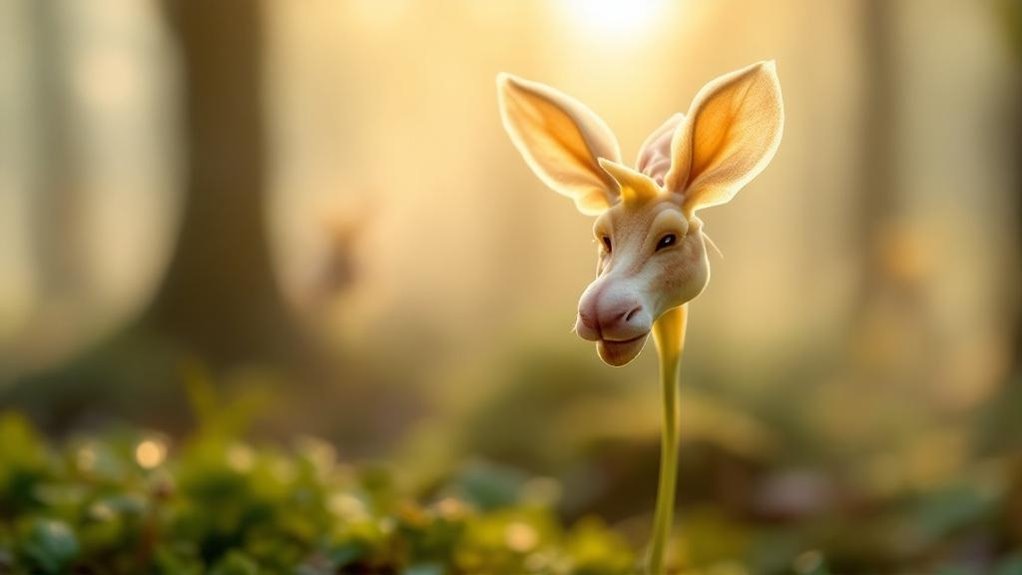
Seen in profile, the Donkey Orchid looks comical for a precise morphological reason: its two long, upright lateral petals rise like oversized ears, the broad labellum sits below as a pouch-like face, and the smaller sepals recede enough that your eye assembles the whole flower into an animal-like silhouette rather than a conventional blossom.
If you study Diuris in southwest Western Australia, you notice how bright yellow and brown markings, with a contrasting dorsal sepal, sharpen that caricatured effect; the flower’s cultivated contrast prevents the image from feeling stagnant, and your observational reading keeps returning to ears and snout. Some species also mimic nearby pea-flowers to draw pollinators, and that adaptation, though strictly ecological, reinforces the odd impression.
In spring, across heath and woodland, the posture and color become especially legible.
Why the Goat Orchid Looks Mythical
When you examine Ophrys reinholdii, the so-called Goat Orchid looks mythical for a disciplined observational reason: the labellum carries dense hairs, pale markings, and pronounced lobes that assemble into a face-like image, while tiny horn-like points and a dark, brownish-purple surface give the flower an anthropomorphic cast that doesn’t feel stagnant, because your eye keeps revising the silhouette between goat, mask, and stranger creature.
- Brownish-purple tones deepen the illusion.
- Pale markings suggest eyes and muzzle.
- Fine hairs sharpen the animal likeness.
- Localized habitats make sightings feel cultivated.
- Pareidolia turns form into legend.
You also notice that precise mimicry serves pollination while guiding your perception, and because the species appears across scattered parts of the southwest Balkans, Greece, Turkey, Iran, and Iraq, its rarity in view strengthens its legendary presence.
How Greek Myth Shaped Orchid Lore
Because orchid lore in the West took shape through Greek language and myth, you can trace much of the flower’s sensual and legendary character to the ancient word *orchis*, “testicle,” a blunt botanical analogy drawn from the paired underground tubers of certain species; from that etymology grew a cultivated framework of meaning, reinforced by the myth of the youth Orchis, whose arrogance invited divine punishment and transformation into the plant itself.
From there, you can see how Greek physicians and writers linked orchids with fertility, virility, and reproduction, not as stagnant superstition alone but as an observational habit that folded plant form into human meaning; that association persisted through European herbal practice, and it later informed Victorian collectors, who treated orchids as rare, exotic objects whose beauty carried an inherited aura of sexuality, potency, and legend.
Why Vanilla Orchid Mattered to the Aztecs

- You see status in each pod.
- You find ritual force in cacao.
- You note trade moving alongside tribute.
- You observe gifts binding court and war.
- You watch conquest redirect meaning.
If you follow vanilla through Aztec life, you don’t find a stagnant sweetener; you find an observational record of ritual, exchange, and power, valued in offerings, courtly gifts, military culture, and, later, transformed by Europeans into chocolate flavoring.
How China Turned Orchids Into Symbols
As orchid culture took shape in China, the flower didn’t remain merely an admired wild plant; it became a disciplined symbol of beauty, refinement, and virtuous character, shaped by centuries of literary praise, cultivated taste, and elite patronage.
You can trace that change to antiquity, when Confucius compared orchids to noble-minded gentlemen, giving them ethical weight that outlasted any stagnant fashion. In poetry and painting, you see orchids aligned with spring, renewal, and purity, especially when they bloom in secluded places, where their quiet persistence suggests moral integrity. Scholars then reinforced that observational meaning by growing orchids in gardens, writing poems, and painting them as cultivated signs of learning and self-command.
Over time, you also find orchids in wedding and celebratory motifs, where they carry wishes for good fortune, prosperity, elegance, and social esteem.
Why Victorian Orchid Mania Created Myths
When Victorian orchid mania took hold in Britain and Europe, it turned a difficult botanical subject into a theater of status, speculation, and cultivated mystique, and that transformation invited myths to flourish wherever knowledge remained partial or deliberately withheld.
- You saw orchids marketed as aristocratic possessions.
- You heard of perilous tropical searches and hidden valleys.
- You encountered claims of secret routes and stagnant exclusivity.
- You absorbed
How Conservation Protects Rare Orchids

Conservation replaces legend with method, and you can see its logic in the way botanists protect rare orchids through law, habitat management, propagation, and close observational study of the relationships those plants can’t live without; seed-banking and ex-situ cultivation preserve genetic material from species on the edge, including the Western Underground Orchid, while trade controls under CITES and state protections in places such as Florida restrict collection of plants like the Ghost Orchid, reducing the cultivated demand that once fed stagnant myths of exclusivity.
You also protect orchids by securing wetlands for Platanthera praeclara and forest refuges near Mount Kinabalu, then matching restoration to fungal symbionts, because translocation fails without them; with fewer than fifty wild Rothschild’s Slipper orchids remaining, monitoring directs patrols, education, and limited propagation efforts.
Frequently Asked Questions
What Is the Rarest Type of Orchid?
You’ll usually find the Western Underground Orchid considered the rarest orchid, with fewer than 50 known wild plants. You can also argue for Rothschild’s Slipper or Europe’s rarest, Hochstetter’s Butterfly Orchid, depending on region.
Why Are Lady Slipper Orchids Illegal in the US?
Some lady’s slipper orchids take 6–11 years to bloom, so you can’t legally collect many in the U.S. because laws protect their rare, slow-growing wild populations from poaching, habitat loss, and often-fatal transplanting.
What Are the Top 5 Rarest Flowers?
You’d rank the top five rarest flowers as the Ghost Orchid, Rothschild’s Slipper, Western Underground Orchid, Hochstetter’s Butterfly Orchid, and Yellow Lady’s Slipper. You’ll find they’re vanishing because habitat loss, poaching, and slow reproduction.
What Does the Bible Say About Orchids?
Like a whisper, you won’t find orchids named in the Bible. Scripture mentions plants generally, not orchids specifically. You can connect orchids to beauty devotionally, but that reflects later Christian symbolism, not direct biblical teaching.
Conclusion
As you consider these orchid legends, you see that rarity grows from ecology, history, and human desire, not from mystery alone; nearly 40% of orchid species are now threatened with extinction, a statistic that clarifies why so many stories cling to them. You can read each legend as observational evidence of what people valued, cultivated, or feared, and as a reminder that without steady conservation, even revered flowers can slip into a stagnant silence.