
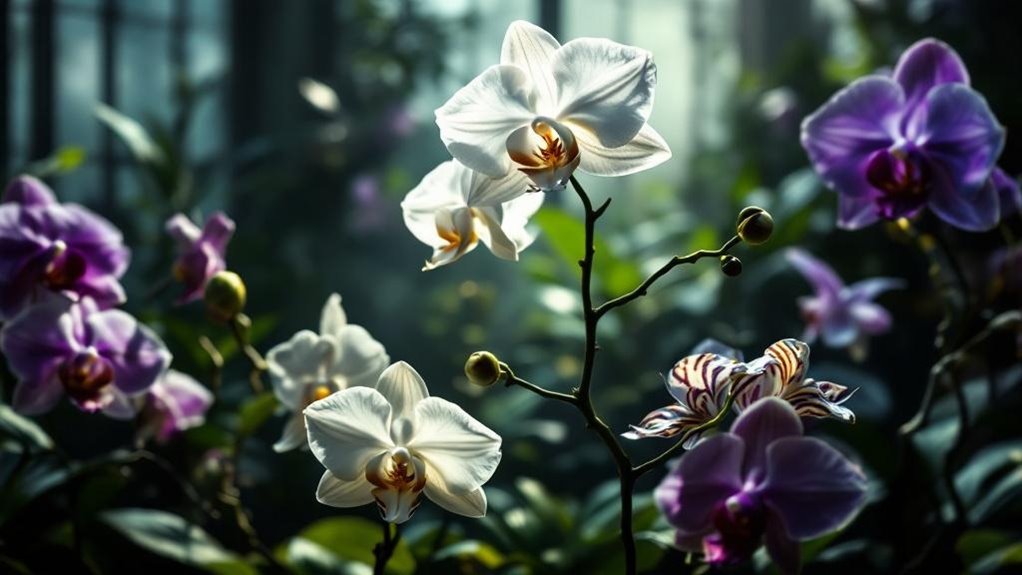
You can understand orchid terms by tracing three linked systems: the Greek root órkhis, which named paired tubers and encouraged fertility myths; later cultural symbolism, which made orchids signify virtue, luxury, renewal, or devotion depending on region and color; and species or genus names, which usually reflect observational habits such as slipper-shaped flowers, moth-like blooms, terrestrial growth, or vine-like form. Once you see those layers together, the names stop feeling ornamental and start becoming legible.
- Key Takeaways
- Core Orchid Terms, Simply Explained
- Where the Word Orchid Comes From
- Why Greeks Linked Orchids to Fertility
- The Myth of Orchis Explained
- How Orchid Symbolism Spread Worldwide
- Aztec Orchid Symbolism
- Orchids in Chinese Culture
- Orchids in Japanese Culture
- Orchids in Hawaiian Tradition
- Victorian Orchid Symbolism
- Orchids in Ancient Rome
- Why Vanilla Counts as an Orchid
- Orchid Color Meanings at a Glance
- White Orchid Meaning
- Pink Orchid Meaning
- Yellow Orchid Meaning
- Purple Orchid Meaning
- Red Orchid Meaning
- Green Orchid Meaning
- How Orchid Species Get Named
- Hidden Meanings in Genus Names
- Shape-Based Orchid Epithets
- Place-Based Orchid Names
- Orchid Names Honoring People
- Common Orchid Names Explained
- Misleading Orchid Names Explained
- Root and Growth Terms Explained
- Care Guide Terms Orchid Owners See
- How Orchid Names Influence Meaning Today
- Frequently Asked Questions
- Conclusion
Key Takeaways
- Orchid comes from Greek órkhis, meaning “testicle,” referring to paired tubers and later formalized in the family name Orchidaceae.
- Orchid mythology includes fertility beliefs and the later legend of Orchis, a youth transformed into the flower after sacrilege.
- Symbolically, orchids represent luxury, rarity, refinement, and enduring affection, while Chinese tradition links cymbidiums with virtue and scholarly integrity.
- Key orchid genera include Phalaenopsis, Cymbidium, Paphiopedilum, Vanilla, and Orchis, each distinguished by flower form, growth habit, or cultural use.
- Vanilla planifolia is an orchid whose cured pods create vanilla flavor, showing orchids have practical as well as symbolic importance.
Core Orchid Terms, Simply Explained
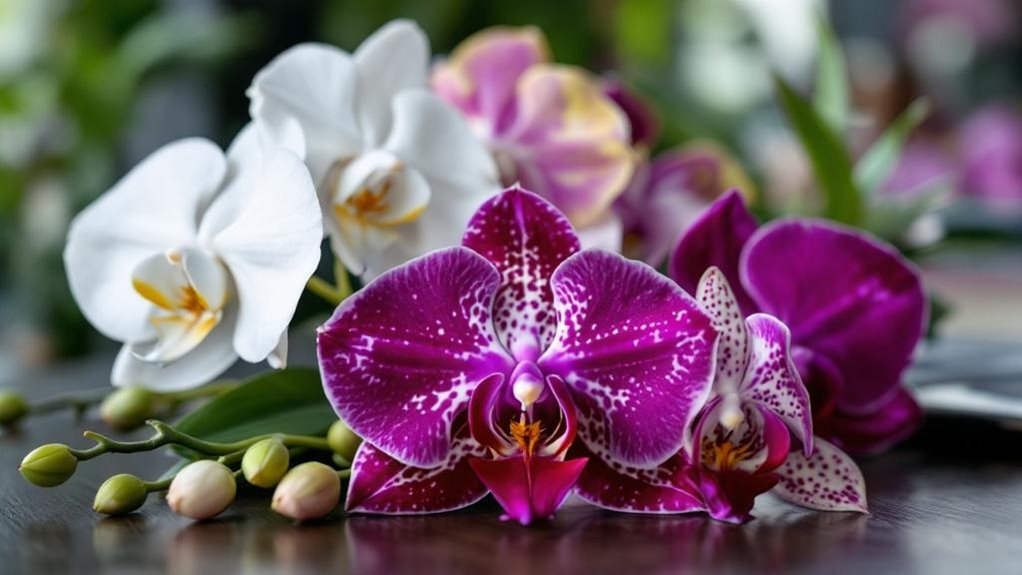
Begin with the family name itself: Orchidaceae comes from the Greek root *orchis*, meaning “testicle,” a reference to the paired tubers of some early known species, and while the origin is anatomical, the term now functions simply as the formal botanical label for one of the most widely cultivated plant families.
From there, you can sort common terms by genus and habit: Phalaenopsis names the moth orchids you’ll usually encounter indoors, valued because they bloom for months and tolerate beginner mistakes if roots don’t sit stagnant; Vanilla identifies the orchid genus whose cured pods flavor foods and perfumes; Cymbidium refers to boat orchids, cultivated for arching sprays and longstanding importance in East Asian horticultural art; Paphiopedilum marks slipper orchids, terrestrial in many cases, recognized by pouch-like flowers and observational appeal. Orchis remains historically central, and Theophrastus used the term around 300 BCE in early botanical descriptions.
Where the Word Orchid Comes From
| Term | Note |
|---|---|
| órkhis | Greek root |
| Orchis | old genus |
| Orchidaceae | Linnaean family |
| English orchid | 16th–17th c. |
| orchid (Vanilla. | modern breadth |
As you trace the name forward, you see Latin and scholarly transmission carry it into English botanical writing; Linnaeus then stabilized Orchidaceae, while cultivated and wild species alike, now over 25,000, kept the ancient root alive rather than stagnant in herbals alone. Orchids also became tied to royal symbolism through rarity, color, and long-standing associations with authority and refined taste.
Why Greeks Linked Orchids to Fertility
Because Greek writers looked at orchids through an observational lens shaped by medicine, symbolism, and visible plant form, they linked the flowers to fertility from the start; Theophrastus used the word órkhis, “testicle,” for orchids whose paired underground tubers resembled male organs, and that resemblance, far from remaining a stagnant botanical note, encouraged a broader belief that the plant carried virility itself.
From there, you can trace how orchis entered cultivated remedies, since Greeks treated its tubers as aphrodisiacs and fertility medicines, while later physicians such as Dioscorides recorded those sexual associations in practical medical writing. You also find folk customs that assigned reproductive power to tuber size, claiming fathers who ate large tubers produced sons, whereas mothers who ate small ones produced daughters, which preserved the flower’s fertile reputation. Ancient herbalists also reinforced this link through aphrodisiac lore and satyr imagery, keeping orchids tied to desire and reproductive power.
The Myth of Orchis Explained

Although the tale survives most clearly in Roman and later retellings, the myth of Orchis gives you a concise explanation for why this flower carried such a persistent sexual charge in the classical world; Orchis, a young man present at a fertility festival, tried to violate a priestess, offended both ritual order and divine authority, and was torn apart before being transformed into the plant that took his name.
From there, you can see why orchis became tied to virility, fertility, and cultivated symbolic reading; Greek órkhis meant “testicle,” an observational name drawn from paired tubers, while botanical writers used the story to reinforce reproductive meanings. You also find folklore claiming tuber size could influence a child’s sex, a belief that kept the flower’s sexual associations active rather than stagnant. The story first appears in Louis Liger’s 1704 gardening literature, not in ancient Greek myth.
How Orchid Symbolism Spread Worldwide
As orchid meanings traveled, they did so through trade, conquest, scholarship, and fashion rather than by any single uninterrupted tradition; Greek merchants and botanical writers such as Theophrastus carried the name orchis and its observational link to fertility across the Mediterranean, Roman authors absorbed and recast those associations for their own cultivated symbolism, and later European readers inherited a framework in which orchids already signified virility, rarity, and refined interpretation.
You can trace parallel currents in East Asia, where Confucian texts and Chinese poetry fixed cymbidiums as emblems of integrity and refinement, then carried those values into Japan; later, Victorian orchidelirium, amplified by collectors, expeditions, and media, made orchids symbolize luxury and exotic distinction worldwide.
Today, horticultural trade keeps meanings from becoming stagnant, standardizing color codes and species associations through floristry, commerce, and popular media.
Aztec Orchid Symbolism
Another strand of orchid meaning took shape in pre-Columbian Mesoamerica, where the Aztecs treated the vanilla orchid not as a mere ornament but as a cultivated source of status, ritual force, and bodily potency; they cured its pods and mixed them with cacao into a ceremonial drink reserved for nobles and warriors, and that elite use linked the orchid to strength, vigor, and virility in ways that were both symbolic and practical.
When you view Aztec orchid symbolism through that observational lens, you see luxury, medicine, and devotion moving together rather than remaining stagnant or separate; wild orchids also served practical ends, healing ailments and yielding sticky gels for adhesives, while trade and ritual placed these plants within sacred exchange.
In that setting, the vanilla orchid signified cultivated power, sanctioned privilege, and embodied connection. The Totonac people of Veracruz are remembered as the earliest known cultivators of vanilla, and their traditions helped shape the orchid’s sacred and cultural significance.
Orchids in Chinese Culture
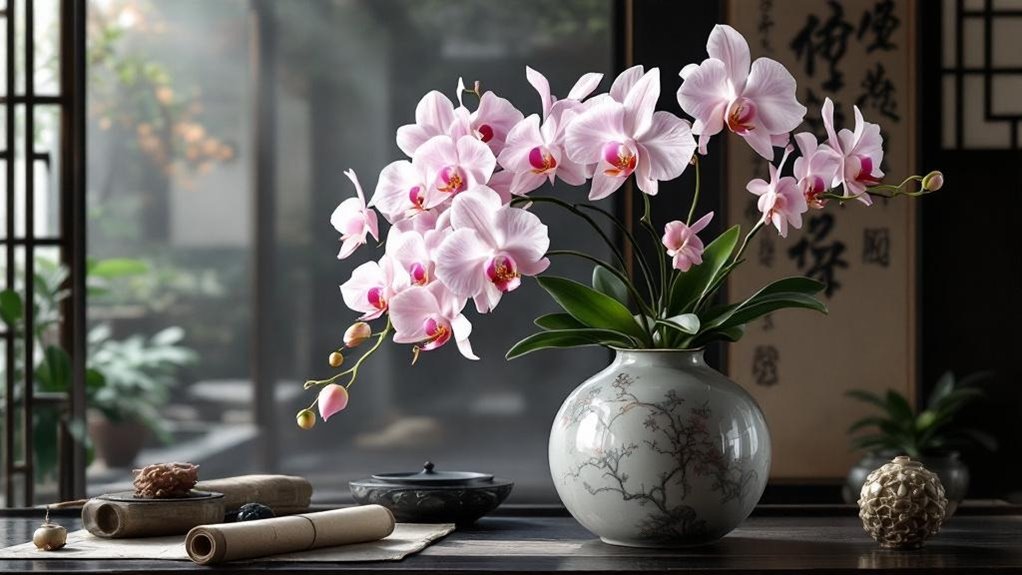
In Chinese culture, you can trace the orchid’s authority to Confucian thought, where its cultivated fragrance and quiet endurance came to represent virtue, integrity, and the observational discipline of the scholar rather than anything coarse or stagnant.
You also see orchids linked with spring, because they signal renewal, harmonious growth, and the return of auspicious energy, which is why they’ve long suggested good fortune in both literary and domestic settings.
As you consider these meanings, you’ll find that the orchid stands not merely as decoration but as a refined emblem of moral character and favorable beginnings.
As one of the Four Gentlemen, the orchid also belongs to a classical group of flowers in Chinese art and literature that embodies refinement, resilience, flexibility, and endurance.
Confucian Virtue Symbolism
Because Confucius praised the cymbidium orchid, or lan, for its delicate fragrance and upright growth, Chinese culture came to treat the flower as a cultivated emblem of integrity, refinement, and scholarly virtue; even when it grows in isolation and passes largely unrecognized, it still releases its scent, and that observational image supports a central Confucian claim that true moral character doesn’t depend on public notice or social reward.
When you encounter orchids in Chinese painting and poetry, you’re seeing more than ornament, because the flower stands among the Four Gentlemen and signals disciplined self-cultivation rather than stagnant display. In literati gardens and scholars’ studios, you can read its subtle perfume as a figure for noble conduct, inwardly maintained and outwardly restrained; that symbolism links personal refinement to social harmony, making the orchid a durable Confucian moral model.
Spring And Good Fortune
As winter recedes and the first mild air returns, orchids—especially cultivated cymbidiums—mark the passage into spring in Chinese culture, and that seasonal timing helps explain why they also carry meanings of renewal, good fortune, and prospering life.
- You see Cymbidium orchids signal warmth’s return.
- You inherit Confucian ideals; fragrance suggests integrity.
- You place them at home; feng shui counters stagnant energy.
- You find observational records from Shen Nung onward.
- You give them at New Year for luck.
When you receive Cymbidium orchids, you also receive a cultivated emblem of harmony, fertility, and abundance; Chinese medicine, literature, and seasonal custom all reinforce that reading, so the flower’s value extends beyond ornament, linking your household to prosperity, refined character, and the steady renewal each spring quietly promises ahead.
Orchids in Japanese Culture

As you turn to orchids in Japanese culture, you see that by the 17th century they’d become cultivated signs of wealth and elegance among elite households, valued not through stagnant display but through observational restraint, discreet placement, and refined methods of care.
You also find that the prized Neofinetia falcata, or Fūran, carried samurai associations, so its presence signaled bravery, peace, and disciplined taste at once.
When you consider how officials and businessmen exchanged orchids as gifts, and how growers shaped exacting display styles to emphasize seasonal beauty, you can read these plants as markers of status, prosperity, and cultural sophistication.
Wealth And Elegance
Trace orchids through Japanese cultural history, and you find that they’ve long signaled wealth, refinement, and social rank, with cultivated specimens prized by elites since at least the Edo period; ownership wasn’t merely decorative, but observational and deliberate, a way to display disciplined taste, access, and status without resorting to anything overt or stagnant.
You see this in selective display, hidden collections, and ceremonial exchange, where an orchid conveyed prestige through restraint rather than excess.
- You signal cultivated status through rarity.
- You value fragrance, leaf form, and pots.
- You read gifting as respect and prosperity.
- You recognize selective display as social control.
- You understand orchids as cultural capital.
In Japan, orchids let you express wealth and refinement quietly, proving that elegance often depends on what you choose to notice, preserve, and reveal.
Samurai Orchid Symbolism
Because its beauty depended on restraint rather than spectacle, the samurai orchid, Neofinetia falcata, came to embody a distinctly Japanese union of bravery, discipline, and cultivated refinement, prized from the Edo period onward by warriors and aristocrats who valued its compact fan-shaped foliage, nocturnal fragrance, and difficult-to-obtain varieties as signs of rank that never felt stagnant or overt.
When you encounter the Samurai orchid in Japanese culture, you see more than rarity; you see an observational ethic of honor, where gifting elite cultivars signaled respect, where special hanging baskets or flat rocks framed disciplined care, and where a sweet, faintly citrus scent released at night supported incense-like appreciation rituals. Its cold tolerance, native range, and enduring presence in shows confirm why its symbolism still carries authority today.
Orchids in Hawaiian Tradition

While orchids arrived in Hawai‘i through both native growth and careful cultivation, they’ve become firmly woven into Hawaiian tradition, appearing in lei-making for significant occasions, in ceremonial display, and in hula adornment, where they signal respect, honor, and a living connection to land, lineage, and community.
In orchids in hawaiian tradition, you see aloha expressed through cultivated blossoms, including Dendrobium and Epidendrum, offered at gatherings and worn with observational care; some varieties also suggest royalty, divine beauty, and, in certain beliefs, Pele’s presence within a volcanic rather than stagnant landscape.
- Lei conveys respect
- Ceremonies mark status
- Hula honors lineage
- Offerings express aloha
- Pele links flower and land
Victorian Orchid Symbolism
Although Victorian England turned many flowers into social signals, the orchid acquired a sharper meaning, becoming an emblem of luxury, exoticism, and cultivated distinction as wealthy patrons financed global collecting expeditions, paid extraordinary sums for rare specimens, and treated possession itself as proof of refined taste. In the Victorian Era, you can read orchids as observational evidence of status; orchidelirium made them socially potent, and legends that only noble blood could keep them from stagnant decline strengthened aristocratic exclusivity. You also see romance in them, since presenting a rare bloom suggested deep devotion and idealized female beauty.
| Meaning | Social use | Effect |
|---|---|---|
| Luxury | Displayed in houses | Signaled wealth |
| Exclusivity | Linked to nobility | Reinforced rank |
Frederick Sander’s specialist houses further shaped commerce, taste, and prestige.
Orchids in Ancient Rome
Long before Victorian collectors turned orchids into observational evidence of rank, Roman artists and patrons had already placed them within a cultivated visual language of abundance, luxury, and imperial richness; orchids appear on the Ara Pacis and related reliefs as decorative motifs tied to celebration, they surface again in the mosaics and frescoes of Pompeii and Herculaneum as stylized floral forms, and their repeated presence in both public monuments and domestic interiors shows that Roman viewers recognized them as part of an ordered, prosperous natural world rather than as stagnant curiosities.
- In ancient Rome, you see power naturalized through ornament.
- You notice elite taste shaping garden imagery and status.
- You find Dioscorides linking orchids to practical medicine.
- You understand later Christian art reduced this imagery.
- You recognize Renaissance revival as a return to Rome.
Why Vanilla Counts as an Orchid

Vanilla’s familiar scent can obscure its botanical identity, yet it belongs fully within the orchid family, Orchidaceae; the plant most often grown for commercial production, *Vanilla planifolia*, isn’t a separate culinary exception but a cultivated orchid whose value comes from its mature seed pods.
If you compare Vanilla with more observational, showy orchids, you’ll notice a vine-like epiphyte rather than a stagnant rosette, yet its floral structure and family lineage remain orchid through and through. In native Mexico, specific Melipona bees pollinate it; elsewhere, growers usually pollinate flowers by hand, which helps explain why cured beans command high prices.
You don’t taste fresh pods as they’re picked; vanillin and many other compounds develop during curing, transforming this orchid’s mature pods into the world’s leading natural flavoring source.
Orchid Color Meanings at a Glance
When you read orchid colors at a glance, you can treat white as a cultivated sign of purity, innocence, and new beginnings, while pink points to love, grace, and happiness, an observational guide that helps you match flowers to weddings, romances, and other measured celebrations.
You’ll also find that yellow suggests friendship, joy, and good luck, whereas green signals health, strength, longevity, and prosperity; together, they frame renewal without becoming stagnant, which is why they’re often chosen for encouragement and balance.
Purple, by contrast, carries a more formal weight, since you’ll see it tied to royalty, admiration, and dignity, and that history gives its meaning a lasting authority.
White, Pink, And Red
Color offers one of the quickest ways to read an orchid’s message, because white, pink, and red varieties carry cultivated meanings that remain widely recognized even as symbolism shifts across regions and traditions.
When you choose White orchids, you signal purity, innocence, and new beginnings; they suit weddings and funerals because they convey reverence without becoming stagnant or overly ornate.
- Pink orchids suggest grace, femininity, joy, and affection.
- You can give pink blooms to express admiration or gratitude.
- Red orchids communicate passion, desire, strength, and bold feeling.
- In Western observational habits, white leans toward purity and sympathy.
- Phalaenopsis and Cattleya offer common white, pink, and red forms.
You should still read color through culture; in parts of Asia, pink emphasizes grace, while red or purple tones can suggest prosperity, status, and ceremonial value.
Yellow And Green Symbolism
Clarity matters here, because yellow and green orchids carry cultivated meanings that are easy to read at a glance yet still depend on context; yellow orchids usually signal friendship, joy, well wishes, and, in many floral traditions, happiness, good luck, and the promise of new beginnings, which is why florists often choose them for congratulatory or get-well arrangements rather than romantic gestures.
When you choose green orchids, you usually communicate health, strength, longevity, prosperity, and renewal; in observational terms, they suggest resilience after difficulty and a refusal to remain stagnant.
In feng shui practice, people place green orchids to invite positive energy and balance, and in some Asian settings they emphasize importance and harmony. Yellow orchids, by contrast, keep the message social, cheerful, and supportive, not intimate or romantic.
Purple And Royal Meaning
Purple orchids move the message from the cheerful, cultivated symbolism of yellow and the restorative, observational associations of green into a register of status, admiration, and ceremonial respect; for centuries they’ve signaled royalty and wealth, and that reading gained particular force in settings such as Victorian England, where rare orchids functioned as visible markers of rank and refined taste.
- You invoke dignity and respect, especially in Chinese and Japanese traditions.
- You signal admiration, achievement, and cultivated esteem without becoming stagnant.
- You draw on anthocyanin pigments, which create lilac through deep violet tones.
- You often choose Cattleya or Vanda when you want concentrated visual opulence.
- You place purple orchids in formal arrangements because their hue conveys prestige, solemnity, and quiet refinement.
White Orchid Meaning
A white orchid usually conveys purity, innocence, and new beginnings, and that cultivated symbolism explains why you’ll often see it chosen for weddings and sympathy arrangements alike; in each setting, it communicates reverence without excess, offers a quiet sense of hope, and presents refined beauty in a form that feels observational rather than sentimental.
If you choose white orchids, you also invoke older associations with elegance and spiritual refinement, especially in Asian ceremonial use, where they mark respect through restraint rather than display. In your home, feng shui traditions link them with calm, clarity, and movement away from stagnant energy, so their presence can feel orderly and mentally clarifying. You’ll also find practical value here: Phalaenopsis, Cattleya, and Dendrobium varieties often hold their blooms for weeks, reinforcing their reputation as sophisticated, enduring gifts.
Pink Orchid Meaning

Often, pink orchids signal love, femininity, grace, and happiness in a form that feels cultivated rather than extravagant, which is why you’ll see them chosen for romantic gifts, birthdays, and other celebratory occasions where affection should appear sincere but not overpowering.
- A pink orchid expresses admiration and gratitude without becoming stagnant or overly sentimental.
- Pale pink suggests innocence, sweetness, and a quieter form of regard.
- Deep pink conveys stronger affection, appreciation, and steadier emotional investment.
- Pink Phalaenopsis and Cattleya reflect elegance; their lasting blooms reinforce this symbolism.
- In Chinese and broader Asian traditions, you’ll notice pink orchids mark refinement, joy, weddings, and new beginnings.
When you choose a pink orchid, you present an observational message: esteem, gentle affection, and happiness, shaped by form, shade, and context.
Yellow Orchid Meaning
Brightness gives yellow orchids their clearest meaning: they signal friendship, fresh starts, and well wishes in a way that feels open rather than sentimental, which is why you’ll see them chosen for congratulations, housewarmings, and other moments when encouragement should appear sincere but never stagnant.
You can also read Yellow orchids through their cultivated presence: they carry joy, happiness, and positive energy, so they’re often placed where you want a room to feel lighter and communication to remain clear.
In feng shui and some Asian traditions, you may use them to invite good luck and prosperity. Their color comes largely from carotenoids, an observational detail that links symbolism to botany, while long-lasting blooms in Cattleya, Oncidium, and Dendrobium hybrids reinforce their value as steady, reassuring gifts over several weeks.
Purple Orchid Meaning
Elegance gives purple orchids their clearest meaning: they represent royalty, wealth, admiration, and dignity, and that symbolism doesn’t arise by accident, since their cultivated rarity and rich tones were historically tied to noble status, especially during the Victorian orchid craze, when exotic blooms signaled taste, access, and social standing.
When you give Purple orchids, you communicate esteem rather than stagnant sentiment; in Chinese and wider Asian traditions, they mark respect, achievement, and rank, which explains their place in formal gifts and ceremonies.
Their shades, shaped by anthocyanin pigments, range from lavender to deep violet across Phalaenopsis hybrids and Cattleya species, reinforcing an observational sense of luxury.
- Respect
- Achievement
- Admiration
- Dignity
- Refined taste
Red Orchid Meaning
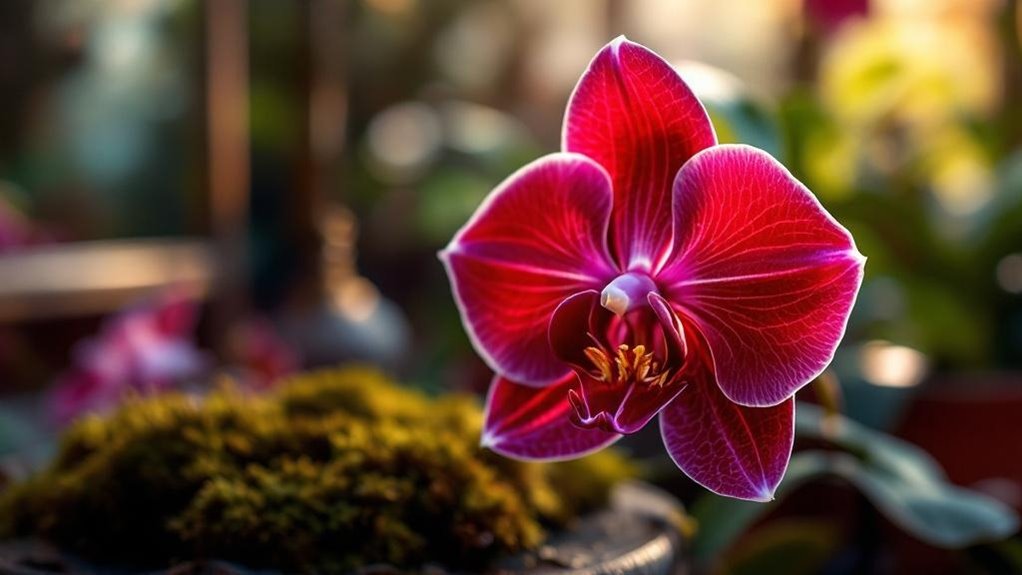
When you consider red orchid meaning, you’ll usually find passion and desire at the center, because its cultivated crimson and scarlet tones have long signaled romantic love, deep admiration, and enduring devotion in a way that doesn’t feel stagnant or vague.
You can also read a red orchid as a sign of strength and respect, since its rare, intensely saturated color suggests energy, dignity, and a steady force that carries weight in both observational floral symbolism and formal gift-giving.
If you choose one, you’re presenting more than a striking flower; you’re indicating feeling with precision, and you’re doing so through a bloom whose color has been carefully cultivated to stand apart.
Passion And Desire
Because red orchids carry the visual force of red while retaining the cultivated rarity long associated with orchids, they’ve come to represent passion, desire, and intense love, making them a deliberate alternative to red roses for expressing deep romantic feeling.
When you choose Red orchids, you signal admiration that doesn’t feel stagnant; Victorian flower language linked them with rare devotion and luxury, and modern florists still favor them for anniversaries, proposals, bouquets, and corsages because vivid Cattleya and Vanda forms project seduction, while long-lasting blooms suggest feeling that persists.
- You offer cultivated intensity, not cliché.
- You imply admiration with observational restraint.
- You connect romance with rarity and intention.
- You may also invoke good fortune at weddings.
- You give a bloom that endures, mirroring desire.
Strength And Respect
Respect gives red orchids a meaning that reaches beyond romance, since their saturated color still carries intensity yet directs it toward strength, resolve, and honored regard; in Victorian flower language, people exchanged them to convey deep admiration and serious esteem, and that older association still shapes how you might read or give them now.
Across Asian traditions, red orchids also suggest liveliness, prosperity, and auspicious momentum, so when you present them for an achievement, promotion, or leadership milestone, you acknowledge courage and recognized standing rather than stagnant sentiment.
Even at a botanical level, observational evidence links their red coloration to anthocyanin compounds, pigments associated in cultivated specimens with health, vigor, and robust blooming, which reinforces why red orchids can represent respected power as clearly as they express feeling and enduring personal regard.
Green Orchid Meaning

Seen across floral traditions and cultivated interiors alike, green orchids usually signify health, strength, longevity, and prosperity; their calm coloration also aligns them with renewal, steady growth, and balanced energy, which is why they appear so often in feng shui practice, ceremonial decor, and gifts meant to mark recovery or new beginnings.
Green orchids symbolize vitality, renewal, and prosperity, bringing balanced energy to healing spaces, ceremonies, and meaningful new beginnings.
- You read green orchids as signs of restored vitality, especially in recovery gifts.
- You place them in homes to encourage balance, prosperity, and non-stagnant energy.
- You notice their observational elegance, since rare green-flowered forms feel restrained and cultivated.
- You see renewal in them, making them fitting for housewarmings, fertility rites, and passages.
- You value how green tones, shaped by chlorophyll-rich petals or pigments, support camouflage and pollinator appeal in cultivated orchids.
How Orchid Species Get Named
When you read an orchid species name, you can usually trace Greek and Latin roots that identify the plant’s genus and sharpen its meaning through descriptive epithets, an observational system that keeps classification cultivated rather than stagnant.
You’ll also notice that many names honor people and places, preserving ties to collectors, patrons, regions, and older cultural references while giving each taxon a distinct historical frame.
As you consider descriptive species epithets, you can see how terms for form, habitat, or color help you infer what the orchid is like before you ever see the plant itself.
Greek And Latin Roots
- Names preserve visible structure.
- orkhislinks language and morphology.
- Latin adjectives reduce stagnant ambiguity.
- Compounds condense traits efficiently.
- Roots train careful seeing.
Honoring People And Places
Commemoration shapes orchid naming as surely as morphology does, because many species epithets preserve a person, a place, or an older cultural association, and they give you an observational record of how botanists have linked cultivated specimens to exploration, patronage, and native range.
| Name | What you infer |
|---|---|
| *Paphiopedilum rothschildianum* | It’s named for the Rothschild family. |
| *Vanda javanica* | You trace it to Java. |
You see this pattern repeatedly: botanists honor patrons, collectors, and describers, as with *Dendrobium kingianum*; they also anchor orchids to geography, so native range doesn’t become stagnant in memory. Mythic association persists too, since *Paphiopedilum* recalls Paphos and Aphrodite. When you read a full botanical name, such as *Cattleya labiata* Lindl., you also see the authority, which records who validly published the name, preserving attribution.
Descriptive Species Epithets
Description often carries the clearest signal in an orchid name, because many species epithets are Latin or Latinized adjectives that mark a visible trait, a growth habit, a color, or even a pollination strategy, and they let you infer something observational about the plant before you see a full cultivated specimen. You can read an epithet as evidence.
- *amabilis* signals lovely flowers.
- *planifolia* marks flat leaves.
- *apifera* suggests bee mimicry in pollination.
- *grandis*, *macrophyllum*, and *epiphytica* indicate size, leaves, or habit.
- Geographic and human-linked names still describe context; vietnamensefixes origin, while *labiata* notes the lip.
When you parse these forms carefully, you move beyond stagnant labels; you see how taxonomy preserves appearance, habitat, and history in compressed language, and each epithet becomes a practical guide for observation.
Hidden Meanings in Genus Names
Why do so many orchid genus names seem obscure at first glance; because they preserve an older, observational logic in which form, habit, and myth were cultivated into scientific language. When you meet Orchis, you encounter Greek órkhis, a name tied to paired tubers and a stark anatomical comparison that older botany accepted without sentimentality or stagnant euphemism.
Elsewhere, you can trace habitat, devotion, and use through names that still carry their first reasoning. Dendrobium joins tree and life, so you immediately read an epiphytic way of living; Paphiopedilum means shoe of Paphos, binding the genus to Aphrodite’s Cypriot sanctuary; Vanilla comes from Spanish for little pod, marking its valued fruit; Cymbidium derives from a Greek word for boat or shell, preserving a carefully observed floral structure in language.
Shape-Based Orchid Epithets

Shape governs a large share of orchid epithets, and once you notice that habit, many names stop seeming obscure; they read instead as compact observational notes, cultivated into Latin or Greek and fixed in scientific form. You can see this clearly in Ophrys, a Greek word meaning eyebrow, where the furry, rounded lip mirrors an insect form; in moniliforme, where beadlike stems suggest a necklace; and in bifolia, which records a two-leaf pattern without stagnant ornament.
In orchid names, shape becomes language: eyebrow, necklace, two leaves—each epithet a brief record of form.
- You read form before lore.
- You see structure guiding language.
- You notice petals, lips, and leaves.
- You decode cordata, lanceolata, orbiculata.
- You recognize precision in naming.
Even Paphiopedilum points you to the sandal-like pouch, and such terms keep description close to the flower itself, where shape remains the first evidence.
Place-Based Orchid Names
Across orchid nomenclature, place-based names tell you where a plant was first observed, collected, or understood to belong, and they often preserve an observational record of range that later cultivation and taxonomic revision haven’t entirely erased.
When you read geographical epithets such as indicum, chinense, japonicum, or sumatranum, you can usually infer India, China, Japan, or Sumatra as native origin or primary distribution; Cymbidium sinense and Pleione japonica make that pattern plain.
In Paphiopedilum, the genus itself recalls Paphos, while Paphiopedilum vietnamense fixes Vietnam as type locality. Vanilla tahitensis points you toward Tahiti through cultivated history, even as Vanilla planifolia belongs to Mexico and Central America.
Trade also left marks: locality names in orchids from Pará or Himalayan border populations preserve provenance where stagnant labels often don’t.
Orchid Names Honoring People
As you read orchid names, you’ll notice that many commemorate botanists, collectors, and patrons, a cultivated naming tradition seen in examples such as Paphiopedilum rothschildianum and Epidendrum fredericii, where the plant’s name preserves an observational record of influence rather than a stagnant label.
You can also recognize this pattern in Latinized endings such as -ii, -ae, and -ianus, which signal how the honoree is represented grammatically and help you connect names like whitei or roeblingiana to the people behind orchid discovery, research, or conservation.
When you understand these commemorative species names, you don’t just identify a label; you see how orchid nomenclature quietly credits the human networks that shaped the history of the group.
Commemorative Species Names
Orchid nomenclature’s commemorative thread appears whenever you encounter species epithets that honor botanists, collectors, patrons, or explorers, because taxonomists have long used Latinized endings such as -ii, -iae, and -ianus to attach a person’s name to a cultivated record of discovery rather than leave that history observational and stagnant.
- In orchid species, endings signal commemoration, not morphology.
- Cattleya preserves William Cattley’s surname at genus level.
- Paphiopedilum rothschildianum records patronage through formal Latinization.
- Masdevallia veitchiana memorializes commercial collecting history without sentimentality.
- Cultivar names, like Paphiopedilum ‘Robert,’ remain separate.
You can also read Dendrobium kingianum as a disciplined memorial, yet modern naming isn’t casual; the Code requires publication, diagnosis, and a type specimen, while priority rules prevent duplicate honorifics from displacing earlier, valid names.
Botanists And Patrons
Because orchid names often preserve the human structure behind discovery, you’ll repeatedly find genera and species that honor botanists, collectors, and patrons, with Latinized endings such as -ii and -iae marking commemoration rather than plant form, and with names like Cattleya trianae or Epidendrum hookerianum turning a cultivated record of exploration into a stable, non-stagnant part of nomenclature.
When you read Paphiopedilum sanderianum, you’re seeing Frederick Sander’s Victorian influence preserved beside the plant; when you encounter author citations, as in Paphiopedilum rothschildianum Veitch ex Rolfe, you can trace both the honored figure and the taxonomists who published the name.
You’ll also notice that commemorations reach beyond famous botanists, since patrons who funded travel and collection, and collectors such as Hooker or Darwin, also remain embedded in orchid taxonomy today.
Common Orchid Names Explained
When you sort through common orchid names, you’re usually seeing a shorthand for growth habit, flower form, and cultivated use rather than a stagnant list of labels; Phalaenopsis, the moth orchid, refers to a widely grown genus of more than 50 species and many hybrids valued for long-lasting blooms and relatively easy indoor care, while Cymbidium, the boat orchid, names a group of about 52 species known for large, clustered sprays that often flower in cooler seasons and once held a firm place in Victorian collections.
Common orchid names condense growth habit, bloom form, and cultivation into quick, useful signals for growers and observers alike.
- Orchids reveal use and form.
- Vanilla links Orchids to commerce, cuisine, and Aztec cultivation.
- Paphiopedilum names the slipper-shaped pouch, and its popularity warns you about overcollection.
- Dendrobium signals breadth, with 1,200–1,500 species and medicinal importance in traditional Chinese medicine.
- Common names guide observational understanding; they don’t replace botanical precision.
Misleading Orchid Names Explained
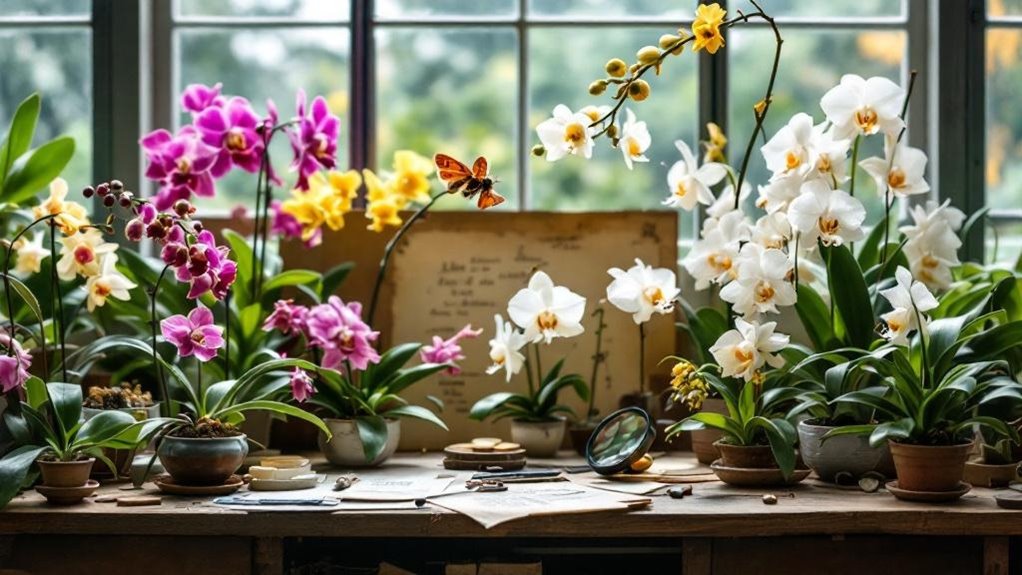
You’ll find that common orchid names often mislead you, because a familiar label may describe a flower’s shape, a cultivated hybrid, or a trade invention rather than a close botanical relationship. As you separate myth from botany, you can see that names like “vanilla orchid,” “slipper orchid,” and “moth orchid” carry observational value, yet they don’t always indicate shared ancestry, identical care needs, or even commercial use, and that distinction keeps your understanding from becoming stagnant.
You’ll also notice that species name origins, from Paphiopedilum’s reference to Paphos to Victorian titles that implied status and rarity, reflect history and perception as much as taxonomy.
Common Names Mislead
Common orchid names often lead gardeners astray, since they arise from appearance, regional habit, or cultivated usage rather than from close botanical relationship; the “moth orchid,” for example, refers to the wing-like form of Phalaenopsis flowers, not to any association with actual moths, while “lady’s slipper” describes the pouch-like labellum shared across several genera in the Cypripedioideae, including Cypripedium, Paphiopedilum, and Phragmipedium, even though those orchids come from different habitats and don’t tolerate the same care.
- You should treat orchid names as observational labels, not proof of kinship.
- Vanilla names a true orchid genus with culinary value.
- “Orchid tree” may indicate a non-orchid with cultivated resemblance.
- Regional titles shift, becoming stagnant markers of local habit.
- Scientific names give you precise identification and better care guidance.
Myth Versus Botany
Although orchid names often sound ancient and meaningful, many of them preserve metaphor, trade habit, or inherited myth more faithfully than they preserve botany; the genus name Orchis itself comes from the Greek órkhis, “testicle,” a label Theophrastus applied because of the plant’s paired tubers, not because the orchid had any true relation to animal anatomy or any verified medicinal function.
When you encounter names like Lady’s Slipper or Moth Orchid, you’re seeing observational shorthand, not evidence of kinship with animals; even vanilla often hides in cultivated, culinary language so completely that you may not recognize it as an orchid at all.
Greek beliefs about aphrodisiacs, and stagnant sexual symbolism attached to orkhis, amplified false functions, while trade labels such as Cymbidium or Cattleya can further blur hybrids and formal botanical boundaries.
Species Name Origins
Once you move from myth and trade habit to species name origins, the same pattern remains visible: orchid names often preserve an observational feature, an old place label, or a cultivated convention more faithfully than they preserve present botanical reality.
You see this in *orkhis*, where tubers, not homeland, shaped *Orchis*; in “vanilla,” where scent creates stagnant assumptions beyond *Vanilla planifolia*; and in lady’s slipper names, where myth and pouch form outweigh close relation.
- Read roots before maps.
- Treat fragrance as suggestive, not definitive.
- Separate mythic imagery from taxonomy.
- Question epithets like japonicaor *sinensis*.
- Verify trade names against formal nomenclature.
If you read names this way, you recover botanical intent, notice reclassification, and avoid mistaking horticultural labels for species identity or lineage.
Root and Growth Terms Explained
Examine an orchid closely and its root and growth terms begin to describe a cultivated survival system rather than a set of isolated parts; tubers, often referred to as pseudobulbs in many orchids, are thickened stem or root structures that store water and nutrients, which is why epiphytic orchids such as Cattleya and Cymbidium can endure dry intervals without becoming stagnant in their growth.
You’ll also notice the pseudobulb as a swollen stem segment, especially in Cattleya and Oncidium, where it carries leaves, supports flowering, and initiates new growth between seasons.
Aerial roots, common on Phalaenopsis and Vanda, wear velamen, a white layered surface that absorbs airborne moisture efficiently.
Rhizomes creep horizontally, producing roots and shoots in sequence, while a keiki forms as a clonal plantlet, ready once roots reach 2–3 cm.
Care Guide Terms Orchid Owners See
Those structural terms become more useful when you begin reading care guides, because words such as repotting, watering, light, fertilizing, and humidity describe how you manage the cultivated conditions that keep orchid roots active, pseudobulbs firm, and growth from turning stagnant.
In Orchid care, you repot most orchids every 12–24 months into chunky bark, charcoal, and perlite; you water by species and medium, usually every 7–10 days for Phalaenopsis, letting roots dry to the touch.
- Bright, indirect light sustains leaves; midday sun scorches.
- Balanced fertilizer, quarter to half strength, supports growth.
- During dormancy, monthly feeding prevents excess salts.
- Humidity at 40–70% steadies hydration and aerial roots.
- Air movement limits fungal pressure and rewards observational discipline.
These terms guide steady judgment, not guesswork, in cultivation.
How Orchid Names Influence Meaning Today

Names still shape how you read orchids today, because botanical Latin, common labels, cultivar epithets, and hybrid trade names don’t merely identify a plant; they frame its meaning before you’ve even observed its habit, fragrance, or cultivated use. In Orchidaceae, roots such as órkhis or Paphiopedilum carry mythic and observational residue, while names like vanilla and moth orchid direct you toward utility or form, not stagnant abstraction.
| Name type | Meaning shaped |
|---|---|
| Botanical Latin | Myth, traits |
| Common names | Use, form |
| Eponyms | Prestige, origin |
| Color epithets | Symbolic color |
| Hybrid names | Parentage, rarity |
When you encounter mastersii, nobile, alba, or ‘Pink Ice,’ you infer status, purity, royalty, or cultivated elegance; when you read × Brassolaeliocattleya, you also read ancestry, rarity, and ceremonial suitability today.
Frequently Asked Questions
What Do Different Orchids Symbolize?
Different orchids symbolize distinct feelings: you’ll see white for purity and new beginnings, purple for royalty and admiration, pink for grace and affection, and yellow or green for friendship, health, prosperity, strength, and renewal.
What Are the 7 Levels of Classification for an Orchid?
Obviously, you’d never guess orchids follow seven tidy ranks: Kingdom, Phylum, Class, Order, Family, Genus, and Species. You can trace an orchid from Plantae down to a specific name, like Phalaenopsis amabilis, through those levels.
Who Is the God of Orchids?
You won’t find one widely recognized god of orchids. Instead, you can link orchids to Aphrodite in Greek tradition, Orchis in myth, Aztec sacred vanilla deities, and Hawaiian royal or goddess associations like Pele.
Is Orchid Greek for Testicle?
Yes—across 25,000-plus orchid species, you still trace the name to Greek órkhis, meaning “testicle.” You can thank paired underground tubers for that comparison, which Theophrastus recorded and later taxonomy preserved in Orchidaceae and “orchid.”
Conclusion
When you understand orchid terms, you see more than labels; you recognize how myth, cultivated symbolism, and botanical observation have shaped what you read and how you care for the plant. With more than 28,000 accepted orchid species worldwide, the family’s scale explains why names often feel dense, layered, and occasionally stagnant with old assumptions. Still, that complexity serves you, because each term carries a traceable history, and that history makes modern orchid meaning clearer, steadier, and more precise.