
You can use orchid mythology by region as a quick observational guide to local values: Greece tied paired tubers to fertility and virility, the Andes linked rare cloud-forest orchids to mountain spirits, Central America treated epiphytes as guardians, and much of Asia cultivated orchids as signs of devotion, refinement, healing, and sacred beauty; where orchids were scarce, cliff-bound, or seasonally hidden, people often read them as protective or potent, and the regional patterns ahead make those meanings easier to trace.
- Key Takeaways
- What Orchid Mythology Means
- How Orchid Myths Vary by Region
- Why Orchids Symbolize Love
- Why Rare Orchids Seemed Sacred
- How Landscapes Shaped Orchid Myths
- Mediterranean Orchid Myths
- Greek Orchid Myths
- Roman Orchid Symbolism
- European Wild Orchid Folklore
- Turkish and Anatolian Orchid Lore
- North African Orchid Beliefs
- Macaronesian Orchid Stories
- South Asian Orchid Myths
- Indian Orchid Sacred Meanings
- Himalayan Orchid Lore
- Orchids in Ayurvedic Tradition
- Southeast Asian Orchid Myths
- Thai Orchid Myths
- Malaysian Orchid Spirit Lore
- Indonesian Orchid Rituals
- Monsoon Forest Orchid Myths
- East Asian Orchid Symbolism
- Chinese Orchid Virtue Symbolism
- Japanese Orchid Ideals
- Korean Orchid Meaning in Art
- Tropical Andes Orchid Myths
- Colombian Orchid Myths
- Ecuadorian Cloud Forest Orchid Lore
- Peruvian Orchid Legends
- Orchids in Andean Belief
- Central American Orchid Myths
- Costa Rican Orchid Lore
- Panamanian Orchid Symbols
- Orchids in Mesoamerican Tradition
- South American Orchid Folklore
- Brazilian Orchid Folklore
- Amazonian Orchid Healing Myths
- Australian Orchid Myths
- Aboriginal Orchid Meanings
- Underground Orchid Legends
- Pacific Island Orchid Stories
- Orchids in Colonial Flower Lore
- Victorian Orchid Symbolism
- How Orchid Hunters Shaped Myth
- Orchid Colors in Myth
- Orchid Shapes in Legend
- Orchid Fragrance in Ritual
- Regional Differences in Orchid Myth
- Shared Orchid Myths Worldwide
- How to Interpret Orchid Symbols Today
- Frequently Asked Questions
- Conclusion
Key Takeaways
- Mediterranean myths tied orchid tubers to fertility and virility, linking orchids with Aphrodite, salep remedies, and transformation stories.
- Tropical Andes traditions connected rare cloud-forest orchids with mountain spirits, protection, fertility, and later national identity.
- Central American folklore viewed epiphytic orchids as guardian flowers, with festivals and courtship rituals reinforcing love symbolism.
- Southeast Asian myths emphasized orchids on cliffs and in monsoon forests as signs of royalty, divine beauty, and temple prestige.
- Himalayan and Australian traditions treated hidden terrestrial orchids as medicinally pure, mysterious, or ancestral, inspiring reverence and conservation.
What Orchid Mythology Means
Although orchid mythology varies from one region to another, it generally means the accumulated myths, legends, and symbolic associations that people have cultivated around orchids, assigning them meanings such as fertility, beauty, strength, status, and healing power according to local ecology and belief.
You can understand orchid mythology as an observational framework through which people read human hopes into flowers, especially epiphytic orchids that seem suspended between earth and air; a Slipper Orchid may suggest refinement or potency, while orchids in Costa Rica often support identity, ceremony, and memory.
These meanings don’t emerge from stagnant imagination alone, because repeated contact with rare forms, medicinal uses, and striking habitats encourages communities to preserve associations that feel credible, instructive, and socially useful across generations.
Greek etymology helped anchor early orchid symbolism in ideas of fertility and virility, giving the flower a lasting place in mythic and medicinal tradition.
How Orchid Myths Vary by Region
Because orchids grow in sharply different landscapes and enter distinct systems of healing, trade, worship, and status, their myths vary by region in ways that reflect what each culture has repeatedly observed and cultivated rather than any stagnant universal meaning; in the Tropical Andes, rare cloud-forest epiphytes are often linked to mountain spirits and herbal practice, while in Southeast Asia orchids such as Vanda and Paphiopedilum more often carry associations of nobility, fertility, and ceremonial offering shaped by courtly exchange and temple use. Orchid symbolism also travels through ritual, gift-giving, and social aspiration, which helps explain why similar themes of beauty, refinement, and reverence appear across distant cultures.
| Region | Mythic focus | Driver |
|---|---|---|
| Central America | guardian orchids | conservation |
| Himalaya | protective, medicinal terrestrial orchids | altitude |
| Australia | cautionary totems, often called curiosities in Botanic Gardens | restraint |
You also find national identity, ecotourism, and seasonal ritual shaping local interpretation today.
Why Orchids Symbolize Love
Where orchids symbolize love, they usually do so through a cultivated convergence of rarity, sensual form, fragrance, and social meaning rather than through any stagnant single myth, and that pattern appears clearly across cultures that observed the flower in very different settings.
You can see this in Greece, where orchid roots suggested virility and fertility; in China, where Confucius treated their fragrance as an emblem of noble, devoted affection; and in Andean courtship, where vivid blooms mark passionate attachment.
In Victorian England, this type of flower carried refined desire because expense, foreign origin, and careful greenhouse culture, often requiring cooler temperatures for some varieties, made a gift feel deliberate.
Even floral language narrowed meanings: Phalaenopsis implied enduring love, Cattleya mature affection, and Cymbidium sincere, noble devotion.
The name itself comes from paired tubers, a classical reference that helped tie orchids to fertility and potency.
Why Rare Orchids Seemed Sacred
When you look across orchid traditions, you can see why scarcity inspired reverence; blooms that appeared briefly in cloud forests, on limestone cliffs, or high on monsoon-swept slopes resisted any stagnant, everyday reading and instead suggested cultivated contact with powers beyond ordinary life.
You also notice that strange forms carried holy meaning, because unusual petals, colors, and growth habits made certain orchids seem less like common flowers and more like observational signs of fertility, protection, healing, or ancestral presence.
As you move through these myths, you’ll find that rare orchids seemed sacred not by accident but because people consistently read their uncommon appearance, exacting habitats, and seasonal returns as evidence of divine favor and spiritual force.
In some traditions, the Ghost Orchid became a wish-granting swamp spirit whose elusiveness deepened its aura of mystery and good fortune.
Scarcity Inspired Reverence
Although rarity alone doesn’t create sanctity, it often cultivated the conditions for it, especially in orchid-rich regions where plants appeared briefly, occupied narrow ecological margins, and resisted ordinary collection; in the Tropical Andes, for example, extreme endemism across more than 4,000 species meant many orchids were confined to thin altitudinal bands, so flowers such as Cattleya trianae came to signify not just beauty but the presence of particular cloud-forest spirits.
- In Southeast Asia, you find cliff orchids revered because inaccessible karst and monsoon timing made appearances observational, not stagnant.
- In Central America, you see protected Pleurothallis and Peristeria elata anchor local identity.
- In the Himalayas, you encounter high-altitude orchids treated as ritual and medicinal treasures.
- In Australia, you understand Rhizanthella gardneri inspired conservation-minded awe through cryptic locality and elusive flowering.
- Victorian orchidelirium turned rare orchids into status symbols, showing how scarcity could transform botanical curiosity into reverence and prestige.
Strange Forms, Holy Meaning
Because rare orchids often combined scarcity with forms that seemed to exceed ordinary botanical order, communities across widely separated regions didn’t treat them as stagnant curiosities but as observational signs, plants whose strange silhouettes, improbable colors, and brief appearances cultivated sacred meaning by suggesting the presence of forces just beyond direct human control.
You can see this logic across regions: in the Tropical Andes, Cattleya trianae and Dracula simia, scarce in cloud forests, suggested spirit messengers; in Southeast Asia, cliff-bound Vanda coerulea, blooming blue-violet with the monsoon, implied protection and auspicious timing.
In Central America, Guarianthe skinneri and Peristeria elata gained ceremonial force through rarity and display; in the Himalayas, Paphiopedilum and Cymbidium joined healing and devotion, while Australia’s hidden Rhizanthella made sacred taboo feel entirely plausible. Ghost orchids added the same aura in Florida and Cuba, where pale, leafless blooms seemed to hover like returning souls.
How Landscapes Shaped Orchid Myths

Across orchid-growing regions, landscapes didn’t merely supply the plants themselves; they cultivated the observational frameworks through which people interpreted rarity, beauty, danger, and renewal, so myths arose not in a stagnant cultural vacuum but in direct response to altitude, moisture, visibility, and access.
- In the Tropical Andes, cloud-forest gradients and immense diversity encouraged you to link orchids with mountain spirits, fertility, and endemic spectacle.
- In Southeast Asia, cliffs and monsoon forests made prominent orchids visible to courts, temples, and trade, so legends emphasized royalty and divine beauty. Orchids also became part of Buddhist offerings and Hindu ceremonies, reinforcing their ceremonial and spiritual status.
- In Central American cloud forests, epiphytes suspended above ground suggested guardianship, while festivals sustained courtship meanings.
- In Himalayan zones and Australia, seasonal extremes, isolation, and hidden habitats encouraged beliefs in medicinal purity or subterranean mystery for local communities.
Mediterranean Orchid Myths
As you turn to Mediterranean orchid myths, you can trace how Aphrodite became linked with orchids through long-standing beliefs about fertility, beauty, and cultivated desire, beliefs strengthened by Greek and Roman uses of orchid tubers as aphrodisiacs rather than stagnant ornament.
You can also place satyrion folk beliefs within this same tradition, since ancient writers treated tuberous orchids as sources of virility and strength, and rural customs preserved that reputation in salep drinks and winter remedies across the region.
When you consider bee orchid legends, you can see an observational basis beneath the lore, because Ophrys flowers mimic female insects to attract males, and that striking deception gave Mediterranean storytellers a natural model for myths of seduction, transformation, and seasonal meaning.
Aphrodite And Orchids
Although Aphrodite is best known for her command over beauty, desire, and fertility, Mediterranean orchid lore places her quietly beside the flower as well, since the Greek word *orchis*, meaning testicle, gave the plant its name and encouraged an observational tradition that read its twin tubers as signs of virility, procreation, and erotic force rather than as stagnant botanical curiosities.
You can trace that bond through several cultivated meanings:
- Greek naming tied orchids to sexuality and reproduction.
- Aphrodite’s sphere made that symbolism religious as well as botanical.
- Roman writers praised mashed tubers, or salep, in desire-enhancing drinks.
- Later medicine used orchid remedies for infertility and impotence.
You also find orchid-like bulbs near Aphrodite or Venus in Mediterranean art, where beauty, fertility, and embodied power converge clearly.
Satyrion Folk Beliefs
You see this belief reinforced by Theophrastus and Dioscorides, who treated satyrion as medicine for desire and sexual weakness; you also find it in village practice, where cultivated knowledge turned powdered tubers into salep, a warm restorative drink credited with strengthening the body and encouraging conception.
Because people valued these orchids for potency rather than ornament, repeated gathering depleted local stands, and later tradition gradually shifted toward caution, restraint, and conservation awareness.
Bee Orchid Legends
How could Mediterranean storytellers ignore the Bee Orchid, when its flower appears to stage an observational drama of deception and desire, its lip shaped and marked like a female bee, a resemblance that Greeks, Romans, and later herbalists read as proof that nature cultivated courtship through mimicry rather than through any stagnant rule of form.
You encounter four recurring meanings:
- Greeks and Romans linked it to pollinator trickery and erotic mimicry.
- Italian and Greek communities placed it in love charms and wedding garlands.
- Sardinians and Sicilians treated finding one as a marriage omen and crop sign.
- Medieval and modern voices recast it as temptation, then conservation.
When guides retell these legends today, you hear beauty disciplined by purpose, illusion serving survival, and myth protecting habitat.
Greek Orchid Myths
When Greek writers and mythmakers turned their attention to orchids, they didn’t treat the flower as merely ornamental; they linked it to fertility, virility, and the cultivated logic of bodily signs, because the paired tubers resembled testes and seemed, in an observational system of nature, to reveal reproductive power. You see this in Theophrastus, who named orchis, and in the myth of Orchis, transformed after offending Dionysus.
| Sign | Meaning | Feeling |
|---|---|---|
| Large tuber | male child | quiet hope |
| Small tuber | female child | tender acceptance |
You also encounter Dioscorides, whose medicinal notes preserved orchid tubers in salep, a sustaining drink; through these texts, the flower never becomes stagnant decoration, but remains a sign of potency, consequence, and metamorphosis in Greek thought.
Roman Orchid Symbolism

You can trace Roman orchid symbolism through:
You can trace Roman orchid symbolism through daily rites, remedies, status display, and the charged superstitions of desire.
- virility, potency, and fertility rites;
- pharmacopeia for digestive and reproductive complaints;
- elite banquets, garlands, and status display;
- love potions and superstitions.
In Rome, you see no stagnant abstraction; you see practical symbolism applied daily.
European Wild Orchid Folklore
Across Europe, wild orchids entered folklore not as stagnant ornaments but as observational signs of fertility, secrecy, and altered states of life, because their paired tubers, sudden seasonal return, and cultivated strangeness invited people to read them as plants that mediated between the buried world and the visible one.
You see that reading in Orchis and Dactylorhiza, whose tubers suggested virility and conception; people dried and ground them into restorative drinks, trusting resemblance as evidence. In Ophrys, you encounter another logic, since bee-like flowers appeared as enchanted brides or watched maidens that lured suitors.
In Britain and Ireland, you meet fairy cups, blooms said to mark dancing grounds and punish disturbance. Farther east, Lady’s Slipper and related orchids served as eye remedies, household charms, and guarded plants.
Turkish and Anatolian Orchid Lore
In Anatolia, orchids entered rural lore through a distinctly observational habit of reading form and season together, since bee orchids such as Ophrys appeared in meadow and yayla landscapes with flowers that seemed to stage courtship itself, and people treated that cultivated strangeness not as a stagnant curiosity but as evidence that these plants bore some influence over fertility, attraction, and the timing of spring unions.
You find that lore grounded in place and use:
- Regional names like çameli tied orchids to meadows and upland pastures.
- Ottoman traditions valued Orchis tubers for salep, a warming, aphrodisiac tonic.
- Spring markets traded tubers as symbolic gifts and local income.
- Conservation now reframes custom, as overharvesting and habitat loss threaten endemic species.
North African Orchid Beliefs

As you turn to North African orchid beliefs, you find Berber floral symbolism shaping an observational view of orchids as signs of vigor and cultivated endurance, especially in Morocco, Algeria, and Tunisia, where terrestrial species have long carried meanings tied to human strength and continuity.
You also see desert fertility beliefs giving orchid tubers unusual force in local thought, since remedies and aphrodisiacs such as salep linked these plants to nourishment, generative power, and relief from stagnant weakness.
You can then trace protective ritual uses across rural communities, where orchids served in folk treatments for coughs and digestive complaints and, at the same time, gathered a quiet authority as medicinal safeguards against bodily harm.
Berber Floral Symbolism
Among Berber, or Amazigh, folk traditions in Morocco and Algeria, wild orchids, especially the tuberous kinds gathered from mountain landscapes, carried a cultivated symbolism of fertility, maternal strength, and seasonal renewal; herbalists powdered their tubers into salep-like preparations that people valued as aphrodisiacs, fertility tonics, and at times postpartum remedies, because their dense, starchy form suggested restorative power rather than stagnant depletion.
- You see High Atlas and Aurès blooms mark spring renewal.
- You read them as omens for harvests and healthy livestock.
- You notice elders’ observational lore linking orchid tonics to maternal recovery.
- You also see revivalists urging cultivation, not wild digging, to prevent decline.
These beliefs persisted because symbolic use and practical herbalism reinforced each other across generations.
Desert Fertility Beliefs
Beyond the mountain lore of Amazigh communities, North African orchid beliefs extended into drier rural landscapes of Morocco and Algeria, where terrestrial orchids, especially Ophrys and Orchis species, took on a cultivated role in fertility charms, love potions, and household remedies meant to strengthen virility and encourage conception; healers processed their tubers into salep or related starchy infusions, then prescribed them to infertile couples and sometimes to pregnant women, because the dense, restorative substance signaled generative force rather than stagnant weakness.
If you trace market records from the eighteenth and nineteenth centuries, you’ll find dried orchid tubers traded for reproductive tonics, and if you follow contemporary observational surveys, you’ll see those beliefs still persist in some villages, though urban medicine has reduced their authority and wild harvesting has increased pressure on orchid populations today.
Protective Ritual Uses
While fertility remained one important strand of North African orchid belief, protective ritual uses gave these plants a broader household and spiritual role in rural Morocco and Algeria, where healers ground terrestrial orchid tubers into salep-like flour believed to strengthen the body during illness, resist evil spirits, and counter the stagnant influence of the evil eye.
You can trace these observational practices through four recurring forms:
- Healers prepared salves and poultices, then marked doorframes or patients’ temples.
- Rural families hung roots in homes, or carried them as amulets for newborn safety.
- Ceremonies joined orchid matter with incense and Quranic recitations, blending cultivated faith and plant symbolism.
- Heavy demand encouraged overharvesting, so conservationists now recommend substitutes that preserve both species and ritual continuity today.
Macaronesian Orchid Stories
Across Macaronesia, a small but distinctive orchid flora has gathered a cultivated body of stories, rooted in the laurel cloud forests of the Azores, Madeira, the Canary Islands, and Cape Verde, where endemic species were rarely treated as stagnant ornaments and were instead read as signs of protection, fertility, hidden wealth, and bodily remedy.
| Island zone | Story pattern |
|---|---|
| Madeira | Dactylorhiza foliosa guarded sailors |
| Canaries/Azores | Fertility, courtship, hidden riches |
You encounter Madeira’s Dactylorhiza foliosa as a protective charm against storms and shipwrecks; in the Canaries, Ophrys flowers enter observational pastoral rites, because their insect-mimicking forms suggested fertility and guided shepherd courtship. In the Azores, orchids marked concealed mountain wealth and circulated in folk healing; such cultivated reverence later supported island conservation, festivals, and botanical gardens.
South Asian Orchid Myths
As you turn to South Asian orchid myths, you encounter Himalayan sacred blooms that carry the weight of mountain spirits and village taboos, monsoon folklore symbols that mark purity and spring in cultivated festival settings, and Ayurvedic orchid legends that connect certain Dendrobium species to vigor, tonics, and observational healing practice.
You can see how these beliefs persist because orchids move easily between ritual and remedy, between love charms in Sri Lankan and southern Indian ceremony and high-altitude offerings in Nepal and Bhutan that seek good harvests and protection from illness.
If you follow these traditions closely, you find that their meanings aren’t stagnant but shaped by landscape, seasonal return, and communal memory; for that reason, South Asian orchid lore remains both symbolic and practical.
Himalayan Sacred Blooms
Because the Himalayas have long bound ecology to worship, orchids in India, Bhutan, and Nepal don’t appear merely as mountain flowers; they function as cultivated signs of purity, healing, and divine presence, especially among temperate Dendrobium and Cymbidium species growing between roughly 1,000 and 4,000 meters, where monastery life, village ritual, and high-altitude landscapes meet in an observational rather than stagnant relationship.
You can trace this sacred framing through:
- Bhutan, where Paphiopedilum fairrieanum enters garlands and monastery offerings as a purified emblem.
- Sikkim, where Dendrobium gibsonii links festival display to Ayurvedic medicinal memory.
- Nepal, where cool-growing Cymbidium marks auspicious healing rites and seasonal ceremonies.
- Sanctuaries, where conservation follows reverence, and sustainable cultivation protects endemic orchids.
These traditions shape how you read Himalayan orchid lore.
Monsoon Folklore Symbols
When the monsoon approaches, orchid lore in South Asia shifts from temple purity to weather, fertility, and household protection, and you can see this change in the cultivated use of Dendrobium sprays tied to eaves in northeastern India and Bhutan, where villagers treat the flowers as rain-bringers, in Paphiopedilum and Cymbidium blooms set on plows or in field shrines in Nepal and Sikkim to steady hopes for fertile soil and reliable harvests, and in riverbank offerings in Bangladesh and Assam, where native orchids serve as observant petitions to water spirits charged with the safety of boats and fishermen during a volatile season.
You also find, in Sri Lanka and southern India, veranda-kept Vanda and Aerides whose swelling roots and dripping stems signal prosperity, because households read moisture held above stagnant ground as a cultivated sign that rains will nourish rather than ruin nearby fields.
Ayurvedic Orchid Legends
Although Ayurvedic orchid legends move in the register of healing rather than storm or harvest, they keep the same close observational bond between plant and place, and across India and Nepal certain orchids, especially some Dendrobium and Cymbidium species, appear in regional medical memory not merely as admired blooms but as cultivated remedies for coughs, fever, and bodily depletion, prepared as tonics and folded into rasāyana practice by healers who say these plants restore balance where heat, weakness, or stagnant recovery have unsettled the body.
- You find Himalayan orchids in temple offerings, where protective power matters.
- You meet cloud-forest species linked to Buddhist healing rites.
- You see Paphiopedilum myths promising fertility and household fortune.
- You notice festivals in Sikkim and Bhutan joining reverence with conservation.
These traditions preserve medicinal knowledge orally, and they protect wild orchids too.
Indian Orchid Sacred Meanings

Across many Indian traditions, orchids carry sacred meanings that join cultivated ritual practice to observational ideas about purity, liveliness, and protection; terrestrial Cymbidium and Dendrobium species are offered at temple shrines during festivals such as Durga Puja and Navratri, where their poised form and fresh bloom support associations with spiritual elevation rather than stagnant material life.
You also encounter orchids in ceremonial adornment, where slipper orchids can appear in bridal garlands and formal decorations, marking beauty, prestige, and social auspiciousness through rarity and disciplined display.
In household belief, when you place certain orchids near entrances or on altars, they may serve as quiet talismans of good fortune and protective presence.
Their role in tonic traditions further reinforces sacred meanings, since vigor, endurance, and longevity often carry spiritual value beyond ordinary bodily maintenance.
Himalayan Orchid Lore
Because Himalayan orchids emerge from steep cloud forests and high valleys rather than cultivated plains, local communities in India, Bhutan, and Nepal often read them through a sacred observational lens, treating species such as Cymbidium and Paphiopedilum fairrieanum as signs of purity, strength, and healing, and linking their persistence in severe mountain conditions to ideals of endurance that don’t belong to stagnant domestic life.
- You see mountain orchids framed as gifts from deities and spirits.
- You notice festivals in Sikkim and Bhutan displaying blooms with mythic meaning.
- You find taboos against uprooting wild plants, which quietly protect groves.
- You understand altitude itself, from roughly 1,000 to 4,000 meters, reinforces sacred status.
These beliefs shape stewardship; when villagers treat orchids as omens of fortune, they preserve trees, habitats, and vulnerable endemic species against loss.
Orchids in Ayurvedic Tradition
While Ayurvedic tradition doesn’t place orchids at the center of its most standardized classical remedies, it does preserve a long, regionally grounded record of Himalayan species such as Dendrobium and Cymbidium being used as tonics and rejuvenatives, prepared as decoctions, powders, or milk infusions for respiratory complaints, fever, and digestive weakness; in this observational medical framework, forest orchids weren’t treated as stagnant curiosities or merely cultivated ornaments, but as potent substances whose value depended on careful identification, restrained dosage, and respectful harvesting.
| Orchid | Image |
|---|---|
| Dendrobium | cool mountain tonic |
| Cymbidium | pale milk infusion |
| Paphiopedilum | shaded forest demulcent |
| Wild stands | carefully thinned slopes |
You see why regional practice matters: formulas vary, Sanskrit authorities don’t fully standardize them, and conservation now requires cultivation.
Southeast Asian Orchid Myths
Although Southeast Asian orchid lore differs from island to mountain kingdom, it follows a consistent logic: people don’t treat remarkable blooms as stagnant ornaments, but as cultivated signs of protection, fertility, prestige, and divine presence, shaped by animist and Hindu-Buddhist cosmologies as well as by observational knowledge of where rare species grow.
Across Southeast Asia, orchids signify protection, fertility, prestige, and divine presence rather than mere ornament.
- In Malaysia, Rothschild’s slipper warns you that forest guardians punish removal with misfortune.
- In Indonesia, *Phalaenopsis amabilis* blesses brides; you see fertility, beauty, and social continuity in its moth-like flowers.
- Across the region, cliff-growing orchids signal deities or ancestors, so you leave sacred plants undisturbed.
- Trade and festivals teach you that displaying *Vanda* and *Dendrobium* brings prestige and good fortune, especially in homes and temple offerings alike.
Thai Orchid Myths
In Thai orchid myths, you see a cultivated system of meaning rather than a stagnant admiration of rare flowers; the blue vanda, long associated with royalty and spiritual protection, appears in palace gardens and ceremonial settings as a sign that beauty, authority, and auspicious power properly belong together.
You also find an observational ethic in village life, where orchids rooted on certain trees suggest a resident spirit, so people spare the host and mark the place as auspicious. In folk healing, especially with Dendrobium, you encounter a tonic logic: orchids restore strength, support longevity, and convert rarity into practical blessing. During the Chiang Mai Flower Festival, judged displays carry status, familial pride, and regional identity through ritual form. Transformation legends, in which women or forest beings become orchids, warn you that beauty demands humility, never vanity.
Malaysian Orchid Spirit Lore
Across Malaysian orchid spirit lore, you encounter a regional and carefully cultivated system of belief rather than a stagnant admiration of unusual blooms; in Peninsular traditions, the rare Paphiopedilum rothschildianum often marks the presence of protective forest spirits, so villagers leave it untouched, not merely from caution, but from an observational ethic that treats spectacular orchids as signs of inhabited ground and demands restraint before the unseen.
- In Borneo, fragrant Dendrobium blooms enter harvest offerings, because you recognize them as invitations to benevolent ancestors.
- Along coasts, white Phalaenopsis amabilis joins bridal garlands, linking purity with sea-faring spirits.
- In healing, Vanda and Renanthera appear sparingly in charms against illness and bad luck.
- Across Peninsular, Sabah, and Sarawak traditions, you see syncretic regional beliefs requiring respectful non-harvest of notable endemic orchids.
Indonesian Orchid Rituals

As you move from Malaysian spirit lore into Indonesian orchid rituals, you see temple offerings in Java and Bali shaped by fragrant Vanda and Aerides, flowers placed in canang and sembahyang to honor deities and ancestors, and you recognize how cultivated beauty serves an observational, sacred purpose rather than a stagnant ornament.
You also find that courtly flower symbolism, especially in ceremonial garlands and wedding decorations, gives orchids such as Paphiopedilum and Phalaenopsis a refined status, one that reflects rank, discipline, and the measured aesthetics long associated with Javanese cultural expression.
At the same time, you notice healing and protective uses that extend beyond ceremony, since dukun and indigenous communities employ orchids in tonics, wound dressings, and fertility rites, trusting these plants to support health, safeguard shifts, and preserve balance.
Temple Offerings And Orchids
Because temple offerings must remain visually ordered and fragrant through heat and humidity, Indonesian Hindu-Balinese ritual practice relies on cultivated orchids such as Vanda and Dendrobium in daily canang sari, where their vivid color, steady form, and durable blooms support an observational discipline of beauty rather than a stagnant display of ornament.
You see that function clearly:
- Vanda and Dendrobium hold color and fragrance through tropical humidity.
- During Galungan and Kuningan, bouquets and garlands mark beauty and devotion.
- Vanda coerulea and Aerides odorata keep their form for several days.
- Temple gardens and orchid farms sustain ritual supply, local income, and regional varieties.
When you study these offerings, you notice that orchids aren’t incidental decoration; they’re selected material, cultivated for endurance, fragrance, and composure, so ritual order remains intact before gods and community alike.
Javanese Court Flower Symbolism
Within Javanese court ceremony, orchids don’t function as mere adornment; they operate as cultivated signs of rank, cosmology, and sacred order, with native Vanda and Phalaenopsis amabilis especially valued for the formal elegance that suits kraton altars and wayang kulit stages, where floral display must remain observational rather than stagnant and must register refinement as a visible extension of divine beauty.
You read color precisely: white affirms spiritual purity and lineage continuity, while deep purple or maroon marks nobility, power, and ancestral authority. In selamatan and ruwatan, you find orchids arranged with exact symmetry on bamboo frames or silver trays, expressing courtly order and status; imported hybrids suggest diplomatic prestige, local wild species assert royal ties to land. At weddings and coronations, sanggul placement and garland species confirm blessings and legitimate succession.
Healing And Protective Uses
You encounter Indonesian orchid ritual practice first through touch and placement rather than spectacle: certain Vanda and Dendrobium flowers are steeped in water for topical infusions used to cleanse minor wounds and soothe skin irritations, and select orchid pseudobulbs, especially in Dayak communities of Borneo, are mashed into cooling poultices for aches and insect bites, not as clinically validated treatment but as part of a cultivated folk pharmacopoeia in which moisture, texture, and botanical familiarity matter.
- In Bali and Java, you place orchids in shrines and canang, seeking protective blessings.
- In Sulawesi, you hang garlands above granaries and thresholds against stagnant misfortune.
- Farmers market revered species as lucky plants, sustaining cultivation.
- Across regions, you see observational healing and protection joined in one ritual logic.
Monsoon Forest Orchid Myths
As the monsoon settles over the forests of Thailand, Malaysia, Indonesia, and the Himalayan foothills, orchid lore turns distinctly observational, linking the flowering of Vanda and Dendrobium species to rain-bringing spirits, ancestral guardians, and the seasonal signs that farming and seafaring communities cultivated over generations; regional legends hold that Vanda coerulea’s blue blooms emerge only after proper ceremonies meant to secure the rains, Indonesian traditions warn that removing terrestrial orchids such as Paphiopedilum from limestone cliffs or cave margins can offend protective ancestral presences and prolong a stagnant dry spell, and in parts of India and Nepal, heavy wet-season blooming in Dendrobium is still read as an omen of a strong rice harvest.
Coastal Thai and Malaysian communities have long treated the first monsoon orchid spikes as signs of safe passage at sea, hanging them on boats as talismans and, in modern festival culture, recasting these same rain-season flowers as emblems of renewal and communal resilience.
East Asian Orchid Symbolism
Although East Asian orchid symbolism varies by courtly tradition, literary taste, and local species, it returns with remarkable consistency to cultivated ideals of character, rank, and inward discipline; in China, especially through Cymbidium, the orchid came to signify nobility, integrity, and scholarly refinement, and Confucius’s comparison of its restrained fragrance to the virtuous gentleman helped secure its place among the Four Gentlemen in painting and moral discourse.
You can trace related meanings across the region:
- In Japan, orchids marked elegance, rarity, and elite taste.
- In Korea, wild orchids suggested humility, loyalty, and observational reserve.
- In Vietnam, orchids signaled prosperity and refined domestic display at Tet.
- Across East Asia, orchid lore included medicinal tonics, especially for lung and kidney ailments, resisting stagnant associations through practical value.
Chinese Orchid Virtue Symbolism
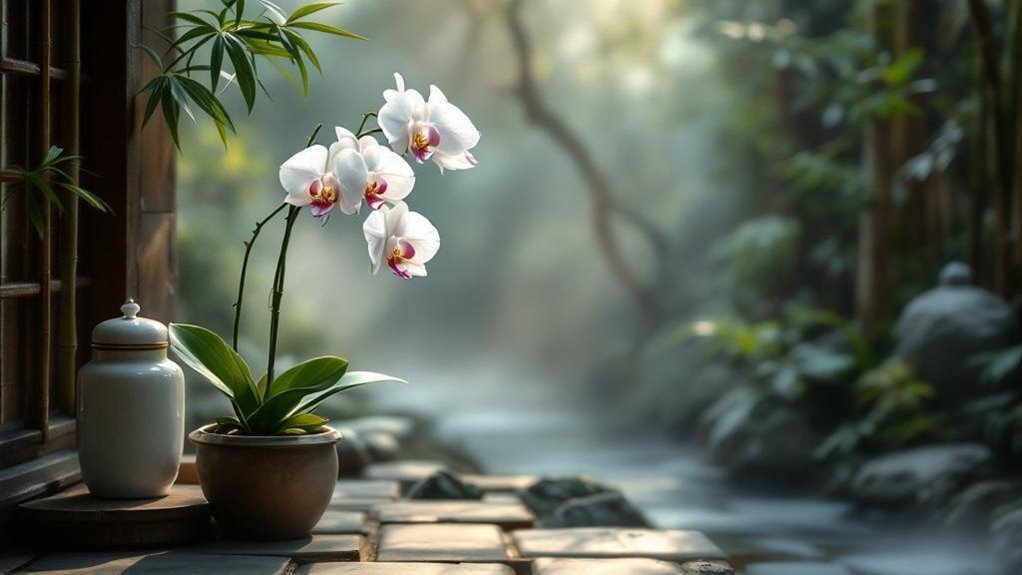
Within the broader East Asian pattern, Chinese orchid symbolism gives the flower its most fully articulated moral role, centering especially on Cymbidium, whose restrained fragrance and cultivated form came to stand for refined virtue, elegance, and moral integrity; Confucius fixed that association in lasting terms when he compared the orchid growing in secluded valleys to the gentleman whose character remains upright even when no audience observes it, and that analogy shaped centuries of literary, artistic, and ethical thought.
You see that ideal extended through the Four Gentlemen, where the orchid marks cultivated scholarship; in poetry, painting, and ceremonial design, it signals fertility, prosperity, lineage, and respect.
When you encounter Dendrobium in medicinal lore, you also find health, longevity, and importance attached, so the orchid never appears stagnant, merely observational and enduring.
Japanese Orchid Ideals
Where Chinese thought cast the orchid as a moral emblem, Japanese ideals refined that inheritance into a quieter aesthetic code, one that treats ran, or 蘭, as a sign of nobility, cultivated taste, and scholarly virtue, closely aligned with the Confucian image of the disciplined gentleman and the balanced harmony of character implied in bunbu no chōwa.
You see this ideal in four forms:
- Edo and Meiji collectors prized shunran for scent and tokonoma display.
- Ikebana favors single stems, asymmetry, and observational restraint over stagnant abundance.
- Haiku and emakimono use orchid motifs for solitude, early spring, and discreet beauty.
- Centuries of cultivation shaped exhibitions, lineage records, and bonsai-like presentation, confirming status.
Through these practices, you recognize an ethic of measured elegance, where rarity matters less than disciplined perception and form.
Korean Orchid Meaning in Art
Restraint governs the Korean orchid’s meaning in art, for 난, or nan, came to signify not display but cultivated virtue; since the Joseon dynasty, painters, poets, and calligraphers have used the orchid to mark the inward qualities prized by Confucian scholarship, especially integrity, humility, and disciplined refinement.
| Form | Meaning | Context |
|---|---|---|
| Ink orchid | Purity | Literati painting |
| Orchid text | Modesty | Sijo, calligraphy |
| Embroidery | Upright taste | Court dress |
When you read observational Joseon works, you find wild Cymbidium rendered with spare ink, never stagnant, so humility and quiet elegance remain central. Literati such as Gosan paired orchids with bamboo and plum, creating resilient fellowship and noble friendship. In textiles and royal garments, stylized orchid motifs signaled status, yet they did so discreetly, asserting cultured taste and ethical uprightness rather than spectacle alone.
Tropical Andes Orchid Myths
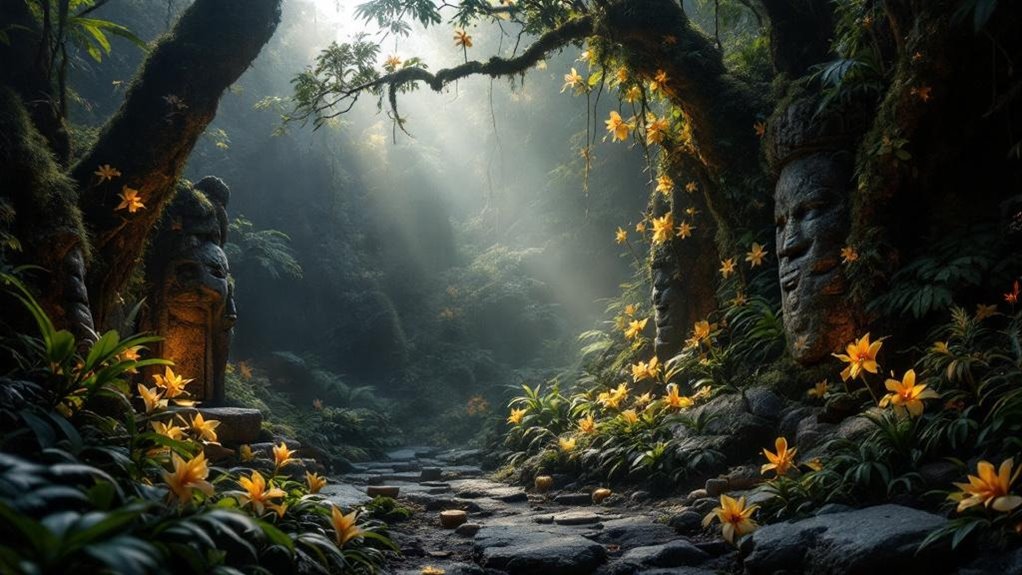
Although the Tropical Andes are often praised for their botanical abundance, with more than 4,000 orchid species spread across Colombia and Ecuador and many found nowhere else, local indigenous traditions don’t treat these flowers as stagnant ornaments; they regard them as living presences, embodiments of spirits or ancestors whose forms carry protective and fertile power into ritual life.
You encounter several recurring themes:
- Cloud-forest orchids summon mist guardians, sustaining rain.
- Páramo blooms mark humid balance and cultivated fertility.
- Dracula and Masdevallia resemble spirit faces, masking tricksters.
- Rare endemics anchor conservation as duty to ancestral lands.
As you read these myths, you notice an observational logic beneath them; orchids growing between 500 and 3,000 meters become signs of moisture, continuity, and ecological identity, and their protection affirms memory, place, and ritual responsibility.
Colombian Orchid Myths
In Colombia, orchid mythology gathers the cloud-forest beliefs of the Andes, the ceremonial uses of Amazonian communities, and a national legend centered on Cattleya trianae, the emblematic bloom said to have sprung from the tears of an indigenous chief’s beloved, a story that binds love, grief, and cultivated pride to the flower’s adoption as a national symbol in 1936.
You encounter orchids in Colombian belief as living thresholds; Andean peoples place epiphytes high in trees, where protective forest wives govern rainfall, fertility, and the observational reading of stagnant mists.
In Amazonian settings, bright orchids mark courtship and festival adornment, granting beauty and social distinction.
Folk medicine also assigns healing and aphrodisiac force to certain species, which explains ritual brews and gathering pressure on wild plants.
At flower fairs, you see these narratives formally retold.
Ecuadorian Cloud Forest Orchid Lore
As you turn from Colombian orchid myths to Ecuadorian cloud forest lore, you encounter a cultivated belief that orchids rising from moss-covered branches and trunks, held in persistent mist between 500 and 3,000 meters, mark the presence of cloud spirits rather than any stagnant natural process.
You can trace how sacred misty forest beliefs formed from close observational contact with epiphytic orchids, whose dependence on high humidity, filtered light, and steady rainfall made them seem like living mediators between forest canopies, mountain weather, and human ceremony.
You also see why these beliefs still matter, because communities have carried orchids into remedies, festivals, and conservation practice, preserving both the symbolic force of the plants and the threatened cloud-forest world that sustains them.
Cloud Spirits And Orchids
Where mist settles through Ecuador’s cloud forests, orchids are often understood to hold cloud spirits within their roots and petals, a belief shaped by the observational reality that many endemic Andean species thrive between roughly 500 and 3,000 meters, where constant moisture renews the forest and prevents the air from turning stagnant.
You encounter this lore through cultivated practice and local interpretation:
- You read epiphytic orchids on mossed branches as ancestral presences guarding water.
- You notice humidity, often 70–90%, reinforcing that association.
- You may hear Dracula and Phragmipedium kovachii treated as weather signs, protective or playful.
- You see offerings and careful harvesting align with conservation, since the Andes hold over 4,000 orchid species.
In gardens and eco-lodges, you find orchids presented as intermediaries with mountain powers, sustaining delicate microclimates.
Sacred Misty Forest Beliefs
Although the cloud forest may seem governed only by moisture and elevation, Ecuadorian orchid lore treats it as a cultivated spiritual terrain in which showy orchids such as Cattleya and Phragmipedium serve as mist-bearers, fertility signs, and guardians of springs from roughly 500 to 3,000 meters; you see the logic in the observational fit between belief and habitat, since these plants flourish under persistent cloud cover, dappled light, and humidity that rarely lets the air turn stagnant.
You find orchids on ritual altars, where shamans place blossoms to call rain, steady crops, and invite ancestral presence; because flowers seem to catch mountain vapor and release it downslope, communities read them as mediators between heaven and earth.
When rare Andean endemics are believed to house guardian spirits, you can see why local stewardship protects páramo edges and cloud-forest fragments.
Peruvian Orchid Legends
Because Peruvian orchid legends developed across both Andean highlands and Amazonian forests, they present orchids not as stagnant ornaments but as cultivated signs of presence, healing, and continuity, and you can see this clearly in stories that treat rare cloud-forest species as gifts from mountain goddesses who safeguard fertility, in Shipibo and Asháninka practices that place fragrant epiphytic orchids in ceremonial garlands and medicinal infusions for protection, and in regional tales of slipper orchids whose pouch-like blooms recall women transformed by grief into vessels of memory.
Across Peru’s highlands and forests, orchids become living emblems of fertility, protection, grief, and enduring continuity.
- You encounter borderland respect for *Cattleya trianae*.
- You see endemic orchids tied to crop fertility.
- You note medicinal garlands in Amazonian ceremony.
- You find storytelling near Manu and the Cordillera reinforcing conservation.
These legends give orchids observational weight, linking beauty, mourning, health, and stewardship.
Orchids in Andean Belief

Across the Tropical Andes, orchids enter belief not as stagnant decorations but as cultivated signs of fertility, beauty, and ecological continuity, and their presence in cloud forests and páramo margins gives them an observational force that local communities have long read as evidence of water, seasonal balance, and the life-giving strength of mountain landscapes.
You see this belief sharpen in Colombia, where Cattleya trianae serves as both national flower and cultural emblem, appearing in festivals and art as proof of natural wealth.
You also find orchids in Indigenous remedies and rituals, especially from humid forests between 500 and 3,000 meters, where medicinal and spiritual value converge.
In Ecuador, prized endemic orchids encourage conservation-minded folklore, while gardens and events like Medellín’s Flower Fair affirm regional biodiversity and eco-cultural heritage across generations today.
Central American Orchid Myths
As you turn to Central American orchid myths, you find sacred forest legends shaped by observational belief, where tiny cloud-forest orchids are treated as signs of household spirits and cultivated as symbols in rites meant to keep mist and rainfall from growing stagnant.
You also see national flower symbolism take a firmer public form in Costa Rica and Panama, where Guarianthe skinneri and Peristeria elata carry ideas of purity, national soul, and the dove’s spirit, and where annual honors and legal protection confirm that these meanings aren’t merely decorative.
If you follow these stories through gardens, festivals, and conservation practice, you can see how myth gives orchids cultural authority, and how that authority now supports protection as strongly as it once encouraged collection.
Sacred Forest Legends
Although these stories differ by region and community, Central American sacred forest legends treat orchids as cultivated signs of moral order rather than as stagnant ornaments, especially in Costa Rican and Panamanian traditions where Guarianthe skinneri appears beside rain-bringing spirits that dwell in montane cloud forests and mark purity through their presence.
You encounter recurring lessons:
- Guarianthe skinneri signals purity, and its appearance confirms observational harmony between people, spirits, and rain.
- Pleurothallis and related miniatures host gemelos, who protect households when you harvest with restraint.
- In Monteverde-like tales, taking a whole flowering orchid provokes guardians and extends drought.
- Sustainable practice governs conduct; you take one bloom, leave the mother plant intact, and preserve mist-fed abundance.
Peristeria elata also enters folklore, where answered grief reveals divine presence through bloom.
National Flower Symbolism
Several Central American orchid myths turn national flowers into cultivated signs of collective character rather than stagnant emblems, and in that symbolic shift you can see how Costa Rica and Panama bind observational ethics, sacred memory, and public identity to living plants whose presence still carries moral weight.
In Costa Rica, you encounter Guarianthe skinneri, the rosa de monte, as purity made civic; folklore, fiestas, and stamps teach you that national identity should appear graceful yet disciplined. In Panama, Peristeria elata carries a dove within its bloom, so legends of divine protection support legal safeguards against overcollection.
Across the region, when you read courtship myths about gifting tiny epiphytic orchids, you see sincerity rendered botanical. Modern reserves, festivals, and Monteverde outreach extend that reverence, joining pre-Columbian memory and Catholic ceremony to conservation today.
Costa Rican Orchid Lore
Where Costa Rican orchid lore becomes most visible, it joins national symbolism, cultivated practice, and an observational reading of the forest, with the guaria morada, Guarianthe skinneri, standing at the center as the national flower and appearing each August in public celebrations and traditional garlands.
- You see identity in gardens and festivals.
- You read cloud-forest orchids, especially miniature Pleurothallis and other epiphytes, as signs that mist, humidity, and forest spirits remain balanced, not stagnant.
- You encounter this lore at Monteverde and Lankester, where native species support eco-tourism, research, and a cultivated respect for habitats.
- You find practice reinforcing belief; growers use sphagnum moss to retain moisture, while botanical gardens encourage sustainable cultivation, linking orchid care with guardianship and steady local protection of forest life.
Panamanian Orchid Symbols
In Panama, orchid symbolism gathers most clearly around Peristeria elata, the Flor del Espíritu Santo, a blossom that carries purity, national pride, and legal protection at once, because its rarity has made it both a cultural emblem and a guarded part of the country’s natural inheritance.
| Symbol | Meaning |
|---|---|
| Purity | Dove form |
| Pride | 1936 emblem |
| Coinage | Half Balboa |
| Faith | Chalice legend |
| Fragility | Cloud forests |
You see that meaning extend through folklore and policy alike; the flower’s dove-and-chalice form supports Catholic observational devotion, while its place on the half Balboa confirms cultivated identity. Festivals in summit reserves and Azuero resist stagnant indifference through habitat protection, and endemic Pleurothallis miniatures add a quieter lesson, reminding you that Panamanian beauty often survives through restraint, rarity, and careful stewardship.
Orchids in Mesoamerican Tradition
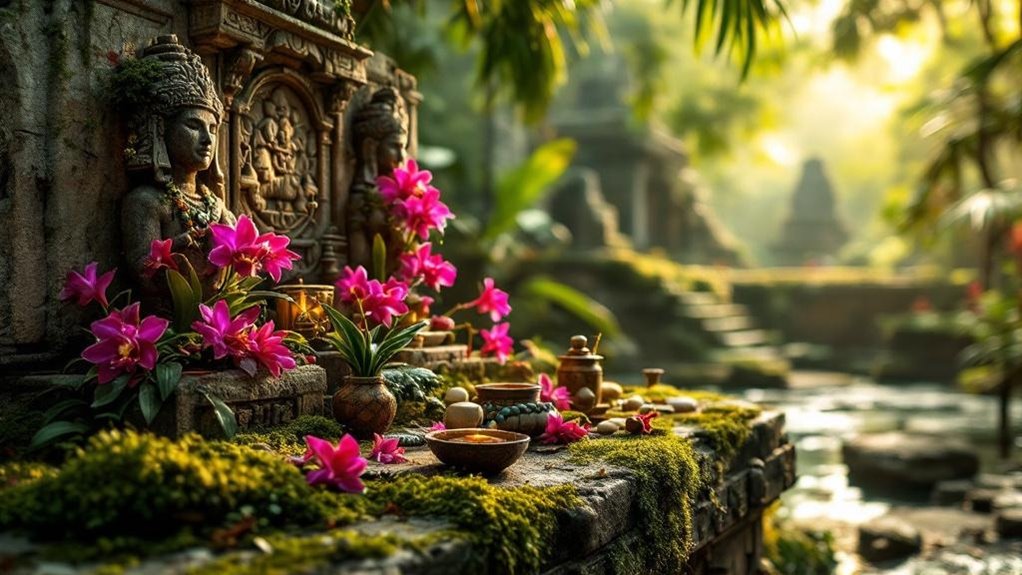
Although later trade carried vanilla far beyond its native range, Mesoamerican tradition kept orchids close to cultivated power and sacred use, because Vanilla planifolia served not only as a flavoring but also as a fragrant offering, a scent for elite chocolate drinks, and a material sign of status among Aztec and Maya nobles.
You can trace that authority through four observational patterns:
- Totonac growers treated vanilla as sacred and refined early cultivation and curing.
- Aztec tribute records show beans circulating as luxury goods, never stagnant commodities.
- Myths connect orchid flowers and tubers with fertility, virility, and supernatural origins.
- Colonial ethnobotany preserves medicinal uses for respiratory ailments, wounds, and poultices.
When you read these traditions together, you see orchids functioning as ritual substance, marketplace value, and embodied knowledge across Mesoamerican life.
South American Orchid Folklore
Across the Tropical Andes, South American orchid folklore ties flowers to landscape, ancestry, and cultivated memory, because communities in Colombia, Ecuador, and Peru have long treated rare orchids as more than ornamental growths, reading them instead as signs of love, beauty, fertility, medicinal power, and the presence of cloud-forest spirits or mountain deities.
You see this clearly in Colombia, where Cattleya trianae and thousands of other species shape regional identity, and in Ecuador, where stories around Phragmipedium kovachii cast slipper orchids as hidden treasures of high, humid forests.
In Andean observational tradition, epiphytic orchids don’t suggest stagnant decoration; they mark healing, abundance, and proper reciprocity with place.
In Peru and Ecuador especially, you’d also find sacred, vulnerable orchids serving as moral warnings against overharvesting, supporting stewardship narratives within cloud-forest communities today.
Brazilian Orchid Folklore
As you turn to Brazilian orchid folklore, you find forest spirit legends attached to native blooms, especially Cattleya and Epidendrum, because many Indigenous and riverine communities regard them as vessels for fertility and crop protection, and that belief supports observational rituals at forest altars.
You also see sacred bloom symbolism take a cultivated form, since bright orchids can signify courtship, seasonal renewal, and offerings to Orixás, with color and fragrance carrying meaning where stagnant explanation would miss the ritual logic.
When you consider Indigenous ritual uses, you notice that these traditions also protect rare endemic orchids, because sacred status and taboo discourage picking and preserve plants that communities treat as spiritually significant.
Forest Spirit Legends
When Brazilian forest lore turns to orchids, it doesn’t treat them as passive ornaments but as cultivated thresholds between the visible world and the spirit-haunted canopy, where epiphytic species such as Cattleya and Oncidium are said to shelter curupira-guardians that defend living trees, punish loggers, and receive flower offerings laid at the base of trunks as a practical sign of respect.
- You notice Tupi-Guarani tales recast vivid blooms as souls of lost children or lovers, an observational explanation for mimicry.
- You learn feminine entities linger near Habenaria and Epidendrum, marking healing springs and active shamanic ground.
- You read lone ground-orchids at dusk as warnings of storms, wandering spirits, and stagnant air.
- You see riverine garlands and orchid sprays used to appease forest presences, securing harvests and safe passage.
Sacred Bloom Symbolism
Although Brazilian orchid folklore often begins with spirits in the canopy, its sacred bloom symbolism settles on a more deliberate claim: certain flowers don’t merely decorate ritual space, they authorize contact, carry petitions, and mark the boundary between cultivated devotion and the unstable forces of forest and river.
You see that logic in revered orchids such as Cattleya labiata, whose purple bloom signifies worthiness and offering; on Afro-Brazilian altars, white and yellow orchids signal purity, protection, and communication directed toward specific divine powers.
Colonial belief adds another register, since a single rare blossom could imply enchantment and bind lovers’ fates.
In Amazonian observational tradition, epiphytic orchids seem to rise from stagnant air itself, so their flowering becomes an omen of seasonal turning, harvest promise, and, today, a reason to protect threatened native habitats.
Indigenous Ritual Uses
Across Brazilian orchid folklore, Indigenous ritual use gives these plants a direct ceremonial function, because communities don’t treat native orchids as passive ornament but as cultivated agents within baths, inhalations, offerings, and healing preparations that mediate fertility, protection, desire, and ancestral presence.
- You find Amazonian groups, including Tikuna and Huitoto, macerating Cattleya and Brassavola flowers in river water for ritual baths and inhalations, practices believed to strengthen fertility and spiritual protection against stagnant forces.
- You see Guarani courtship rites use fragrant epiphytes in headbands and sleeping mats, because scent carries observational meaning and directs desire.
- You note shamans sometimes apply pseudobulbs and roots in poultices for rheumatism and snakebite.
- You also encounter eastern Brazilian altars and Candomblé incense, where orchid offerings invite ancestors, harvest guidance, and fertility-linked orixás.
Amazonian Orchid Healing Myths
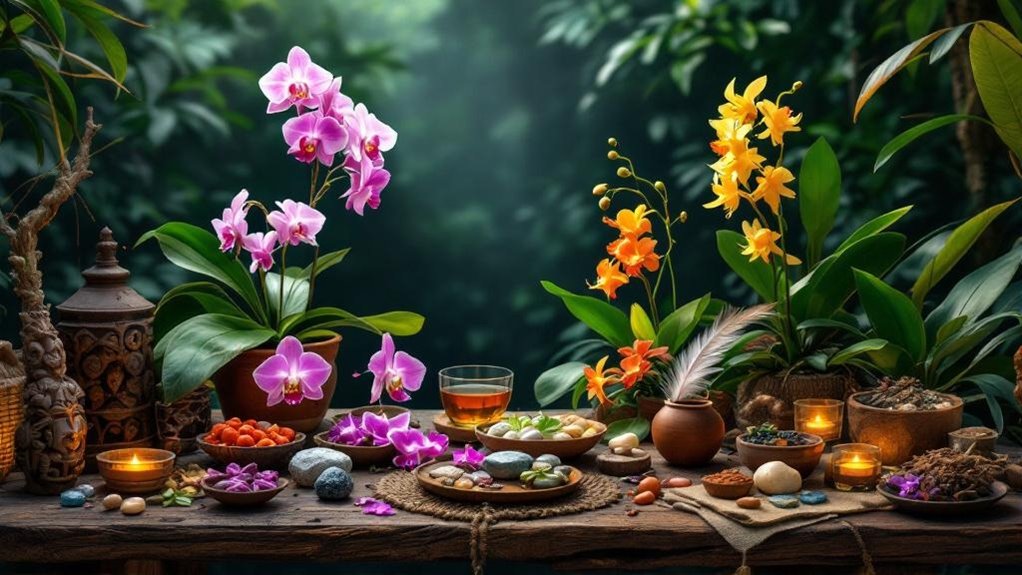
Step into Amazonian orchid healing myths, and you find a tradition in which medicinal practice, observational knowledge, and spiritual interpretation aren’t treated as separate domains but as cultivated parts of the same system; Indigenous communities have long used orchids such as Cattleya, Epidendrum, and Brassavola in poultices and infusions for wounds, skin infections, and respiratory ailments, while healers in parts of Peru and Brazil burn or brew certain epiphytic species to create aromatic smoke that’s believed to clear spiritual afflictions and open contact with plant spirits.
You also encounter beliefs linking orchid preparations to fertility, postpartum recovery, and desire; tubers and pseudobulbs may be macerated for analgesic, anti-inflammatory use, although evidence remains limited.
Because wild harvesting pressures endemic populations along the Andes–Amazon fringe, sustainable cultivation matters if this knowledge is to endure.
Australian Orchid Myths
Where Australian orchid myths take shape, you find an observational tradition in which flowering cycles, sacred geography, and ancestral memory remain cultivated together; Aboriginal stories in Queensland and New South Wales often cast native orchids as more than decorative plants, with Dendrobium speciosum linked to rain and fertility because its blooming coincides with seasonal change, and terrestrial Cymbidium species remembered as transformed spirits whose presence protects children or marks sites that mustn’t become spiritually stagnant through neglect.
You can trace four motifs:
- Rhizanthella gardneri stays hidden, so lore ties it to underworld knowledge.
- Colonial collectors recast orchids as emblems of scientific prestige.
- Flower shows helped fold Dendrobium and Cymbidium into national identity.
- Conservation narratives now ask you to value 1,300 species and habitats like the Daintree Rainforest.
Aboriginal Orchid Meanings
Because Aboriginal knowledge is cultivated through story, season, and place rather than separated into symbolic and practical categories, you can understand orchid meanings in many Australian traditions as part of an observational system in which Caladenia and other native orchids mark ancestral presence, identify ceremony grounds, and signal the right time for gathering, hunting, or moving through country.
You also see meanings in use: tubers from microtis and related orchids serve as seasonal bushfoods, governed by clan names, territorial rules, and sustainable harvesting protocols that prevent stagnant depletion. Flowering calendars guide your reading of country, especially from late winter into spring, while local ethnographies record some orchids as linked with fertility, healing, or protective power. These meanings vary by language group and habitat, yet stewardship remains central across many regions.
Underground Orchid Legends

As you turn to underground orchid legends, you encounter hidden earth spirits and cave bloom folklore shaped by observational traditions, where rare plants that rise from stagnant soil or flower unseen were cultivated in memory as signs of ancestral presence, seasonal change, and guarded power.
You can trace this pattern from Australian Rhizanthella Dreaming tales, in which wholly subterranean orchids are linked to sacred beings and spirit dwelling places, to Himalayan beliefs that buried orchid tubers signal shifting seasons and carry medicinal or mystical force.
You also see how European salep lore and Central American ritual medicine extended the same logic, because what remains concealed underground often comes to represent fertility, protection, and knowledge that shouldn’t be handled carelessly.
Hidden Earth Spirits
Although orchids are often imagined as luminous flowers suspended in branches, many traditions place their deepest power below the surface, in tubers, rhizomes, and cave-root systems that mark a cultivated relationship between hidden plant life and unseen beings; in the Tropical Andes, some Kichwa and Quechua communities describe subterranean orchid-like plants as apus’ ruma, dwelling places of earth spirits that govern soil fertility and even the movement of cloud-forest mist, so the condition of the buried orchid becomes an observational sign of whether crops will thrive or fail in stagnant ground.
- In Southeast Asia, you approach limestone-root orchids with offerings, acknowledging guardian spirits and avoiding misfortune.
- In Central American highlands, respectful travelers may find miniature orchids linked to duendes and water.
- In Sikkim and Bhutan, disturbing medicinal tubers risks illness or bad weather.
- In Australia, emergence marks ancestral law and taboos.
Cave Bloom Folklore
From those buried spirit-orchids, the tradition moves easily into cave bloom folklore, where darkness, stone, and hidden moisture create a more explicit sacred geography, and where orchids that flower beneath soil, in grottoes, or at cave mouths become observational signs of ancestral presence, seasonal change, and local protection.
| Region | Orchid belief | Meaning |
|---|---|---|
| Queensland | Cave flowers guide souls | Burial passage |
| Himalaya | Subterranean cymbidiums bloom | Spring, fertility |
| Andes | Grotto orchids follow offerings | Landslide protection |
You see this pattern recur elsewhere; in Malaysia and Thailand, limestone blooms promise cultivated fortune despite stagnant cave air, while in Costa Rica, tiny pleurothallids at cave mouths guard households if left undisturbed, reinforcing a measured rule: when orchids emerge from hidden stone, communities read them not as curiosities, but as protective instructions.
Rhizanthella Dreaming Tales
Where cave-bloom folklore locates orchids at the threshold of stone and air, Rhizanthella dreaming tales move the sacred sign fully beneath the ground, and in Aboriginal traditions of Western Australia these earth-blooming orchids stand for hidden knowledge, ancestral guardianship, and the disciplined understanding required to notice what never rises into ordinary view.
You read these legends through four cultivated principles:
- You seek what stays hidden; only observational knowledge finds underground bloom.
- You recognize ancestors beneath soil, guarding sacred places through a stagnant, watchful presence.
- You understand life comes through fungal partners, not sunlight; the orchid feeds from earthbound exchange.
- You accept rarity as law; because Rhizanthella gardneri survives in few places, you don’t disturb it, and modern conservation rightly joins dreaming narrative to botanical fact.
Pacific Island Orchid Stories
Across Pacific Island traditions, orchids appear not as stagnant ornament but as cultivated signs of love, ancestry, rank, healing, and seasonal renewal, and the stories attached to them show an observational understanding of how fragrance, growth habit, and bloom timing could be woven into ritual life.
You see this clearly in Polynesia, where fragrant Dendrobium and Aerides enter courtship through Tahitian garlands worn in dance; in Samoa and Tonga, ground-rooting blooms rest on family altars, inviting ancestral protection. In Hawaii, orchid leis mark chiefly rank and mana, while chants honor scent and resilience.
In Fiji, infusions treat skin ailments and frame orchids as gifts from forest and sea deities. In the Marquesas and Cook Islands, goddess-tear legends explain trunk-clinging growth and seasonal flowering aligned with lunar cycles.
Orchids in Colonial Flower Lore
By the nineteenth century, colonial flower lore had turned orchids into cultivated emblems of possession and refinement, because British officials in India, Spanish clerics and collectors in Central America, and later Victorian plant hunters treated species such as Vanda, Dendrobium, and Peristeria elata not as stagnant ornaments alone but as proofs that distant climates, labor, and botanical knowledge could be gathered under imperial control.
Nineteenth-century orchid lore made bloom and empire appear inseparable, turning cultivated rarity into a polished sign of colonial command.
You can trace that lore through four recurring patterns:
- Anglo-Indian rooms displayed Vanda and Dendrobium as observational trophies of conquest.
- Spanish collectors exported Peristeria elata for churches and curiosity cabinets.
- Botanical gardens, including Kew and Bogor, acclimatized orchids, then circulated hybrid stock through imperial trade.
- Missionary accounts recorded indigenous uses, yet they often recast them as curiosities, enabling misappropriation, knowledge transfer, and overcollection.
Victorian Orchid Symbolism

Victorian orchid symbolism distilled empire, desire, and cultivated judgment into a single bloom, because in England’s parlors and conservatories orchids signaled luxury and refined taste while also marking their owners as observational, scientifically curious, and socially discerning.
If you displayed Cymbidiums or Cattleya hybrids, you announced money, access, and a disciplined eye for rarity; in a stagnant room, one flowering spike could reorder social perception.
You also entered a coded language: white orchids suggested innocence and refinement, while colored or unusually rare specimens implied passion, wealth, or even scandal, depending on who observed them.
Because Victorians linked orchids to femininity and eroticism, and knew Orchis carried a charged classical etymology, you could give an orchid as a courtly compliment or a more suggestive declaration, carefully calibrated to context.
How Orchid Hunters Shaped Myth
Orchid hunters didn’t simply bring specimens home; they carried back stories, and in the 19th and early 20th centuries those stories steadily reshaped how people understood orchids, turning difficult habitats, cultivated scarcity, and observational science into modern myth.
- In the Andes, you see documentation become national romance; Triana and others fixed rare blooms within patriotic legend.
- In Southeast Asia, you inherit cliff-orchid tales; commercial demand made danger seem essential, not stagnant invention.
- In Central America, you encounter cloud-forest guardians; explorers tied rarity to spirits, then to conservation-minded travel.
- In the Himalaya, and later in Australia and Europe, you watch medicinal reports and field observations harden into curative lore and “lost species” narratives, which guided searches, shaped collecting habits, and sometimes narrowed survival itself for vulnerable orchids.
Orchid Colors in Myth
Although color seems like a simple visual trait, in orchid mythology it carries cultivated meaning, and you can trace that meaning across regions where local climate, ritual use, and observational habit shaped which hues came to stand for purity, protection, love, healing, or seasonal order.
Across orchid mythology, color gathers meaning from climate, ritual, and habit, becoming a map of purity, protection, love, healing, and season.
In Andean rites, you find white orchids aligned with mountain spirits and purity, their cloud-forest growth in humid, never stagnant air reinforcing spiritual clarity; in Southeast Asia, blue and purple orchids signal royalty and protection, a prestige strengthened by trade and festival display.
In Central America, pink and red orchids carry love, fertility, and civic identity, especially in Costa Rica’s wedding use; in Himalayan practice, pale and greenish orchids suggest resilience and healing through Ayurvedic association.
In Australia, earthy orchids mark seasonal timing, guiding courtship and food-gathering.
Orchid Shapes in Legend
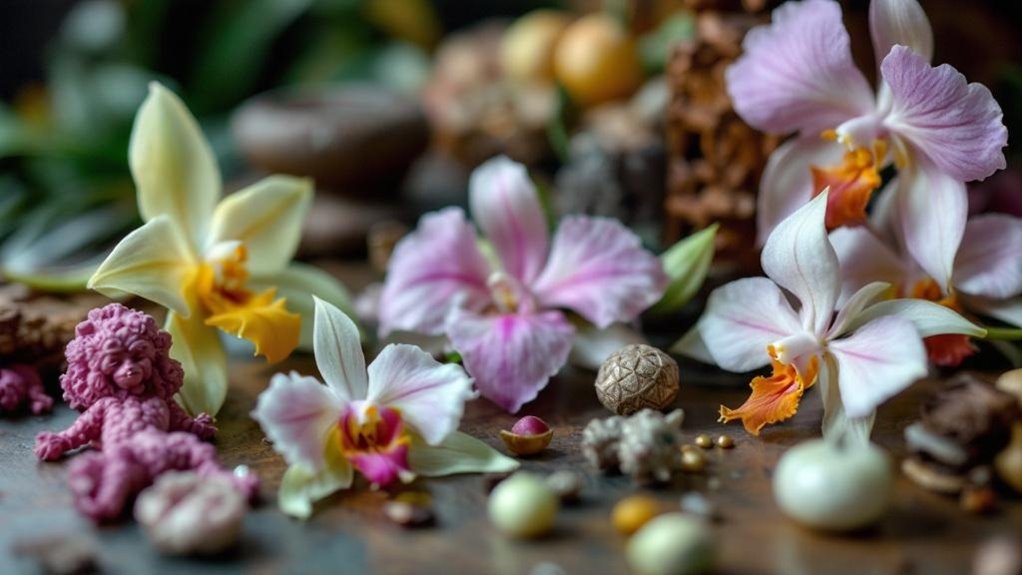
As you turn from color to form, you see how orchid shapes guide legend with observational force; animal-like faces become spirits and tricksters, while starry petals, moon-curved lips, and winged silhouettes suggest celestial signs that cultures wouldn’t let remain stagnant.
You can trace this pattern from monkey-faced blooms in Andean storytelling to slipper orchids linked with fairies, and to broad-lipped flowers in Southeast Asian tales, where cultivated beauty and scent make the blossom resemble dancers, garments, and other beings that stand between earth and the divine.
You also notice that sacred patterns in petals, especially the balanced symmetry of the orchid flower, support myths of duality and harmony; they give shape a disciplined symbolic role, and they show why form, no less than color, carries belief.
Animal Forms And Spirits
Where floral form departs from the expected and begins to suggest a beak, a frog’s mouth, or a small animal poised in stillness, legend tends to follow, and many orchid traditions treat these shapes not as decorative accidents but as signs of spirit presence, animal transformation, or ancestral return.
You find this pattern across regions:
- In the Tropical Andes, Dracula and Masdevallia forms house spirits, and dawn sounds support the observational claim.
- In Southeast Asia, pouch orchids become guarded brides; Paphiopedilum rothschildianum preserves a warrior’s slipper memory.
- In Central America, tiny Pleurothallis guide hunters toward water, especially in cultivated mountain paths above stagnant valleys.
- In the Himalayas and Australia, pseudobulbs and terrestrial forms mark ancestors, monks, and creature-to-human change across high and coastal rainforest country.
Star, Moon, And Wings
When orchid symmetry resolves into a star, a crescent, or a pair of apparent wings, legend usually reads that geometry as evidence of contact between sky and forest rather than as a neutral quirk of floral design; in the Andes, star-shaped Cattleya and Epidendrum are linked to celestial beings and treated as gifts from mountain spirits, a belief reinforced by their appearance across cloud-forest elevations from roughly 500 to 3,000 meters and by festival calendars that still track their bloom, while in Southeast Asia the moon-like labellum of certain Vanda and Dendrobium forms supports associations with lunar goddesses and monsoon-season temple offerings in Thailand and Indonesia.
In Central America, you find winged Pleurothallis and Oncidium cast as forest spirits or birds, shaping dances; in the Himalayas and Queensland, similar forms mark protective presence, ancestral descent, and cultivated sacred geography rather than stagnant ornament.
Sacred Patterns In Petals
Because petal form rarely stays observational in myth, cultivated communities read the orchid’s visible architecture as a legible sign of sacred character, and they attach meaning to breadth, curvature, and enclosure with remarkable consistency across regions; in the Andes, the broad, ruffled petals of Cattleya trianae are said to recall the flowing skirts of mountain maidens, so the flower comes to signify fertility and enters local wedding rites, while in Southeast Asia the flat, spreading petals of Vanda and Dendrobium are likened to the celestial garments of apsara dancers, which makes them apt for temple offerings that ask for beauty, blessing, and divine favor.
- In Panama, you see Peristeria elata’s bowl-like petals as dove wings, so protection sanctifies nationhood.
- In Himalayan lore, tubular petals become naga forms, linking orchids to medicinal water power.
- In Australia, hooded greenhoods resemble ancestral faces, encoding clan memory.
- Shape keeps myth from turning stagnant.
Orchid Fragrance in Ritual
Although orchid flowers often draw attention for their visual intricacy, their fragrance has carried equal ritual force across cultures, shaping ceremonial space through scents that people cultivated, interpreted, and offered as signs of purity, attraction, seasonal change, and spiritual focus.
You can trace that force through ceremonial practice: in the Tropical Andes, sweet, citrusy Cattleya orchids entered garlands and offerings during cloud forest rites; in Southeast Asia, scented Vanda and Dendrobium garlands support temple blessings, their jasmine-like perfume signaling purity and divine favor.
In Central America, Guarianthe skinneri links fragrance with courtship and fertility, carrying matrimonial meaning.
In Himalayan worship, you encounter Cymbidium and Dendrobium on altars or burned for cooling, sweet-smoky aromas that steady meditation and resist stagnant thought.
In Australia, subtle terrestrial orchid scents mark seasonal ceremonies and sharpen observational ties to place.
Regional Differences in Orchid Myth
As you compare regional orchid myth, you find that Andean sacred symbolism ties orchids such as Cattleya trianae to fertility and mountain spirits, and this cultivated belief reflects the Tropical Andes’ dense orchid diversity across varied elevations rather than any stagnant ornamental tradition.
You also see Asian ritual meanings shape a different pattern, because orchids like Vanda coerulea and Paphiopedilum rothschildianum signify nobility and beauty through royal patronage, festival use, and horticultural exchange, while Himalayan traditions connect highland species to medicinal and spiritual practice in a distinctly observational way.
When you turn to highland and forest lore across Central America and Australia, you notice that orchids enter folk tales, national symbols, seasonal knowledge, and habitat-based narratives, and these regional uses show how myth adapts to cloud forests, rainforests, and the communities that depend on them.
Andean Sacred Symbolism
- You see epiphytes mark spiritual guardianship and medicinal potency.
- You find páramo orchids symbolize endurance, thresholds, and stagnant afterlife margins.
- You note Ecuadorian rarities gain protective taboos after poaching.
- You recognize Colombian festivals frame orchids as pride, resilience, and ancestral continuity.
These meanings persist because ecology, ceremony, and memory reinforce one another across generations.
Asian Ritual Meanings
Across Asia, orchid mythology changes with landscape, court culture, and ritual use, yet you can still trace a shared logic in which cultivated rarity, fragrance, and endurance become signs of ethical character, sacred attention, and social refinement; in China and Taiwan, especially around Cymbidium, classical Confucian writing treats the flower’s restrained perfume as proof of noble virtue and moral integrity, while Japan shifts the emphasis toward elegance, seasonal sensitivity, and rare beauty through ikebana practice and imperial symbolism.
| Region | Orchid meaning | Ritual use |
|---|---|---|
| Thailand, Myanmar | respect, hospitality | garlands, royal rites |
| India, Nepal | healing, fertility | remedies, deity rituals |
You also find maritime Southeast Asia linking showy orchids to marriage, ancestry, and spirit presence, so you can read the bloom as cultivated beauty resisting stagnant ordinary life.
Highland And Forest Lore
Mountain and forest traditions shift orchid mythology away from courtly refinement and toward place-bound powers, so you can see how altitude, mist, rock, and monsoon weather shape meaning just as strongly as ritual culture does; in the Tropical Andes, where orchids grow between roughly 500 and 3,000 meters in cloud-forest conditions marked by 70 to 90 percent humidity and temperatures near 15 to 25°C, species such as Cattleya trianae appear in indigenous stories as the souls of lost lovers or as mountain spirits, because their cultivated rarity, dependence on unstable microclimates, and sudden flowering make them seem poised between visible life and the unseen.
- In Thai and Malay uplands, Vanda and Dendrobium suggest fertility and royal favor.
- In Monteverde, mist orchids guard rain.
- In Himalayas, orchids protect and heal.
- In Australia, Dendrobium speciosum signifies locality, resilience, against stagnant seasonal pressure.
Shared Orchid Myths Worldwide
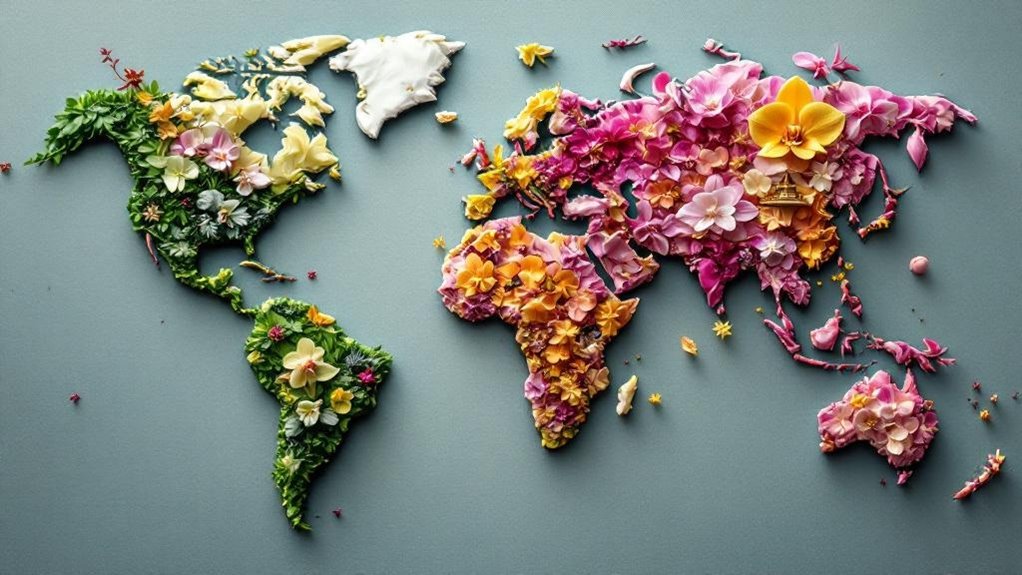
Although orchid myths emerge from very different landscapes and belief systems, they return with notable consistency to a small set of cultivated meanings: fertility, desire, moral refinement, rank, and the life-giving force of water, which suggests that people have long treated these flowers not as stagnant ornaments but as observational signs of human and ecological order.
| Theme | Example |
|---|---|
| Fertility | Vanilla with cacao in Aztec practice |
| Virtue | Cymbidium in Confucian traditions |
| Courtship | Victorian Orchis love potions |
You can trace these meanings across regions: in Europe, desire shaped courtship lore; in China and Himalayan cultures, orchids marked disciplined virtue; in Southeast Asia and Indonesia, Vanda and Paphiopedilum joined creation stories and royal protection; in Andean cloud forests, sacred orchids linked mountain spirits, moisture, and survival.
How to Interpret Orchid Symbols Today
When you interpret orchid symbols today, you should let context shape meaning, because the same flower can signify biodiversity and resilience in the Tropical Andes, status and trade in Southeast Asia, national pride in Central America, medicinal and ritual value in the Himalayas, or endemism and adaptation in Australia.
You can use that observational approach to guide modern symbolism toward cultivated responsibility rather than stagnant cliché, citing the Andes’ more than 4,000 species and high endemism, supporting certified nursery sources in Asian trade and festival settings, and promoting reserve-based viewing in places such as Monteverde and Lankester Garden.
If you read orchids this way, you don’t treat them as fixed emblems; you connect them to living cultures, specialized habitats, and conservation-minded choices, including cultivation over wild collection in monsoon-sensitive Himalayan landscapes.
Context Shapes Meaning
Context governs interpretation; if you want to understand what an orchid symbolizes today, you can’t treat the flower as a stagnant universal sign, because its meaning has been cultivated by ecology, trade, ritual, and modern conservation in different places.
- In the Tropical Andes, you read orchids through biodiversity and nationhood; Colombia’s Cattleya trianae joins cultural pride to conservation.
- In Southeast Asia, you notice prestige, export history, and ceremony; Vanda coerulea and Paphiopedilum rothschildianum signal wealth and status.
- In Central America, cloud-forest orchids suggest resilience and stewardship; festivals and reserves tie Guarianthe skinneri to observational conservation narratives.
- In the Himalayas and Australia, you see healing, sacred altitude, place, and ecological uniqueness; Dendrobium traditions and endemic species anchor local meaning.
You interpret orchids best by asking where, how, and why people cultivated significance.
Modern Symbolic Uses
Modern orchid symbolism makes the most sense if you read the flower as a public sign shaped by present uses as much as inherited meaning, because today orchids appear in logos, festivals, gifts, exhibitions, and ceremonial displays, and each setting directs interpretation toward a distinct social value.
In the Tropical Andes, you read orchids as biodiversity and national pride; Colombia’s Cattleya trianae turns conservation branding into an observational claim about stewardship. In Southeast Asia, cultivated rarity still signals wealth, refinement, and marriage prestige through gifts and trade. In Central America, festival displays and ecotourism imagery keep epiphytic orchids tied to heritage without becoming stagnant. In the Himalayas, medicinal and spiritual associations guide you toward purity and ritual value. In Australia, exhibitions use endemic orchids to signify resilience, regional distinctiveness, and ecological care in outreach.
Frequently Asked Questions
How Do Orchid Myths Influence Modern Festivals or Public Celebrations?
You see orchid myths shape modern festivals by inspiring costumes, dances, floral displays, and rituals that celebrate love, fertility, beauty, or luck. Organizers use those stories to attract crowds, strengthen identity, and preserve tradition.
Are There Taboo or Unlucky Orchid Beliefs in Any Cultures?
Yes—if you visit parts of Victorian-influenced Europe, you’d hear orchids can signal dangerous seduction or moral excess. You might even avoid gifting deep-purple orchids at funerals, fearing they’ll invite sorrow, scandal, or lingering bad luck.
Which Orchid Myths Came From Trade Routes or Migration?
You’ll find many orchid myths traveled along Silk Road, Indian Ocean, and colonial trade routes; migrants carried Chinese fertility, Southeast Asian spirit, and Victorian exoticism beliefs, then you see them blending into local folklore.
How Have Christian or Islamic Traditions Reshaped Older Orchid Myths?
For example, you can see missionaries recast orchid spirits as saints’ symbols, while Islamic storytellers folded them into paradise imagery. You’d find older fertility, ancestor, or forest myths softened, moralized, or branded as superstition.
Do Endangered Orchids Change How Traditional Myths Are Understood Today?
Yes, endangered orchids change how you understand traditional myths today. You see sacred symbols become fragile living beings, so myths shift from explaining origins or powers toward urging protection, grief, responsibility, and cultural renewal now.
Conclusion
As you compare orchid myths across regions, you see a cultivated pattern: each story reflects local terrain, ritual practice, and social values, yet each also resists stagnant interpretation; orchids signify love, sanctity, and rarity because people attached meaning to what was elusive, fragrant, and difficult to possess. You read these symbols most clearly when you ask not only what an orchid meant, but where it grew, who revered it, and why that setting mattered.