
You should treat orchid symbolism as a mix of documented tradition and later invention, because older meanings came from specific contexts: Greek órkhis linked orchids to fertility through observational tubers; China tied them to integrity and cultivated refinement; Mesoamerica valued vanilla orchids in ritual exchange; Victorian collectors made them signs of luxury and control. Many viral myths, especially the Orchis transformation tale, aren’t ancient at all, and the distinctions become clearer as the history unfolds.
- Key Takeaways
- What Orchid Symbolism Really Means
- Orchid Color Meanings Today
- Orchid Symbolism in Ancient Greece
- The Truth About the Myth of Orchis
- Orchid Symbolism in Aztec Culture
- Orchid Symbolism in Ancient China
- Orchid Symbolism in Japanese Culture
- Orchid Symbolism in Hawaiian Tradition
- Orchid Symbolism in Victorian England
- How Orchid Meanings Changed Over Time
- Why Orchid Myths Spread Online
- Which Orchid Myths Are Fake?
- How to Spot Fake Orchid Myths
- What Orchids Symbolize Today
- Frequently Asked Questions
- Conclusion
Key Takeaways
- Orchid symbolism is historical but varied: ancient Greece linked orchids to fertility and virility through their paired tubers and medicinal beliefs.
- The popular myth of a youth named Orchis transformed into the flower is a later invention, not an attested ancient Greek source.
- In China, orchids symbolized virtue, integrity, friendship, and refined scholarship, especially through Confucian moral analogies.
- In Japan, especially among samurai elites, orchids represented restraint, status, disciplined taste, and were exchanged as prestigious gifts.
- Victorian “orchidelirium” recast orchids as symbols of luxury, rarity, and elite display, while modern internet claims often oversimplify these traditions.
What Orchid Symbolism Really Means

Although orchid symbolism often gets reduced to a vague idea of beauty or romance, its real meaning is more layered and more observational, shaped by how different cultures interpreted the plant’s unusual form, rarity, and cultivated value over time; in ancient Greece, even the name orchis linked the flower to fertility and the body, while in China orchids came to signify virtue, scholarly refinement, and enduring friendship through their association with moral character rather than display alone.
If you ask what orchids symbolize, you have to read the history of orchids without repeating stagnant internet myths; Aztec use of vanilla orchids connected them with ritual strength, Victorian collectors made them emblems of luxury, and later invented legends blurred evidence with ornament, so their symbolism reflects status, ethics, fertility, and human interpretation more than a single fixed meaning.
The name orchid itself comes from paired tubers in early Greek botanical observation, not from the flower’s delicate appearance.
Orchid Color Meanings Today
Today, orchid color meanings work less as fixed doctrine than as cultivated social shorthand, because modern gift-giving and floral design tend to sort the flower’s broader symbolic history into more immediate visual cues; pink orchids usually signal femininity, grace, and admiration, which is why people often choose them for mothers or to mark the arrival of a new child, while white orchids convey purity, elegance, and innocence, making them common in weddings and formal arrangements where reverence and refined simplicity matter more than sentimentality.
| Orchid Colors | Common reading |
|---|---|
| Purple | royalty, dignity |
| Green | health, renewal |
When you choose an orchid flower today, you also navigate culture; in China, for example, orchids suggest integrity and friendship, so meanings stay observational, regional, and never stagnant. White orchids are also widely used in memorial arrangements to convey peace, remembrance, and quiet dignity.
Orchid Symbolism in Ancient Greece
If you trace the surviving evidence, you find Theophrastus and later herbalists describing satyrion as medicinal and aphrodisiac, its tubers eaten in remedies, and its differing sizes linked in folk belief to whether you’d father sons or daughters; you don’t find strong evidence that orchids stood centrally in classical myth. Greek tradition also tied orchids to fertility and virility through these medicinal and erotic associations.
The Truth About the Myth of Orchis
When you trace the claim carefully, you see a post-classical invention built from observational borrowings, not a stagnant ancient tradition; Liger, or later repeaters, seems to have cultivated a composite narrative from real Greek motifs, including punishment, metamorphosis, and sexual violence, while the plant’s name more likely grew from órkhis, the botanical term tied to virility. The story first appears in Louis Liger’s 1704 gardening manual, not in classical Greek myth, which is why scholars treat it as a learned fabrication rather than an authentic ancient legend.
Orchid Symbolism in Aztec Culture
When you consider orchid symbolism in Aztec culture, you find that the vanilla orchid stood as a sacred gift, cultivated for elite use and framed within an observational understanding of power, offering more than fragrance or ornament.
You can see this most clearly in the vanilla-cacao ritual drink, whose frothy, spiced character linked the orchid to strength and importance; it nourished nobility, supported ceremony, and resisted any stagnant separation between sustenance and divinity.
As you trace these meanings, you recognize that vanilla’s value in ritual life helped establish the orchid as a sign of sacred provision, worldly authority, and divine favor.
The Totonacs of Papantla cultivated vanilla around 1000 AD, helping shape the orchid’s sacred memory long before it became an emblem of Aztec tribute and prestige.
Vanilla As Sacred Gift
Reverence shaped the Aztec view of vanilla, the orchid now known as *Vanilla planifolia*; they treated its fragrant pods as a sacred gift, cultivated and traded them as a valued commodity, and reserved their most honored use for a cacao-based drink consumed by nobility and during ritual occasions.
In that observational context, you can see why the vanilla orchid carried meaning beyond beauty; Aztecs revered its scent, linked it with divinity, and placed it within elite and religious practice rather than stagnant decoration.
You can also trace its broader importance through cultivation, exchange, and practical orchid uses, since Mesoamerican peoples employed native orchid materials for adhesive gels and medicine as well.
That mix of sacred association and utility made vanilla culturally central, economically visible, and symbolically durable long before European contact across Mesoamerica.
Orchid traditions elsewhere also include traditional medicine in Chinese and regional healing practices, where species such as Dendrobium and Bletilla were prepared as teas, powders, and tonics for dryness, sore throats, and recovery.
Cacao Ritual Drink
Within Aztec ceremonial life, cacao became more than a drink once vanilla entered it; by blending xocolātl with the fragrant pods of *Vanilla planifolia*, and at times with chili, honey, or other aromatics, elites and ritual specialists cultivated a beverage that signaled status, sacred exchange, and embodied power at once.
When you examine how the Aztecs used this drink, you see a cultivated system of prestige rather than a stagnant recipe, because prized vanilla pods moved through tribute networks, entered offerings and feasts, and marked rank in observational ways that chroniclers noticed.
Although other orchids appeared in medicine and food, vanilla remained the primary orchid directly tied to cacao, so its presence gave the mixture unusual ritual weight and helped anchor orchids within Aztec courtly and cosmological symbolism over generations.
Like the Ghost Orchid, it shows how a flower can gather meaning through rarity, symbolism, and the stories people build around it.
Strength, Vitality, Divinity
You can also see how Vanilla carried sacred weight for the Aztecs, since ritual offerings treated it as a divine gift, while medicinal and adhesive uses kept orchids from becoming stagnant symbols detached from daily life; their market value, tribute presence, and ceremonial roles joined economic importance to spiritual authority.
Orchid Symbolism in Ancient China
Elegance shaped the orchid’s place in ancient China, where early records attributed to Shen Nong noted medicinal value in certain species, and later thinkers gave the flower a moral weight that reached far beyond the garden; Confucius, writing of cymbidium-like orchids and their subtle fragrance, used them to express the character of the virtuous man, suggesting that true worth persists even when it isn’t loudly proclaimed.
| Aspect | Meaning | Example |
|---|---|---|
| Fragrance | Integrity | Confucius |
| Cultivation | Scholarly taste | Elite gardens |
| Dendrobium | Chinese Medicine | Shi hu |
You see this symbolism deepen in art and literature, where cultivated orchids signal refinement, friendship, spring, and good fortune; their quiet presence counters stagnant display, and their observational power rests in how modest beauty, medicinal use, and moral analogy reinforce one another across centuries of Chinese thought.
Orchid Symbolism in Japanese Culture
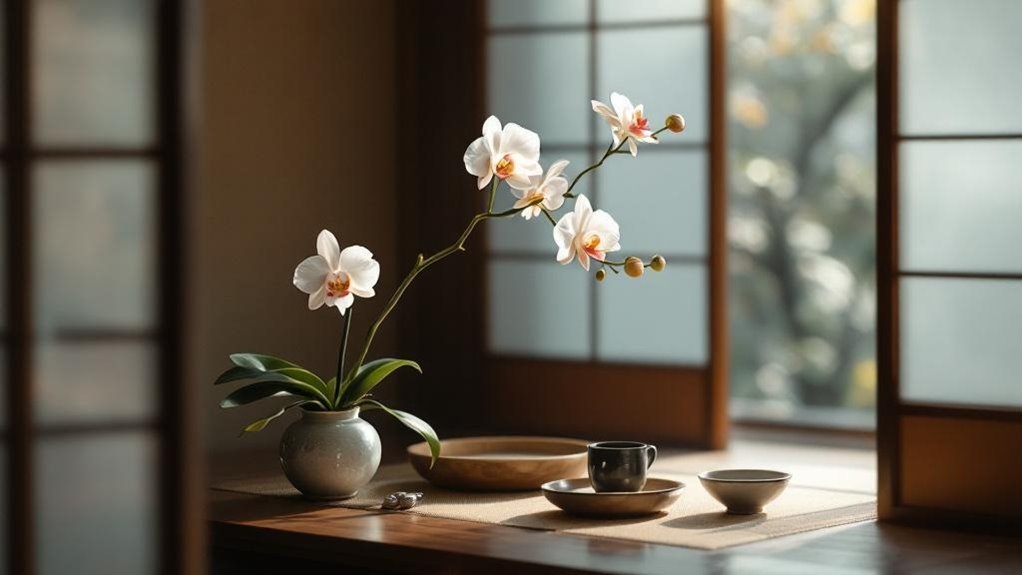
In Japanese culture, you can see orchids, especially cultivated dendrobiums, as clear emblems of respect, admiration, and refined taste, valued among the elite by the 17th century as observational markers of status rather than stagnant ornaments.
You also find the native fūran tied to samurai ideals, where its careful display in special pots and stands connects bravery with peace, and where disciplined cultivation signals noble character and horticultural skill.
When you consider orchids as gifts in business and social settings, you can recognize how they carry wishes for fortune, fertility, and prosperity, while their continued ceremonial, decorative, and medicinal use preserves older associations with power, resilience, and wealth.
Samurai Ideals And Orchids
Although orchids often suggest delicacy, by the 17th century Japanese samurai had cultivated Neofinetia falcata, the wind orchid, as a mark of refinement and status, because its spare form, quiet resilience, and disciplined presentation reflected values they claimed for themselves: bravery without excess, restraint without stagnation, and beauty shaped by control.
You can trace that symbolism through practice:
- You see cultivated displays, where elegant mountings signaled taste and rank.
- You find specialized care, which rewarded patience, order, and observational discipline.
- You notice records and labels, showing that collections weren’t casual possessions.
- You recognize formal exchange, where prized plants marked alliance and moral integrity.
In samurai households, Neofinetia falcata wasn’t merely ornamental; it embodied a code, linking cultivated beauty to steadiness, ceremony, and controlled strength.
Respect And Admiration
Respect in Japanese orchid symbolism grows from use as much as appearance, because cultivated orchids, especially dendrobiums and Neofinetia falcata, moved through aristocratic and samurai circles as objects that registered discernment, composure, and social regard; when people displayed them in tokonoma alcoves, arranged them with disciplined restraint, or presented them as formal gifts, they weren’t simply admiring a rare flower but acknowledging the character, status, and cultivated taste of the recipient.
In Japanese culture, you can read orchids as markers of respect and admiration because their care demanded patience, observational judgment, and a refusal of stagnant display; fūkiran, with its evening fragrance and elegant habit, especially signaled refinement, while ikebana placement and alcove display showed that esteem became visible through cultivated form and measured attention alone.
Fortune, Peace, And Gifts
Fortune attaches to orchids in Japanese culture because their beauty never stands alone; it arrives joined to patience, cultivated skill, and the quiet power of a plant that rewards steady observational care, which is why orchids came to signify not only prosperity but peaceful well-being, fertility, and social promise.
You can trace that meaning through Japanese practice:
- By the 17th century, elites cultivated orchids as disciplined art, so admiration carried status.
- Neofinetia falcata linked samurai taste to bravery, peace, and refinement.
- Hosts and businessmen gave orchids to invoke good fortune, resilience, and prosperity.
- Today, ceremonial and corporate gifting continues because orchids wish recipients success without stagnant display, signaling cultivated judgment, social respect, and calm promise.
Orchid Symbolism in Hawaiian Tradition
In Hawaiian tradition, orchids carry a cultivated symbolism shaped less by ancient orchid-specific worship than by the observational logic of ceremony, status, and place; woven into lei for weddings, formal celebrations, honored guests, and other significant occasions, they signal respect, high standing, and affection, while their vivid color and durability make them especially suited to the island climate and to the social expectations surrounding public display.
In lei-making, you see how introduced orchids, including Dendrobium and Vanda hybrids, entered Hawaiian floral custom without displacing native values; instead, they support them, marking weddings and offerings with formality and regard.
You can also trace associations with Pele, where orchids suggest divine beauty and a bond to ʻāina, not stagnant myth, but contemporary practice grounded in ceremony, aesthetics, and social meaning.
Orchid Symbolism in Victorian England
In Victorian England, you can see orchids become cultivated emblems of luxury, rarity, and elegance, as wealthy collectors turned orchid mania into a visible contest of status and prestige.
You can also trace how trade expanded that symbolism, because rare species arrived through global plant-hunting networks, commercial nurseries grew, and costly glasshouses kept these flowers far from anything ordinary or stagnant.
If you view the period through an observational lens, you’ll notice that orchids signaled more than beauty; they marked refinement, social rank, and the authority that came with owning what few others could obtain.
Orchid Mania And Status
Often, Victorian England treated orchids as more than cultivated curiosities; the rarest varieties became visible markers of rank, taste, and observational engagement with modern science, especially as wealthy collectors financed dangerous expeditions to secure specimens that few others could obtain.
You can see Orchidelirium, or Orchid Obsession, in four linked pressures:
- Demand rose as explorers returned with unfamiliar species.
- Prices climbed, making collections public proofs of wealth.
- Darwin’s orchid studies made ownership seem scientifically progressive, not stagnant ornament.
- Traders like Frederick Sander turned orchids into commercial emblems of prestige.
When you displayed orchids, you signaled cultivated judgment and participation in fashionable horticulture; because cultivation was costly, difficult, and surrounded by myths of noble exclusivity, ownership became competitive, and greenhouse design itself reflected status.
Luxury, Rarity, Elegance
Beyond their role as status objects, orchids came to represent a more polished Victorian ideal, one shaped by luxury, rarity, and elegance; as wealthy collectors paid extraordinary sums for uncommon specimens and financed plant-hunting expeditions across Asia and the Americas, they turned the flower into a cultivated sign of exclusivity rather than a stagnant household ornament.
In the Victorian Era, you can see how orchids became visual shorthand for refined taste, because Darwin’s observational work and improved greenhouse methods made tropical varieties legible to elite cultivation; myths that only noble households could keep them thriving deepened their aura of aristocratic distinction.
You also find that purple orchids, especially prized, carried associations with royalty and dignity, so the flower signaled elegance, controlled sensuality, and the disciplined display of cultivated wealth in domestic interiors.
Collectors, Trade, Prestige
Driving the craze that Victorians called orchidelirium, collectors, dealers, and nurseries turned orchids into instruments of prestige, because each newly imported species carried not only botanical interest but also proof that its owner could command distant trade networks, absorb heavy costs, and sustain the cultivated conditions these plants required.
You can trace Victorian “orchidelirium through four signs:
- You see fortunes spent on hazardous tropical expeditions.
- You notice Frederick Sander, the Orchid King, scaling imports into vast commercial trade.
- You recognize coal-heated glasshouses and exhibitions as observational stages for elite display.
- You understand why rare species, hybrids, and even illicit collecting gained value.
In that market, orchids never signaled simple beauty; they announced wealth, scientific sophistication, and control over fragile life kept from stagnant air.
How Orchid Meanings Changed Over Time
As orchid symbolism moved across cultures and centuries, it didn’t remain stagnant; it shifted with each society’s observational habits, medical theories, religious practices, and cultivated ideals of beauty and status.
In ancient Greece, you find Orchids linked to virility and fertility, because physicians and herbalists read bodily Meaning and Symbolism into the plant’s paired tubers.
In Mesoamerica, the vanilla orchid carried ceremonial force, especially when Aztecs mixed it with cacao, so value moved from bodily medicine toward sacred strength.
In China, Confucian tradition taught you to see orchids as emblems of refinement, integrity, and scholarly virtue, a reading that endured for centuries.
Why Orchid Myths Spread Online
When you trace viral retellings online, you often find that orchid myths rest not on ancient primary sources but on later gardening books, repeated so often that observational readers can mistake cultivated recycling for inherited tradition. You also see how mistranslated classical terms, sensational readings of botanical notes, and stagnant citation practices turn scattered references into fertility, royalty, or mystical claims that feel authoritative while remaining weakly sourced.
As you compare these accounts, symbolism helps explain their spread; blended cultural narratives and SEO-driven storytelling make a single, shareable orchid myth easier to circulate than a careful record of provenance.
Viral Retellings Online
Online, orchid myths catch on because they offer a cultivated mix of brevity, taboo, and apparent antiquity; the oft-repeated “Orchis” story, first printed in Louis Liger’s 1704 gardening book, gets passed along as ancient Greek myth despite the absence of attested classical sources, and that observational gap rarely slows circulation because a neat origin story travels better than a qualified one.
You see viral retellings thrive through four pressures:
- Sensational sexual details raise clicks and shares.
- Simplified references to Theophrastus sound authoritative, even when decontextualized.
- Visual platforms reward striking blooms plus compressed captions.
- SEO, florist copy, and affiliate pages recycle legends because they convert.
As you move through feeds, repetition can make weak claims feel established, while stagnant sourcing, polished imagery, and commercial incentives keep uncertain symbolism visible and persuasive online daily.
Myth Versus Source
The reason these orchid legends circulate so easily becomes clearer once you separate source from story, because many widely repeated claims, especially the tale of Orchis transformed into the flower, don’t come from attested Greek or Roman texts at all but from Louis Liger’s 1704 gardening book, a much later and more cultivated retelling that acquired the appearance of antiquity through repetition.
When you check scholarly references such as Der Neue Pauly or William Smith, you find no ancient record of Orchis; that absence matters. Genuine history exists, but it’s narrower: Theophrastus used the Greek word órkhis for tubers resembling testicles, and later writers mention aphrodisiac uses.
Online summaries often fuse those observational details with invented transformation plots, then cite stagnant secondary material. If you verify claims through primary authors and modern scholarship, fabrication usually becomes visible.
Symbolism Drives Sharing
Part of the reason orchid myths catch on so readily is that sharing systems reward stories you can grasp at once and repeat without friction, so a cultivated tale like the Orchis transformation, though first printed in Louis Liger’s 1704 gardening book and unsupported by ancient sources, travels farther than a careful note about missing evidence.
You see this pattern clearly:
- Internet sharing favors concise morals and vivid images.
- True etymology, órkhis, gets mixed with invented mythic detail.
- Orchids are associated with love, fertility, and luxury, so symbolic posts travel.
- Wedding use, decor trends, and color meanings invite reposts.
When you encounter stagnant corrections from scholarship, they rarely match the observational pull of folklore; nuanced caveats spread poorly, while polished symbolic claims, especially those tied to Victorian excess or Aztec vanilla, circulate again.
Which Orchid Myths Are Fake?
Although orchid lore often sounds ancient and settled, several of its most repeated stories don’t hold up under observational scrutiny; the best example is the tale of Orchis, the youth supposedly torn apart after assaulting a priestess and transformed into the flower, which scholars generally trace not to surviving Greek or Roman literature but to Louis Liger’s 1704 gardening book.
You should also distrust claims that ancient Greeks widely taught orchids sprang from Orchis’s body, because sources such as Theophrastus discuss tubers and fertility beliefs without preserving that narrative. Likewise, tubers didn’t offer reliable ways to predict a baby’s sex; herbalists recorded folk ideas, not evidence. Victorian claims that orchids favored noble blood were cultivated status myths, botanically stagnant. Many online summaries simply splice unrelated facts into dramatic, unsupported origin stories today.
How to Spot Fake Orchid Myths

Start by checking whether a supposed orchid myth shows up in primary sources at all, because that single step filters out most cultivated legends; if a story such as Orchis appears first in Louis Liger’s 1704 gardening book and remains absent from major ancient-source compilations, you shouldn’t treat it as inherited Greek tradition but as a later construction.
- Check reference works and specialists; if Bernhardt, Beekes, Endersby, or Forbes Irving don’t cite it, stay observational.
- Compare plot motifs; stagnant recycling from Pentheus, Hyacinthus, or Butes usually signals fabrication.
- Separate plant lore from personified myth; Theophrastus records órkhis and uses, not romantic biography.
- Trace etymology carefully; a genuine botanical name doesn’t authenticate an eponymous character, and later attributions often distort chronology badly.
What Orchids Symbolize Today
Today, orchids symbolize a cultivated blend of elegance, character, and value, and their meanings shift by color and context rather than resting on any single stagnant formula; pink orchids commonly signal femininity, grace, and admiration in gifting, white orchids stand for purity, and purple orchids suggest royalty and dignity, which is why florists, brands, and private buyers keep returning to them when they want a flower that feels refined without looking overly ornate.
You also see orchids represent integrity, refinement, and good fortune in modern China and Confucian-influenced settings, especially in spring festivals and scholarly art; in weddings and interiors, dendrobium and phalaenopsis reinforce romance through longevity.
Even now, rarity, provenance, sustainability, and ethical sourcing shape how you read orchid value in contemporary culture and branding.
Frequently Asked Questions
What Is the Myth of the Orchid Flower?
You’ll usually hear that Orchis, a lustful youth, offended the gods and was transformed into the orchid. But you should know this tale appears late, likely borrowing older mythic motifs, not surviving from antiquity.
What Do Orchids Symbolize or Represent?
Orchids symbolize love, beauty, fertility, refinement, and luxury for you; with over 25,000 species worldwide, they also represent rarity and elegance. You’ll see white orchids suggest purity, pink grace, purple royalty, and friendship too.
What Does the Bible Say About Orchids?
The Bible doesn’t mention orchids directly. You can connect flowers there with beauty, purity, transience, and God’s care, but if you assign orchids special biblical meaning, you’re adding later cultural symbolism, not explicit scriptural teaching.
What Is the History of the Orchid?
You can trace orchid history back over 2,300 years: Theophrastus named them from Greek órkhis. Later, you’d see Greeks prize fertility links, explorers collect wild species, and Victorians spark “orchidelirium,” turning orchids into luxury symbols.
Conclusion
When you trace orchid symbolism through history, you walk a cultivated garden rather than a wild legend, and each path shows how meaning grows from observation, trade, ritual, and repetition, not from every stagnant tale the internet preserves; if you read carefully, you can separate inherited tradition from decorative fiction, and in that quiet work, orchids return to what they’ve long offered—beauty, rarity, desire, and a measured reminder that symbols endure because people keep shaping them.