
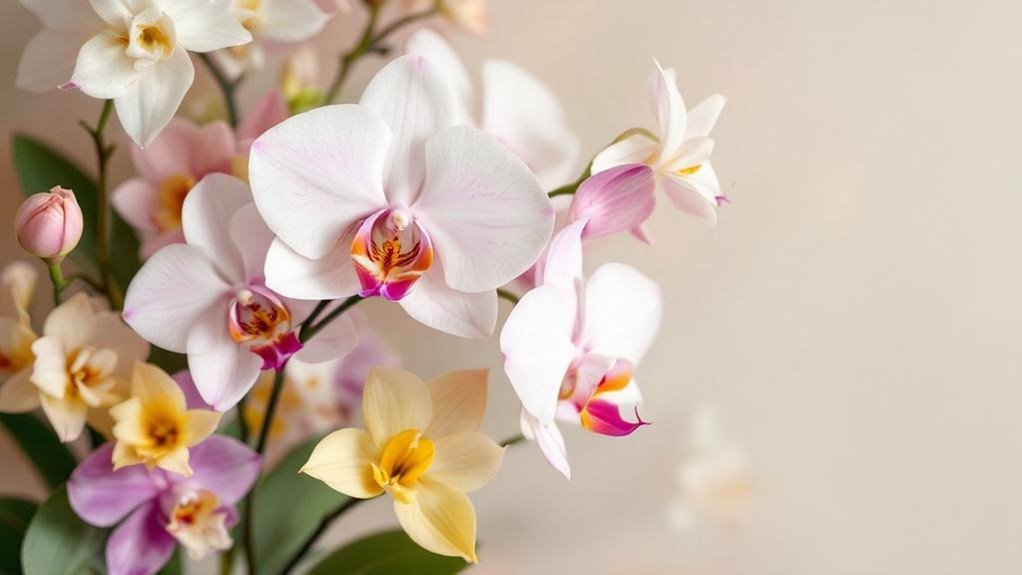
You can understand orchid terms more clearly when you separate naming, structure, and culture; genus and species identify the plant, hybrids, grexes, and cultivars record cultivated parentage or stable selections, and growth habits such as monopodial or sympodial explain why roots, pseudobulbs, and division practices differ. Habitat terms, including epiphyte, lithophyte, and terrestrial, guide media and moisture decisions, while flower and root anatomy sharpen observational care, and the sections ahead make those distinctions practical.
- Key Takeaways
- Core Orchid Terms Beginners Should Know
- How to Read Orchid Names
- Genus, Species, Hybrid, and Cultivar
- Orchid Plant Types Explained
- Epiphyte, Lithophyte, and Terrestrial
- Orchid Growth Habits Explained
- Monopodial vs Sympodial Orchids
- Rhizomes, Crowns, and Leads
- Orchid Root Terms Explained
- What Does Velamen Mean in Orchids?
- Pseudobulbs, Backbulbs, and Nodes
- Orchid Leaf Terms Explained
- Unifoliate vs Bifoliate Orchids
- Orchid Flower Parts Explained
- Orchid Lip, Column, and Anther
- Orchid Spike, Scape, Raceme, and Panicle
- Orchid Pollination Terms Explained
- Orchid Hybrid Types Explained
- Natural Hybrid vs Intergeneric Hybrid
- Orchid Propagation Terms Explained
- Keiki vs Division vs Mericlone
- Orchid Genetics Terms Explained
- Diploid, Polyploid, and Tetraploid
- Orchid Media, Dormancy, and Care
- Frequently Asked Questions
- Conclusion
Key Takeaways
- Orchid names use binomial form: italicized genus plus lowercase species, while cultivar names appear in single quotes and are not italicized.
- A grex groups all seedlings from one cross, while a cultivar names one selected plant with stable, clonally preserved traits.
- Monopodial orchids grow from one upward stem, while sympodial orchids spread laterally along a rhizome with pseudobulbs.
- Pseudobulbs store water and nutrients, and backbulbs can sometimes revive dormant buds to support recovery after division.
- Epiphytic orchids grow on bark, lithophytes on rocks, and terrestrials in soil, each reflecting different root and moisture needs.
Core Orchid Terms Beginners Should Know
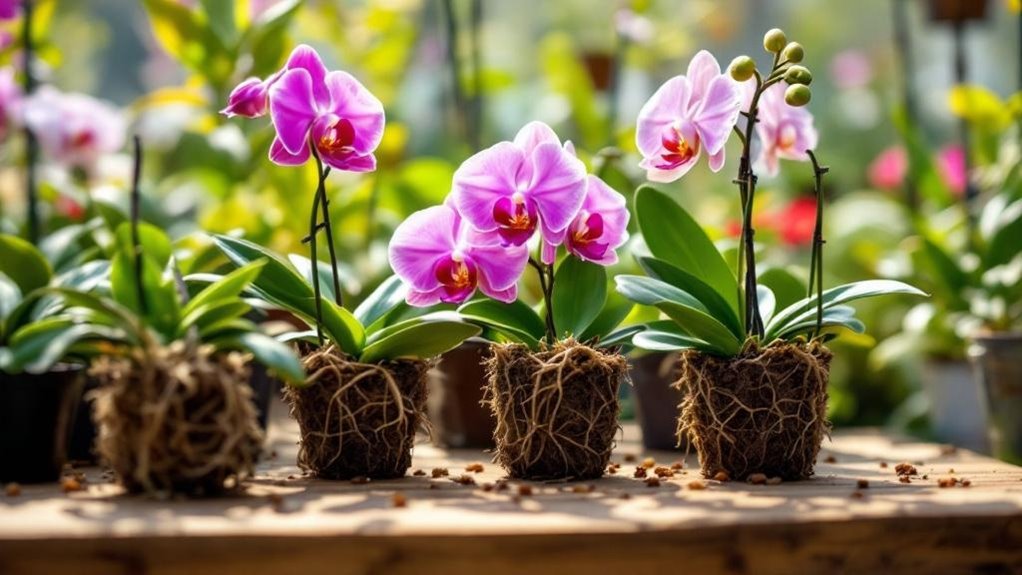
Start with the terms that shape how orchids are identified and propagated, because once you recognize them, the rest of orchid care becomes more observational and less confusing; the genus is the first part of a plant’s scientific name, italicized and capitalized, and it groups closely related species, while the species name, also italicized but lowercase, identifies the exact plant within that genus.
From there, you should know that a Hybrid results from a deliberate cross, sometimes between different genera; Pseudobulbs store water and nutrients, helping cultivated sympodial orchids endure dry intervals without becoming stagnant.
A Keiki is a clonal baby plant that develops on a stem or spike, and you can pot it once roots are sufficient. Tissue culture produces uniform mericlones, which lets growers propagate desirable orchids efficiently.
Orchids also carry deep cultural symbolism in traditions from Greece to East Asia, where they have been associated with fertility, beauty, virtue, and refined admiration.
How to Read Orchid Names
Orchid names work like a map, because each part tells you whether you’re looking at a naturally occurring species, a cultivated selection, or a hybrid with recorded parentage; in botanical form, the name is a binomial made of the genus, capitalized and italicized, followed by the species epithet, lowercase and italicized, and together they identify one species, as in *Cattleya labiata*.
When you read Orchid botanical names, you’ll often see extra elements after the species; a cultivar appears in single quotes, while a grex name appears in plain type, both non-italicized, which keeps observational distinctions clear and prevents stagnant labeling.
If the plant is an intergeneric hybrid, you may see a nothogenus such as Rlc., treated typographically like a genus. In formal literature, author citations may follow, though growers usually omit them.
The word orchid ultimately comes from Ancient Greek paired tubers, reflecting the plant’s original root-based name rather than its delicate flowers.
Genus, Species, Hybrid, and Cultivar
As you read orchid names, you’ll notice that the genus and species form the scientific foundation, with the capitalized, italicized genus placing the plant among closely related orchids and the lowercase italicized species identifying the exact kind with observational precision.
You’ll also see that hybrids, whether produced within one genus or across different genera, reflect cultivated parentage rather than stagnant categories, and breeders often group all seedlings from the same cross under a single grex name because shared ancestry matters even when individual plants vary.
When a particular selection is maintained for stable traits through asexual propagation, you can recognize it as a cultivar, written in single quotes and not italics, which gives you a reliable way to distinguish a named clone from the broader hybrid or species background.
Orchids also gained their aura of prestige through Victorian orchidelirium, when rare specimens became coveted symbols of taste, access, and social status.
Genus And Species
Although orchid names can seem technical at first, they follow a precise structure that lets you read a plant’s identity with far less ambiguity: the genus, written first and capitalized in italics, places the plant within a broader group of related orchids, while the species, written second in lowercase italics, identifies the distinct taxon within that genus, as in *Cattleya labiata*.
When you read a name this way, classification becomes observational rather than stagnant, because each term signals rank and relationship. You may also encounter a hybrid, which marks parentage from crosses, and a cultivar, which identifies a cultivated selection written in single quotes after the botanical name, as in *Cattleya labiata* ‘Sea Queen’.
Together, genus, species, hybrid, and cultivar give you a controlled vocabulary for reading orchids accurately, consistently, and with confidence daily. Their careful naming also reflects the same cultivated rarity that has long made orchids symbols of refinement and status.
Hybrid Types Explained
Once you can read genus and species with confidence, the next step is to see how hybrid, grex, and cultivar names refine that identity, because orchid classification doesn’t remain stagnant at the species level; it also records parentage, breeding intent, and cultivated selection with a controlled, observational precision.
You read a genus as a broader group, a species as a natural unit, and a hybrid as any cross, whether within one species, between species in one genus, or across genera, which creates nothogenera. A grex gathers every seedling from one defined cross, even when those plants differ in color or form. The Victorian era’s orchidelirium turned orchids into elite status symbols and helped drive the fascination with naming, collecting, and breeding them.
Cultivar Naming Basics
| Term | Role |
|---|---|
| Genus | Related group |
| Species | Natural binomial part |
| Hybrid | Cross-derived identity |
| Grex | All progeny |
| Mericlone | Cloned cultivar |
You should distinguish grex from cultivar; seedlings vary, mericlone copies remain uniform. Orchid history was shaped by Orchidelirium and the prestige-driven demand for rare blooms.
Orchid Plant Types Explained

To understand orchid meanings with any precision, you should first distinguish the main plant types, because orchids don’t all live or grow in the same way, and their cultivated form often reflects the conditions they’ve adapted to over time. In observational terms, epiphytes, terrestrial orchids, and lithophytes signal different environmental strategies, while monopodial and sympodial habits describe how the plant itself develops under cultivated conditions.
When you read an orchid’s form, you’re also reading adaptation; monopodial orchids extend from one stem and place leaves and spikes along it, whereas sympodial orchids advance laterally, often with pseudobulbs that prevent stagnant stress through storage. You’ll also notice keikis on some canes or stems, and in certain cool-season terrestrial types, deciduous dormancy marks a seasonal rhythm rather than decline. These distinctions sharpen interpretation. Ghost Orchid lore is a reminder that rarity and habitat specificity can shape how orchids are understood as symbols of mystery, longing, and protection.
Epiphyte, Lithophyte, and Terrestrial
At the most basic observational level, orchids fall into three habitat habits—epiphytic, lithophytic, and terrestrial—and that distinction matters because it tells you where the plant expects to anchor itself, how its roots manage moisture, and why cultivated care so often fails when those conditions are ignored.
Orchid habit—epiphytic, lithophytic, or terrestrial—reveals how it anchors, drinks, and why improper culture leads to failure.
When you see epiphytes, you should think branches, air, and fast drainage; their roots cling without stealing from the host, then capture rain, humidity, and debris.
Lithophytes occupy rock crevices, where roots grip mineral surfaces, gather sparse organic matter, and avoid stagnant conditions through rapid drying.
A terrestrial orchid, by contrast, expects soil or leaf litter, steadier moisture, and more organic content, so its roots are usually finer.
Because genera can contain epiphytes, lithophytes, and terrestrial species, you should match bark, stone-heavy mixes, or humus-rich media accordingly.
Orchid Growth Habits Explained
You can recognize orchid growth habits by watching how each plant builds itself over time; monopodial orchids rise from a single stem, add leaves and flowers along that axis, and don’t produce pseudobulbs, which makes your observational approach to watering and support more exact.
You’ll see a different pattern in sympodial orchids, which move laterally along a rhizome and form successive leads or pseudobulbs, including backbulbs, that store reserves, resist stagnant conditions less well, and often let you divide cultivated plants for propagation.
You should also connect structure to habitat, because epiphytic and lithophytic orchids rely on exposed roots adapted to capture moisture and nutrients from rain and debris, while terrestrial orchids anchor in soil or leaf litter and usually require a different balance of moisture, air, and seasonal rest.
Monopodial Growth Pattern
Because a monopodial orchid grows from a single, continuously extending apical meristem, its form remains upright and linear, with new leaves, roots, and flower spikes emerging along the same main stem rather than from a spreading rhizome or a series of pseudobulbs; in cultivated genera such as Vanda and Phalaenopsis, this pattern is easy to observe in the plant’s persistent vertical axis, its aerial roots coated in velamen, and its tendency to produce inflorescences from leaf axils while the same stem continues living and blooming for years.
- You read structure through one stem, not clustered storage organs.
- You protect the apical meristem, since damage can halt ascent.
- You keep air roots evenly moist, never stagnant, with support.
- You expect each flower spike to arise from leaf axils repeatedly over time.
Sympodial Growth Pattern
While monopodial orchids extend from one persistent stem, sympodial orchids advance laterally along a rhizome, producing a sequence of distinct shoots or pseudobulbs, each with its own apical meristem, its own leaves, and often its own flowering potential; you can identify this cultivated pattern by its chainlike progression rather than a single vertical axis.
Each pseudobulb stores water and nutrients, supports one or more leaves, and may carry an inflorescence, so your observational care should track the age and vigor of each growth.
New leads emerge from eyes along the rhizome, which is why division works best when each section keeps at least two healthy growths.
An older leafless backbulb may still generate renewal, and this sympodial habit, common in Cattleya and Oncidium allies, helps you avoid stagnant maintenance practices.
Habitat And Structure
Growth habit becomes clearer when structure is read alongside habitat, since an orchid’s form reflects the surfaces it occupies and the way it captures water, air, and dissolved nutrients under cultivated conditions.
- If you observe epiphytes, you’ll notice aerial roots with velamen, an adaptation that gathers intermittent moisture and avoids stagnant conditions above soil.
- In sympodial orchids, growth runs laterally along a rhizome; pseudobulbs store reserves, and backbulbs let you divide plants and restart growth.
- In monopodial orchids, one stem rises from a single apex, without pseudobulbs, so you support and pot them differently.
- Lithophytes fasten to rock, while terrestrials root in leaf litter; each habitat governs drainage, nutrient access, and the observational structure you should expect.
Monopodial vs Sympodial Orchids

Although orchids are often grouped together in casual discussion, you can understand much of their cultivated behavior by distinguishing monopodial plants from sympodial ones, since the difference lies in how each orchid extends itself over time and allocates water, energy, and flowering potential.
| Type | Growth image | Cultivated effect |
|---|---|---|
| monopodial | a single stem rising | no pseudobulb; steady moisture |
| sympodial | a creeping rhizome advancing | pseudobulb storage; rests |
| Vanda, Phalaenopsis | aerial roots around a crown | avoid stagnant crowns |
| Cattleya, Oncidium | clustered canes and older bulbs | drier intervals suit them |
You’ll observe that monopodial orchids lengthen upward from one apical point, producing leaves and spikes along the stem, whereas sympodial orchids advance laterally, adding successive growths; this observational distinction also governs propagation, since dividing a sympodial clump differs profoundly from preserving a monopodial stem.
Rhizomes, Crowns, and Leads
Once you’ve distinguished monopodial orchids from sympodial ones, the next observational step is to identify the structures that carry that pattern forward in cultivated life, because a sympodial orchid extends along a rhizome, a horizontal root-bearing stem that runs at or just beneath the medium surface and produces successive pseudobulbs and roots at its nodes, whereas a monopodial orchid centers its activity at the crown, the top growing region from which leaves and inflorescences arise.
- The rhizome records direction and age.
- The crown marks present activity.
- Each lead shows future capacity.
- Even an older pseudobulb may reawaken.
When you divide a sympodial plant, keep two or three leads with attached rhizome, or vigor turns stagnant. Given warmth, humidity, and fresh medium, backbulbs can sometimes produce a new lead again.
Orchid Root Terms Explained
When you read orchid root terms, you should note that aerial roots sit above the pot on many epiphytic orchids, and their velamen, a cultivated, spongy covering, absorbs moisture and nutrients from the air while limiting loss in stagnant conditions.
You should also recognize that the rhizome is a horizontal stem, not a true root, and that its nodes produce roots and successive growths, which explains how sympodial orchids spread laterally and why division works.
As you observe these structures, you’ll understand root health more accurately, because active feeder roots and emerging growth from the rhizome show how the plant gathers water, stores resources, and sustains future development.
Aerial Roots And Velamen
Because many orchids live as epiphytes rather than in cultivated soil, you’ll often see aerial roots extending above the potting medium, and these roots aren’t stray growth but working structures that anchor the plant while absorbing moisture and dissolved nutrients from humid air and trapped debris.
In epiphytic orchids, the roots of epiphytic orchids carry velamen, a spongy covering that supports uptake and limits drying.
- White or gray velamen turning green when wet shows active absorption.
- Beneath it, cortical cells and root hairs move water inward.
- Some aerial roots also exchange gases and photosynthesize slightly.
- Firm, plump roots suggest health; brown, black, mushy tissue suggests rot.
You should let aerial roots dry slightly between waterings, since stagnant wetness weakens function and invites decline.
Rhizome, Nodes, And Growth
In sympodial orchids, the rhizome is the organizing stem that runs horizontally along or just beneath the cultivated medium, bearing roots as it advances and producing new shoots at regular nodes; those nodes are the plant’s working joints, the points from which leaves, aerial roots, and flower spikes may arise, and they determine whether a division has enough latent growth to recover and continue developing.
You can read the rhizome as an observational map of future spread, because the active apical node produces each new lead or pseudobulb, while older basal nodes may persist as backbulbs, storing water and nutrients rather than remaining stagnant. When you divide a sympodial orchid, keep two or three consecutive nodes or growths together, since established roots and viable meristems give each section the structure required for steady recovery.
What Does Velamen Mean in Orchids?
Aerial orchid roots wear a specialized sheath called velamen, a thick, spongy, multi-layered epidermis that acts like a cultivated absorbent skin, drawing in water and dissolved nutrients from rain, mist, and humid air with remarkable speed while also limiting loss once conditions turn dry.
For you, velamen reveals how orchid roots endure observational extremes, especially in epiphytic species, where water absorption, attachment, and gas exchange must occur without stagnant media.
- Dry velamen looks white or silvery; when wet, it turns translucent.
- Its dead outer cells shield inner tissues from desiccation and abrasion.
- Thicker velamen often marks orchids adapted to drier, canopy-exposed habitats.
- Intact velamen signals healthy roots, while brown, mushy tissue suggests rot, informing watering, foliar feeding, and repotting decisions with useful precision.
Pseudobulbs, Backbulbs, and Nodes
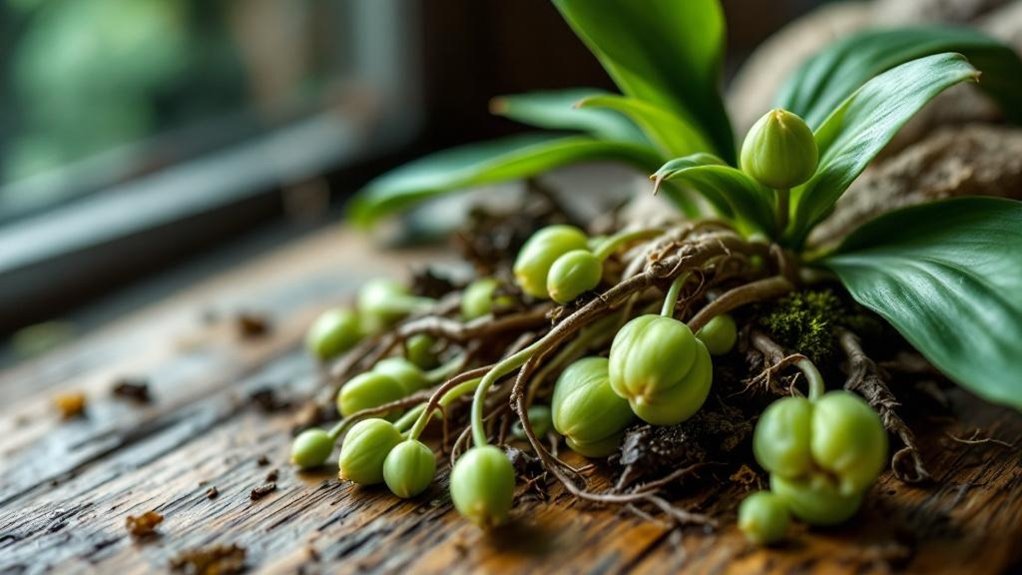
Trace the growth of a sympodial orchid and you’ll find that pseudobulbs, backbulbs, and nodes form its practical architecture; the pseudobulb is a thickened stem segment, often swollen between nodes and shaped anywhere from rounded to cane-like, that stores water and nutrients so the plant can endure intervals when moisture and feeding are less available.
You can read each pseudobulb as a cultivated storage organ, sometimes unifoliate, sometimes bifoliate, with form influencing habit and flowering. A backbulb, though older and often leafless, still matters; under warmth and moisture, it may activate dormant buds and push new growth.
Each node marks a decisive joint where roots, inflorescences, or keikis arise, so when you divide a plant, you should keep several pseudobulbs, at least one healthy node, and a viable backbulb for steady re-establishment.
Orchid Leaf Terms Explained
Once you’ve read the pattern of pseudobulbs and nodes, the leaves give you the clearest observational record of how an orchid is actually functioning; each leaf serves as the plant’s primary photosynthetic organ, carrying stomata that manage gas exchange and regulate transpiration, and those surfaces produce the sugars that support new growth, root activity, and flowering.
Leaves reveal an orchid’s true condition, regulating gas exchange and producing the energy that drives roots, growth, and bloom.
- A firm, green Leaf signals cultivated balance, while black spotting or mushy tissue suggests stagnant moisture, pests, or disease.
- Because stomata control transpiration, humidity and air movement directly shape watering frequency.
- Unifoliate and bifoliate are structural terms, describing pseudobulbs with one or two leaves, and they help you read architecture.
- When dormant or deciduous orchids shed leaves, reduced activity means cooler conditions and less water protect recovery and future flowering cycles.
Unifoliate vs Bifoliate Orchids
The distinction between unifoliate and bifoliate orchids gives you a practical way to read both structure and behavior, because a unifoliate plant produces one leaf on each new pseudobulb while a bifoliate plant produces two, and that simple count often corresponds with differences in habit, flowering, and culture.
| Type | Observational cue |
|---|---|
| unifoliate | one leaf |
| bifoliate | two leaves |
| unifoliate | larger blooms |
| bifoliate | more blooms |
You’ll often see unifoliate Cattleya types make taller growths and fewer, heavier flowers, while bifoliate plants stay stockier, carry more flowers, and may appreciate slightly cooler, shadier conditions with no stagnant air. When you divide a cultivated sympodial orchid, keep at least three growths, because leafless backbulbs, especially in either growth pattern, can take longer to push new leads.
Orchid Flower Parts Explained
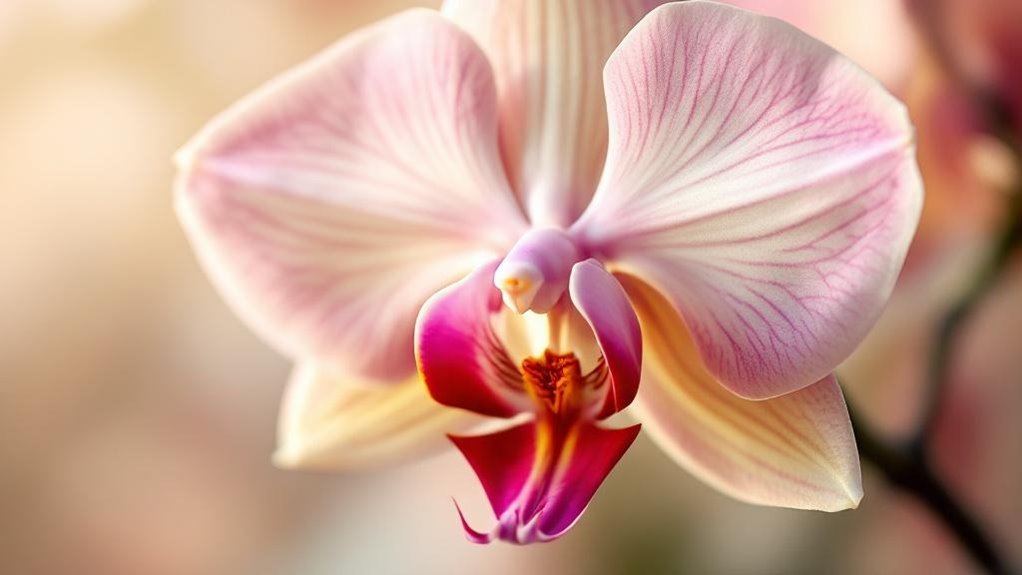
Look closely at an orchid bloom, and you can read a precise floral plan: three sepals frame the flower, with the dorsal sepal usually held above the center and two lateral sepals set lower at the sides, while two standard petals accompany a third petal that’s been transformed into the lip, or labellum, a showier structure that often acts as a landing platform or visual guide for pollinators.
- You’ll notice the sepals establish balance and protect developing tissues.
- The labellum directs approach, sometimes through spurs, pouches, or a synsepalum.
- At the center, the column consolidates key structures, creating an efficient, cultivated design.
- Pollinia move as compact packets, not stagnant dust, which supports precise, species-specific transfer.
This observational structure explains why orchids appear deliberate, symmetrical, and unusually specialized.
Orchid Lip, Column, and Anther
As you examine an orchid more closely, you’ll notice that the lip, or labellum, is a cultivated petal with an observational function as much as an ornamental one, because its enlarged form, vivid patterning, and guiding features direct pollinators toward the flower’s reproductive center without stagnant movement.
You’ll also find that the column, unique to orchids, fuses male and female structures into a single organ, positioning the stigma and anther in close proximity so pollination happens with unusual precision. At the column’s apex, the anther holds pollinia as compact pollen masses, often linked by adhesive structures that let pollinators remove and deposit them as a unit, which helps explain why lip form and reproductive design work together so efficiently.
Lip Function And Form
Although orchid flowers can seem extravagantly varied, much of their meaning and function comes into focus through three cultivated structures—the lip, the column, and the anther—which direct pollinators with remarkable precision and prevent the process from becoming random or stagnant.
In your observational reading of an orchid, you should treat the lip, or labellum, as the flower’s clearest invitation, because its enlarged form, color, scent, and texture guide approach toward the column and position visitors where pollinia can later attach.
- You read the lip as a landing platform.
- You see pouch, spur, or fringe as cultivated signals.
- You understand form as evidence of pollinator partnership.
- You recognize compatibility in how the labellum channels movement.
Through this architecture, meaning appears deliberate, selective, and quietly exact.
Column And Anther Roles
Where the lip invites and positions, the column governs the exchange itself, because this fused structure gathers the orchid’s stigma, style, and anther into a single cultivated axis, concentrates reproductive contact at one exact point, and guarantees that pollination doesn’t drift into a stagnant scatter of chance encounters.
As you observe the column, you’re seeing a fused sexual organ whose design channels a pollinator’s body with observational precision; the anther caps that structure and holds pollinia, cohesive pollen masses often linked to a sticky attachment, so transfer happens whole rather than grain by grain.
You also find that a rostellum often separates stigma from anther, reducing self-pollination until contact occurs properly, while each species adjusts column length, lip shape, and anther position to match pollinator behavior and limit casual hybridization.
Orchid Spike, Scape, Raceme, and Panicle
Orchid flower stems follow a cultivated structure, and if you learn how growers use the terms scape, spike, raceme, and panicle, you can read an orchid’s blooming habit with more observational precision. You see more than shape; you recognize order, pacing, and how the plant presents its flowers without stagnant confusion.
- A scape is the single flowering stalk arising from the plant, often leafless at the base, carrying one flower or an inflorescence.
- A spike stays unbranched, and its flowers attach directly to the axis without stalks.
- A raceme also remains unbranched, yet each flower sits on a short pedicel along one axis.
- A panicle branches outward, and those lateral divisions bear multiple flowers or raceme-like sprays, giving you the clearest sign of structural abundance.
Orchid Pollination Terms Explained
When you read orchid pollination terms, you’ll notice that pollinia aren’t loose pollen at all, but cultivated masses carried as one unit, while the column and anther organize transfer with an observational precision that keeps pollen from becoming stagnant or wasted.
You can also see how the viscidium secures that package to a pollinator, how specialized partnerships support cross-pollination, and why many orchids resist self-fertilization in favor of genetic diversity.
As you move into crosses and seedpods, you’ll understand that successful pairing depends on this exact sequence, because each structure guides pollen placement, fertilization, and the development that follows.
Pollinia And Pollen
Consider orchid pollen closely, and you’ll find that it usually isn’t released as loose dust but as a pollinium, a cohesive mass of pollen grains that’s often linked to a sticky viscidium, sometimes by a slender caudicle, so the plant can move its reproductive material as a single, cultivated unit rather than leave transfer to a more stagnant and uncertain scatter.
- You observe the anther cap shift or lift, exposing pollinia for removal.
- You see the viscidium adhere firmly to a pollinator, securing transfer.
- You note the caudicle, when present, guiding attachment within the pollinarium.
- You recognize that waxy, mealy, or granular pollinia shape which visitors can carry them.
Together, these structures show you an observational strategy: orchids limit waste, direct placement, and improve pollination precision.
Column And Anther
Seen from the pollinium outward, the next structure to watch is the column, the fused central organ that brings the anther and stigma into a single cultivated arrangement, shaping how a visitor approaches the flower and where its body makes contact. As you observe an orchid, you’ll notice the anther at the column tip, where pollinia sit beneath a cap that lifts or shifts during a visit, exposing them for removal.
The column doesn’t merely hold parts together; it directs movement, and its observational value lies in that guidance. Through structures such as the rostellum, stipe, and viscidium, the flower places pollinia on a precise body surface, avoiding stagnant, wasteful contact. If the column or anther becomes damaged or misaligned, you can expect pollination to fail despite otherwise healthy bloom development.
Crosses And Seedpods
As the orchid’s mechanical precision gives way to outcome, the next terms to watch are cross and seedpod, because they mark the moment pollen transfer becomes lineage, whether within a species or between distinct taxa.
- In a cultivated cross, you move pollinia from anther to stigma, often with forceps, and you label the pairing.
- Pollinia travel as cohesive masses, attached by a viscidium or caudicle, so pollination stays precise rather than stagnant.
- After success, the seedpod forms as a dry capsule, holding thousands to millions of dust-like seeds, which need fungi or sterile culture.
- In the wild, natural hybrids arise when compatible orchids cross; you’ll often observe intermediate form, while fertility varies with ploidy, season, and developmental stability across habitats.
Orchid Hybrid Types Explained
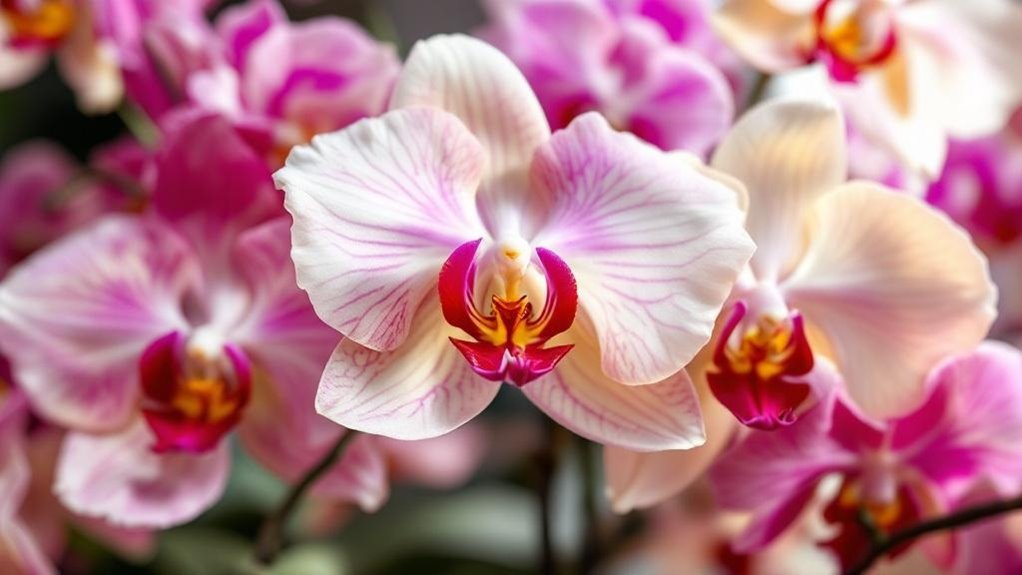
Although orchid hybrids may look simply varied at first glance, breeders classify them by parentage and chromosome makeup, and that system gives you a more observational way to read cultivated plants, from intraspecific crosses between varieties of one species to interspecific crosses within a genus and intergeneric hybrids that unite species from different genera under names such as × Brassocattleya.
When you see a hybrid label, you can infer breeding goals; an intergeneric cross usually signals an attempt to combine flower form, color, or tolerance traits that stagnant lines may lack. You should also note the grex name, because it groups all seedlings from one cross, even though individual plants still vary genetically. A tetraploid hybrid often appears fuller and more vigorous than a diploid counterpart, which is why breeders select or create it deliberately in modern programs.
Natural Hybrid vs Intergeneric Hybrid
Where the distinction matters most is in origin and purpose; a natural hybrid forms in the wild when two orchid species cross without human intervention, often in overlapping or intermediate habitats, and it usually shows a blended set of morphological traits that lets you read both parents in the flower and plant.
An intergeneric hybrid results from cross-pollination between species placed in different genera, most often under cultivation, and breeders create or select it to combine form, color, vigor, or tolerance traits that stagnant lines may not supply.
- You read a natural hybrid as field evidence of gene flow.
- You track an intergeneric hybrid through grex and nothogenus naming.
- You’ll notice cultivated lines often use tetraploid parents for better fertility.
- You should separate observational conservation questions from breeding goals and commerce.
Orchid Propagation Terms Explained
Start with the propagation term itself, because each one tells you whether an orchid is being multiplied by cloning a cultivated plant or by managing breeding potential; division refers to cutting a sympodial orchid’s rhizome into sections, each with at least two pseudobulbs or active growths and enough roots to support recovery, keiki propagation describes the removal of asexual plantlets that form on a flower stem, cane, or pseudobulb once they’ve made several roots about 2–3 cm long, and tissue culture, often called micropropagation, uses sterile meristem or other tissues on nutrient media to produce large numbers of uniform plants.
You’ll also see mericlones, which are micropropagated plants identical to the parent and valued for uniformity; in observational breeding work, ploidy matters, because diploid, tetraploid, and triploid orchids shape vigor, flower substance, and fertility, avoiding stagnant breeding lines.
Keiki vs Division vs Mericlone

To sort out keiki, division, and mericlone, it helps to focus on how each method multiplies a cultivated orchid and what that means for vigor, timing, and uniformity; a keiki is a small asexual plantlet that forms naturally, or after hormone induction, on a flower spike, stem, or pseudobulb, and you remove it only after it has produced several roots about 2–3 cm long, while division is a manual act of cutting a sympodial orchid’s rhizome so each new section retains at least 3–4 healthy pseudobulbs or active growths, or several fan growths in non-pseudobulbous genera, because anything smaller often recovers slowly and declines into stagnant growth.
Keikis root into a single clone, divisions recover by retained growth, and undersized pieces often stall instead of thriving.
- Keiki and division reproduce asexually, usually yielding few plants.
- Mericlone culture produces many identical plants rapidly.
- Environmental conditions can slightly alter clonal appearance.
- Scale, uniformity, and recovery time shape your observational judgment.
Orchid Genetics Terms Explained
Once you’ve sorted out how keikis, divisions, and mericlones multiply a cultivated orchid, the next step is to read the genetic terms that explain why related plants may still differ in size, fertility, and flower substance; diploid orchids carry two sets of chromosomes and form the usual baseline for many species, while tetraploids carry four sets and often show thicker leaves, fuller flowers, and stronger overall vigor because the added chromosome sets can increase cell size and improve substance.
You’ll also see polyploidy, an observational term for orchids with extra chromosome sets, whether arising naturally or through breeding work; a diploid crossed with a tetraploid often yields triploid seedlings, which stay largely infertile and can leave breeding lines stagnant. A grex names every seedling from one registered cross.
Diploid, Polyploid, and Tetraploid
Although most orchids in nature are diploid, carrying the usual two complete sets of chromosomes, cultivated plants often include polyploids, an observational category for orchids with extra sets that arise through natural genome duplication or deliberate breeding, and those added sets can change far more than a label on a tag.
- When you see diploid, you’re seeing the standard 2n condition, one set of chromosomes from each parent.
- A polyploid orchid carries extra sets, so triploid and tetraploid forms move beyond that baseline.
- Tetraploid orchids, with four sets, often show broader substance, thicker petals, stronger growth, and sometimes fertility shifts rather than stagnant reproduction.
- Breeders favor matching chromosome counts, because balanced crosses improve hybrid outcomes, while triploids often remain poor seed producers.
Orchid Media, Dormancy, and Care

Often, orchid care becomes more stable when you match the plant’s medium and seasonal routine to its natural habit, because many cultivated orchids are epiphytic and don’t tolerate stagnant moisture around their roots; they perform best in fast-draining mixes such as medium-grade fir bark with charcoal and perlite, or in more inorganic blends that preserve air flow and limit rot.
You should watch pseudobulbs closely, because they store water and nutrients, and during dormancy they let you reduce watering, allow the medium to dry more thoroughly, and prevent collapse from excess moisture.
You’ll also get better results if you lower night temperatures slightly, reduce fertilizer, and ease light during rest, then restore higher filtered light during active growth.
Repot only when new roots emerge, using fresh sterile mix, and leave backbulbs undisturbed.
Frequently Asked Questions
What Is the Symbolic Meaning of an Orchid?
An orchid symbolizes love, beauty, luxury, and admiration—because apparently roses were too ordinary. You give one to express respect, refined taste, strength, fertility, or new beginnings, depending on its color and the occasion.
Does the Word “Orchid” Mean Testicle?
Yes, you can say “orchid” ultimately comes from a Greek word meaning testicle. It doesn’t mean that in modern use, though; you’re seeing an old etymology based on the paired tubers of some species.
What Is Orchid Slang For?
Over 25,000 orchid species inspire plenty of grower slang. You’ll hear keiki for a baby plant, clone or mericlone for tissue-cultured copies, backbulb for old pseudobulbs, division for splits, and resting for dormancy.
What Is the Metaphor of the Orchid?
You can read the orchid as a metaphor for rare beauty, refined desire, resilience, and interdependence. It shows how you thrive through adaptation, precise connections, and hidden strength, even when your environment demands extraordinary balance.
Conclusion
Once you understand orchid terms, you stop relying on guesswork and start making observational choices that fit the plant’s cultivated needs; names, growth habits, and genetic labels begin to clarify care rather than complicate it. You may think the vocabulary is too technical, yet most terms simply prevent stagnant routines by showing you how an orchid grows, rests, and reproduces, and that knowledge lets you read plants more accurately, respond more consistently, and grow with greater precision.